Sometimes writing fiction means not just moving a few characters around the map but planning entire campaigns for massive armies. In previous entries in the travel series we looked at some basic issues and how small groups travel on foot. For large groups on foot, much of what we discussed in those entries is relevant, but large groups of people, like armies or mass migrations, bring with them their own set of problems. Today we’ll look at some basic questions in the movement of large groups: How large is “large?” What did it take to make the journey successfully? How far could they travel? And how fast?
This post is written with a particular focus on armies, since they are the best-studied large groups that traveled in the pre-industrial world, but any sufficiently large group of people traveling by foot would face the same basic problems.
“As for the Hobbits of the Shire, with whom these tales are concerned, in the days of their peace and prosperity they were a merry folk… with mouths apt to laughter, and to eating and drinking. And laugh they did, and eat, and drink, often and heartily, being fond of simple jests at all times, and of six meals a day (when they could get them).”
So Tolkien introduces us to his Hobbits, lovers of good food and good company. There is plenty of eating and drinking in The Lord of the Rings, from humble Hobbit fare to Elven delicacies, from the foraged meals of rangers in the wild to the feasts of great kings.
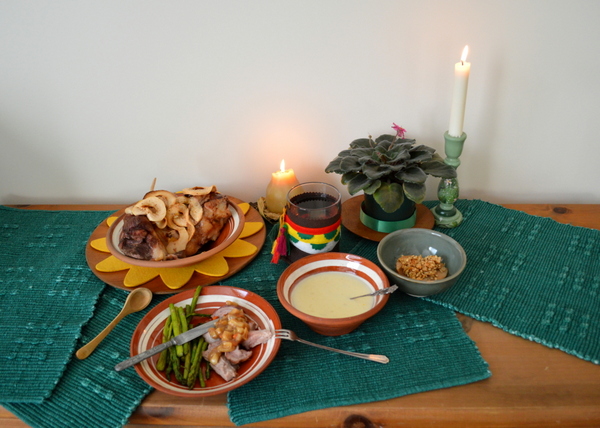
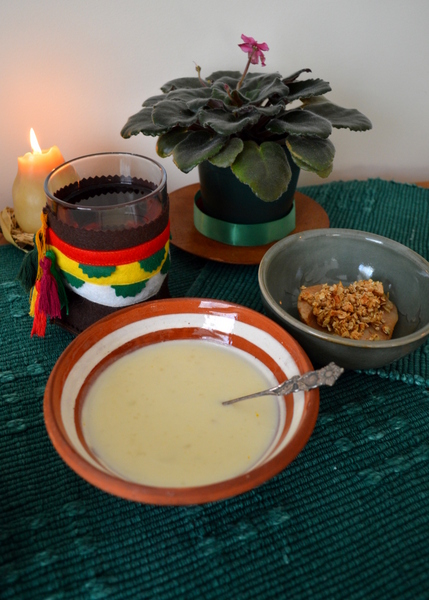
In 2016, we’re taking up a project to eat our way through The Lord of the Rings. Every month, we’ll prepare and present a dinner inspired by foods from the novel, working our way through the story from Bilbo’s 111th birthday party to Frodo’s return to the Shire. Along the way, there are some meals that Tolkien describes in such detail that we can read the menu straight from the page. In other places, he offers only tantalizing hints that require us to engage in gastronomical-literary archaeology to fill a table.
We’re doing our best to stay true to the novel in the project, so where Tolkien gives us a clear idea of what the characters eat, we stick to it. When we have to figure something out on our own, we use clues from The Lord of the Rings and The Hobbit and ideas from historical cookery to guide us.
We’ll share the results of our work with you around the middle of the month. A post introducing the month’s meal and showing the results of our labors will come out on a Wednesday. The following day, we’ll offer a behind-the-scenes view of how we researched the food, decided on a menu, prepared the dishes, and designed the setting, complete with recipes you can try for yourselves. We’ll collect links to all the entries on this post, so you can always come back here to get caught up, or check the dining in Middle Earth tag to find them all.
A note on the behind-the-scenes posts: we’ll be referencing passages from the book and since there are many different editions of the text with different paginations, we’re using the book and chapter divisions given in Tolkien’s table of contents. For example, the first half of The Fellowship of the Ring is identified as Book 1. In that book, chapter 4 is “A Short Cut to Mushrooms,” so we reference that chapter as (1.4); we reference Hobbit chapters with (H).
For our final Star Wars rewatch, here’s a sweet but simple bread pudding.
Ingredients
Stale bread, any kind, enough to make 4-5 cups loosely packed cubes
4 egss
1 tablespoon rum
1/4 cup sugar
1 teaspoon cinnamon
1 teaspoon nutmeg
3 cups milk
Cut the bread into chunks and press into a buttered baking dish until well packed in.
Beat the eggs, rum, sugar, and spices together until well mixed. Add the milk and beat well.
Pour the milk mixture over the breadcrumbs. Press down the top with a spatula or spoon to make sure the liquid is well distributed.
Let sit for half an hour, pressing again occasionally, until the liquid is thoroughly absorbed by the bread.
For best results, set the baking dish inside a larger dish of water to make a water bath, ensuring that the level of the water reaches up to the top of the pudding. If this is not practical, you can just bake the pudding in its dish, but be aware that the edges may get crusty.
Bake at 350F / 175 C for 1 and 1/4 hours.
Serve warm with ice cream or whipped cream.
Image by Eppu Jensen
Geeks eat, too! Second Breakfast is an occasional feature in which we talk about food with geeky connections and maybe make some of our own. Yum!
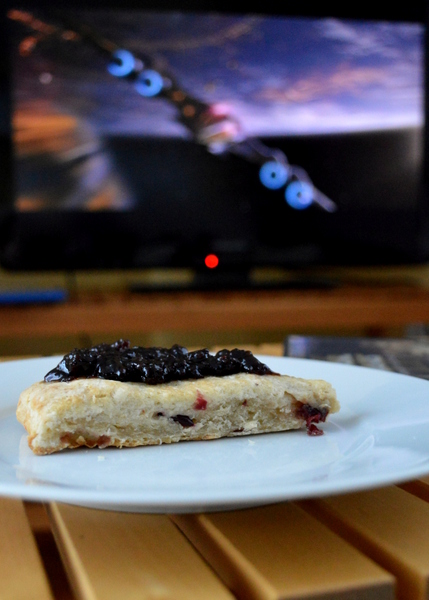
Empanadas are often savory and filled with meat, but for our Star Wars rewatch I made this sweet variety filled with caramel and apple.
Crust
Ingredients
1 cup milk
3/4 cup butter or shortening
1 package dry yeast
3 cups flour
pinch of salt
pinch of cinnamon
Heat the milk in a saucepan until bubbles form on the top.
Add the butter and let stand 10 minutes until butter is melted.
Stir in the yeast and let stand another 10 minutes.
In a large bowl, combine the flour, salt, and cinnamon. Make a well in the center and pour in the milk mixture. Stir until it forms a ball.
Turn out onto a floured surface and knead well, adding flour as needed.
Let rise in a warm place for 30 minutes to an hour.
Punch down the dough, turn it out on a floured surface for another quick knead, then divide into sixteen small balls. Flatten these balls out into six-inch circles and place them on parchment paper on baking sheets.
Filling
Ingredients
1/2 cup sugar
2 tablespoons water
2 tablespoons cream
2 medium apples
You will want to fill and bake your empanadas as soon as the filling is ready, so preheat the oven to 425 F / 220 C while you work.
Peel, core, and finely dice the apples.
Place the sugar and water in a shallow saucepan and stir until the sugar is well dissolved.
Put the pan on medium heat. Large bubbles will eventually give way to smaller bubbles. Stir gently as the sugar mixture begins to brown.
When the caramel has reached a golden brown, add the cream and mix well.
Add the apple pieces and stir well.
Place a generous tablespoonfull of filling centered on one half of each dough circle. Fold the dough over and press the edges together with your fingers, then crimp the edge with the tines of a fork.
Bake for 20 minutes or until beginning to brown. You can continue to cook them as they are until golden brown (about five more minutes) or take them out, glaze them with egg, and return them to the oven to finish baking.
Image by Eppu Jensen
Geeks eat, too! Second Breakfast is an occasional feature in which we talk about food with geeky connections and maybe make some of our own. Yum!
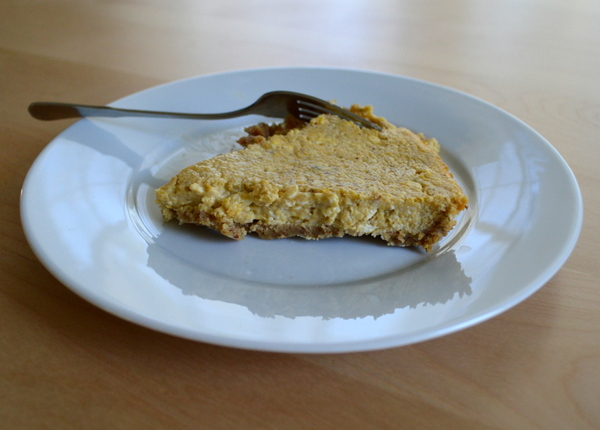
We start on the original trilogy with this Tatooine-orange pumpkin cheesecake which uses neufchatel cheese in place of cream cheese.
Crust
Ingredients
6 oz. butter
1/2 cup graham cracker crumbs
1/2 cup almond meal
1/2 teaspoon cinnamon
pinch of salt
Melt the butter.
Mix the crumbs, almond meal, cinnamon, and salt. Add butter and mix thoroughly.
Spread the mixture in a buttered pie pan an pat out evenly.
Bake at 350 F / 175 C for 10 minutes or until the crust is set
Filling
Ingredients
1/2 cup brown sugar
1/2 teaspoon cinnamon
1/2 teaspoon cloves
1/2 teaspoon ginger
1/2 teaspoon nutmeg
1/2 teaspoon cardamom
1 pound neufchatel cheese
3 eggs
1 cup roasted pumpkin puree
You can use canned pumpkin or roast your own. To roast, split a pumpkin into two halves from top to bottom and scoop out the seeds. Lay both halves inner side down in a broad shallow pan with just enough water to cover the bottom and roast at 400 F / 200 C for 1-2 hours or until the flesh of the pumpkin comes away from the skin easily. Roasted pumpkin freezes well and what you don’t use for this cheesecake you can save for the future.
Mix brown sugar and spices in a small bowl.
Beat the neufchatel cheese in a large bowl until smooth. Add the sugar mixture and beat until well mixed.
Add the eggs one at a time and beat well, scraping the sides of the bowl well after each addition.
Add the pumpkin and beat well.
Put a pan of water in the oven to moisten the air while the cheesecake cooks.
Pour the filling into the crust and bake at 350 F / 175 C for 30 minutes. Turn the heat down to 325 F / 160 C for another 10 minutes.
Let the cheesecake sit until well cooled.
Image by Eppu Jensen
Geeks eat, too! Second Breakfast is an occasional feature in which we talk about food with geeky connections and maybe make some of our own. Yum!
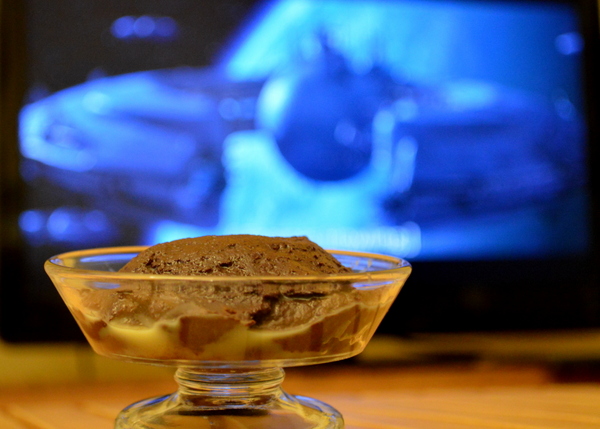
To accompany the first of our Star Wars rewatches, I made a dark chocolate mousse. As rich as Queen Amidala’s wardrobe and as dark as Senator Palpatine’s heart, this mousse kept us happy through the podrace and droid battles.
Ingredients
7 oz dark chocolate
2 tablespoons butter
4 tablespoons dark rum
3 eggs
Melt the chocolate, butter, and rum together in a double boiler over barely simmering water
Separate the eggs
Remove the melted chocolate from the heat and whisk in the egg yolks
Beat the egg whites until they form soft peaks
Whisk the egg whites into the chocolate mixture
Spoon into dishes and chill for an hour
Image by Eppu Jensen
Geeks eat, too! Second Breakfast is an occasional feature in which we talk about food with geeky connections and maybe make some of our own. Yum!

From time to time, I get sucked into thinking about the pragmatics of fictional worlds. By that I mean all the mundane details of how people lead their everyday lives, starting from the very basic human (or creature) needs like food, clothing, waste management, and social interaction. Not just who takes care of, say, the laundry and when, but where do they go to do it, how do they get there, what kinds of implements are they expected to bring in themselves and what is shared, how long does it take, what physical motions do they go through, is it a solo activity or a joint effort, and the like.
For me as a visual person, often thinking about everyday activities and movement through spaces tumbles into thinking about what exactly do these various spaces look like. It’s a way to add depth and realism into a story – we are physical beings who love tactile experiences and accumulate all sorts of personal possessions, and if a fictional world ignores that, it makes that world fall flat for me. (Hello, Star Trek!)
The Hunger Games is one of the current ones in my mind because of the approaching Mockingjay – Part 2 premiere and because of an article on Colossal I saw about a World War II era bomb shelter in London that has been turned into an underground farm.
The company running the operation, Growing Underground, produces leafy greens like watercress, basil, coriander, and radish in hydroponic beds lit by LED lamps.
In the The Hunger Games world, the population of District 13 lives in underground bunkers; the above-ground structures were destroyed by the Capitol. In the Mockingjay novel, Collins mentions various spaces like the armory, the laundry, labs, testing ranges, and farms in passing. She describes these spaces mostly just in very generic terms; e.g., the color of the living compartments is white, and we hear of furniture like dressers and conference tables with individual screens, but that’s about the extent of the detail.
Scenes in the movie Mockingjay – Part 1 show the special weapons lab with a shooting range, the hangar, the bunker, and some hospital and apartment rooms, among others, but I don’t think we’ve seen any underground farms of any kind, nor the poultry farm, for example, that was destroyed in the book version of the bombing of 13 by the Capitol.
Clockwise from top: living quarters, cafeteria, and infirmary at District 13. Images via Jabberjays.net.
The Growing Underground photos of their growing beds fit quite well with Collins’s carefully frugal description and the established Hunger Games visual style. So, in my headcanon, even if we haven’t seen them on screen, District 13’s underground hydroponics now look very much like those of Growing Underground.
Out There is an occasional feature highlighting intriguing art, spaces, places, phenomena, flora, and fauna.
What’s a party without munchies? Make some mini monster eyeball treats for yours from donuts and candy with this how-to by Ashley Rose at Sugar & Cloth; photo by Jared Smith.
Ashley Rose at Sugar & Cloth; photo by Jared Smith.
You must be logged in to post a comment.