Race and Culture in Hannibal’s Army

160322elephantTor.com published an article online today about diversity in Hannibal’s army written from the point of view of historical wargaming. It is a interesting article and well worth a read, but unfortunately it misses the opportunity to really address questions of racial and cultural diversity in ancient warfare. Here is a quick attempt to address some of the things that were lacking.

Race and culture

Race is a term with a lot of baggage, as we are all painfully aware, but it means different things in different contexts. In modern parlance, it describes a socially-constructed division of human beings into more or less arbitrary categories, largely on the basis of skin color and other physical features. In a fantasy context, it refers to distinct species of intelligent creatures like Elves, Orcs, Dwarves, and so on.

The unaddressed problem in the Tor.com article is the conflation of race and culture. In the nineteenth and early twentieth century, overtly racist theories of history posited that people of different genetic backgrounds naturally had different qualities. Many of these stereotypes still linger in our popular culture: the stoic Indian, the mischievous Irishman, the passionate Italian, etc. This belief in racial character was encoded in early classic works of fantasy like Tolkien’s Lord of the Rings, which gave us the stubborn Dwarf, the ethereal Elf, the vicious Orc, etc.

Even as we struggle to root out this conflation of race and culture from our modern life, it lingers on in works of fantasy and science fiction: the logical Vulcan, the boisterous Klingon, the decadent Centauri, the proud Dothraki. As we look back at history, we have to think of the people of the past not in terms of racial qualities but in terms of cultural contexts. People of different origins often do behave differently, but those differences are explained by the cultures they lived in, not the races they represent.

Continue reading

Making Supper at the Prancing Pony

Here’s a look at how we made yesterday’s Supper at the Prancing Pony.

The menu

  • Root vegetable soup
  • Cold chicken and ham
  • Bread and butter
  • Cheese
  • Blackberry tart
  • Beer

erikchef1No meal in The Lord of the Rings is more clearly described than the supper laid on by Butterbur of Bree at the Prancing Pony, and we have stuck to the letter of the description: a hearty vegetable soup and cold chicken and ham served up with bread, butter, and cheese, with home-brewed stout to drink and a blackberry tart for dessert. (1.9)

Continue reading

Dining in Middle Earth: Supper at the Prancing Pony

“In a twinkling the table was laid. There was hot soup, cold meats, a blackberry tart, new loaves, slabs of butter, and half a ripe cheese: good plain food, as good as the Shire could show, and homelike enough to dispel the last of Sam’s misgivings (already much relieved by the excellence of the beer).”

LotR Dinner3 Dessert

Barliman Butterbur serves up a filling supper of good home cooking at the Prancing Pony and we’ve done our best to do his fare justice. We have a soup of roasted root vegetables, cold chicken and ham, and bread with butter and cheese. A simple blackberry tart makes a satisfying dessert and a home-brewed blackberry stout goes with it all.

LotR Dinner3

We imagined a material culture in Bree-land that combines Hobbit and Bree Human features, possibly with some Dwarven-made touches. The color white is pulled from Mr. Butterbur’s white apron and the white tablecloth on the four Hobbits’ dinner table. Expanding on that, we used mostly white dishes, white candles, and clear glass. The soup bowl with leaf imprints on its inner surface is similar to the green one in the Long-Expected Party. A fabric-lined basket holds a variety of bread, and half a wheel of cheese invites nibbling.

LotR Dinner3 Main

And there’s pie!

LotR Dinner3 BW

Check out what’s it about in the introduction, or read the how-to!

Images by Eppu Jensen

Geeks eat, too! Second Breakfast is an occasional feature in which we talk about food with geeky connections and maybe make some of our own. Yum!

Making A Farewell Feast in Bag End

Here’s a look at how we made yesterday’s Farewell Feast in Bag End.

The menu

  • Fish and chips
  • Boiled cabbage wedges with rosemary mint sauce
  • Blueberry soup

erikchef1As with last month’s party, we have very little to go on in the text for an actual menu. Once again, this requires some imagination, but this time I’m trying to imagine a small, intimate dinner for friends, not a grand party.

Continue reading

Dining in Middle Earth: A Farewell Feast in Bag End

“In the evening Frodo gave his farewell feast: it was quite small, just a dinner for himself and his four helpers… The dining-room was bare except for a table and chairs, but the food was good, and there was good wine: Frodo’s wine had not been included in the sale to the Sackville-Bagginses.”

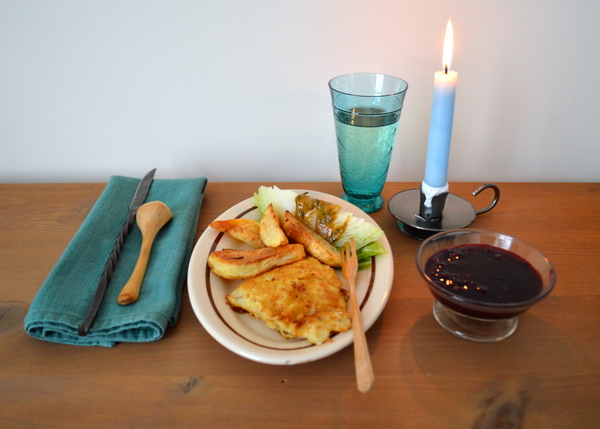
LotR Dinner2Our take on Frodo’s last dinner in Bag End has Sam Gamgee’s fish and chips at the center, accompanied by boiled cabbage wedges with rosemary mint sauce. For dessert there is a simple blueberry soup. And with it all, a glass of wine for toasting the good old hole farewell.

LotR Dinner2 Simple

Since this is quite a small, pre-long-distance-move dinner, the props are mostly simple, too: plain ceramics, plain glass, and wooden utensils on a bare table. Since the “good wine” was explicitly not included in the sale, we went with the spirit of indulgence and picked a fancier glass for it.

LotR Dinner2 Drink

Check out what’s it about in the introduction, or read the how-to!

Images by Eppu Jensen

Geeks eat, too! Second Breakfast is an occasional feature in which we talk about food with geeky connections and maybe make some of our own. Yum!

Making A Long-Expected Party

Here’s a look at how we made yesterday’s A Long-Expected Party.

The menu

  • Potato and cream soup
  • Roast pork with apples, root vegetables, and ginger gravy
  • Roasted asparagus
  • Stuffed pears
  • Red wine

erikchef1As Elves love song and Dwarves love the gems of the earth, so Hobbits love their food. We know more about Hobbit food than about the cuisine of any other culture on Middle Earth, so it is a surprise to find that in the description of the festivities for Bilbo Baggins’s 111th birthday, we learn nothing about what was actually on the table. (Though clearly there was plenty of it, whatever it was.) That means that for our very first Middle Earth dinner, we have to use a little imagination. Fortunately, there’s a lot to go on.

Since this is a party of special magnificence (with supplies brought in all the way from Dale), I’ve tried to make a combination of typical Hobbit fare with a few special or exotic twists.

Continue reading

Dining in Middle Earth: A Long-Expected Party

“When every guest had been welcomed and was finally inside the gate, there were songs, dances, music, games, and, of course, food and drink. There were three official meals: lunch, tea, and dinner (or supper). But lunch and tea were marked chiefly by the fact that at those times all the guests were sitting down and eating together. At other times there were merely lots of people eating and drinking – continuously from elevenses until six-thirty, when the fireworks started.”

LotR Dinner1

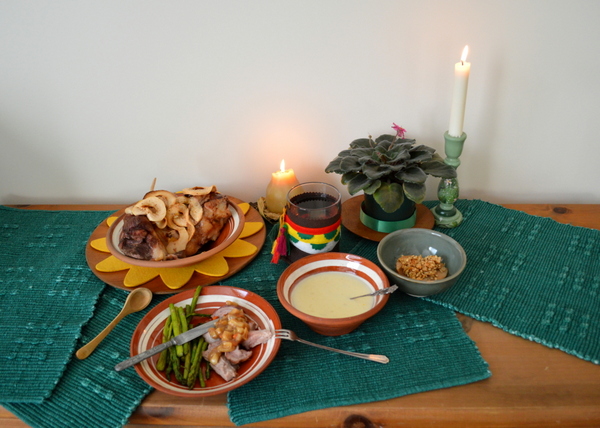
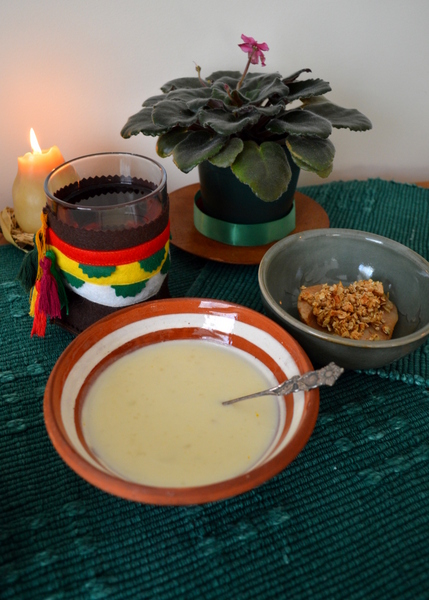
Our version of Bilbo Baggins’s party of special magnificence begins with an appetizer of potato and cream soup, followed by roast pork and root vegetables served with ginger gravy and asparagus on the side. It ends in dessert, with baked stuffed pears. (Of course, in proper Hobbit fashion, you may start and end with whatever you like.) A glass of red wine washes it all down.

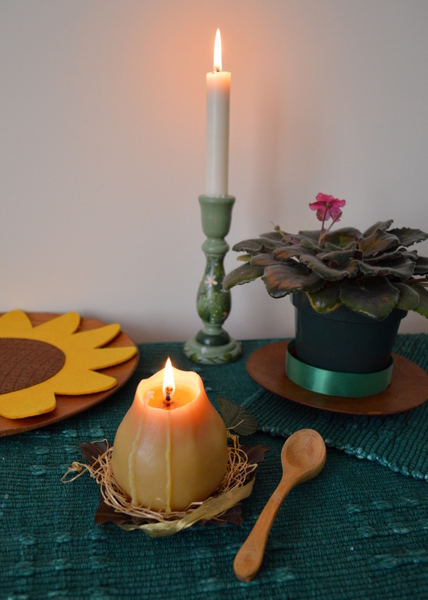
LotR Dinner1 Soup DessertOur imagined table comes with a variety of kitchenware styles. Glass and green glazed crockery complement basic redware pottery. There are wood and metal utensils, including a fork and silver soup spoon. The colors green and yellow were pulled from the general description of Hobbits’ preferences. A potted plant and candles finish off the table setting.

LotR Dinner1 Decor2Check out what’s it about in the introduction, or read the how-to!

Images by Eppu Jensen

Geeks eat, too! Second Breakfast is an occasional feature in which we talk about food with geeky connections and maybe make some of our own. Yum!

Dining in Middle Earth

“As for the Hobbits of the Shire, with whom these tales are concerned, in the days of their peace and prosperity they were a merry folk… with mouths apt to laughter, and to eating and drinking. And laugh they did, and eat, and drink, often and heartily, being fond of simple jests at all times, and of six meals a day (when they could get them).”

So Tolkien introduces us to his Hobbits, lovers of good food and good company. There is plenty of eating and drinking in The Lord of the Rings, from humble Hobbit fare to Elven delicacies, from the foraged meals of rangers in the wild to the feasts of great kings.

In 2016, we’re taking up a project to eat our way through The Lord of the Rings. Every month, we’ll prepare and present a dinner inspired by foods from the novel, working our way through the story from Bilbo’s 111th birthday party to Frodo’s return to the Shire. Along the way, there are some meals that Tolkien describes in such detail that we can read the menu straight from the page. In other places, he offers only tantalizing hints that require us to engage in gastronomical-literary archaeology to fill a table.

Napkin Knife Spoon

We’re doing our best to stay true to the novel in the project, so where Tolkien gives us a clear idea of what the characters eat, we stick to it. When we have to figure something out on our own, we use clues from The Lord of the Rings and The Hobbit and ideas from historical cookery to guide us.

We’ll share the results of our work with you around the middle of the month. A post introducing the month’s meal and showing the results of our labors will come out on a Wednesday. The following day, we’ll offer a behind-the-scenes view of how we researched the food, decided on a menu, prepared the dishes, and designed the setting, complete with recipes you can try for yourselves. We’ll collect links to all the entries on this post, so you can always come back here to get caught up, or check the dining in Middle Earth tag to find them all.

A note on the behind-the-scenes posts: we’ll be referencing passages from the book and since there are many different editions of the text with different paginations, we’re using the book and chapter divisions given in Tolkien’s table of contents. For example, the first half of The Fellowship of the Ring is identified as Book 1. In that book, chapter 4 is “A Short Cut to Mushrooms,” so we reference that chapter as (1.4); we reference Hobbit chapters with (H).

January: A Long-Expected Party / Making A Long-Expected Party

February: A Farewell Feast in Bag End / Making A Farewell Feast in Bag End

March: Supper at the Prancing Pony / Making Supper at the Prancing Pony

April: Food in the Wild / Making Food in the Wild

May: In the House of Elrond / Making In the House of Elrond

June: Dinner with Durin’s Folk / Making Dinner with Durin’s Folk

July: Of Herbs and Stewed Rabbit / Making Herbs and Stewed Rabbit

August: Rangers’ Rations / Making Rangers’ Rations

September: The Courtesy of the Golden Hall / Making The Courtesy of the Golden Hall

October: Flotsam and Jetsam / Making Flotsam and Jetsam

November: The Return of the King / Making the Return of the King

December: A Proper 1420 / Making a Proper 1420

Image by Eppu Jensen

Geeks eat, too! Second Breakfast is an occasional feature in which we talk about food with geeky connections and maybe make some of our own. Yum!

Sean Bean on the LotR Joke in The Martian

Finland’s national public broadcasting company Yle interviewed actor Sean Bean (article in Finnish; the 4-minute video in English) during his promo tour for The Martian.

Yle Sean Bean Interview
Yle Uutiset.

(Note: I wasn’t able to share the video; you’ll have to follow the link to Yle and play it there.)

Bean mentions that the Lord of the Rings reference – Project Elrond – was something he didn’t know how to react to. My partial transcription from the interview (from ca. 1:50-2:30) picks up with Bean’s answer to how it came about:

“I don’t know. I think it was in the script originally and it stayed in there, and it was very funny ’cause I’ve never been in a f– I was in a film that– then– which was– within a film. So it was very funny. [Laughs.] And, erm, you know, I just kind of listened to it, I didn’t know how to react, really [laughs], to that. It’s an unusual kind of situation I was in. But it was great, it’s great. I love that, it’s nice.”

When asked whether they joked about the reference on set, Bean answered:

“Not really, no, you said it and everyone went, like– [indistinct; laughs.] You know, I couldn’t kind of go, like, ‘Oh yeah, I was in [that]’, you know. But I– So I just kind of– [makes a gesture of playing it cool] went on with it.”

Other questions touch on the large number of team leader roles he’s played or characters who die (which Bean doesn’t seek out, specifically), how Bean built the character of Mitch Henderson with director Ridley Scott, and the kind of roles Bean would like to play in the future.

Serving exactly what it sounds like, the Quotes feature excerpts other people’s thoughts.

The Martian and Tolkien

The Martian got me thinking about Tolkien (and not just because of the Council of Elrond reference, although I loved that bit). On a basic level, The Martian is about the same thing that The Lord of the Rings is about. No, Mark Watney doesn’t have to destroy a magic ring and Frodo and Sam weren’t planting potatoes in Mordor, but the question that both works keep coming back to is the same: how do you make good decisions when you don’t have the information you need?

151006potatoes

I was thinking about The Lord of the Rings recently after listening in on a conversation between a couple of fantasy geeks about why they don’t like Tolkien. Their complaints were that Tolkien’s writing moves slowly, people talk about things instead of doing them, and most of the action doesn’t even happen on the page. These are all perfectly valid points, and if you prefer action to talking, they are good reasons to read something else. We all like the things we like and there’s no right or wrong about it. What struck me, though, was that the things they didn’t like about Tolkien are precisely the things I love.

There is a rich vein of fantasy literature all about heroes who charge boldly into the thick of battle and remake the world by sheer force of their will. Tolkien’s heroes are not of this kind. For him, what makes a hero is slowing down, thinking carefully, and making the best decision you can, even when you can’t be sure your choice is the right one.

My favorite part of The Lord of the Rings is the Council of Elrond. I know that I am in a minority in this and that even many people who love Tolkien find the whole chapter tedious. I understand the objections, but I can’t help loving the fact that dealing with the ring is something the heroes have to puzzle over and work out. Some fantasy writers would just slip in a helpful ancient prophecy or have Elrond drop a little exposition on the party and get the Fellowship on the road as soon as possible. (Peter Jackson, working within the constraints of film, understandably comes pretty close to this.) But Tolkien lets them take their time, piecing together scraps of information that are all fragmentary and biased. What they end up with is not a perfect answer but the best they can do with what they have. The courage of Tolkien’s heroes is less about facing the danger of Sauron and more about facing the fact that the best decision they can make might still be wrong.

And that’s what I love about The Martian. Mark Watney is a Tolkienian hero. He has to make the best decisions he can even when he can’t be certain what NASA is doing a planet away, or if anyone even knows he’s still alive. He survives not by strength or force of will but by slowing down, thinking things through, and facing the inescapable uncertainties of his predicament. He does the best he can with what he has. Or, as he puts it: sciencing the shit out of things.

I could use a few more heroes like this. We have enough heroes who swing swords, shoot guns, drive cars, and punch things. Let’s have more heroes who plant potatoes. Sam Gamgee would approve.

150906sam

Images: The Martian via moviepilot.com. Sam Gamgee via dwarfsandhobits.tumblr.com

In the Seen on Screen occasional feature, we discuss movies and television shows of interest.