Dining in Middle Earth: Of Herbs and Stewed Rabbit

“’I’ve got a bit of a stew for you, and some broth, Mr. Frodo. Do you good. You’ll have to sup it in your mug; or straight from the pan, when it’s cooled a bit. I haven’t brought no bowls, nor nothing proper.’

“Sam and his master sat just within the fern-brake and ate their stew from the pans, sharing the old fork and spoon. They allowed themselves half a piece of the Elvish waybread each.”


LotR Dinner7

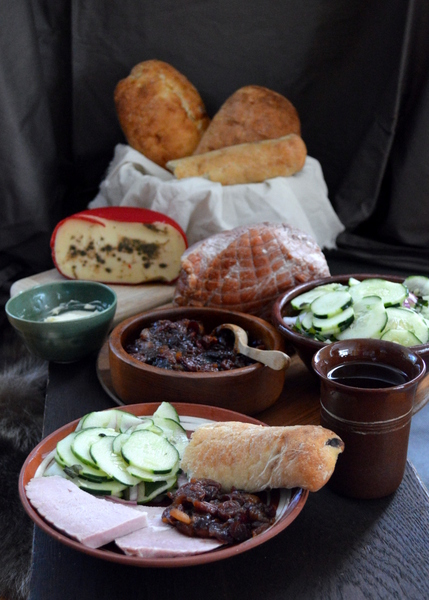
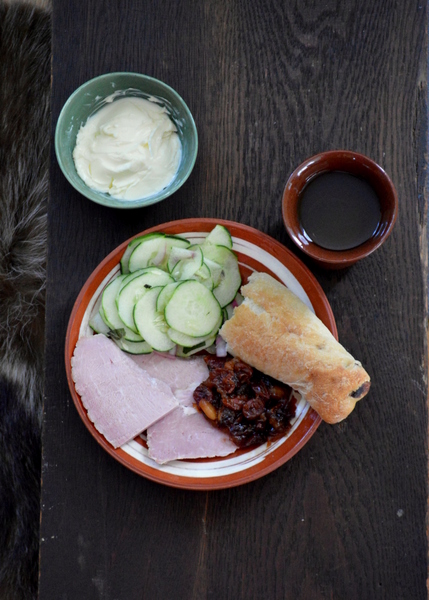
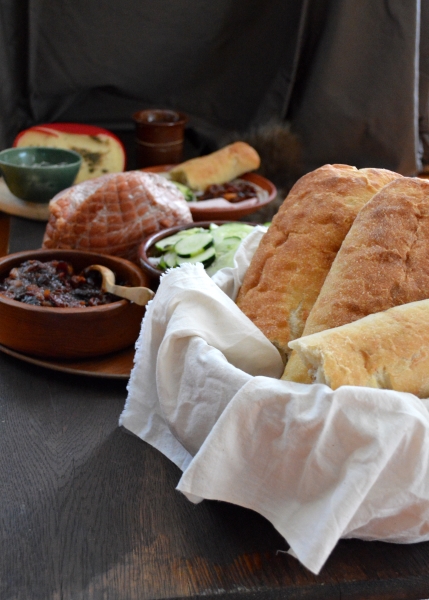
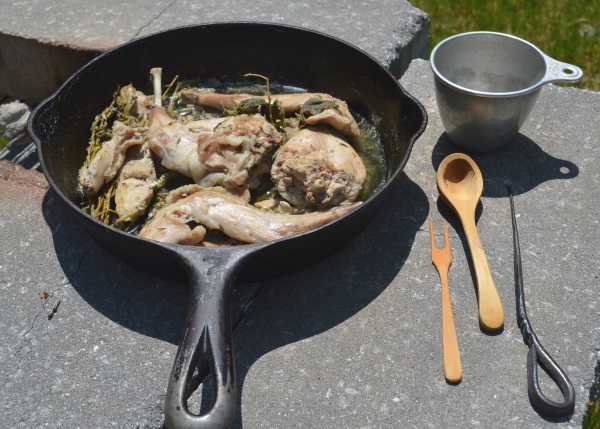
The simplest and most famous of all meals in The Lord of the Rings is without doubt the rabbit stew cooked in the wilds of Ithilien by Sam Gamgee. This is the closest Tolkien comes to giving us a recipe and we have done our best to honor both Tolkien’s words and the simplicity of the scene he evokes. This month we have a simple rabbit stew cooked on a fire outdoors and accompanied by our version of lembas bread.

LotR Dinner7 Stew

Like in The Lord of the Rings, our stew is served from the pan. Hobbit implements from previous dinners (Long-Expected Party and Farewell Feast in Bag End) make a reappearance. There’s also a skewer-like metal poker for cooking, and an old metal measuring cup has pretensions of mughood. Lembas wrapped in strawberry leaves and blackberries inside a piece of cloth add a hint of comfort to the austerity.

LotR Dinner7 Munchies

Check out what’s it about in the introduction, or read the how-to!

Images by Eppu Jensen

Geeks eat, too! Second Breakfast is an occasional feature in which we talk about food with geeky connections and maybe make some of our own. Yum!

Making Dinner with Durin’s Folk

Here’s a look at how we made yesterday’s Dinner with Durin’s Folk.

The menu

  • Sourdough rye bread
  • Rosemary crackers
  • Lentil soup
  • Grilled sausages
  • Honey-nut cakes
  • Beer
  • Whiskey cider punch


erikchef1The idea for this month’s dinner is a meal that doesn’t actually happen in Tolkien’s text. We were trying to imagine what sort of a dinner the Fellowship might have enjoyed if they had arrived at Moria and found a thriving Dwarven colony there instead of a fallen kingdom. Not only is there no particular meal in the text for us to use for reference, in fact it is a bit of a puzzle to work out what proper Dwarven food would actually be like. Gimli doesn’t have much of an opportunity in The Lord of the Rings to serve up food of his own. There’s plenty of Dwarves and plenty of food in The Hobbit, but it’s mostly the Dwarves eating food prepared by other people—Hobbits, Elves, Beorn, etc.—or making do with what they can find in the wild. We don’t get much of a sense of what Dwarves cook for a nice dinner at home or offer to guests.

LotR Dinner6 Utensils etc

So, a little speculation is called for. We can start with the fact that Moria is underground. Thorin recounts to Bilbo that the Dwarves of the Lonely Mountain traded with the Men of Dale for food rather than growing their own. (H1) We know that the Dwarves of Moria traded with the Elves of Hollin long ago, so Balin and company would probably have traded for food from the world outside as well. (2.4) Since the lands west of the Misty Mountains were quite desolate, most of the Dwarves’ trade would have been with people to the east, especially with the Beornings whose baking Gimli praises. (2.8) In those days of wolves and war, keeping the trade routes open for fresh food would have been difficult. The Dwarves of Moria would have mostly had to make do with food that would keep for a long time.

These are the ideas that inform our menu: ingredients that keep (salted and smoked meats, roasted nuts, dried lentils) and things they could have gotten in trade from the Beornings or other peoples east of the mountains (honey, bread, and flour).

Continue reading

Dining in Middle Earth: Dinner with Durin’s Folk

 “’I thought it was only a kind of cram, such as the Dale-man make for journeys in the wild,’ said the Dwarf.

‘So it is,’ they answered. ‘But we call it lembas or waybread, and it is more strengthening than any food made by Men, and it is more pleasant than cram, by all accounts.’

‘Indeed it is,’ said Gimli. ‘Why, it is better than the honey-cakes of the Beornings, and that is great praise, for the Beornings are the best bakers that I know of.’”

LotR Dinner6

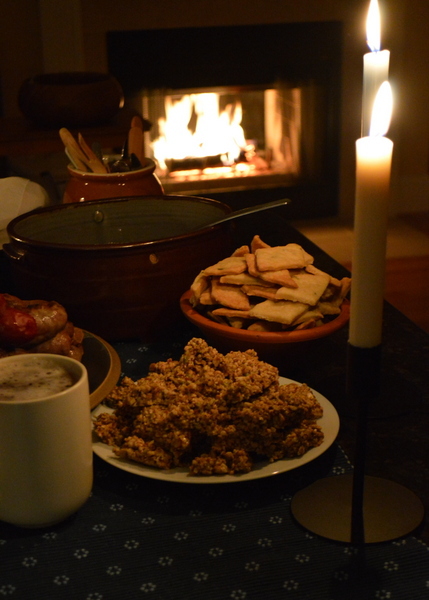
We never get to see proper Dwarven food in The Lord of the Rings, but what if we had? What would a proper Dwarven feast look like? For this month’s dinner, we try to imagine what sort of a welcome Frodo and the company might have received in Moria if they had come in better days, when Balin and his followers were bringing the ancient kingdom of the Dwarves back to life. Lentil soup, rye bread, rosemary crackers, a great pile of sausages, and honey-nut cakes make a hearty meal for weary travelers, with beer and whiskey cider punch on the side.

LotR Dinner6 Fire

Instead of place settings, a pile of heavy plates stands near the food for an informal help-yourself serving. There’s also a utensils crock with a mishmash of forks, knives, and spoons. Two simple candle holders of black metal hold white tapers. They are accompanied by a tall white marbled pillar candle and a silver napkin ring for a little more flair.

LotR Dinner6 Utensils etc

A table runner with hexagonal woven decorations softens the polished stone table, and a striped scarf stands in for banners or wall hangings.

LotR Dinner6 Soup

Chunky stoneware mugs for the frothy beer and simple pottery bowls for the soup are perfect for the setting.

Dinner6 Soup

Check out what’s it about in the introduction, or read the how-to!

Images by Eppu Jensen

Geeks eat, too! Second Breakfast is an occasional feature in which we talk about food with geeky connections and maybe make some of our own. Yum!
Making In the House of Elrond

Here’s a look at how we made yesterday’s In the House of Elrond.

The menu

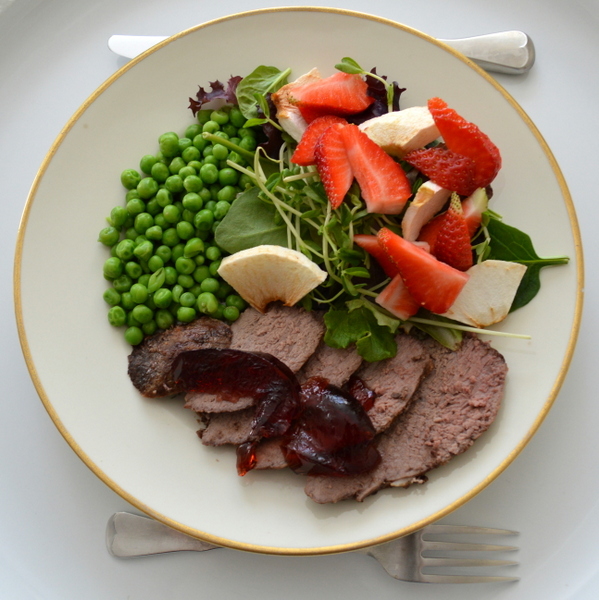
  • Roast lamb
  • Peas
  • Salad with strawberries and roasted apples
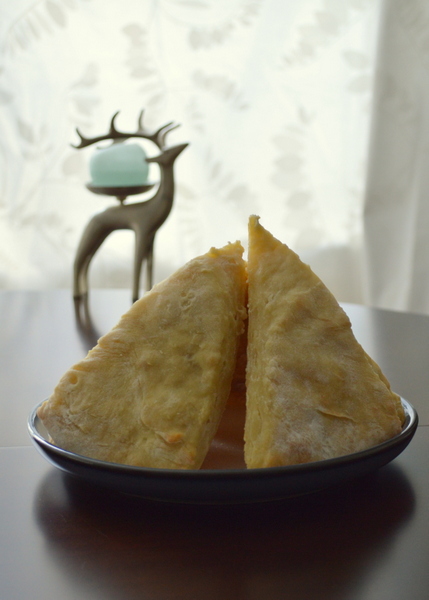
  • Bannocks
  • Cardamom buns

erikchef1Elven food leaves us in a bit of a pickle, as Sam Gamgee would say. We know that Elves eat and drink, but Tolkien’s descriptions of their food, as with most things Elven, are long on ethereal glamour and short on detail. (Most of our information about Elven food comes from The Hobbit. The Lord of the Rings is a little more circumspect about what exactly Elves eat.) We have to do a little detective work to come up with a menu.

Dinner5 Main

Continue reading

Dining in Middle Earth: In the House of Elrond

“Pippin afterwards recalled little of either food or drink, for his mind was filled with the light upon the elf-faces, and the sound of voices so various and so beautiful that he felt in a waking dream. But he remembered that there was bread, surpassing the savour of a fair white loaf to one who is starving; and fruits sweet as wildberries and richer than the tended fruits of gardens; he drained a cup that was filled with a fragrant draught, cool as a clear fountain, golden as a summer afternoon.”

LotR Dinner5

This month we present an Elven dinner such as Frodo and his companions might have enjoyed during their stay in Rivendell. With very little information from Tolkien to go on, we have put together a dinner of roast lamb, peas, bannocks, and salad, with cardamom buns for dessert and wine to go with it.

LotR Dinner5 Main

The dark wood beams Frodo saw upon waking in Rivendell inspired us to use a dark table. The vibrant greens, reds and browns of this dinner prevent the mostly white table setting from getting monotonous. A printed white on white tablecloth with meandering vines provides a thematically appropriate background. A silver-stemmed martini glass and a reindeer candle holder bring glimmers of silver to the table.

LotR Dinner5 Bread

LotR Dinner5 Salad

The dessert is as delicious to the eye as to the mouth: Erik’s cardamom buns are pretty enough on their own not to require a more ornate plate, especially with a small mound of strawberries placed in the middle.

LotR Dinner5 Dessert

Check out what’s it about in the introduction, or read the how-to!

Images by Eppu Jensen

Geeks eat, too! Second Breakfast is an occasional feature in which we talk about food with geeky connections and maybe make some of our own. Yum!
Making Food in the Wild

Here’s a look at how we made yesterday’s Food in the Wild.

The menu

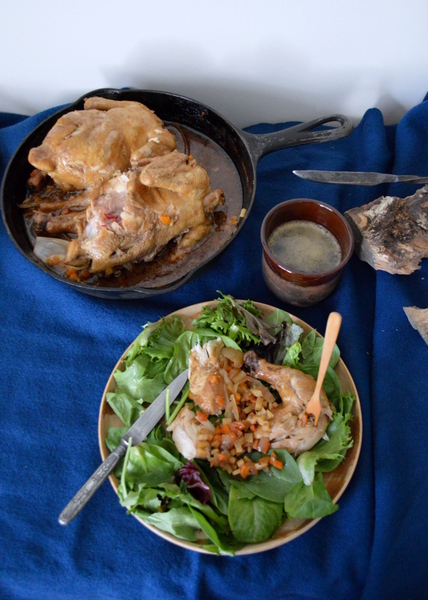
  • Pan-braised game hens with root vegetables
  • Leaf and herb salad
  • Blackberries with mint leaves

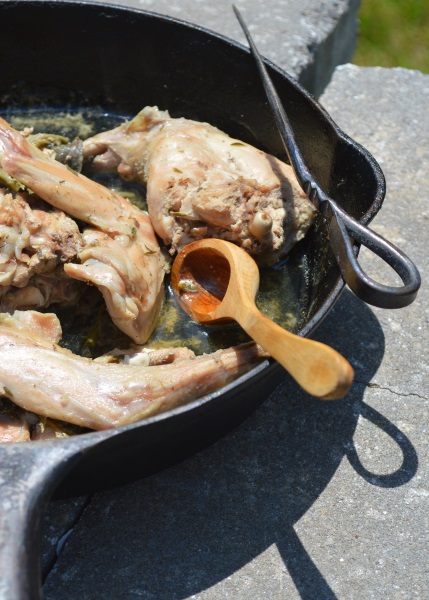
erikchef1Our heroes were in too much of a hurry to do any good eating in the wild between Bree and Rivendell, but we’ve tried to imagine what a ranger might have been able to cook up in better times. Strider mentions four different kinds of wild food: berries, roots, herbs, and game, and we’ve used a little of each in this meal. (1.11)

Dinner4 Main

The main course is pan-braised game hens. It is the only dish that needs cooking and can be cooked in a shallow pan over a campfire. We used commercially raised game hens and farmed roots for our version, but wild-caught birds and carefully dug wild root vegetables would also do. We also used farmed greens and blackberries, but there are many wild-growing plants whose young leaves can be eaten (the full-grown leaves of most edible wild plants, in contrast to their cultivated cousins, are too tough or bitter to be eaten raw, but may still be useful for cooking). Wild blackberries are common in many forested areas—and they seem to be especially common in Middle Earth, as Bilbo frequently wishes for blackberries while traveling and the Prancing Pony offers a blackberry tart (H4, H6, 1.9)

Continue reading

Dining in Middle Earth: Food in the Wild

“‘There is food in the wild,’ said Strider; ‘berry, root, and herb; and I have some skill as a hunter at need.’”

LotR Dinner4

For this month’s dinner, we take up Strider on his offer and imagine what sort of a meal a ranger could have created in the wild at the best of times. This is what Strider might have cooked up for a party of hungry Hobbits if they hadn’t been running for their lives from ringwraiths: pan-braised game hens with root vegetables on a bed of green leaf and herb salad with fresh blackberries for dessert.

LotR Dinner4 Drink

Cooking would’ve been done with a cast iron spider, and light-weight wooden plates and small utensils wouldn’t add too much to the burden. Small pieces of fabric and sacks provide storage, and a rough piece of firewood functions as a makeshift stool or table. Everything is laid on rich, deep blue wool blend that nods towards Aragorn’s high status as the heir of Elendil.

Check out what’s it about in the introduction, or read the how-to!

Images by Eppu Jensen

Geeks eat, too! Second Breakfast is an occasional feature in which we talk about food with geeky connections and maybe make some of our own. Yum!

I’ll Have Elevensies with My Elevensies, Thanks!

Beer brewers Night Shift Brewing in Massachusetts made a Baltic porter aged in apple brandy barrels. They call it Elevensies, and describe it as dark and of high gravity.

Night Shift Brewing elevensies_square-01
Elevensies beer by Night Shift Brewing
Night Shift Brewing Elevensies
Elevensies beer. Screenshot from Night Shift Brewing

Sounds like it would’ve made a perfect partner for our Prancing Pony dinner. Maybe we can still find some…!

Found via File 770.

Geeks eat, too! Second Breakfast is an occasional feature in which we talk about food with geeky connections and maybe make some of our own. Yum!


Race and Culture in Hannibal’s Army

160322elephantTor.com published an article online today about diversity in Hannibal’s army written from the point of view of historical wargaming. It is a interesting article and well worth a read, but unfortunately it misses the opportunity to really address questions of racial and cultural diversity in ancient warfare. Here is a quick attempt to address some of the things that were lacking.

Race and culture

Race is a term with a lot of baggage, as we are all painfully aware, but it means different things in different contexts. In modern parlance, it describes a socially-constructed division of human beings into more or less arbitrary categories, largely on the basis of skin color and other physical features. In a fantasy context, it refers to distinct species of intelligent creatures like Elves, Orcs, Dwarves, and so on.

The unaddressed problem in the Tor.com article is the conflation of race and culture. In the nineteenth and early twentieth century, overtly racist theories of history posited that people of different genetic backgrounds naturally had different qualities. Many of these stereotypes still linger in our popular culture: the stoic Indian, the mischievous Irishman, the passionate Italian, etc. This belief in racial character was encoded in early classic works of fantasy like Tolkien’s Lord of the Rings, which gave us the stubborn Dwarf, the ethereal Elf, the vicious Orc, etc.

Even as we struggle to root out this conflation of race and culture from our modern life, it lingers on in works of fantasy and science fiction: the logical Vulcan, the boisterous Klingon, the decadent Centauri, the proud Dothraki. As we look back at history, we have to think of the people of the past not in terms of racial qualities but in terms of cultural contexts. People of different origins often do behave differently, but those differences are explained by the cultures they lived in, not the races they represent.

Continue reading

Making Supper at the Prancing Pony

Here’s a look at how we made yesterday’s Supper at the Prancing Pony.

The menu

  • Root vegetable soup
  • Cold chicken and ham
  • Bread and butter
  • Cheese
  • Blackberry tart
  • Beer

erikchef1No meal in The Lord of the Rings is more clearly described than the supper laid on by Butterbur of Bree at the Prancing Pony, and we have stuck to the letter of the description: a hearty vegetable soup and cold chicken and ham served up with bread, butter, and cheese, with home-brewed stout to drink and a blackberry tart for dessert. (1.9)

Continue reading