The Story of Kullervo: Tolkien Inspired by the Finnish Folk Epic

J. R. R. Tolkien’s The Story of Kullervo edited by Verlyn Flieger will be published only a few weeks from now in the U.S. The October release was preceded by a late August launch in the U.K.

HarperCollins.
HarperCollins.

According to the publisher’s statement,

“Kullervo son of Kalervo is perhaps the darkest and most tragic of all J.R.R. Tolkien’s characters. ‘Hapless Kullervo’, as Tolkien called him, is a luckless orphan boy with supernatural powers and a tragic destiny.

“Brought up in the homestead of the dark magician Untamo, who killed his father, kidnapped his mother, and who tries three times to kill him when still a boy, Kullervo is alone save for the love of his twin sister, Wanona, and guarded by the magical powers of the black dog, Musti. When Kullervo is sold into slavery he swears revenge on the magician, but he will learn that even at the point of vengeance there is no escape from the cruellest of fates.

“Tolkien wrote that The Story of Kullervo was ‘the germ of my attempt to write legends of my own’, and was ‘a major matter in the legends of the First Age’; his Kullervo was the ancestor of Túrin Turambar, tragic incestuous hero of The Silmarillion. In addition to being a powerful story in its own right, The Story of Kullervo – published here for the first time with the author’s drafts, notes and lecture-essays on its source-work, The Kalevala, is a foundation stone in the structure of Tolkien’s invented world.”

As The Kalevala is my national epic, it feels odd to see the storylines and names used with little or no change by a celebrated international author. I’m used to thinking of my country and culture as small and unimportant. Perhaps that is our strength, after all – we’ve managed to hold on to some unique features in our little corner of Europe.

If the original folk epic interests you, an English-language version of The Kalevala is available for free at Project Gutenberg.

This post has been edited for formatting.
Crowdfunding Campaign to Build Minas Tirith for Real

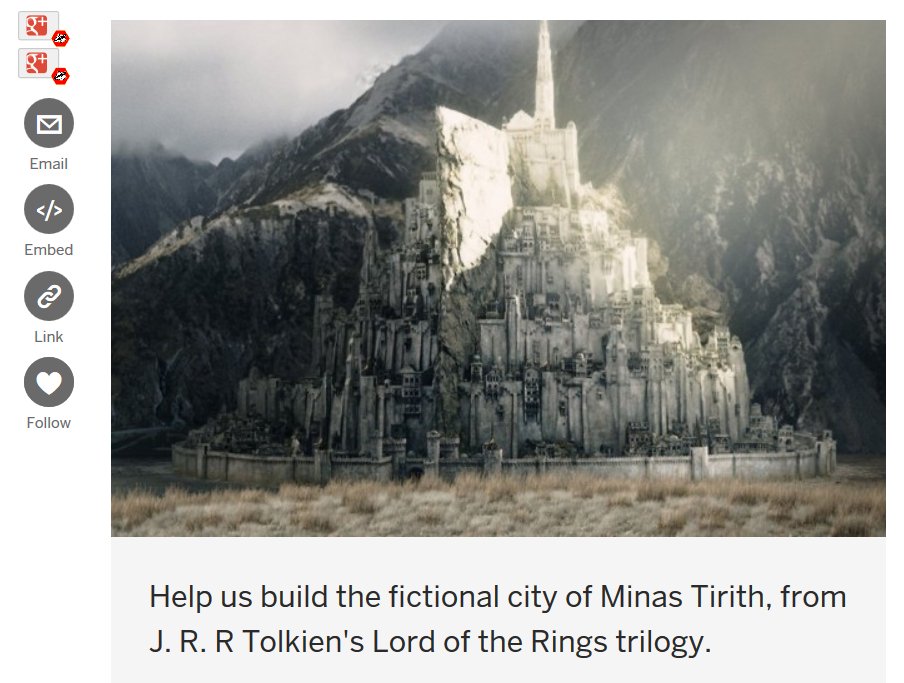
Turns out a group of people in Great Britain is hankering after a real Minas Tirith so much that they started an Indiegogo campaign to fund the building effort:

“We are a team of Tolkien fans who are passionate about creating a beautiful, inspirational and fully-functioning replica of Peter Jackson’s depiction of Minas Tirith, as seen in his Lord of the Rings films.

“We all share a love of Tolkien’s work, and a desire to challenge the common perception of community and architecture. We believe that, in realising Minas Tirith, we could create not only the most remarkable tourist attraction on the planet, but also a wonderfully unique place to live and work.”

Realise Minas Tirith on Indiegogo.

If the project sounds far-fetched to you, rest assured: the team knows it’s a long shot:

“Please only donate within your means, and in the knowledge that this project is a light-hearted venture with virtually no chance of succeeding. […] We make no claim on the image or name of Minas Tirith, and will happily cancel this project should any dispute arise over such.”

Two things come to mind: it’s a fascinating example of 1) how throwing money at something has become an established way to show public support for a project or person, and 2) how the Internet allows people to engage in collective daydreaming across the globe.

Hey, look! We found a thing on the internet! We thought it was cool, and wanted to share it with you.

2016 Tolkien Calendar Illustrated by Tove Jansson

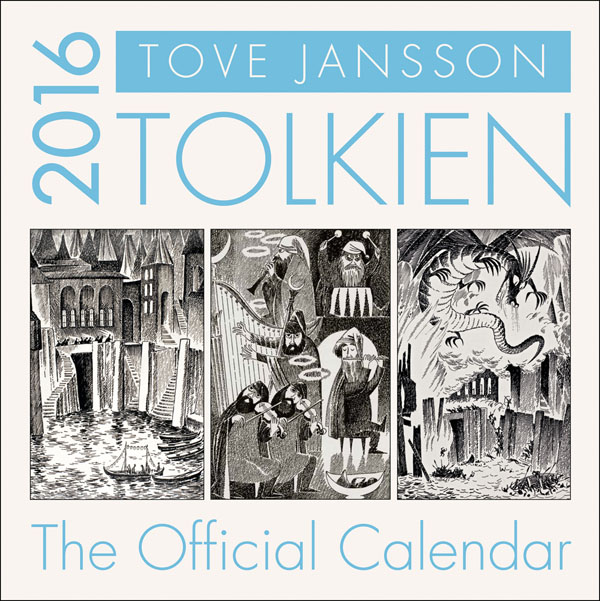
According to The Tolkien Society, the Official Tolkien Calendar for 2016 will be released tomorrow, July 30, 2015. The calendar is illustrated by Tove Jansson, a Finnish visual artist and author.

Tolkien Calendar 2016. HarperCollins.

Jansson (1914-2001) is best known as the creator of Moomins. However, she also illustrated Swedish translations of The Hobbit and Lewis Carroll’s The Hunting of the Snark and Alice’s Adventures in Wonderland. Some of these illustrations were later used in Finnish translations.

Jansson's illustrations for early Swedish and Finnish translations of The Hobbit. The estate of Tove Jansson, via Tolkien Library.
Jansson’s illustrations for early Swedish and Finnish translations of The Hobbit. The estate of Tove Jansson, via Tolkien Library.

The publisher’s description of the calendar reads:

“Jansson illustrated The Hobbit in 1961 for the Swedish and Finnish editions, creating a dozen enchanting full page drawings plus many smaller vignette pieces. Never before published in an English-language edition, the 2016 calendar contains all twelve of these illustrations, many of the vignettes, and a full-colour centrefold featuring her dramatic cover painting of Smaug attacking the Dwarves. The calendar is introduced by Tolkien expert and author Brian Sibley, who corresponded with the artist and provides insightful commentary regarding the genesis of the illustrations and Jansson’s tireless work continuing to build the world of The Moomins. The Official Tolkien Calendar has been an established publishing event for Tolkien fans and Hobbit collectors for the last four decades, and the 2016 edition will continue to delight and surprise.”