Race in Antiquity: Skin Color

“What race were the ancient Greeks and Romans?”

It sounds like a simple question that ought to have a straightforward answer, but both the question and its answer are far more complicated than they appear. In these posts, I dig into the topic to explore what we know, what we don’t know, and what we mean by race in the ancient Mediterranean world.

Part 3: Skin Color

Race, as we use the concept today, applies arbitrary divisions on the wide diversity of human physiology. The fact that these divisions are arbitrary does not make them irrelevant or innocuous. As with many other ways of dividing up humanity, race has often been used to justify inequalities. The ancient Mediterranean world was not free of inequality or arbitrary divisions between people, but that does not mean that those divisions worked the same way as the modern idea of race.

Skin color is a useful place to start. Although many different aspects of human physiology have been used to mark out racial divisions—face shape, hair texture, skeletal proportions—none is more thoroughly interwoven into racial ideology as skin color. The terms black and white are conventional ways of identifying race. Others, such as red, yellow, and brown, though not as widely used as they once were, still appear today, sometimes with more complex meanings than they once had. Even the currently preferred circumlocution people of color still supposes that skin color is a prime marker of identity. In both life and art, we tend to look at skin color as the signal marker of racial identity, and to identify both ourselves and others in those terms.

What did skin color mean to the people of ancient Greece and Rome? It was not irrelevant. Greek and Roman authors and artists were aware that different people had different skin tones and they sometimes connected these distinctions with identity in significant ways, but that is not the same as recognizing race. We cannot read ancient literature or look at ancient art and evaluate it the same way we would treat at a modern movie or news story.

Consider this cheeky couplet from the Roman poet Catullus, addressed to Julius Caesar:

I don’t try too hard to please you, Caesar.

I don’t even know whether you are a black person or a white person.

– Catullus, Songs 93

(All translations my own)

To a modern Western audience, this sounds at once like a reference to race. To call someone a “black person” or a “white person” today is transparently and unambiguously a racial identification. Yet Catullus meant nothing of the kind. He certainly was not ignorant of the ancestry and identity of one of the most powerful people in the Roman world in his day. In Classical Latin, “I don’t know whether it’s black or white” is a common saying meaning “I don’t care in the slightest.” Catullus wasn’t talking about Caesar’s skin color at all.

There are examples in classical literature when people’s skin color is explicitly described, but even those cases do not follow the same patterns as modern racial categories. For example, in the Odyssey, the hero Odysseus is disguised by the goddess Athena when he first arrives home to Ithaca. When he first meets his son Telemachus, however, the disguise is briefly lifted, and part of what marks the transformation is a change in skin color:

Athena pointed with her golden wand.

First she wrapped him well in a cloak

and spread a tunic around his breast, filled out to its prime.

He became black-skinned again, his jaws stretched out,

and a dark blue beard covered his chin.

– Homer, Odyssey 16.172-6

The word used to describe Odysseus’ color, melanchroiēs, can be literally translated as ‘black-skinned,’ but really means ‘deeply suntanned.’ The darkness of Odysseus’ skin is important because it marks his age and experience. It was not part of an ethnic identity he was born with but something he acquired through experience.

Ancient authors similarly associated pale skin with youth and naivete. The comic playwright Aristophanes used whiteness as a marker of foolish inexperience to describe a character who had what his Athenian audience would have regarded as a ludicrously bad idea:

After this, some handsome young fellow,
as white as Nikias, jumped up,
put up his hand to speak,
and said we should hand the city over to the women.

– Aristophanes, The Assemblywomen 427-30

Nikias was a prominent politician of the age who championed the cause of peace between Athens and Sparta. Just like Odysseus’ “black skin” was a marker of his long career as a warrior, Nikias’ “whiteness” distinguished him as a military dilettante. In neither case was the color of their skin meant to convey a racial identity.

It seems that even at a basic level, ancient Greeks and Romans described colors differently than we do today. Latin has two words for both white and black. Albus means pale, lusterless white, while candidus means bright, gleaming white. Ater is flat, matte black while niger is glossy black. In Greek literature, many objects are described with colors we would not associate with them today: wine is black; grass is white; honey is green; iron is blue. (Note also Odysseus’ “dark blue” beard.) When ancient authors describe people in terms of color, we must be particularly cautious in how we interpret them.

In some cases, ancient authors did use skin color as a way of describing ethnic identity, but it was not the only physical feature, or even the most common one, that they paid attention to. Hair color, eye color, facial features, and physical proportions were equally relevant as ethnic traits, as shown in a couple of examples from the Greek philosopher Xenophanes and the Roman historian Tacitus:

Ethiopians say the gods are dark and snub-nosed; the Thracians give them red hair and blue eyes.

– Xenophanes, fragment 16

The physical variety [of the Britons] is suggestive. The golden-red hair and burly limbs of the Caledonians shows them to be of Germanic origin. The colorful faces and curly hair of the Silures, plus their position opposite Spain, suggests their ancestors were Spaniards who came across the ocean.

– Tacitus, Agricola 11

These observations should both caution and stimulate us.

On one hand, we cannot simply read ancient sources—or their modern translations—the same way we would read modern texts. Ancient Greek and Roman authors did not think in the same racial terms we use today, and we risk misunderstanding them if we simply apply modern concepts to ancient texts. When we read that the Greek historian Herodotus described the people of Egypt as “black” (Histories 2.22), the question we have to ask is not “What does ‘black’ mean?” but “What did ‘black’ mean to Herodotus?” Like Homer describing Odysseus, he probably meant that they were deeply tanned. He could not have meant that they belonged to the racial category of people we today classify as black because Greeks of his day did not use the word black with that meaning. Quite simply, Herodotus tells us nothing of much use in assigning modern racial categories to the ancient Egyptians.

On the other hand, the fact that ancient authors did not generally use skin color as a way of distinguishing racial groups in the same way we do does not mean that the ancient Mediterranean was ethnically homogeneous. Greek and Roman authors described the world in the terms that mattered to them. They had no idea that we would be coming along a couple of millennia later asking different questions with different ways of describing ourselves. Absence of evidence is not evidence of absence: the fact that ancient authors tended not to describe people’s ethnicities in terms of skin color does not mean that people of many different ethnic origins and skin tones did not live among them.

Race is a clumsy and historically fraught way of dividing up the rich complexity of human diversity. Just because ancient Greeks and Romans didn’t divide people up in the same way we do doesn’t mean that the world they lived in was any less complex than our own. If we want to find evidence for that diversity, we have to be prepared to look for it in ways that don’t depend on modern conventions.

Other posts on Race in Antiquity:

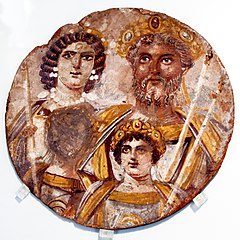
Image: Portrait of Septimius Severus and family, photograph by José Luiz Bernardes Ribeiro via Wikimedia (currently Altes Museum, Berlin; c. 200 CE; painted panel)

History for Writers is a weekly feature which looks at how history can be a fiction writer’s most useful tool. From worldbuilding to dialogue, history helps you write. Check out the introduction to History for Writers here.

Inuit Tactile Maps

Maps tell us where we are and how to get where we’re going. Sometimes, the top-down, bird’s-eye-view style of map we are most used to today is not the most helpful tool for achieving that goal. Anyone who’s had to orient themselves in a strange landscape with a traditional map knows the frustration of trying to match the visible landmarks and shapes of the terrain to the lines and symbols of the map. There are also plenty of places where pulling out a flat paper map would be impractical.

From Greenland comes a different approach to mapping. These drawings show two carved wooden maps of the coastline around the eastern Greenland settlement of Sermiligaaq that were sold to Danish explorers by a local named Kunit in the 1880s.

These small carvings, known as the Ammassalik wooden maps, represent the shapes of the coastline. The narrower map represents a string of islands; the wider one records a stretch of the mainland coastline and is read in a continuous stretch up one side and down the other. They are small enough to be held inside a mitten so that a traveler paddling down the coast by kayak could feel their way along from one bay to the next.

Just another example of how human ingenuity finds different solutions to similar problems.

Image: Drawing of the Ammassalik maps via Wikimedia

Hey, look! We found a thing on the internet! We thought it was cool, and wanted to share it with you.

Eating

Whether it’s lembas bread and stewed rabbit or a nice fresh pan-galactic gargle blaster, the things that characters eat and drink can be a useful way of establishing the feel of an unfamiliar world. But how your characters eat and how their food is prepared and served can contribute just as much to your worldbuilding as what they eat. Here are a few things to think about when creating food systems for fantasy worlds.

Wet carbs or dry carbs?

Traditional cuisines in most of the world are based on carbohydrates, but those carbs can come in many different forms. If they’re dry—flatbread, raised breads, tortillas, biscuits, etc.—then people are likely to eat them by hand and may well use them to pick up and hold other dishes like stews and sauces. If they’re wet—porridge, cooked rice, pasta, etc.—people are more likely to use implements like spoons and chopsticks to hold them.

Eating by hand or eating with implements?

While this can be to some extent determined by the nature of the food, many foods can be eaten either by hand or with implements. Implement-eating cultures tend to develop specialized implements for particular foods or kinds of eating; whether or not people have access to or know how to use the correct implements for the right food can be a marker of social status. On the other hand, hand-eating cultures can have just as complicated rules about how to eat. Forget the renfaire stereotypes about grabbing a turkey leg and tearing into it; societies that eat by hand tend to have strict rules governing when and how often you wash your hands, which hand you use to eat with, even which fingers and which individual finger joints should be used for which foods.

Large pieces or small pieces?

Some cuisines, such as most traditional European cookery, tend to cook meats and vegetables in large pieces which individual diners cut up for themselves. Others, such as traditional cuisines across much of south and east Asia, tend to cut meats and vegetable into smaller pieces in the kitchen which are served up to be consumed as they are.

Communal dishes or individual servings?

Sometimes food is served in communal dishes from which everyone takes what they like; other times, everyone gets their own individual serving. Both ways of serving are wrapped up with social etiquette. With communal dishes, there are usually rules about how people serve themselves, in what order, and how much at a time. With individual dishes, there may be rules about whether everyone gets the same things or the same amount.

In any culture, you are also likely to find variations on these possibilities. People of different social classes or ethnic backgrounds within the same society may well follow different eating customs. The same people may also eat differently under different circumstances: a quiet family dinner at home probably has different social rules than a public banquet for a festival day. Drawing out these complexities is also a part of worldbuilding.

Food is important. People often get emotionally invested not just in what they eat but in how they eat it. Many of the customs and norms that societies develop for how food is eaten and served have their roots in protecting hygiene and managing social hierarchies, two very important issues for personal well-being. Even today, when modern food safety practices and the weakening of traditional social hierarchies has made these issues less urgent, people can still have deep emotional reactions to perceived transgressions as trivial as folding a slice of pizza or eating a hamburger with fork and knife.

Imagine how important customs of cooking, serving, and eating food could be in a world in which your character’s standing in society may depend on knowing which finger to use to dip into the shared sauce bowl.

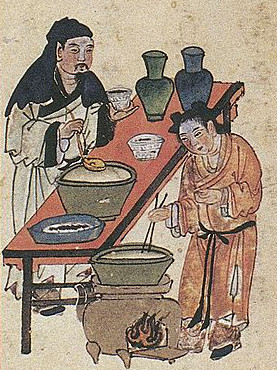
Image: Preparing butter, image from Shiwunbencao (ink on paper, Ming period)

History for Writers is a weekly feature which looks at how history can be a fiction writer’s most useful tool. From worldbuilding to dialogue, history helps you write. Check out the introduction to History for Writers here.

Quotes: A Woman Who is Always Going on About the Grammatical Arts

And don’t get me started on the woman who, as soon as she sits down to dinner,

lauds Vergil, makes excuses for the fallen Dido,

pits the poets against each other, and weighs up

Maro and Homer in a balance scale.

Teachers give way, professors are vanquished, the whole crowd

falls silent, the lawyers and hawkers can’t get a word in—

not even another woman!

Don’t sit down to dinner with a woman

of that loquacious sort who slings a tricky syllogism

with her whirling talk, who knows all the histories,

but rather one who isn’t well read.

I can’t stand a woman who is always going on about the grammatical arts,

whose talk is always in tune with the laws of logic

and who has some verses of an antique poet I’ve never heard of on her lips.

– Juvenal, Satires 6.434-40, 448-54

(My own translation)

This bit of the Roman satirist Juvenal’s harangue against women—directed at those who have the audacity to read books, have opinions on them, and not give way to men who think they know better—sounds to me a lot like certain modern men’s bellyaching on social media about women who insist on having opinions on comic books, sci-fi movies, video games, or other pieces of popular culture.

There are two broad schools of thought on Juvenal. One takes his curmudgeonly satires at face value and sees him as a butt-hurt bro throwing a tantrum. I incline towards the other school of thought which sees Juvenal’s satiric persona as a put-on performance, like Stephen Colbert’s old schtick. The real target of Juvenal’s ire was not well-read women but his fellow Roman men who were sore about women having ideas about books they hadn’t even read themselves.

Serving exactly what it sounds like, the Quotes feature excerpts other people’s thoughts.

Transmog: Darkmoon Days

WoWable has a fun new thing going on: a transmog contest! Check it out here.

This edition’s theme is the Darkmoon Faire, a monthly off-kilter carnival that brings players together for fun mini-games and profession quests. The transmog challenge is: “If your character lived/worked on the Darkmoon Faire, what would be his/her occupation?”

Erik:

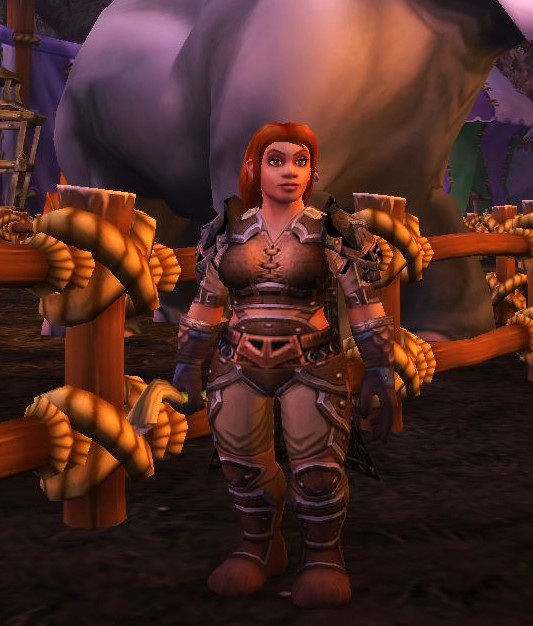
Here’s my dwarven hunter. If she worked at the Faire, she would be the in-house veterinarian because she loves all creatures great and small—but especially the great! A giant elekk is just a big puppy to her. Now, when you’re caring for weird giant animals from all over the world and beyond, that means dressing appropriately for the possibility of getting poked, bitten, and just maybe breathed fire on, so this is the sort of practical gear she would wear around the menagerie.

(Here’s the vet set in Wowhead’s Dressing Room.)

Eppu:

My dwarven windwalker monk would be a fire juggler at the Faire. I don’t really role-play her, but I think of her as a shamanesque monk, interested in the various elements. And as a windwalker, in my headcanon she’d be able to propel the torches in very showy ways.

WoW Darkmoon Faire Fire Juggler Transmog Windwalker Monk

(And here’s the fire juggler set.)

This was fun. We look forward to the next challenge!

Of Dice and Dragons is an occasional feature about games and gaming.

Rating: Doctor Who, Season 3

Time moves ever onwards and so do we. Here’s our take on Doctor Who (new series) season 3:

  1. “The Runaway Bride” – 5.5
  2. “Smith and Jones” – 9.5
  3. “The Shakespeare Code” – 7.5
  4. “Gridlock” – 6
  5. “Daleks in Manhattan” – 6
  6. “Evolution of the Daleks” – 4
  7. “The Lazarus Experiment” – 1
  8. “42” – 10
  9. “Human Nature” – 6
  10. “The Family of Blood” – 7.5
  11. “Blink” – 10
  12. “Utopia” – 4
  13. “The Sound of Drums” – 2.5
  14. “The Last of the Time Lords” – 3

Season 3 is a roller coast ride with some incredible highs, a few real lows, and a lot of good solid episodes in between. The average rating for the season is 5.9, a good showing and a noticeable increase from the previous two seasons, at 5.3. This season brings us Martha, a medical student with a good head on her shoulders and our all-time favorite companion. We also see David Tennant’s acting chops as he gets to play not just the Doctor but also an absent-minded schoolmaster and a murderous sun (yes, a sun). After some wobbly writing in previous seasons, this season gets more of a grip on how to balance the whimsical aspects of the show with its serious side.

The low point of the season is “The Lazarus Experiment” at a dismal 1, about a rejuvenation device that goes horribly wrong and turns its creator into a bad CGI scorpion thing. There are so many problems with this episode, from laggy pacing to a plot that is nonsensical even by Doctor Who‘s generous standards. Too much time is spent on Dr. Lazarus, a shallow stereotype of a bitter old man that we are apparently meant to find deep and engaging (and of course he’s called Dr. Lazarus—we couldn’t have a character who wants to restore his lost youth not be called Dr. Lazarus, could we?). Even a “reverse the polarity” callback gag can’t save this episode.

At the other end of the scale, there are two absolute standout episodes this season, both rating a full 10. The first is “42,” an intense and emotional thriller about a spaceship under attack by a killer star, whose predicament turns out to be more complex than at first appears. Everything in this episode is at its best: the fast-paced plot that still finds time for Martha to reflect on her time with the Doctor, the guest cast who even in their brief screen time bring life and depth to their space-trucker characters, and the music, which gives us one of the tenth Doctor’s most thrilling themes.

Burn With Me via DoctorWhoInfinity

And then there’s “Blink,” an episode like no other. The Doctor and Matha appear only sporadically in this one, and instead we follow Sally Sparrow as she slowly unravels the mystery of the Weeping Angels. This episode does ingenious things with time travel (a surprising rarity in a show about a time traveler), including messages left on the walls of an old house under peeling wallpaper and a long-distance conversation via DVD Easter egg. It is also a masterful demonstration that you don’t have to have violence or gore to be absolutely terrifying. This is an episode that rewards watching over and over again—just not late at night when you’re alone in the house.

Honorable mention goes to “Smith and Jones,” at 9.5, which introduces Martha with a story about an alien killer hiding in a London hospital—taken to the moon. We see Martha in action as a level-headed problem-solver while David Tennant gets to deliver some goofy comedy.

We know there are lots of other Doctor Who fans out there, and some of you have different takes on this season and its episodes. We’d love to hear about it. Let us know which episodes of season 3 you loved or didn’t.

Image: Doctor Who Season 3 via IMDb

In the Seen on Screen occasional feature, we discuss movies and television shows of interest.

Top Five Posts for 2017

Another year is behind us, and what a year it was. Here are the 2017 posts that got the most views. Most of them are from our How to Helsinki series in the run-up to Worldcon75 in Helsinki in August:

  1. How to Helsinki: Concerning Finns Erik’s post about Finnish culture and how to be a good visitor to Finland
  2. What Makes a Fantasy World Feel European? Erik’s reflections on geography, history, culture, and why some fantasy worldbuilding feels like a recreation of Europe
  3. How to Helsinki: Getting around Helsinki Eppu’s detailed and user-friendly guide to navigating around Helsinki
  4. How to Helsinki: Resources by Worldcon 75 Staff Eppu’s list of helpful info and links provided by the staff of Worldcon 75
  5. How to Helsinki: Sauna, That Scary-Hot Room Full of Naked Eppu’s introduction to the Finnish sauna for those who have never experienced it before

Some posts from previous years have remained popular as well. Here’s the overall list of top five posts people read in 2017, some of them from a year or two back:

  1. Do-It-Yourself Fantasy Place Name Generator Erik’s basic system for creating fictitious place names (from 2015)
  2. How to Helsinki: Concerning Finns Erik’s post about Finnish culture and how to be a good visitor to Finland
  3. What Makes a Fantasy World Feel European? Erik’s reflections on geography, history, culture, and why some fantasy worldbuilding feels like a recreation of Europe
  4. Sean Bean on the LotR Joke in The Martian Eppu shares a short transcript from an interview with Sean Bean by Yle, the Finnish national broadcast company (from 2015)
  5. Hogwarts Dueling Club Tablecloth Transformed into Wall Hanging Eppu shares an eye-catching Harry Potter craft project found online (from 2016)

Thanks for stopping by. We hope you enjoyed reading our posts as much as we enjoyed writing them!

Messing with numbers is messy.


History for Writers Compendium: 2017

History for Writers explores world history to offer ideas and observations of interest to those of us who are in the business of inventing new worlds, cultures, and histories of our own. Here’s where we’ve been in 2017:

Practicalities

Connections between cultures

Ancient wisdom for troubled times

Telling stories

Thinking historically

Past cultures

Race in Antiquity

Join us in 2018 for more history from a SFF writer’s perspective.

History for Writers is a weekly feature which looks at how history can be a fiction writer’s most useful tool. From worldbuilding to dialogue, history helps you write. Check out the introduction to History for Writers here.

Lost Heirs and Clever Peasants

(Note: minor spoiler ahead for Star Wars: The Last Jedi)

Our story-telling traditions often make a big deal out of family and descent. Part of the classic Campbellian Hero’s Journey is the son’s need to measure himself against his father. A Real Princess™ can tell when there’s a pea under a dozen mattresses, or needs a Real Prince™ to wake her up (apparently princesses do a lot of napping). Modern stories often reinforce the importance of true family lines in similar ways, whether they’re directly invoking the mythic tradition (like Star Wars) or just because family is still an important part of the drama of our lives ( like Harry Potter).

The idea that family lines determine our characters’ stories, abilities, and ambitions is such a big part of our narrative legacy that it can seem like a primordial principle of storytelling, but in fact these kinds of stories arise from specific cultural contexts. These contexts have to do with the assertion of class.

Small-scale societies historically tended to be egalitarian. When a culture contained only a few hundred people, everyone knew one another personally, resources were freely shared, and there was no real differentiation between rich and poor, powerful and powerless. As societies got larger, up into the range a few thousand people or more, social distinctions tended to emerge because people were no longer held together primarily by personal and family relationships. In societies of this scale, some families acquired more resources and more influence than others. Over time, these differences hardened into class distinctions, with prosperous families asserting their own superiority over the less fortunate. An aristocratic class with a sense of its own importance took shape.

A rising aristocracy, however, often struggled against the older traditions of egalitarianism and mutual support. To maintain their position, aristocrats had to create and disseminate a new ideology which justified their status. In many societies all over the world, this ideology was framed by stories about heroic ancestors and special powers passed down through family lines. If you weren’t part of the family line, you didn’t inherit the special powers, and therefore you didn’t deserve to be rich or powerful like them.

Many of the ancient stories that have been passed down and become part of our common narrative tradition were stories originally told by and for aristocrats and would-be aristocrats clawing their way into positions of privilege. When ancient Greek bards recited the tales of Achilles, Odysseus, Helen, and Penelope, they weren’t just telling stories to entertain the masses. Bards and singers depended for their livelihoods on the support of aristocratic patrons, and the stories they told were propaganda for the people who paid the bills. Greek aristocrats claimed to be actual descendants of the heroes of the Trojan War and other myths. The Homeric epics are quite clear that no one from outside the family line deserves to get anywhere near the heroes’ wealth and power.

On the other hand, our story-telling traditions also include narratives that are democratic (or at least anti-aristocratic). Some of these take the form of “clever peasant” tales in which someone from an unimportant background gets the better of the rich and powerful through luck, audacity, and wits. These tales often set up the aristocrats as buffoons who are humiliated in the end and forced to acknowledge the individual merits of people with no family claim to riches or power. Stories of this type are common in folk traditions, including English Jack tales and their analogues in other cultures.

Another type of story combines elements of both, often revolving around a lost heir or disguised royal. In these stories, the hero at first appears to be an ordinary person whose individual initiative and skill earn them acclaim and awards, but they turn out in the end to be the misplaced scion of an important family. Sometimes these lost heirs know their own identity and are in hiding; other times they are themselves unaware until their true identity is revealed. King Arthur, in some versions of the Arthurian mythos, fits this pattern: having been raised in obscurity, he comes into his true heritage when he proves his special powers by pulling the sword from the stone. Robin Hood—again, in some versions—represents a different take on the same pattern: by rights a nobleman, he hides his true identity and fights for the common people. This tradition represents a degree of compromise between the aristocratic and anti-aristocratic narratives. The hero acquires something of the common touch and has to get by on individual merits, but the aristocratic claims to a unique status remain unchallenged.

When modern stories draw on these older traditions, they don’t always think about the implications of them. Star Wars, for example, has always awkwardly balanced the democratic ideals of the Republic, Rebellion, and Resistance with the mythic focus on the Skywalker bloodline. This is why I am so happy that The Last Jedi decided that Rey is not part of the Skywalker family or descended from Obi-Wan Kenobi or any other established Jedi but just the cast-off child of drunken scavengers from nowhere. (Assuming, of course, that Kylo Ren is telling the truth or even knows it to begin with, which is not a trivial assumption, but I’m going with it until we hear otherwise from a canonical source.)

Star Wars has always been told in the mode of myth, but myths don’t come out of nowhere and they aren’t just stories. Myths are stories that mean something. If Star Wars is going be meaningful in the world we live in today, it’s time to democratize the Force. We need more clever peasants these days, not more lost heirs.

Image: Arthur pulling the sword from the stone from An Island Story by Henrietta E. Marshall, New York: Frederick A. Stokes Company, 1906, via Wikimedia

History for Writers is a weekly feature which looks at how history can be a fiction writer’s most useful tool. From worldbuilding to dialogue, history helps you write. Check out the introduction to History for Writers here.

Rating: Doctor Who, Season 2

We’re continuing to rewatch and rate Doctor Who (new series) with season 2. Here’s how the season looks to us:

  1. “The Christmas Invasion” – 6
  2. “New Earth” – 3.5
  3. “Tooth and Claw” – 9
  4. “School Reunion” – 5
  5. “The Girl in the Fireplace” – 9
  6. “Rise of the Cybermen” – 4
  7. “The Age of Steel” – 4
  8. “The Idiot’s Lantern” – 5
  9. “The Impossible Planet” – 8
  10. “The Satan Pit” – 7
  11. “Love and Monsters” – 4
  12. “Fear Her” – 5
  13. “Army of Ghosts” – 2.5
  14. “Doomsday” – 2

Season 2 carries on much in the same spirit as season 1, with a mix of highs and lows, and ends up with the same average rating, 5.3. David Tennant slides easily into his role as the tenth Doctor, although we found Rose started to wear thin as a companion in this season and by the end of it we weren’t sorry to see the back of her. (In fact, by the end of the season, we were much more excited to see her erstwhile boyfriend Mickey return than to see any more of Rose.)

The low point of the season comes at the very end, with “Doomsday”—the conclusion to a two-part finale in which Cybermen and Daleks fight in the skies over London—coming it at only a 2. Many things dragged this episode down, including the ham-fisted introduction of Torchwood, which had been teased all season long. Worse, coming after some of the well-crafted storytelling in previous episodes, this one chucks out any attempt at story development or narrative logic in favor of Daleks and Cybermen trash talking each other.

By contrast, the best episodes of the season, “Tooth and Claw” and “The Girl in the Fireplace,” both at 9, show off how effective the slow unfolding of complex stories can be. “Tooth and Claw” has Queen Victoria menaced by an alien werewolf in the Scottish highlands while “The Girl in the Fireplace” has Madame de Pompadour menaced by clockwork robots from the future. Although both these episodes involve historical women in danger, neither is a “damsel in distress” story, as both Victoria and Madame de Pompadour get to play active roles in their stories. These episodes also share a pattern of multi-layered plots in which things that seem bizarre and inexplicable at first gradually become clear as pieces of the story fall into place one after another.

We know there are lots of other Doctor Who fans out there, and some of you probably feel quite different about this season and its episodes. We’d love to hear your take. Let us know which episodes of season 2 worked for you or didn’t.

Image: Doctor Who Season 2 via IMDb

In the Seen on Screen occasional feature, we discuss movies and television shows of interest.