Recommended Reading: Apuleius, The Golden Ass

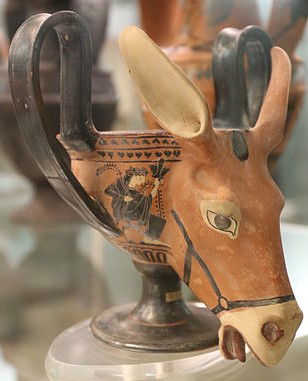
161017kantharosModern fantasy literature has taken a lot of inspiration from ancient Greek and Roman mythology. Many people have noted how comic book superheroes play much the same role in modern culture that heroes like Hercules and Odysseus did for ancient readers. The important difference is that Greeks and Romans regarded their heroes as real, semi-divine figures of history. Modern fantasy knows it’s all made up. That’s one of the fundamental differences between myth and fiction: the poet who retells a myth wants you believe that the story is true; the fiction author knows they’re spinning a tale.

But modern people aren’t the first to tell stories just as stories. Ancient literature, in addition to myths that made claims to historical and religious truth, offered tales of adventure, romance, and comedy, just like modern fiction. It even had some works that we would class as speculative fiction. Metamorphoses—more commonly known as The Golden Ass—by Apuleius is one of them.

There are lots of translations available. Here’s one you can read online, but I particularly recommend the translation by Sarah Ruden (Yale, 2012), which expertly captures the wit and cheek of Apuleius’ original text.

The story is told by Lucius, a young man about town who gets in over his head with magic and accidentally turns himself into a donkey. He then has madcap misadventures—getting stolen by bandits, requisitioned by a soldier, displayed in the arena, and mutely witnessing all kinds of domestic comedy and tragedy as he tries to stay alive long enough to find the antidote to cure his transformation.

In this passage, Lucius the donkey has been bought by a local magnate and is being trained to perform tricks, which causes a bit of a tricky situation for the human mind in the donkey body:

He gave me to a favored freedman of his, a well-off man, having instructed him to take good care of me. This man treated me kindly and fed me well and, to please his patron, eagerly encouraged my tricks. First he taught me to recline at the dining table, then to wrestle and even dance with my forelegs in the air. Then—even more remarkable—to respond to words by tossing my head, signing “no” by throwing it back and “yes” by nodding. When I was thirsty, I could request a drink by alternately winking my eyes at an attendant. Of course, this was all perfectly simple for me to follow and I hardly needed a trainer, but I was afraid to behave in too human a way at the table uninstructed, or they might take me for an ill omen, set on me as a monster, and serve up my fat body to the vultures.

– Apuleius, The Golden Ass 10.17

(My own translation)

Lucius’ adventures range from the lewdly ludicrous, as when a rich lady takes him for a lover, to the tragic, as when he witnesses the death of a happy newlywed couple. On the way, just about every level of society, from poor farmers to rich landowners comes in for a bit of satirical skewering. There’s also a surprise ending, which I won’t give away here.

In transforming Lucius into a donkey, Apuleius also addresses the anxieties of his time, in a society where slavery was routine and barriers of language and culture often impeded communication. Romans of his time looked on some other peoples in their world as little better than animals, and must have worried about being seen the same way themselves by others. Sudden loss of status, whether by being taken captive in war or stripped of citizen rights in the court, was nothing strange. While no one had to worry about not behaving donkeyishly enough, as Lucius does, many Roman slaves probably faced the predicament of ingratiating themselves with their masters without seeming too clever or ambitious. The story of Lucius’ adventures, like much fantasy and science fiction of recent decades, provides a way to observe and comment on these anxieties and even, in the end, to offer some hope.

The Golden Ass is a good read and a nice example of how there’s nothing new in the human urge to make up fantastical stories, or to use that fantasy to contemplate contemporary problems.

Image: Donkey head kantharos, photograph by Pymouss via Wikimedia (Athenian, currently British Museum; late 6th c. BCE; black-figure pottery)

History for Writers looks at how history can be a fiction writer’s most useful tool. From worldbuilding to dialogue, history helps you write. Check out the introduction to History for Writers here.

Making Flotsam and Jetsam

Here’s a look at how we made yesterday’s Flotsam and Jetsam.

The menu

  • Roasted ham
  • Sliced apples
  • Toast
  • Honey
  • Wine

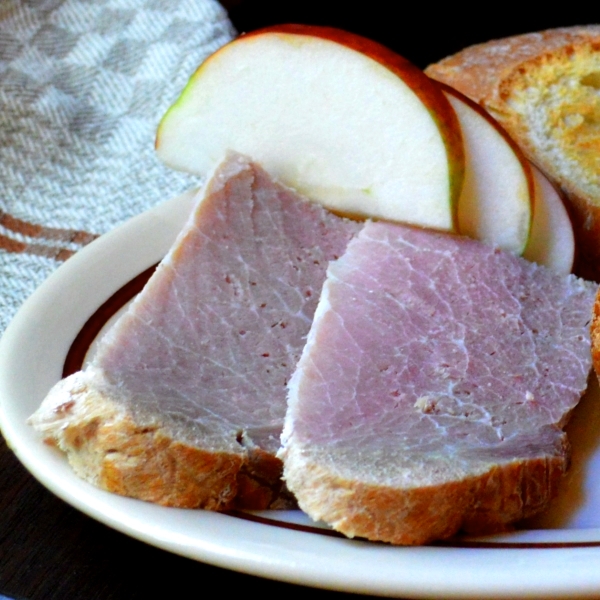
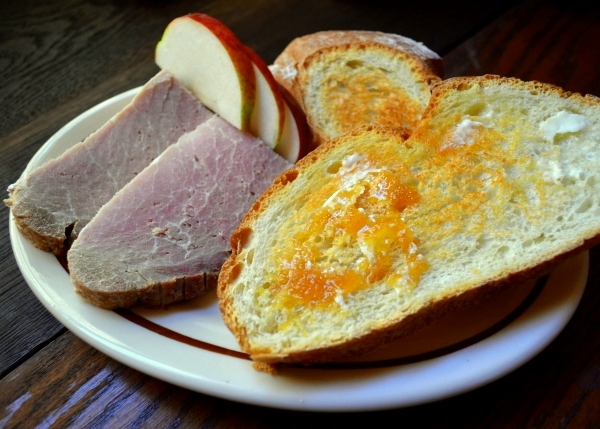
erikchef1Merry describes the available food pretty clearly and we have stayed close to it. (3.9) The only substitution we have made is ham for salted pork. The two meats are similar, but salt pork is fattier and closer to (what Americans call) bacon. Ham is meatier and more satisfying for a meal. We added fresh sliced apples to go with the ham, reasoning that if Minas Tirith has apples in storage, Isengard’s storerooms probably had the same. (5.1) Our toast was made with bakery bread a few days old, like the Isengard bread that was “three or four days old.” (3.9)

Dinner10 w Props2

Recipes

Roasted ham with apple slices

Our ham was a small portion from a local farm and was not pre-cooked. Roasting times will depend on the size of your ham, so use a thermometer to make sure that the meat reaches a temperature of 160 F / 70 C.

Ingredients

  • Small, uncooked ham
  • 2 firm apples

Directions

  1. Preheat oven to 325 F / 160 C.
  2. Wash and trim the ham.
  3. Lay the ham in a roasting pan with a meat thermometer stuck into the thickest portion.
  4. Roast until the temperature reaches 160 F / 70 C. Small hams may take only an hour; larger hams may require up to three hours.
  5. Core and slice the apples thin. Serve as garnish to thick slices of ham.

Dinner10 Ham Apple


Setting

eppucamera1 Unlike Peter Jackson’s movie, Tolkien’s version of the Isengard sequence actually includes a meal shared between the two Hobbits and Aragorn et al. It takes place indoors in a guard-house hewn out of stone. Other than the presence of “a hearth and chimney,” “a long table,” and “dishes, bowls, cups, knives and food of various sorts,” we hear few details. (3.9)

Dinner10 Toast

Finding a location for our photoshoot was a bit of a problem. You may have noticed that after the first four dinners, we’ve moved away from our initial spot; the desk we used was too narrow and too close to the wall for a good variety of setups. Since then I’ve tried several different areas of the house and even outdoors, but haven’t landed on a single place that has everything I want. Anyway. 🙂

We don’t have access to a stone structure that sounds suitably like Saruman’s guardroom. We do, however, have a room with wooden walls and a built-in bench that could stand in for a table: our sauna. We decided it was non-typical enough of an indoor space for our purposes. In the end, I decided to add two old table leaves on top of the built-in bench because I quite liked their worn surface for this purpose.

The setting in the ruins of Isengard sounds quite bare, but not ascetic. I chose therefore not to have a tablecloth, but added a simple unbleached linen napkin. In addition, I selected simple ceramic and wood dishes like the oval plate and the turned wooden tumbler. There’s a plain wooden knife for spreading butter and honey on toast, and an iron eating stick for spearing the ham and apple. On the side, one of our sushi sauce bowls masquerades as a honey dish.

LotR Dinner10

Finally, purely for mood purposes, there is a stack of extra plates in one corner and two candlesticks in the other. I used candle stubs, for Saruman doesn’t strike me as the kind of leader who makes sure their underlings have sufficient supplies handy at all times.

If I were to do this dinner setup again, I don’t think I’d have large changes to make. (Unless I could find a fancy stone room like Tolkien’s text describes.) Perhaps I’d consider adding a butter dish, but that’s about it.

Check out the introduction for more!

Images by Eppu and Erik Jensen

Geeks eat, too! Second Breakfast is an occasional feature in which we talk about food with geeky connections and maybe make some of our own. Yum!

Dining in Middle Earth: Flotsam and Jetsam

“’I will make you some toast. The bread is three or four days old, I am afraid.’

“Aragorn and his companions sat themselves down at one end of a long table, and the hobbits disappeared through one of the inner doors. […]

“’And you need not turn up your nose at the provender, Master Gimli,’ said Merry. ‘This is not orc-stuff, but man-food, as Treebeard calls it. Will you have wine or beer? There’s a barrel inside there – very passable. And this is first-rate salted pork. Or I can cut you some rashers of bacon and broil them, if you like. I am sorry there is no green stuff: the deliveries have been rather interrupted in the last few days! I cannot offer you anything to follow but butter and honey for your bread. Are you content?’”


LotR Dinner10

The Hobbits and their friends make a decent meal out of the remains of Saruman’s stocks after the destruction of Isengard. This month, we dine along with them on roasted ham with sliced apples, bread with honey, and a cup of wine.

LotR Dinner10 Plate

A simple oval plate and a turned wooden tumbler are set on a worn wood surface (old table leaves). There’s a plain wooden knife for spreading butter and honey on toast, and an iron eating stick for spearing the ham and apple. On the side, one of our sushi sauce bowls masquerades as a honey dish. A stack of extra plates in one corner and two candlesticks with candle stubs in the other help with the mood.

LotR Dinner10 w Props

Check out what’s it about in the introduction, or read the how-to!

Images by Eppu Jensen
Geeks eat, too! Second Breakfast is an occasional feature in which we talk about food with geeky connections and maybe make some of our own. Yum!

The Shannara Chronicles: The Delight of Bad Television

We’ve been watching The Shannara Chronicles. (We only watch series on DVD, so we’re still working our way through season 1). It’s some of the worst television I’ve seen in a while, and I can’t wait to see more.

161010shannara
One trailer park elf, one spoiled princess, and one edgy ex-bandit, coming right up. Image via IMDb.

Make no mistake, The Shannara Chronicles is terrible. The plot is a meandering soap opera mashed together from two parts Tolkien (a band of hobbits teenagers, occasionally aided by a grumpy wizard druid, must carry the magical ring seed to a distant place through a strange wilderness in order to save the world from a dark lord warlock who mostly just chills out in his tower henge being all evil and stuff) and one part Hunger Games (a tedious teenage love triangle between one girl half-elf boy and two boys girls—one rugged, the other sophisticated—in a vaguely-defined post-apocalyptic North America). Episode scripts are written Mad-Lib style: Dire warning about [peril] goes unheeded, recurring bandit guy threatens to [do something awful], someone explains [plot point] to the confused half-elf dude, princess has to be saved from [unheeded peril].

Yet despite its flaws, Shannara Chronicles manages the trick that most bad television doesn’t: to be both bad and enjoyable. More remarkably, it has managed this feat while remaining convinced of its own seriousness, instead of embracing its camp absurdity like most other beloved bad SFF shows, from Batman to Xena.

The scenery, the design, there are beautiful things under the layers of bad storytelling. Image via IMDb.
There are beautiful things under the layers of bad storytelling. Image via IMDb.

It’s hard to explain why I enjoy Shannara. Taste, of course, is subjective: one viewer’s guilty pleasure is another’s eye-roll marathon. I think there are three things about it that work for me:

  1. The diamonds among the dross. Shannara is a kiwi production and I watch it in much the same spirit that I watch Peter Jackson’s Hobbit movies: for the moments of beauty buried in the failings of concept and writing. The visual design is inventive and sometimes startling. Among the actors there are some shining stars like John Rhys Davies, Jed Brophy, and Manu Bennett improving the lackluster scripts with their performances. Plus New Zealand scenery is always worth seeing.
  2. We’re starved for good fantasy. I like classic fantasy. I like it better when it’s done well, but in the absence of that (or when showrunners think that doing fantasy well means adding as much torture, rape, and pointless death as possible), I’ll take it done badly. Plus, it’s refreshing to see a post-apocalyptic story in which the post-apocalypse is a quaint side note to the plot rather than a weight around its neck.
  3. The straight line is funnier than the joke. Comedy is well and good, but sometimes the best laughs come from people who don’t know they’re funny, and if the creators of Shannara know how funny they’re being, they aren’t letting on. I enjoy groaning at the teenage drama, the princess who has to be saved from something once an episode, the elite Elven soldiers who get themselves clobbered by bandits in under ten seconds, and the rest of the show even more when there isn’t a wisecracking sidekick poking me in the ribs and saying Hey, didja see what we did there? Huh? Huh?
Because this is totally how you dress to save the world. Image via IMDb.

In 2016, this terrible year in which some disasters hit with the shock of a thunderbolt and others drag on like a cold you can’t shake, the small-scale disaster of a wonderfully bad tv show is just what I need to take my mind off the rest of the world for a few hours.

In the Seen on Screen occasional feature, we discuss movies and television shows of interest.

New Edition of Alice in Wonderland with Salvador Dalí

In 2015, commemorating the 150th anniversary of Alice’s Adventures in Wonderland, Princeton University Press reprinted a color edition with illustrations by Salvador Dalí.

William Bennet Modern Down the Rabbit Hole DALI1003

Surreal, almost psychedelic, and rarely seen before the reprint, the original gouaches were first published in 1969.

William Bennet Modern The Mock Turtle's Story DALI1011

The color use is amazing, and the surrealist style fits elements of the story. However, I can’t escape the feeling that had I seen these illustrations as a kid, they would’ve given me nightmares.

Found via Colossus and Brain Pickings.

Images: Down the Rabbit Hole and The Mock Turtle’s Story via William Bennett Gallery (1969; heliogravures of original gouaches; by Salvador Dalí)

Out There is an occasional feature highlighting intriguing art, spaces, places, phenomena, flora, and fauna.

Labyrinth Released 30 Years Ago

Jareth: “You remind me of the babe.”

Goblin 1: “What babe?”

Jareth: “The babe with the power.”

Goblin 2: “What power?”

Jareth: “Power of voodoo.”

Goblin 3: “Who do?”

Jareth: “You do.”

Goblin 4: “Do what?”

Jareth: “Remind me of the babe.”

Labyrinth

This year marked the 30th anniversary of the release of Labyrinth by director Jim Henson. This past weekend FantomEvents ran some special Labyrinth showings in theaters. We didn’t go due to schedule issues (=work, work, work) but instead watched it at home.

As a geeky kid of the 80s, I have very fond memories of the movie. It’s mostly because of its visuals, but I do like the fantastic lines—great for learning English with—and voice acting as well.

Sarah: “Did you say ‘Hello’?”

Worm: “No, I said ‘allo’, but that’s close enough.”

(The worm was one of my very first tastes of dialectal / regional English!)

If my memory serves, the puppetry effects in Labyrinth are mostly better than in The Dark Crystal, Jim Henson’s previous fantasy movie. (Note to self: Find out if I can rent / stream The Dark Crystal. Local library to the rescue!)

Some of the songs, too, have become long-time favorites, especially “As the World Falls Down” by David Bowie.

Ballroom Scene – Labyrinth – The Jim Henson Company

As a kid, I didn’t really understand how someone could like Bowie’s music, but that one song opened my eyes. (Ears?) I still love it, and the ballroom scene with its floating props.

Bonus find: Stephanie at Make and Tell shares her “the babe with the power” wall art printable.

Stephanie Make and Tell babewiththepower_printable_mockup2

What’s your favorite Labyrinth memory?

Images: Labyrinth DVD case by Eppu Jensen. The babe with the power printable by Stephanie at Make and Tell.

This post has been edited.

In the Seen on Screen occasional feature, we discuss movies and television shows of interest.

Making The Courtesy of the Golden Hall

Here’s a look at how we made yesterdays The Courtesy of the Golden Hall.

The menu

  • Rye porridge
  • Braised beef
  • Roasted vegetables
  • Saffron and cream pancake
  • Apple compote

erikchef1Tolkien gives us only a few hints about the food of Rohan, but they are enough for us to flesh out the picture.

Dinner9 Main2

There are several references to meal, in the sense of coarsely ground flour. Éomer mocks Wormtongue by questioning whether anyone would trust him with a sack of meal (3.6) and Théoden warns the herald of Minas Tirith to have supplies ready for the Rohirrim when they ride to Gondor’s aid, for to travel light and fast they can carry only meal and water enough to last until they reach the battlefield. (5.3) Coarse flour makes poor bread and, significantly, bread is never mentioned in Rohan. Every other people in Middle Earth, from Hobbits to Orcs, has some kind of bread, but not the Rohirrim, which suggests they are making something else with their grain: porridge. Porridge is a staple of many northern European cultures like those that inspired the Rohirrim. The deep, earthy flavors of rye make for a very satisfying porridge to start our dinner.

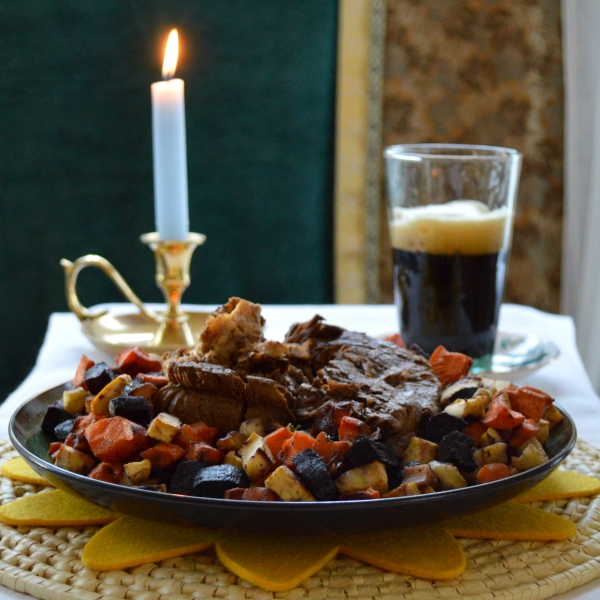
The herds of Rohan are prominently mentioned, although what exactly they are herds of is never specified. (2.9, 3.2) Since cattle were highly prized across ancient northern Europe, beef seems like the right meat to serve at the royal table. Braising is an excellent way to cook large joints of meat and could be done in a cauldron over a low fire in a mead hall. Root vegetables are also a staple of northern European cuisines and make an good accompaniment to braised beef.

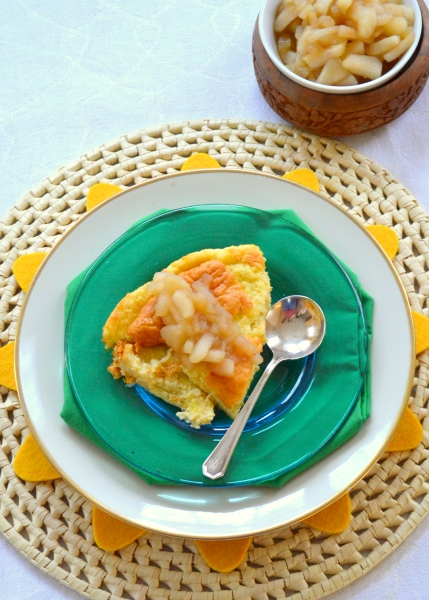
The saffron and cream pancake recipe comes from a Viking source and shows the extent of the trading networks the Vikings were engaged in, connecting them with the distant shores of the Mediterranean where saffron was harvested. It seems an appropriate way to honor the friendship between Rohan and Gondor to suggest that the Rohirrim had access to a few southern luxuries as well. The apple compote we serve with it is based on Anglo-Saxon recipes.

Continue reading

Dining in Middle Earth: The Courtesy of the Golden Hall

“At the King’s board sat Éomer and the four guests, and there also waiting upon the king was the lady Éowyn. They ate and drank swiftly.”

LotR Dinner9 Main

This month we visit the Golden Hall of Meduseld in Rohan. Our food reflects the northern roots of Tolkien’s Rohirrim, drawing on Scandinavian and Anglo-Saxon traditions.

LotR Dinner9 Starter

We start with a hearty rye porridge, followed by braised beef and roasted vegetables. For dessert, a rich saffron and cream pancake served with apple compote.

LotR Dinner9 Dessert

The table setting is built with multiple colors, layers, and lush textiles. The colors refer to the expansive grasslands of Rohan, and gold-colored or metallic-sheen details add opulence. The dishware turns showier as the meal progresses, moving from a plain white bowl to a plate with brown and green glazing, and ends with a pale teal handblown glass plate on a gold-rimmed white charger.

Dinner9 Runner and Ribbons2

Check out what’s it about in the introduction, or read the how-to!

Images by Eppu Jensen

Geeks eat, too! Second Breakfast is an occasional feature in which we talk about food with geeky connections and maybe make some of our own. Yum!

Ginormous List of Oncoming SFF Screen Adaptations

Natalie Zutter at Tor.com has made a list of SFF adaptations currently in the works either for tv or cinema.

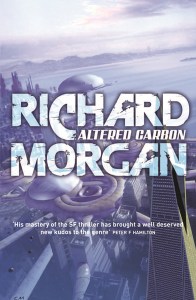
Richard K Morgan altered-carbon_UK_Pb

Such a variety of projects! It really seems like a golden age for genre adaptations, like Zutter says. Head on to Tor.com for the full list.

I’m most interested in Arrival (based on a story by Ted Chiang and out very soon now!), Altered Carbon by Richard K. Morgan, and Lilith’s Brood by Octavia E. Butler. It would also be great to see Ann Leckie’s Ancillary series, Red Mars by Kim Stanley Robinson, and Daniel José Older’s Bone Street books on screen.

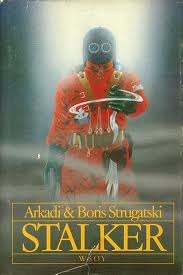
It was also intriguing to see Roadside Picnic by Arkady and Boris Strugatsky on the list, for I’m not used to seeing Eastern bloc SFF authors in the Anglo-American market. According to the all-knowing Internets, Roadside Picnic was turned into a Russian SFF art film Stalker in 1979. I never saw that, but did read the Finnish translation (Stalker: huviretki tienpientarelle) when I was too young to really understand it, so it would be nice to refresh my memory.

Goodreads Strugatski Stalker

Besides works in progress mentioned in Zutter’s list, I’m looking forward to OtherLife. It’s adapted from Kelley Eskridge’s Solitaire (2002), which I read only this year and loved. Unfortunately, OtherLife seems currently to have paused in post-production. We live in hope, though! (I’ve been following the story of its development on Eskridge’s blog; do visit for a glimpse of indie movie projects from a writer’s perspective.)

Anything on your radar that especially tickles your fancy? Do share!

Images: Altered Carbon via Richard K. Morgan. Stalker via Goodreads

Hey, look! We found a thing on the internet! We thought it was cool, and wanted to share it with you.

The Neverending Story Has an Anniversary Doodle

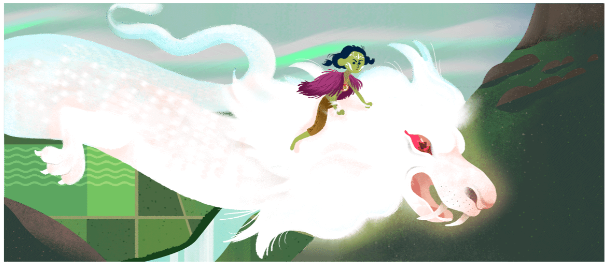
Google tells me with a lovely doodle that it’s the 37th anniversary of the first printing of The Neverending Story by Michael Ende.

Google Doodle Falkor from Neverending Story

Originally published in German on September 01, 1979, Die unendliche Geschichte was translated into Finnish in 1982 (and apparently English in 1983, with the film adaptation in 1984). I can’t quite remember if I ever read it. At the same time, I want to recall a gorgeous tome with both green and red print, so I guess I must at least have been handling the Finnish translation at one point.

Finnish translation of The Neverending Story (Tarina vailla loppua) by Katja Jalkanen at Lumiomena

(No, I did not imagine the green and red print!)

While the movie version isn’t terribly well-made nor the first I saw in a theater, it is one of the first screen adaptations that made me realize I was a geek even if I didn’t have a word for it at the time. It’s purely for nostalgia that I own and occasionally rewatch it. I’m now wondering whether I should’ve bought the book instead.

Images: Falkor from Neverending Story by Sophie Diao via Google Doodle. Finnish translation of The Neverending Story (Tarina vailla loppua) by Katja Jalkanen at Lumiomena

This post has been edited for style.

ICBIHRTB—pronounced ICK-bert-bee—is short for ‘I Can’t Believe I Haven’t Read This Before’. It’s an occasional feature for book classics that have for some reason escaped our notice thus far.