The Visual Inspiration occasional feature pulls the unusual from our world to inspire design, story-telling, and worldbuilding. If stuff like this already exists, what else could we imagine?
“[S]torytellers also have to constantly remind the audience how hot their female characters are, right? At least that seems to be the case, based on how often authors emphasize their female leads’ looks. Of course, this dual need makes writing women much harder, since readers don’t typically appreciate their stories being interrupted with reminders about a character’s sexy bod.”
A male protagonist gets to protag; a female protagonist has things happen to her.
The male protagonist is at the center of the story. He gets to make key decisions, call the shots, lead teams (successfully), and propel the plot forward.
In contrast, a female protagonist reacts to what’s happening around and/or to her. In addition, all too often women’s story arcs are marked as of less importance or condemned outright. (Or branded as a “women’s genre”, often with a sneer, like romance.)
One of the first that I remember noticing on screen is J.J. Abrams’s Fringe. Anna Torv’s protagonist character Olivia Dunham, an FBI agent, started out by actively investigating potential paranormal phenomena, but in later seasons she was pushed aside in favor of the father-son drama and relationship wrangling between characters played by Joshua Jackson and (always excellent) John Noble. Egad—as if we don’t have enough!
And just the latest I’ve had the misfortune to see is the tv series Extant. Despite its gorgeous visuals, high production values, and Halle Berry as the lead, the writing keeps her guessing, defending herself against gaslighting, physically running, flailing, and emoting. Two episodes from the end I was done; I didn’t want to finish that crap.
(To be fair, I’ve also come across stories that dreadfully misrepresent men. As one example, I’ve had my fill—to the fracking brim!—of stories of damaged middle-aged alcoholics who are just trying to hang on.)
This post has been edited for clarity.
Story Time is an occasional feature all about stories and story-telling. Whether it’s on the page or on the screen, this is about how stories work and what makes us love the ones we love.
My very first WoW character, created towards the end of vanilla, was a female gnome mage. I still have her—specced the same, too—although I don’t play her as my primary anymore.
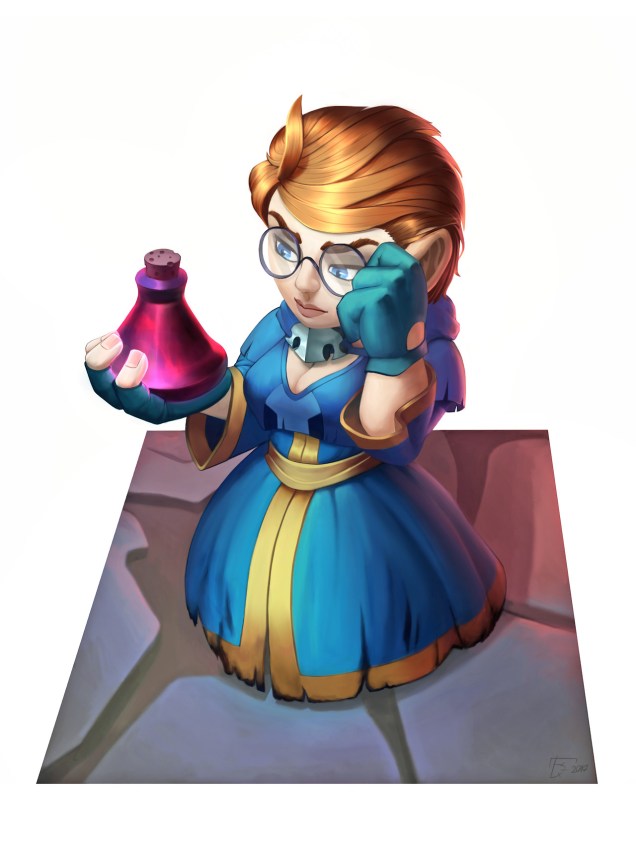
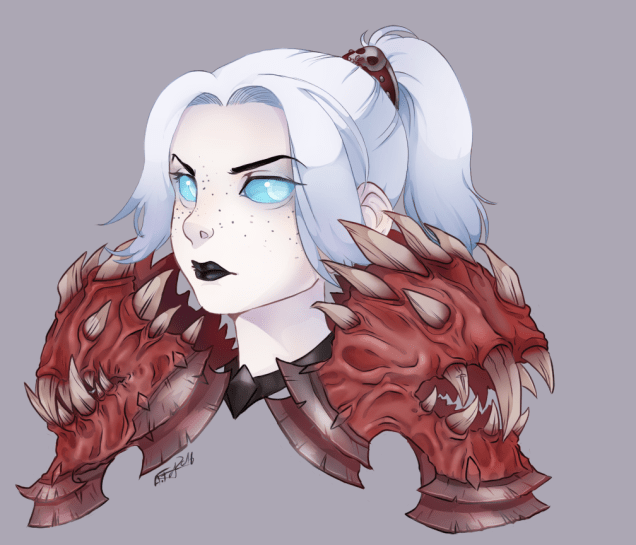
Anyway, I was looking for something else on the Internet when I fell into a hole on Tumblr and found all of this AWESOME female gnome fanart. I’ll share just five of my favorites below. And this is just the tip of the iceberg!
An alchemist by Boz:
Love the thoughtful expression!
A custom portrait of a gnome with goggles by Azuralynx (aka Niniel-Gnoll):
The grin! 😀
Sketch of a mage by Bryss (aka Alynissia):
Chromie, the dragon who prefers a gnome humanoid form, by mhazaru:
A death knight by Flyingterra—she clearly means business!
The range of illustration techniques is impressive, but even more so is how all of these artists capture the range of possibilities for gnome characters.
The new Doctor Who season started this past weekend, on Sunday October 07, 2018. The big thing, of course, is that Jodie Whittaker makes her doctorial debut in season 11! I have some thoughts on it. But first, the official trailers:
I get chills from both! 😀 Although the music choices for trailer 2 seem a little odd—I suspect I might be missing some cultural references here.
I haven’t seen the first episode yet, so I only have previously shared glimpses, various reports, and other people’s reactions to go by. Reading to the rescue, then! Below are quotes from some of the most interesting writeups I found.
Spoiler warning is in effect! (Also, because some quotes are quite long, I’ll pop the rest behind a cut.)
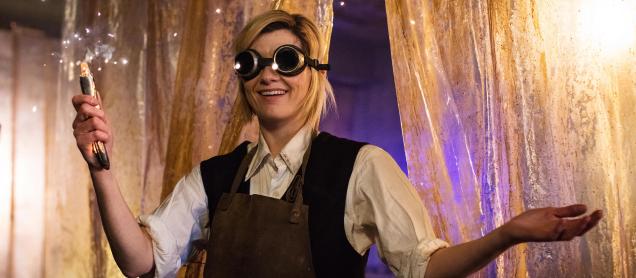
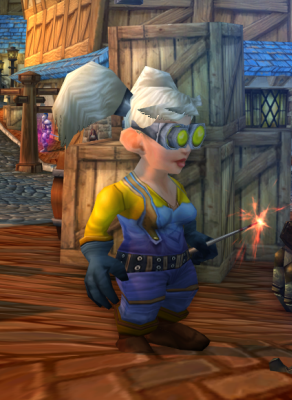
I was browsing some Doctor Who reading on the latest iteration of the Doctor herself when I saw this photo of Jodie Whittaker in costume:
The new Doctor Who is– a WoW gnome?!?
😀
Images: Jodie Whittaker as the Doctor by Sophie Mutevelian / BBC Studios 2018 via TV Guide. World of Warcraft screencap cropped from one by Cindy on LiveJournal.
We haven’t talked about music lately. Time to fix it!
One of the new allied races in Battle for Azeroth, the latest World of Warcraft expansion, is Dark Iron Dwarves. (Note: I don’t think there’s much actual info as of yet, but people have been gathering mentions at a Wowhead thread.)
As I’ve mentioned before, female Dwarves are my absolute favorite race / gender combo to play in WoW, so I’m going to want at least one. 🙂 Consequently, my WoW thoughts have revolved heavily enough around Dwarves to push into the real life in the form of music befitting these mountain-dwellers.
Below are some of my current most favorite Dwarf-ish pieces, whether originally something quite different or composed specifically with Dwarves in mind.
“Beware! Beware! For the wind blows high. Blood will rain down on men’s bared bodies. Point and edge will share all men’s inheritance, now that the sword-age cuts sharply upon us.”
To my mind, the lyrics are very reminiscent of Vikings or Anglo-Saxons, but I could also see them applying to a fantasy race in WoW. (After all, the game is called World of Warcraft.)
This version of the old Christmas carol “Masters in This Hall” from the album A Feast of Songs by Barry and Beth Hall also reminds me of Dwarves because of the steady rhythm and low key.
The next is a bit special. A music-heavy version of The Lord of the Rings was produced by the Finnish theater company Ryhmäteatteri in 1988 and 1989. Bilbo’s song “I Sit Beside the Fire and Think” from The Fellowship of the Ring, book 2, chapter III (“The Ring Goes South”) was turned into a song for the play, and it’s wonderfully meditative and solemn.
The lyrics were originally translated into the Finnish version (Taru sormusten herrasta) by Panu Pekkanen; for the play they were slightly modified. The melody was composed by Toni Edelmann and sung by Timo Torikka.
This next piece was made by Simon Swerwer for the 2012 computer game Dwarf Fortress:
Lastly, Neil Finn’s “Song of the Lonely Mountain” (the end credits song for Hobbit: An Unexpected Journey) because of the bittersweetness, melancholy, and—just perhaps—glimmer of hope that comes through.
“Features authentic detailing, an opening mouth and flapping wings.
“Also includes a display stand with decorative fact plaque and an extra porg mini build.
“Porg without stand stands over 7” (19cm) high.
“Display stand measures approx. 2” (6cm) high and 1” (3cm) deep, and over 4” (11cm) wide.
“Relive fun porg adventures from Star Wars: The Last Jedi.”
Otherwise it sounds fine and dandy, but does anyone else get an odd vibe from “fun porg adventures”—like being roasted by Chewbacca?!? The marketing department didn’t quite succeed with this particular copy.
Other than that, this almost makes me wish I’d kept my old Legos. Almost—it’s a little too specialized to use inventively in other builds.
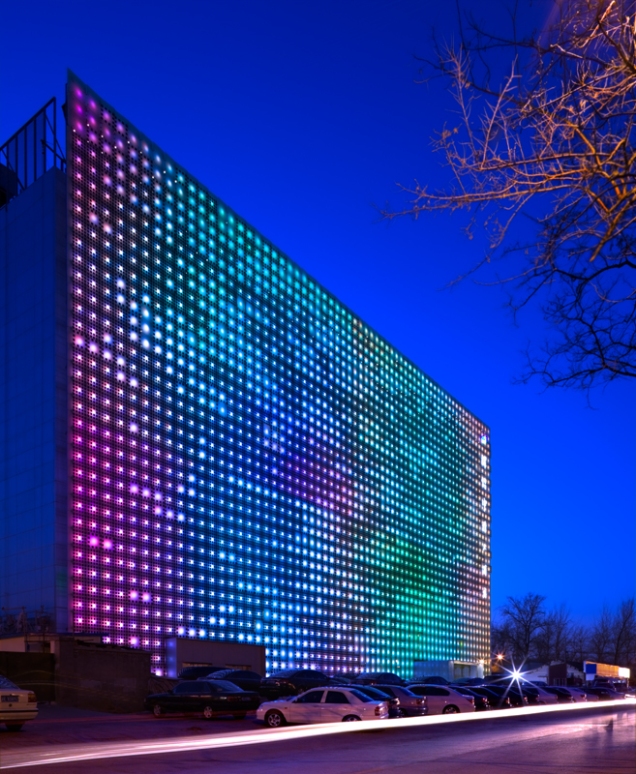
Solar power technologies are advanced enough that they are increasingly being integrated into buildings during construction, not just added onto existing ones. For example, there’s a way to make thin enough, light-weight enough, and transparent enough solar cells to embed them into windows. Some cells even have color, which makes inventive facades a definite possibility!
Below are some colorful glass facades and/or windows, some actually photovoltaic, others made from regular glass or other sun control materials, to illustrate just a few possibilities SFF creators might want to consider.
SwissTech Convention Center in Ecublens, Switzerland
Using dye-sensitized solar cells or DSSC (also known as Grätzel cells), the world’s first multicolored solar facade was built at Ecole Polytechnique Fédérale de Lausanne (EPFL) in Switzerland. Although the technology is 30 years old already, the building is only from 2014.
Biochemistry building at The University of Oxford in Oxford, UK
The facade is made up of glass fins that emulate the colors of the historic buildings surrounding it.
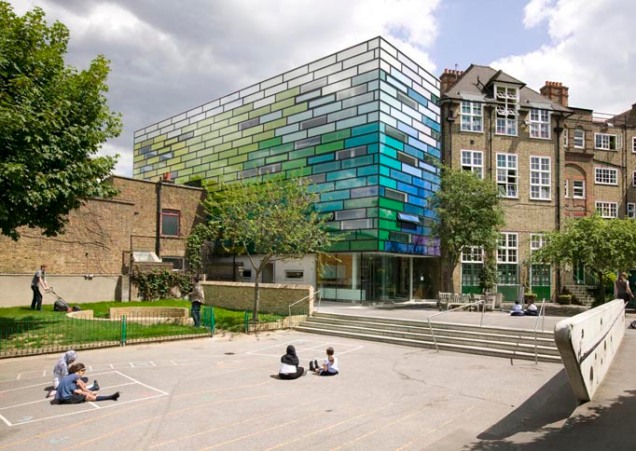
Clapham Manor Primary School in London, UK
A new wing added to an existing Victorian school. No solar glass as far as I can tell, but the combinations of solid and fritted, on one hand, and clear and colored glass, on the other, allow for some environmental control.
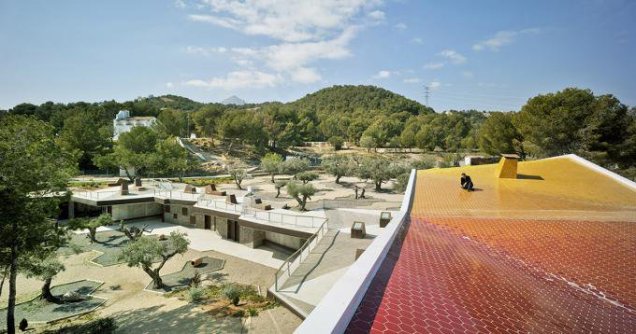
Environmental education center El Captivador in Alicante, Spain
Designed by CrystalZoo, the roof tiles of the sustainably built environmental education center flow from bright reds via oranges to yellows.
An atrium with semi-translucent photovoltaic ceiling panels plus regular colorful glass (as far as I can tell).
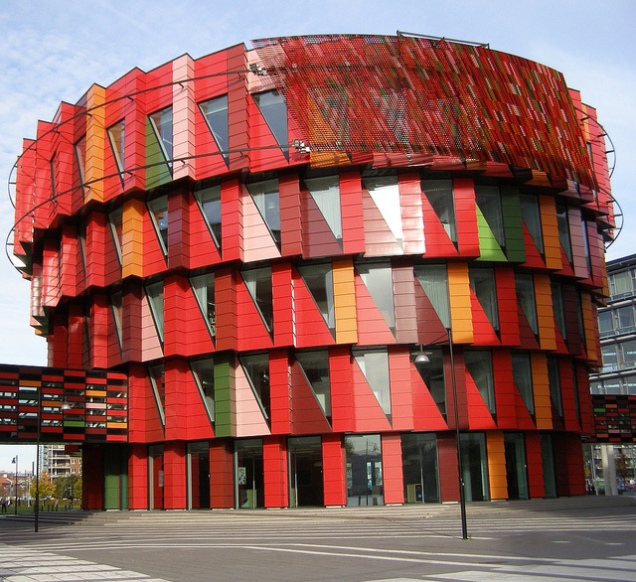
Kuggen building, Chalmers tekniska högskola in Gothenburg, Sweden
Designed by Winngårdh Arkitektkontor for the Chalmers University of Technology, Kuggen has a movable sunscreen and six floors, each shielding the floor below.
At the moment, it seems that next to cost, fairly low efficiency is the biggest problem with building-integrated photovoltaics. (Although, the efficiency problem might soon be solved.) Fortunately, both are something that SFF writers can easily deal with. 🙂
The Visual Inspiration occasional feature pulls the unusual from our world to inspire design, story-telling, and worldbuilding. If stuff like this already exists, what else could we imagine?
“All that was left of a person’s life was recorded on paper, in annals, in almanacs, in the physical items they produced. To end that was to end their history, their present, their future.”
– Aster Grey in An Unkindness of Ghosts by Rivers Solomon
…Which is why the attitudes and words of those writing our world’s history matter; why social sciences, humanities, and languages matter (and not just STEM); why diversity, inclusion, and empathy matter.
Solomon, Rivers. An Unkindness of Ghosts. Brooklyn, NY: Akashic Books, 2017, p. 327.
Serving exactly what it sounds like, the Quotes feature excerpts other people’s thoughts.









 Co-Geeking
