Quotes: Tanks Being Repulsed by Pistol Fire

After the Finnish centennial in 2017, I’ve been reading outside my usual periods of Finnish history a little, including on the Finnish Winter War (1939-1940, for 105 days against the USSR). Here’s another literally incredible detail.

Fighting was going on near Hulkoniemi village (close to Suomussalmi) near the eastern border in December 1939:

“[T]wo Red tanks attacked a Finnish squad caught in lightly wooded terrain near the village. A lieutenant named Huovinen taped five stick grenades together and crawled forward toward the tanks; his friend, First Lieutenant Virkki, intended to provide covering fire, despite the fact that he was carrying only his side arm. At a range of forty meters Virkki stood up and emptied his 9 mm. Lahti automatic at the vehicles’ observation slits. The T-28s replied with a spray of machine-gun fire, and Virkki went down. Those watching felt sure he had been killed. But he had only dropped down to slap another magazine into the butt of his weapon. That done, he jumped up and once more emptied his pistol at the tanks. Altogether this deadly dance step was repeated three times, at which point the Russian tankers seemed to become unnerved. They turned around and clanked back to the village. Meanwhile, Lieutenant Huovinen had been crawling closer to them from the rear and now had his arm cocked to throw the grenade bundle. Just at that moment the tank nearest him put on speed and retreated. He lowered his grenades in astonishment. Surely there were not many instances in modern warfare of tanks being repulsed by pistol fire.”

– William Trotter, A Frozen Hell: The Russo-Finnish Winter War of 1939-1940

I’m flabbergasted! Gobsmacked! Slack-jawed! Astounded! A pistol against two tanks, and not a scratch!

In school, we’ve been through the major whys and wherefores, but I don’t remember small-scale stories like this. If you’d put this in a fictional story of any kind, I’m not sure I’d believe it. And, yet, it happened to countrymen of mine.

Trotter, William R. A Frozen Hell: The Russo-Finnish Winter War of 1939-1940. Chapel Hill, NC: Algonquin Books of Chapel Hill, 1991, p. 157.

Serving exactly what it sounds like, the Quotes feature excerpts other people’s thoughts.

Bread and Cheese

A sturdy adventurer in a fantasy novel pauses to take a break from their journey to the Land of Quest Completion. They open their knapsack looking for something to eat and what do they find? Bread and cheese.

Always bread and cheese.
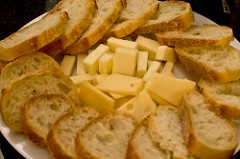
It’s a well enough known trope to make an easy, low-hanging joke. It’s the sort of thing you expect in fantasy media whose worldbuilding can be charitably described as “medieval Europe but with magic and dragons and also I’ve never actually read a book on medieval Europe.”

But bread and cheese is not a joke. It is, in fact, a very good and sensible choice for an adventurer to pack for a long and difficult journey.

The human body needs nourishment. For long term health, there are a lot of things you need: a proper balance of amino acids, vitamins, minerals, fiber, and so on. Doing without any of these essentials for prolonged periods means risking malnutrition, disease, and other serious health problems. For getting through several days or weeks of hard physical work, like traveling in rough terrain or fighting monsters, though, three things are crucial: water, calories, and protein.

An average adult human requires a minimum of about 2 liters of water, 3,000 calories, and 70 grams of protein each day in order to remain fit for physically demanding labor. More is better, but these will get you through if you don’t keep it up for too long. These are the requirements a meal must meet to be suitable for basic adventuring rations.

Water can be found in most parts of the world where people live. It may not be available in large quantities and it may not be safe or pleasant to drink straight from the source, but chances are your standard adventurer can find enough to survive on in most terrains. That leaves calories and protein.

There are lots of different ways of getting both. Your adventurer might eat meat, fish, eggs, milk, beans, vegetables, mushrooms, fruit, nuts, seeds, honey, insects, or plenty of other things. When a variety of food options is available, people like to indulge themselves (as we moderns and our waistlines know all too well). But not all these food items travel well. Fresh vegetables and fruit will wilt and rot. Meat and fish go bad and may attract dangerous animals. Eggs won’t hold up well to being jostled around in a traveler’s knapsack. Some of these products can be dried, salted, pickled, or otherwise preserved to last longer, but processing adds to cost. Depending on growing seasons and local farming practices, these foods may not be available when your adventurer needs them.

Hence the advantages of bread and cheese. In agricultural regions, staple crops like grain are almost always available. Unprocessed grain, if kept dry and safe from vermin, can be kept for a long time. Bread kept similarly dry and safe may become unappealing and tough to chew, but will preserve its nutritional value even after many days of jostling around in a hero’s handy haversack. Cheese can be made wherever there are milk-giving animals (often reared on marginal or fallow land in agrarian communities), and will last a long time without deterioration if well taken care of. In farming societies throughout large parts of the world, bread and cheese are both readily available, inexpensive, and easy to make portable.

Bread provides a good dose of calories and protein; cheese even more. Combined, they provide the complete set of amino acids that the body needs. (It turns out that combining different protein sources is nowhere near as complicated as conventional wisdom says it is. As long as you have a variety of different foods in your diet and you’re not trying to subsist on on a single non-animal source of calories, you’re pretty much covered. Still, for an adventurer braving the wilderness without a lot of variety easily available, it doesn’t hurt to make sure you’ve got everything your body needs in one meal.)

Bread and cheese. Don’t leave on an adventure without it.

Thoughts for writers

Bread and cheese make good sense for adventurers’ traveling rations in a lot of settings, but that doesn’t mean that if you’re writing an adventure you should just fall back on bread and cheese for all your heroes’ dietary needs.

Food is a fundamental part of life. As such, it is an indispensable element in worldbuilding. People eat the things they eat for good reasons, and societies are often structured, in very basic ways, around the production and distribution of foodstuffs. The availability of a single plant can have far-reaching effects on the culture that grows it. The consequences for worldbuilding don’t end with the food itself but carry on into how it is produced and consumed. Descriptions of food in fantasy literature often feature just as local color, but food can in fact inform major parts of your worldbuilding.

Bread and cheese may seem like an overused cliché, but it has been used so much for a reason. It is an entirely sensible and realistic choice of provisions for travelers in the hinterlands of any fantasy world that broadly resembles the living conditions across most of the premodern world. Don’t be afraid to fall back on bread and cheese if it is the right choice for your story, as long as you are choosing it for a reason and not just because it’s what fantasy adventurers always eat.

Image: Bread and cheese wheel, photograph by Andrew Malone via Flickr

History for Writers is a weekly feature which looks at how history can be a fiction writer’s most useful tool. From worldbuilding to dialogue, history helps you write. Check out the introduction to History for Writers here.
Quotes: Finns Know How to Listen to the Stillness in the Great Forest

After the Finnish centennial in 2017, I’ve been reading outside my usual periods of Finnish history a little, including on the Finnish Winter War (1939-1940, for 105 days against the USSR). Here’s another tidbit that caught my attention:

“Finns know how to listen to the stillness in the great forest; for them it is never absolutely silent, and they can read considerable information about their environment from the sounds of which outsiders are not even aware. Finns, in short, can adapt to their environment because they feel a part of it.”

– William Trotter, A Frozen Hell: The Russo-Finnish Winter War of 1939-1940

I know people who love water, to be on and in the water, whether a lake or an ocean. I don’t. It’s nice to look at or splash in now and then, don’t get me wrong, but I don’t adore it.

I’m in love with woods.

I need trees to feel whole and at peace, and preferably wild instead of planted and pruned trees. Whether in the cool, clear incandescence of summer nights, or wet, loamy autumn rain, or the crisp, brisk dark of winter, or, finally, the unhurried, budding, green spring, Finnish woods are dear to me.

Trotter, William R. A Frozen Hell: The Russo-Finnish Winter War of 1939-1940. Chapel Hill, NC: Algonquin Books of Chapel Hill, 1991, p. 145.

Serving exactly what it sounds like, the Quotes feature excerpts other people’s thoughts.

Race in Antiquity: Short Answers

Over the past year, I’ve been posting on the topic of race in ancient Greek and Roman society. The subject is a much more complicated one than it may at first appear and there is a lot to say about it. Today, to bring things to a conclusion, I’d like to offer some short, simple answers to some basic questions. Like most things in history, the full answers are always more complicated, but these are a start.

Did ancient Greeks and Romans have a concept of race?

Not as we understand it today. They primarily thought of human populations as defined by language, culture, family, and legal status. While they were aware of the kinds of natural variations in skin tone, face shapes, hair types, and other physical features we typically use to categorize race today, they did not generally regard these variations as markers of identity.

Did skin color matter in Greek and Roman society?

Yes, but not as an indicator of race. Across much of the ancient Mediterranean world there was a cultural ideal (at least among the elite levels of society who have left us written evidence) that men should work outdoors, preferably as farmers or soldiers, and women should work indoors, especially at textile production. As a result, dark skin was valued in men—a sign that they had spent plenty of time working in the sun—and light skin was valued in women. Light-skinned men and dark-skinned women were often looked down on for failing to meet this social standard. Judgments about skin color stemmed from prejudices relating to gender and class, not race.

Were there any black people in ancient Greece or Rome?

Yes. Blackness is a modern identity grounded not just in physical features but in historical experience and which we cannot simply apply onto people in the past; however, in simple biological terms, people whose features we would today associate with blackness have been identified in Greek and Roman contexts from as early as the thirteenth century BCE to as as late as the fourth century CE. As genetic evidence becomes more available in archaeological research, the number of known examples will surely grow, but literary and artistic evidence is already abundant.

Were there any East Asian people in ancient Greece or Rome?

Yes. Contacts of trade and diplomacy across Eurasia are well documented and people from East and Southeast Asia have been identified in Greek and Roman contexts as far north and west as Roman London.

Were there any Indigenous American, Australian, or Oceanian people in ancient Greece or Rome?

Not as far as I know, but the development of genetic research may yet surprise us on this score. As far as the present evidence will take us, we can say that Greece and Rome were connected to networks of trade, travel, and migration that spanned Eurasia and Africa, but that appears to be their limit.

Were the black and East Asian people who lived in Greece and Rome seen as different?

It’s hard to say. Ancient authors didn’t spend much time writing about the issue, which in itself may suggest that these sorts of differences didn’t matter, but arguments from silence are hard to rely on. Since Greek and Roman culture did not have a concept of race, though, it seems unlikely that these sorts of variations mattered very much. Just as we notice peoples’ hair and eye color today but don’t generally attach much meaning to it, Greeks and Romans may well have noticed if someone had a different skin tone or facial shape, but they didn’t necessarily think it mattered very much.

Were the black and East Asian people who lived in Greece and Rome also Greeks and Romans?

Most of them probably were. The definition of who could be counted as a Greek or a Roman was flexible and depended on circumstance. In some times and places, lines of identity were tightly policed and newcomers were not welcomed in; in other times and places, the definitions were expansive and new people were easily incorporated. A lot of people who came to the Mediterranean from other parts of the world settled down and had families. Even if the original immigrants were not accepted as Greeks and Romans, there is a good chance that their children and grandchildren thought of themselves and were thought of by their neighbors as being just as Greek or Roman as anyone else.

Were ancient Greece and Rome white civilizations?

No. The majority of people who identified as Greeks and Romans in any given time and place were probably, in modern terms, white, but that does not mean that Greek and Roman culture were themselves “white” or had any necessary connection with whiteness. The category of “white” did not exist in Greek or Roman culture, nor did Greeks and Romans believe that their culture was inherently linked to their ancestry. Indeed, they were generally quite happy to point out where they had taken cultural ideas and influences from other peoples. The idea of a “white civilization” would have sounded very strange to Greek and Roman ears.

For more information and further discussion, check out other entries in this series:

History for Writers is a weekly feature which looks at how history can be a fiction writer’s most useful tool. From worldbuilding to dialogue, history helps you write. Check out the introduction to History for Writers here.

Quotes: Finns Were on Intimate Terms with Winter

After the Finnish centennial in 2017, I’ve been reading outside my usual periods of Finnish history, including on the Finnish Winter War (1939-1940, for 105 days against the USSR).

It’s easy for a modern Finn—at least this modern Finn—to get tired of reading endless takes, almost exclusively by foreigners, condemning the horribleness of the Finnish winter. Like in this excerpt from a book on the Winter War:

“One of the main factors that enabled the Finns to destroy forces much larger than their own was surely rooted in the differing psychologies of the men engaged on either side. To the Finnish soldier, the cold, the snow, the forest, the long hours of darkness were all factors that could be turned to his advantage. To say that the Finns were on intimate terms with winter is to voice an understatement. In Finland winter is the fact of life, and all else—the economy, the culture, the national psychology—is colored by, or derived from, that single overriding reality. The relationship between the Finns and winter constitutes something of a contradiction. On the one hand, winter makes life harsh and lonely and something crude. It is this aspect of living with winter, the cumulative effect of endless subarctic nights, the unearthly silences of the winter landscape, the harsh and marginal quality of rural life, that imparts to the Finnish character that dour and brooding quality that is so hard for foreigners to penetrate.”

– William Trotter, A Frozen Hell: The Russo-Finnish Winter War of 1939-1940 [original emphasis]

It is true that we stayed poor quite long and urbanised quite fast, pretty much during my parents’ generation, so it’s easy for me to lose perspective. Even as late as 1950s (I believe) it wasn’t unheard of for more remote farms not to have electricity. And our winters are undoubtedly long and dark compared to even central Europe, not to mention the Mediterranean and further south.

What bugs me, though, is that people seem to expect conditions like Siberia or Greenland. Hate to disappoint you, but our climate is greatly tempered by the Gulf stream and it isn’t that different from, say, New England. Another detail I’d like foreigners to really learn is that less than half of the country is arctic, and that means the rest is not. The southern coast is, in fact, part of the temperate broadleaf forest zone which covers most of central Europe, Britain, southern Scandinavia, and southern Russia.

I do grant that the Finnish character hasn’t caught up with the technological development, at least not yet: in general terms, we still tend towards melancholy despite now having world-class cities, transportation, and tech.

Trotter, William R. A Frozen Hell: The Russo-Finnish Winter War of 1939-1940. Chapel Hill, NC: Algonquin Books of Chapel Hill, 1991, p. 144.

Serving exactly what it sounds like, the Quotes feature excerpts other people’s thoughts.

Quotes: Willful and Obstinate Little Country

After the Finnish centennial in 2017, I’ve been reading outside my usual periods of Finnish history a little, including on the Finnish Winter War (1939-1940, for 105 days against the USSR).

In November 1939, just before hostilities broke out, a Finnish delegation met with the Soviets in Moscow to discuss land transfers and other concessions Russians demanded from Finland. The following tidbit is reportedly from the delegation’s last meeting with Stalin and Molotov.

“But after an hour of futile discussion it was obvious to everyone that the whole business had come to a dead end. Each side bade farewell to the other. Since the Finnish delegates were clearly just as upset by this outcome as the Russians, the final meeting ended with remarkably little display of animosity by anyone. The actual parting, in fact, was almost jovial. Molotov waived and said, ‘Au revoir!’ and Stalin shook hands all around and wished the Finns ‘all the best’. Then he went off to confer with his generals about how best to subdue this willful and obstinate little country.”

– William Trotter, A Frozen Hell: The Russo-Finnish Winter War of 1939-1940

It’s not clear whether “willful and obstinate little country” is Stalin’s phrasing or Trotter’s. I like it nevertheless—it tells you a very important thing of the Finnish character: as we say, a strong will takes you through a grey stone. 🙂 Or, in this case, it slows down a massive army significantly enough to retain the country’s independence, which none of the other small Baltic states were able to do.

Trotter, William R. A Frozen Hell: The Russo-Finnish Winter War of 1939-1940. Chapel Hill, NC: Algonquin Books of Chapel Hill, 1991, p. 18.

Serving exactly what it sounds like, the Quotes feature excerpts other people’s thoughts.

History for Writers Compendium: 2018

History for Writers explores world history to offer ideas and observations of interest to those of us who are in the business of inventing new worlds, cultures, and histories of our own. Here’s where we’ve been in 2018:

Thinking historically and mythically

Daily life

Crossing cultures

Women in the ancient world

Conflict and resolution

Race in Antiquity

Join us in 2019 for more history from a SFF writer’s perspective.

History for Writers is a weekly feature which looks at how history can be a fiction writer’s most useful tool. From worldbuilding to dialogue, history helps you write. Check out the introduction to History for Writers here.
Tali for Saturnalia

The ancient Romans celebrated the holiday of Saturnalia on this day, the 17th of December. (At least in early Roman history it was a one-day holiday; later, it was extended so that it started on the 17th and lasted through the 23rd.) Saturnalia was a festival of good cheer and relaxed social strictures, thought of as recreating a lost golden age ruled over by the god Saturn. Typical practices included feasting, gift-giving, and a holiday from the usual social rules: children got to order their parents around while adults played children’s games; the masters of the household served a feast to their slaves; and gambling, which was a popular passtime but not usually allowed in public, was freely tolerated.

Romans played many different gambling games, but some of the most popular involved dice. One common game, known as tali, was played either with the knucklebones of sheep or goats (called astragals) or with cubical six-sided dice marked with the numbers 1 through 6, like modern dice. Astragals had four sides. For gaming purposes, it seems they were assigned values of 1, 3, 4, and 6. When playing with six-sided dice, only those numbers were used; 2 and 5 were ignored.

The rules of tali are not entirely understood today. Probably there were many different variations with different rules, and all of them were so common that no one bothered to write down instructions for how to play. Here is a playable modern interpretation based on what we can gather from literary references and artistic depictions.

All you need for any version of the game is four six-sided dice and something to bet with (coins, poker chips, chocolates—whatever you like), although a pencil and piece of paper for each player to record their throws can also be useful.

Simple Tali

Each player pays an ante into the pot.

Each player then rolls four dice, either their own set or taking turns with a common set.

Each player’s roll is then scored, and the winner takes the pot. If no one wins a round, everyone rolls again. If two or more players tie, only those players roll again until someone wins.

Dice rolls are scored according to the following system in which “hands” of dice are ranked, much like hands of cards in the modern game of poker.

  • 6,4,3,1 – called Venus, the best roll, always wins.
  • Rolls that include at least one 6 (apart from 6,6,6,6, which is a Vultures—see below) are called Senio and are scored by totaling the numbers shown (excluding the numbers 2 and 5, which are not counted). Any Senio always beats a Vultures or a roll that includes no 6.
  • Rolls that show four of the same number, called Vultures, score at the bottom of the heap, but will win over other 6-less rolls.
    • 6,6,6,6 – called Vultures, beats only a lower Vultures, The Dog, or a roll without a 6.
    • 4,4,4,4 – called Vultures, beats only a lower Vultures, The Dog, or a roll without a 6.
    • 3,3,3,3 – called Vultures, beats only The Dog, or a roll without a 6.
    • 1,1,1,1 – called Vultures or The Dog, beats only a roll without a 6.
  • Any roll that has no 6 (except a Vultures) always loses.

Here’s how a sample round might play:

  • A rolls 6,1,1,1 – a Senio worth 9
  • B rolls 6,5,3,1 – a Senio worth 10 (because the 5 is not counted)
  • C rolls 3,3,3,3 – a Vultures
  • D rolls 4,4,4,3 – a losing roll

B wins this game with a Senio of 10. Even though D’s roll totals higher, it has no 6, and therefore automatically loses.

Tali variations

The version of tali described above is perfectly playable, but it’s a simple game of chance with no real strategy. Here are a few ways you can make it more interesting. (All these variations use the same scoring system described above.)

Liars’ tali

Each player rolls their dice in secret and hides the total (or, if using a common set of dice, records their roll in secret). After an initial bet, players raise, call, or fold in turn, as in poker, until everyone calls or folds. The players still in the game then reveal their rolls and the winner takes the pot.

Draw tali

Each player rolls their own dice (this variation is difficult to manage with common dice). Any player may then ante into the pot again for the chance to reroll a die. Repeat either for a limited number of rerolls or until everyone passes. The player with the best roll on the table wins the pot.

Stud tali

Each player rolls one die and either keeps it (if using individual dice) or records it (if using common dice). After all players have rolled once, each one either antes into the pot or folds. Repeat three more times until all players have rolled a full four dice. The player with the highest roll among those still in the game takes the pot.

Happy Saturnalia!

Image: Roman dice, photograph by Wendy Scott via Portable Antiquities Scheme (Leicestershire; 1-410 CE; lead)

History for Writers is a weekly feature which looks at how history can be a fiction writer’s most useful tool. From worldbuilding to dialogue, history helps you write. Check out the introduction to History for Writers here.

Race in Antiquity: The Ivory Bangle Lady

“What race were the ancient Greeks and Romans?”

It sounds like a simple question that ought to have a straightforward answer, but both the question and its answer are far more complicated than they appear. In these posts, I dig into the topic to explore what we know, what we don’t know, and what we mean by race in the ancient Mediterranean world.

Part 9: The “Ivory Bangle Lady”

In the past entries in this series, we have talked a lot about theories of identity, how we can interpret (and sometimes misinterpret) both written and artistic sources, and the problems in knowing just who we mean by Greeks and Romans in the first place. Today we approach the question from a different angle, looking at one individual and the world she lived in.

Around 400 CE, a wealthy lady was buried near the Roman city of Eburacum (modern York) in northern Britain. She was buried with jewelry including an assortment of bangles, some of white ivory from Africa, others of black jet from Britain. Her name is not recorded, but she has come to be known, because of her jewelry, as the Ivory Bangle lady.

Examination of the Lady’s remains using the techniques of forensic anthropology shows that she was of African ancestry and had spent her childhood in a warmer climate, perhaps somewhere in southern Europe or North Africa. Her skull has features typical of sub-Saharan African populations and in fact the reference measurements that most closely match her skeletal morphology come from nineteenth-century black Americans. Although no indication of her skin color survives, it is almost certain that, if we passed her on the street today, we would describe her as a woman of color.

Roman York may seem like the last place we would expect to find evidence of racial diversity. It was the northernmost city in the Roman empire, just a little over a hundred kilometers from the Scottish frontier. There are few places in the Roman world that were farther from the cosmopolitan centers of the Mediterranean, yet archaeology has revealed late Roman York to have been a vibrantly multi-ethnic city. Individuals from Gaul, Italy, and Egypt are mentioned in Roman-period inscriptions from around York. Local potters made cooking vessels characteristic of North African cuisine. A Germanic king with his retinue of warriors is attested in the city backing the emperor Constantine’s rise to power. Not far away, in the forts along Hadrian’s Wall, soldiers were worshiping gods imported from Syria and Persia. A North African woman of Sub-Saharn African descent would have been right at home in such a place.

What did she think of herself? We have no way of knowing except to try to interpret the circumstances of her burial. The bangles with which she was buried may suggest a consciousness of being both African and British, although ivory and jet were both prized in late Roman jewelry. They certainly, however, point to a family of wealth and status. The remains of a wooden box were also found in the grave, including a decorative mount carved with the text “Hail, sister, may you live in God” (AVE S[OR]OR VIVAS IN DEO). The text suggests a Christian connection, although the richness of the lady’s grave is at odds with the contemporary Christian preference for simple burial. The Lady may or may not have been Christian herself, but she certainly had contact with the Christian movement.

The most noteworthy thing about the Lady’s burial may be how unremarkable it is. It is in many ways an entirely typical late Roman provincial grave for a woman of high status. Her choice of jewelry may have been meant to say something about her origin, but it was a choice that would not have stood out among her peers. She was in touch with one of the major religious movements of the day but buried in a traditional fashion; she was neither ahead of nor behind the times. If we had only the grave goods and not the remains, there would be nothing to suggest that the deceased belonged to an ethnic minority.

The most important thing for us to learn from the Ivory Bangle Lady is this paradox: the relative scarcity of people of African origin in the ancient Mediterranean literary record is the product of their presence, not their absence. There were enough North Africans in York to influence the local pottery market, but in most respects they were just like other provincial Romans. They followed the same social trends and religious developments as their neighbors. They had come as soldiers in Roman service, as merchants, or as travelers, just like the Gauls, Italians, and Germans who also ended up in York. They were of all genders and lived at all levels of provincial society, from the bottom to the very top. Among them were people with features typical of sub-Saharan Africa and who would likely appear to us as black, but in their historical context, they were just Romans like everybody else.

If there were women like the Ivory Bangle Lady in York, the farthest Roman city from Africa, then people of black African descent cannot have been uncommon in the cosmopolitan cities of the Mediterranean. If they are not evident to us in the sources, it is in part because they were so commonplace and so thoroughly integrated into ancient Mediterranean culture that contemporary authors didn’t feel the need to mention them. People tend not to write about the ordinary. We know this well enough from modern social media: our Facebook friends and Twitter celebrities mostly post about the unusual things that happen to them, good or bad, not the everyday events of a typical day. The same principle applies, even more so, to ancient authors, given how much more costly and difficult it was to put their observations onto papyrus in ink than it is to fire off a tweet today.

Archaeology, especially with current developments in genetic research, may provide us with individual cases like the Ivory Bangle Lady, but most of the racial diversity of ancient populations will always be invisible to us because most graves don’t survive in good enough condition and the resources available for research are limited. But individual cases like late Roman York are a reminder that there was nothing the least bit unusual about people of many different backgrounds and—in modern terms—different races living side by side in antiquity.

Further reading

H. Cool, “An Overview of the Small Finds from Catterick,” in Cataractonium: Roman Catterick and its Hinterland ed. P. Wilson. York: Council for British Archaeology, 2002, 23-43

S. Leach et al., “A Lady of York: Migration, Ethnicity and Identity in Roman Britain,” Antiquity 84, no. 323 (March, 2010): 131-45.

Patrick Ottaway, Roman York. Stroud: Tempus, 2004.

V. G. Swan, “Legio VI and its Men: African Legionaries in Briatin,” Roman Pottery Studies, 5 (1992): 1-33

R. Warwick, “The Skeletal Remains,” in The Romano-British Cemetery at Trentholme Drive, York, ed. Leslie P. Wenham. London: Her Majesty’s Stationery Office, 1968, 113-76

Other posts on Race in Antiquity:

Image: Modern artist’s reconstruction of the burial of the Ivory Bangle Lady, from Leach, “A Lady of York.”

History for Writers is a weekly feature which looks at how history can be a fiction writer’s most useful tool. From worldbuilding to dialogue, history helps you write. Check out the introduction to History for Writers here.

Medieval Realism: Holding a Distaff Under One Arm While Feeding Chickens

As usual, some days ago while doing something quite different I found an intriguing detail I wanted to look into. Finally I had the time to chase it down.

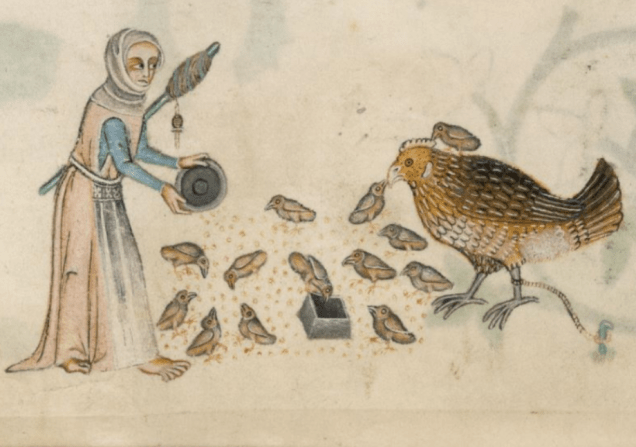
So: I was struck by this scene from an English illuminated manuscript.

British Library Add MS 42130 f166v Feeding Chickens
Add MS 42130, f.166v via British Library (England; 1325-1340; illuminated manuscript)

The way the woman in the image is holding a distaff under one arm while she feeds chickens from a bowl feels incredibly authentic. I may not have to spin my own yarn nor feed chickens in 2018, but I have often held a thing under my arm momentarily while taking care of a small, short task. Such a lovely, realistic detail.

I do have one question for the artist, though: what on earth is that chick doing, standing on top of the hen and pecking her? (“Mom, look, I’m up here! Mom? Mom? Mooom!”) LOL!

The manuscript is from England and known as The Luttrell Psalter. Fortunately for us, British Library has digitized the whole manuscript. In addition to the chicken-feeding one above, the illuminations include a slew of other everyday scenes, like a miller in his windmill, bear-baiting(!), a wattle pen full of sheep, and various stages of tending fields and preparing food.

Being a textile nerd, I enjoyed the image of two women preparing fibers into yarn: one is using a spinning wheel, the other is carding.

British Library Add MS 42130 f193r Spinning Carding
Add MS 42130, f.193r via British Library (England; 1325-1340; illuminated manuscript)

The coloring is quite lovely. I do wonder, however, what’s with the awkward poses. The chicken-feeding image felt much more natural in that respect, too.

Images via British Library

Out There is an occasional feature highlighting intriguing art, spaces, places, phenomena, flora, and fauna.