Phew, we made it!
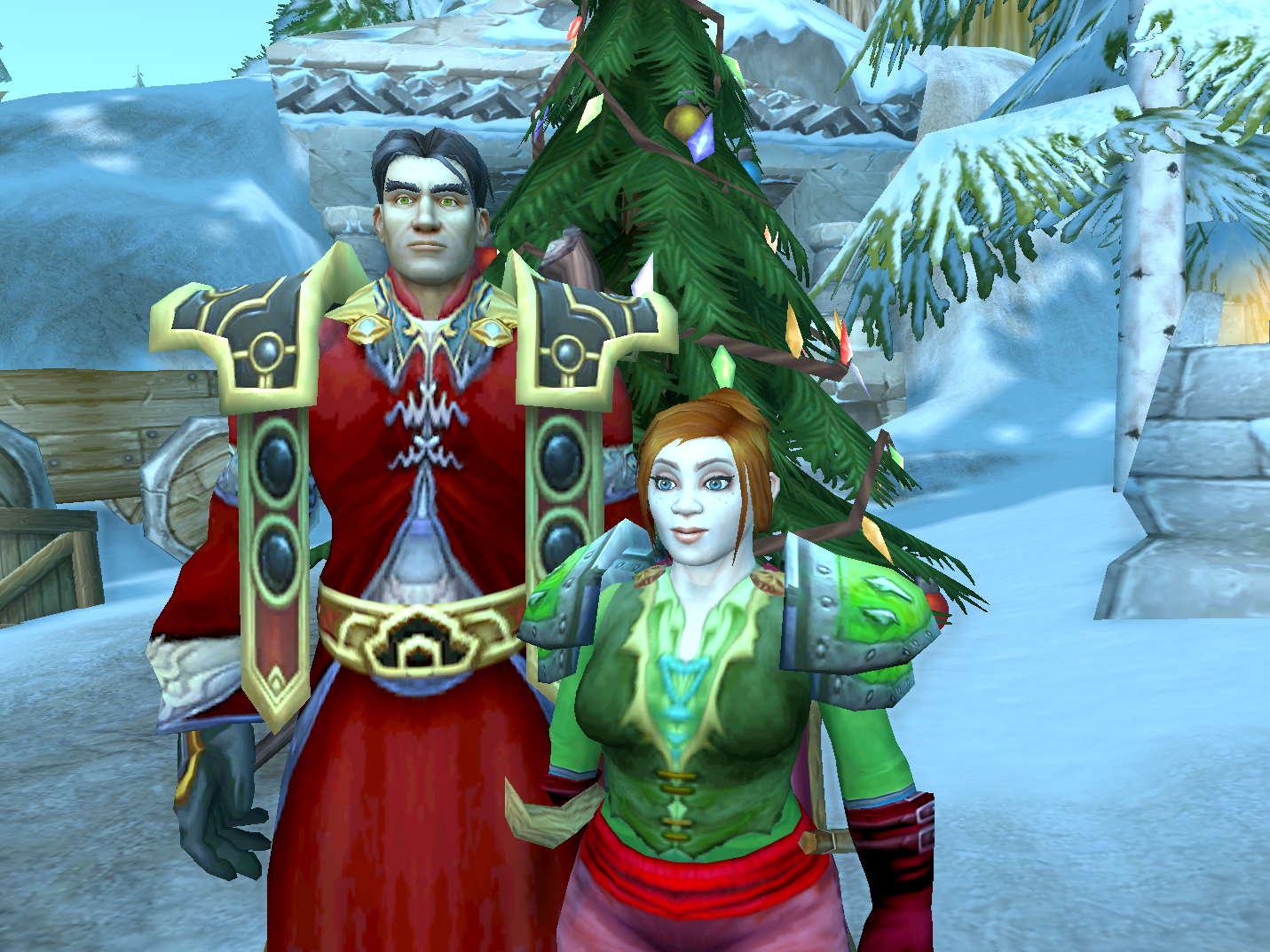
May 2018 fulfill promises, bring joy, and push you to exceed your goals.
Image: screenshot from World of Warcraft
Announcements from your hosts.
Phew, we made it!
May 2018 fulfill promises, bring joy, and push you to exceed your goals.
Image: screenshot from World of Warcraft
Announcements from your hosts.
Another year is behind us, and what a year it was. Here are the 2017 posts that got the most views. Most of them are from our How to Helsinki series in the run-up to Worldcon75 in Helsinki in August:
Some posts from previous years have remained popular as well. Here’s the overall list of top five posts people read in 2017, some of them from a year or two back:
Thanks for stopping by. We hope you enjoyed reading our posts as much as we enjoyed writing them!
Messing with numbers is messy.
Although the Star Wars and Star Trek fandoms have not always gotten along entirely peacefully, I hope that the two fan videos below show that singing is a pastime shared across the divide.
Take it away, Chewbacca and the crew of Deep Space Nine.
Silent Night by Chewbacca via How It Should Have Ended
“Merry Wookie Christmas from HISHE and James Covenant! (http://tinyurl.com/jkc9f7l)
The brilliant idea for “Chewbacca Sings Silent Night” was actually created in 1999 by Scott Andersen (story here: http://room34.com/chewbacca/) and since then his audio has been shared many times, often without crediting him. You can download the original at the link above, or better yet support his genius by hiring him for web design at http://room34.com
“With Scott’s “blessing” and in honor of Christmas and Star Wars season, James Covenant (creator of the awesome Star Trek “Make It So” video: https://youtu.be/oiSn2JuDQSc) was inspired to create this new video for our channel to wish you all a very Star Wars Christmas!”
Captain Sisko & the DS9 Ensemble sing “Wonderful Deep Space Nine” by John C. Worsley
“In the grand tradition of Star Trek captains singing holiday standards, for your consideration: ‘Wonderful Deep Space Nine’ sung by Captain Sisko, Major Kira, Constable Odo, Lieutenant Commander Worf, Chief O’Brien, Congenial Barkeep Quark, Plain Simple Garak, and the rest of the Star Trek: DS9 ensemble. Special appearances by Morn, Martok, Moogie, and Vorta Iggy Pop.
Apologies to Berman, Piller, Brooks, Visitor, Farrell, Auberjonois, Siddig, Shimerman, Meaney, Dorn, Robinson, Eisenberg, Lofton, Grodenchik, Alaimo, Biggs, Marshall, Jens, de Boer, Barrett, Sadler, and Combs.”
We’re vacationing for the rest of the year. Until 2018, Happy Merry!
This post has been edited to correct language.
Hey, look! We found a thing on the internet! We thought it was cool, and wanted to share it with you.
History for Writers explores world history to offer ideas and observations of interest to those of us who are in the business of inventing new worlds, cultures, and histories of our own. Here’s where we’ve been in 2017:
Practicalities
Connections between cultures
Ancient wisdom for troubled times
Telling stories
Thinking historically
Past cultures
Race in Antiquity
Join us in 2018 for more history from a SFF writer’s perspective.
History for Writers is a weekly feature which looks at how history can be a fiction writer’s most useful tool. From worldbuilding to dialogue, history helps you write. Check out the introduction to History for Writers here.
A news and culture writer Andrew Husband writes in “Porg Recipes For The ‘Star Wars: The Last Jedi’ Fans In Your Life” on Uproxx that us Nordics eat puffins:
“[…] we’ve put together a short recipe list — consisting of hors-d’oeuvre, entrées, and entremets based on traditional puffin and poultry dishes — for your perusal.
“Yes, you read that right. Despite being protected by several national and international conservation organizations, puffins are considered a rare delicacy in Nordic countries. And seeing as how The Last Jedi‘s porgs are based on the puffins writer/director Rian Johnson saw while filming at Skellig, it makes sense their preparation would be similar.”
As a source for his wild claim, Husband offers all of one link, and that goes to a CNN Travel article “Iceland food can be unusual; check out these 10 dishes”.
Here’s my official response as a Nordic person:
Yeah… nope. Nopety-nope-nope-nope. So much NOPE!
While Iceland is unquestionably one of the Nordic countries, it’s ludicrous to claim that the existence of a practice in one country (or even two) equals its existence in all five.
Now, had Husband talked for instance of reindeer, he would be more correct, but still not entirely so. The Sami herd reindeer in the north of Finland, Sweden, and Norway, so we three nations tend to eat reindeer meat. In fact, sauteed reindeer or poronkäristys was one of the regular dishes at my elementary school cafeteria in Northern Finland, so I personally couldn’t call it a delicacy even though I’ve eaten it less often since. In Denmark and in Iceland it’s an import, and apparently they hardly eat reindeer at all (or so the all-knowing Internet tells me).
But puffin? I’ve never even heard of eating puffin before, although it sounds like the practice does have long roots in Iceland and Norway (judging e.g. by the existence of lundehunder or puffin dogs in the latter) and some other areas like the Faroes. And now that I know Atlantic puffins are considered vulnerable, I wouldn’t eat them even if I happened to be in a country where hunting them wasn’t banned. Not even if you paid me.
“Porg Recipes” arcticle found via File 770.
In Live and Active Cultures we talk about cultures and cultural differences.
(Note: minor spoiler ahead for Star Wars: The Last Jedi)
 Our story-telling traditions often make a big deal out of family and descent. Part of the classic Campbellian Hero’s Journey is the son’s need to measure himself against his father. A Real Princess™ can tell when there’s a pea under a dozen mattresses, or needs a Real Prince™ to wake her up (apparently princesses do a lot of napping). Modern stories often reinforce the importance of true family lines in similar ways, whether they’re directly invoking the mythic tradition (like Star Wars) or just because family is still an important part of the drama of our lives ( like Harry Potter).
The idea that family lines determine our characters’ stories, abilities, and ambitions is such a big part of our narrative legacy that it can seem like a primordial principle of storytelling, but in fact these kinds of stories arise from specific cultural contexts. These contexts have to do with the assertion of class.
Small-scale societies historically tended to be egalitarian. When a culture contained only a few hundred people, everyone knew one another personally, resources were freely shared, and there was no real differentiation between rich and poor, powerful and powerless. As societies got larger, up into the range a few thousand people or more, social distinctions tended to emerge because people were no longer held together primarily by personal and family relationships. In societies of this scale, some families acquired more resources and more influence than others. Over time, these differences hardened into class distinctions, with prosperous families asserting their own superiority over the less fortunate. An aristocratic class with a sense of its own importance took shape.
A rising aristocracy, however, often struggled against the older traditions of egalitarianism and mutual support. To maintain their position, aristocrats had to create and disseminate a new ideology which justified their status. In many societies all over the world, this ideology was framed by stories about heroic ancestors and special powers passed down through family lines. If you weren’t part of the family line, you didn’t inherit the special powers, and therefore you didn’t deserve to be rich or powerful like them.
Many of the ancient stories that have been passed down and become part of our common narrative tradition were stories originally told by and for aristocrats and would-be aristocrats clawing their way into positions of privilege. When ancient Greek bards recited the tales of Achilles, Odysseus, Helen, and Penelope, they weren’t just telling stories to entertain the masses. Bards and singers depended for their livelihoods on the support of aristocratic patrons, and the stories they told were propaganda for the people who paid the bills. Greek aristocrats claimed to be actual descendants of the heroes of the Trojan War and other myths. The Homeric epics are quite clear that no one from outside the family line deserves to get anywhere near the heroes’ wealth and power.
On the other hand, our story-telling traditions also include narratives that are democratic (or at least anti-aristocratic). Some of these take the form of “clever peasant” tales in which someone from an unimportant background gets the better of the rich and powerful through luck, audacity, and wits. These tales often set up the aristocrats as buffoons who are humiliated in the end and forced to acknowledge the individual merits of people with no family claim to riches or power. Stories of this type are common in folk traditions, including English Jack tales and their analogues in other cultures.
Another type of story combines elements of both, often revolving around a lost heir or disguised royal. In these stories, the hero at first appears to be an ordinary person whose individual initiative and skill earn them acclaim and awards, but they turn out in the end to be the misplaced scion of an important family. Sometimes these lost heirs know their own identity and are in hiding; other times they are themselves unaware until their true identity is revealed. King Arthur, in some versions of the Arthurian mythos, fits this pattern: having been raised in obscurity, he comes into his true heritage when he proves his special powers by pulling the sword from the stone. Robin Hood—again, in some versions—represents a different take on the same pattern: by rights a nobleman, he hides his true identity and fights for the common people. This tradition represents a degree of compromise between the aristocratic and anti-aristocratic narratives. The hero acquires something of the common touch and has to get by on individual merits, but the aristocratic claims to a unique status remain unchallenged.
When modern stories draw on these older traditions, they don’t always think about the implications of them. Star Wars, for example, has always awkwardly balanced the democratic ideals of the Republic, Rebellion, and Resistance with the mythic focus on the Skywalker bloodline. This is why I am so happy that The Last Jedi decided that Rey is not part of the Skywalker family or descended from Obi-Wan Kenobi or any other established Jedi but just the cast-off child of drunken scavengers from nowhere. (Assuming, of course, that Kylo Ren is telling the truth or even knows it to begin with, which is not a trivial assumption, but I’m going with it until we hear otherwise from a canonical source.)
Star Wars has always been told in the mode of myth, but myths don’t come out of nowhere and they aren’t just stories. Myths are stories that mean something. If Star Wars is going be meaningful in the world we live in today, it’s time to democratize the Force. We need more clever peasants these days, not more lost heirs.
Image: Arthur pulling the sword from the stone from An Island Story by Henrietta E. Marshall, New York: Frederick A. Stokes Company, 1906, via Wikimedia
History for Writers is a weekly feature which looks at how history can be a fiction writer’s most useful tool. From worldbuilding to dialogue, history helps you write. Check out the introduction to History for Writers here.
“One should not seek ugliness in this world. There is no lack of it. You will find it soon enough, or it will find you.”
– Sigrud je Harkvaldsson in City of Miracles by Robert Jackson Bennett
Although my life has been very different from that of a Dreyling operative and assassin, I agree. (For instance, I’ve never understood the appeal of vampire or horror genres, but to each their own.)
Bennett, Robert Jackson. City of Miracles. New York: Broadway Books, 2017, p. 177.
Serving exactly what it sounds like, the Quotes feature excerpts other people’s thoughts.
We’re continuing to rewatch and rate Doctor Who (new series) with season 2. Here’s how the season looks to us:

Season 2 carries on much in the same spirit as season 1, with a mix of highs and lows, and ends up with the same average rating, 5.3. David Tennant slides easily into his role as the tenth Doctor, although we found Rose started to wear thin as a companion in this season and by the end of it we weren’t sorry to see the back of her. (In fact, by the end of the season, we were much more excited to see her erstwhile boyfriend Mickey return than to see any more of Rose.)
The low point of the season comes at the very end, with “Doomsday”—the conclusion to a two-part finale in which Cybermen and Daleks fight in the skies over London—coming it at only a 2. Many things dragged this episode down, including the ham-fisted introduction of Torchwood, which had been teased all season long. Worse, coming after some of the well-crafted storytelling in previous episodes, this one chucks out any attempt at story development or narrative logic in favor of Daleks and Cybermen trash talking each other.
By contrast, the best episodes of the season, “Tooth and Claw” and “The Girl in the Fireplace,” both at 9, show off how effective the slow unfolding of complex stories can be. “Tooth and Claw” has Queen Victoria menaced by an alien werewolf in the Scottish highlands while “The Girl in the Fireplace” has Madame de Pompadour menaced by clockwork robots from the future. Although both these episodes involve historical women in danger, neither is a “damsel in distress” story, as both Victoria and Madame de Pompadour get to play active roles in their stories. These episodes also share a pattern of multi-layered plots in which things that seem bizarre and inexplicable at first gradually become clear as pieces of the story fall into place one after another.
We know there are lots of other Doctor Who fans out there, and some of you probably feel quite different about this season and its episodes. We’d love to hear your take. Let us know which episodes of season 2 worked for you or didn’t.
Image: Doctor Who Season 2 via IMDb
In the Seen on Screen occasional feature, we discuss movies and television shows of interest.
When you’ve been looking forward to something for a long time, the closer it gets, the harder it is to wait. So, to keep you entertained in this last week before The Last Jedi comes out, here’s a father-son duo playing the classic Mos Eisley cantina music on the piano. Enjoy!
Star Wars Cantina Band by Brian Lockard
Hey, look! We found a thing on the internet! We thought it was cool, and wanted to share it with you.
I shared my WoW: Legion hidden artifact appearance last month and mentioned that I might be re-doing my fire mage’s transmog to match it. Well, here she is in her new, golden, white, and turquoise hues:
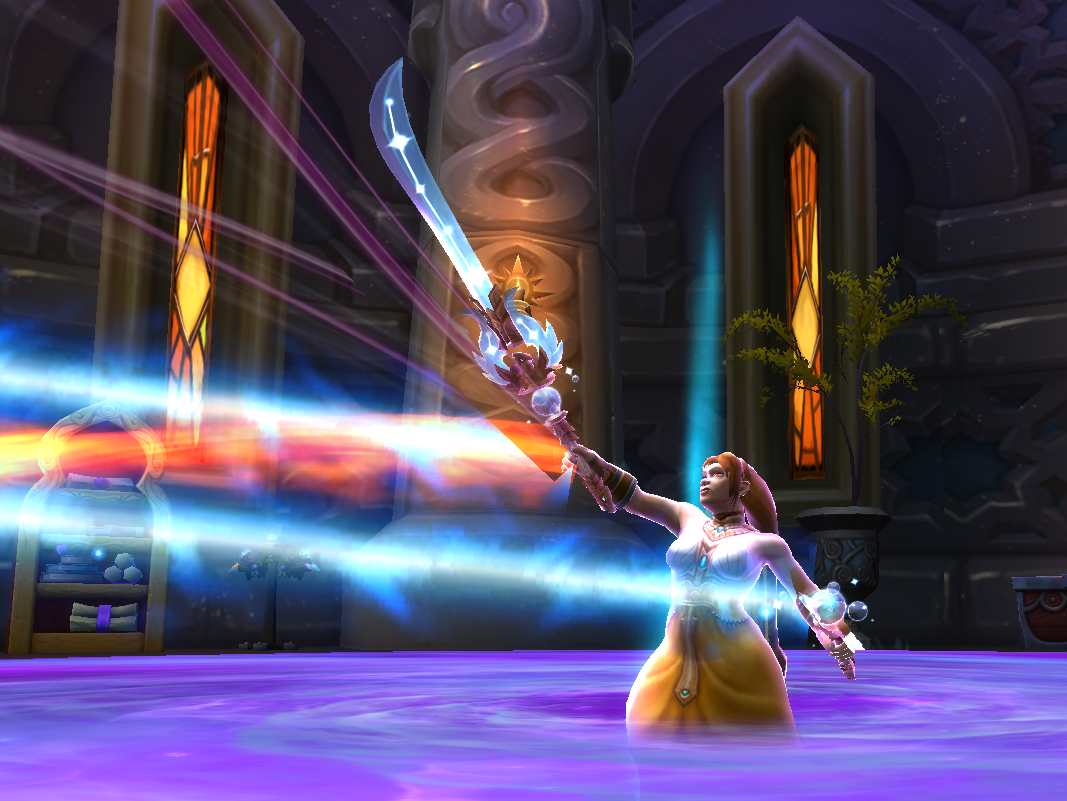
This may be my favorite transmog to date. I’ll try and get a better screencap later; this one doesn’t really show some of the details. I’m also making good progress on completing 200 world quests in order to unlock another color variant for The Stars’ Design appearance, so, yay! 🙂
Image: screenshot from World of Warcraft
Of Dice and Dragons is an occasional feature about games and gaming.
 Co-Geeking
_(14801002423).jpg)