One of the best things about social media—like the Internet, too—is how many different phenomena you can witness if not first hand then at least in a secondary capacity; way more than would be possible in a regular human lifetime.
Case in point: the Clay Forest is a massive gorge like the Grand Canyon, except it’s located in Western Tibet. Apparently it wasn’t really accessible for Westerners until 2015.
Ooh—I knew cosplayers were an ingenious group, but this is awesome: cosplayers portray Disney princesses in Boba Fett -like armor:
Oh my goodness, the leaf detailing on the Pocahontas / Fett helmet! And the detailing in general—love it!
The photography is credited to Jonathan York who posts his photos as York In A Box. I haven’t been to confirm it, since Facebook has been glitching for me for some reason. It would’ve been great to read more about the setup and the individual cosplayers’ thoughts.
(I did some searching elsewhere, too, but my google fu fails me for the moment. If you can find a different link, please share!)
Four Master’s students from the Royal College of Art and Imperial College, London, UK, have created a bioplastic from chitin combined with vinegar. This sustainable plastic can be manipulated to produce items of varying stiffness, flexibility, thickness, and translucence by adjusting the ratios of the base ingredients.
Apparently, the material can also be turned back into the original bioplastic solution.
Shellworks is Ed Jones, Insiya Jafferjee, Amir Afshar, and Andrew Edwards. Their work is still at prototype stage, but it sounds like there is a potential for increasingly (if not utterly and entirely) recyclable, non-toxic plastic here. Sounds awesome!
The Staffordshire Hoard is the largest and perhaps the most magnificent find from Anglo-Saxon England. The hoard dates from the 7th century and comes from the Kingdom of Mercia. It was found in 2009 by an amateur archaeologist with a metal detector, and is now owned by Birmingham and Stoke-on-Trent City Councils on behalf of the nation.
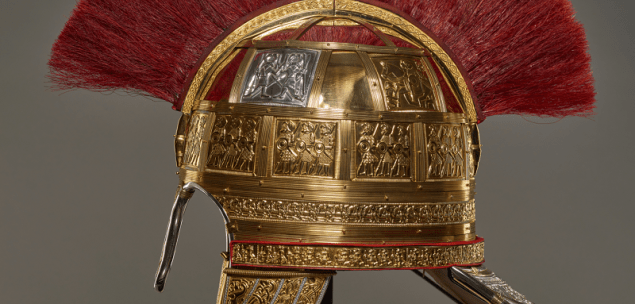
The vast majority of items in the hoard are war gear, especially sword fittings. Among the items, all of which are of exceptionally high quality, is a helmet. Two copies of a reconstruction completed in 2018 are now available for public viewing, one in Birmingham Museum and Art Gallery (Birmingham, England) and the other in The Potteries Museum and Art Gallery (Hanley, Stoke-on-Trent, Staffordshire, England).
And it’s utterly breathtaking!
The so-called Staffordshire Helmet is very rare—only five other Anglo-Saxon helmets are known—and looks exquisite: the gold filigree with red accents make an arresting combination, and the dyed crest adds to the wearer’s height.
As Erik pointed out, ancient Greeks and Romans portrayed northwestern barbarians as violent, ignorant, savage, and lacking in technology and social organization. On the basis of the Staffordshire Hoard alone, whatever else they were, there’s absolutely no basis in calling Anglo-Saxons technologically unskilled!
As usual, some days ago while doing something quite different I found an intriguing detail I wanted to look into. Finally I had the time to chase it down.
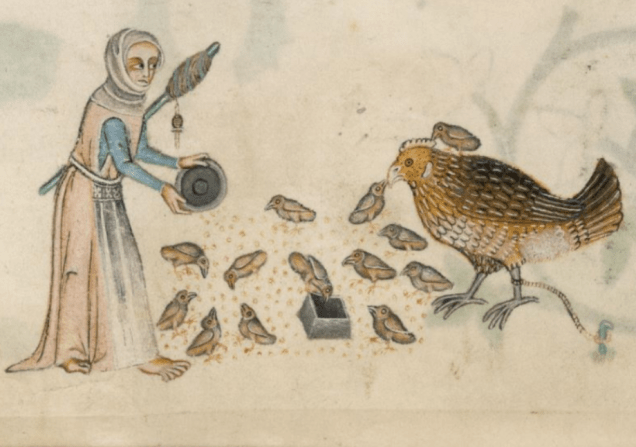
So: I was struck by this scene from an English illuminated manuscript.
Add MS 42130, f.166v via British Library (England; 1325-1340; illuminated manuscript)
The way the woman in the image is holding a distaff under one arm while she feeds chickens from a bowl feels incredibly authentic. I may not have to spin my own yarn nor feed chickens in 2018, but I have often held a thing under my arm momentarily while taking care of a small, short task. Such a lovely, realistic detail.
I do have one question for the artist, though: what on earth is that chick doing, standing on top of the hen and pecking her? (“Mom, look, I’m up here! Mom? Mom? Mooom!”) LOL!
The manuscript is from England and known as The Luttrell Psalter. Fortunately for us, British Library has digitized the whole manuscript. In addition to the chicken-feeding one above, the illuminations include a slew of other everyday scenes, like a miller in his windmill, bear-baiting(!), a wattle pen full of sheep, and various stages of tending fields and preparing food.
Being a textile nerd, I enjoyed the image of two women preparing fibers into yarn: one is using a spinning wheel, the other is carding.
Add MS 42130, f.193r via British Library (England; 1325-1340; illuminated manuscript)
The coloring is quite lovely. I do wonder, however, what’s with the awkward poses. The chicken-feeding image felt much more natural in that respect, too.
Out in the deserts of the Nazca region of southern Peru there are spiral-shaped holes bored into the ground. These holes are connected to networks of underground channels that bring fresh water from subterranean aquifers into the arid landscape. The spiral holes help the system work by channeling wind into the tunnels, which increases pressure and forces the water to move to where it is needed. These water systems are called puquios.
It is not known just when the puquios were constructed. Textual sources from the early days of the Spanish conquest do not mention them, but neither is there any record of them having been built post-conquest. They seem to be related to indigenous settlements that date to the first millennium CE, and some samples of organic material from the construction have been dated to the 6th-7th c. CE. On balance, the evidence suggests that they were built by precolonial cultures.
Despite their age, many of the puquios are still functioning and delivering water to desert communities today. What an interesting alternative they make for something so fundamental as water systems!
Image: Spiral entrance to the puquios, photograph by Ab5602 via Wikimedia
Out There is an occasional feature highlighting intriguing art, spaces, places, phenomena, flora, and fauna.
I’ve been meaning to share this for a while now, but something or other was always supposedly more important or interesting. No more! 🙂
The Viking Age Sigtuna, Sweden, was formally founded around 980 AD, and it was a much more cosmopolitan city than thought before. According to new DNA analysis, approximately half of city’s population were immigrants.
The study looked at the remnants of 38 individuals who lived and died in Sigtuna between the 900s and 1100s CE, and included other scientific approaches as well (like analysing the strontium isotope contents of the residents’ teeth).
Roughly half of the population grew up in the near-by region Mälardalen (the Mälaren Valley, or Stockholm-Mälaren Region). The other half arrived either from southern Scandinavia (including Norway and Denmark) or further away. The long-distance immigrants came from the British Isles, Ukraine, Lithuania, northern Germany, and other parts of central Europe, and were more likely to be women than men (approx. 70 percent of women vs. 44 percent of the men).
Read more on the Stockholm University research news page: article in Swedish / article in English.
I guess I’m by far not the first woman to fall in love with a Viking and to move far away with him. 🙂








 Co-Geeking

You must be logged in to post a comment.