A Rich Anglo-Saxon Burial Chamber Found in Essex

A new-ish Anglo-Saxon burial chamber found at Prittlewell in Southend-on-Sea, Essex, in southern England has all of the markings of a valuable find, both in terms of quality and quantity of the grave goods and of historical significance.

The male body was placed within a wooden coffin in a timber room. The burial most likely dates to the late 6th century (575-605 CE). It was first discovered in 2003 in remarkably good condition.

MOLA Prittlewell Burial Chamber Drawing

Artefacts from the burial were studied at Museum of London Archaeology (MOLA), and the most impressive items are now on permanent display at Southend Central Museum in Southend-on-Sea. MOLA has also created an interactive website for the find.

Just some of the items discovered include a gold belt buckle, two Frankish gold coins, a beautiful sword, iron-bound buckets, a huge metal cauldron, latticed glass beakers, a tall iron candelabrum, a folding iron stool, a basin and a flagon made from copper alloy, a silver spoon, a painted wooden box, and an Anglo-Saxon lyre.

MOLA Prittlewell Blue Glass Decorated Beaker

Incidentally, the wooden box is so far the only surviving example of painted Anglo-Saxon woodwork!

MOLA Prittlewell Painted Wooden Box

MOLA The Guardian Prittlewell Gold Copper Item Collage

There are two interesting implications for the burial. Firstly, two gold foil crosses were likely placed on the body’s eyes. If the burial can indeed be placed at its earliest possible date, it makes the connection to Christianity remarkable because it would predate Augustine’s mission to convert the British in 597. A royal connection has been surmised (Seaxa, a younger brother of king Sæbert of Essex, whose mother Ricula was Æthelbert of Kent’s sister) but not confirmed.

(King Æthelbert of Kent married a Merovingian Christian princess called Bertha in 580, so Roman Christianity was known to Anglo-Saxons to some degree by the end of the 6th century, but to my knowledge we had previously not known of other converts outside their court prior to 600.)

Secondly, although Essex has earlier been seen as an Anglo-Saxon backwater of sorts, this rich burial chamber suggests otherwise. Indeed, some of the luxury items come from the near-by continental Europe (the Frankish gold coins), but others have much more far-reaching origins (the Byzantine or Syrian copper alloy flagon, for example).

Having studied Anglo-Saxons myself and witnessed Erik’s research on the side, I keep being amazed at how much paraphernalia is extant from the Roman period and early middle ages onwards. Not only that, but how much of it is still being discovered! If you tour any of the major museums of Roman history in Germany, for example, you will see massive (massive!) amounts of metalwork, gold, silver, glass, and pottery. And what’s on display doesn’t even account for the remnants in storage.

People from old cultures had as large incentives as we do today to dress up and surround themselves with ornate household goods—after all, we are humans who like their stuff, right? Their ability to do so naturally depended on the resources available in the area and era, and—despite what most of us seem to have been taught—early history is full of times when our predecessors were able to produce items on a massive scale and the richest in those societies did have the wherewithal to go all out.

Like the Staffordshire helmet, the Prittlewell burial will be of immense importance to our understanding of Anglo-Saxon history and culture. I’m so delighted it was found!

Images by MOLA; collage of the gold and copper alloy items by MOLA via The Guardian.

Out There is an occasional feature highlighting intriguing art, spaces, places, phenomena, flora, and fauna.

LightSail 2 Spacecraft Is Successfully Driven by Solar Sails

Have you guys heard of the LightSail project?

The Planetary Society LightSail 2 Australia New Guinea

Run by The Planetary Society (the world’s largest private non-profit space organization), LightSail is a crowdfunded project that successfully launched a solar sail driven spacecraft into Earth orbit in June 2019 in an effort to lower the cost of space exploration.

While not the first spacecraft to successfully use solar sails, LightSail 2 has managed to slow down the deterioration of its orbit and on occasion to reverse drag created by the atmosphere and correct course. Indeed: one of the mission’s functions is doubling as a probe of far-atmospheric thickness.

LightSail 2 deployed its solar sail in July 2019, and has been sending data down to Earth since then. Access the LightSail project page or LightSail 2 mission control for some interesting browsing.

Really cool, isn’t it?

Image: Australia and New Guinea from LightSail 2 by The Planetary Society (CC BY-NC 3.0)

Out There is an occasional feature highlighting intriguing art, spaces, places, phenomena, flora, and fauna.
Living Vicariously Through Social Media: Firefall at Yosemite

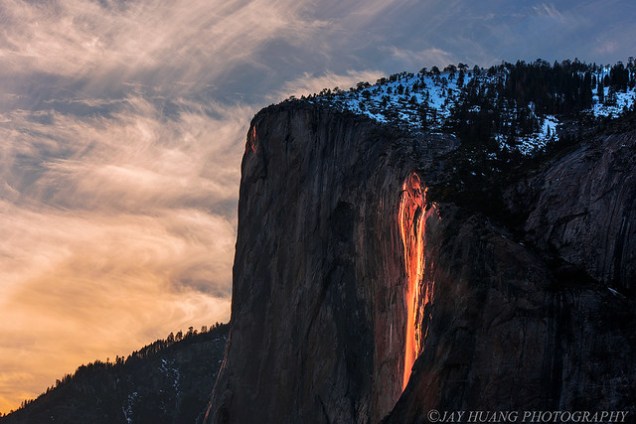
Each February, if conditions allow the seasonal Horsetail waterfall in Yosemite National Park in California to flow, the waterfall appears to be set ablaze by the setting sun. This event is known as the firefall (apparently as homage to Yosemite Firefall).

Flickr Jay Huang Firefall Yosemite National Park

Just stunning! Why hasn’t anyone put this kind of an effect into a story yet—or have I just missed it? Anyone know???

Image by Jay Huang via Flickr (CC BY 2.0)

Out There is an occasional feature highlighting intriguing art, spaces, places, phenomena, flora, and fauna.

Sigiriya

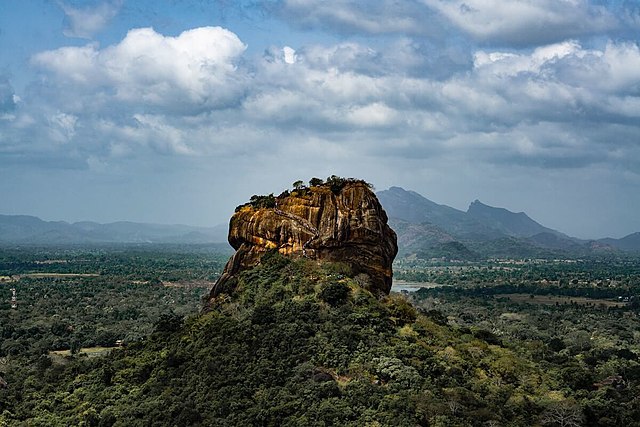
In the hills of central northern Sri Lanka are the remains of a palace built over a thousand years ago on top of an extraordinary natural rock formation. The place is known as Sigiriya. At the base of the rock, intricately organized gardens incorporating sophisticated irrigation and water retention structures stretch out along the hillsides. On top of the rock was originally a fortress, later converted into a Buddhist monastery.


A view of Sigiriya from a nearby hilltop, photograph by Azharkhanam via Wikimedia

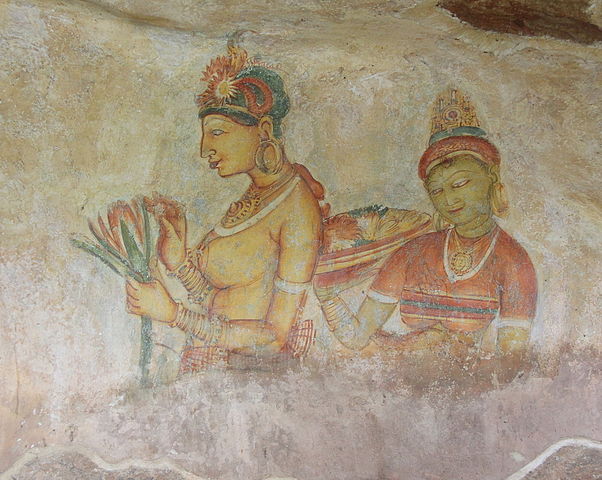
According to Sri Lankan literature, the site was built in the late 400s CE by the king Kashyapa. Sources describe colorful frescoes covering the sides of the rock and a great gate in the shape of a lion, both of which are now only to been seen in fragmentary form. After Kashyapa’s death, Sigiriya ceased to be a royal site and for the next thousand years was inhabited by monks and visited by pilgrims, many of whom left inscriptions on the frescoed faces of the rock. Today, it continues to attract many visitors, although writing on the walls is no longer allowed.

The remains of the lion gate at the base of the citadel, photograph by Cherubino via Wikimedia
Surviving fragments of fresco, photograph by Peter van der Sluijs via Wikimedia (Sigiriya; late 5th c. CE; fresco)

The next time you’re imagining where the royals of your world might live for a story, artwork, or game, think of Sigiriya and remember that a palace doesn’t have to look like Neuschwanstein or Versailles.

History for Writers looks at how history can be a fiction writer’s most useful tool. From worldbuilding to dialogue, history helps you write.

Slavic Pagan Fusion Photoshoot Is Out of This World

This photo project is an older one, but due to the buzz generated by The Witcher screen adaptation it might be of interest.

(FYI: I can’t find a webpage dedicated solely to the project, so what I know mainly comes from an article at Design You Trust.)

Polish photographer and graphic designer Marcin Nagraba collaborated with designer Agnieszka Osipa to create a photoshoot entitled Pagan Poetry. Stylistically it can be described as Slavic fusion meets myth, fantasy, or Baroque. Osipa’s outfits certainly are out of this world—just check out the three examples below!

FB Marcin Nagraba See No Evil

FB Marcin Nagraba White and Red

FB Marcin Nagraba Alberta Ushakova

Nagraba’s personal Facebook page states he’s a “Former Photographer at Marcin Nagraba – Photography & Art”, so it sounds like he will not be continuing this project. Osipa is active, however, and she’s posting new work on Instagram and Facebook.

Found via Design You Trust. Check out the article and Nagraba’s Facebook page for more photos!

Images by Marcin Nagraba via Facebook: See No Evil, red and white, Alberta Ushakova.

Out There is an occasional feature highlighting intriguing art, spaces, places, phenomena, flora, and fauna.
Six Kings

When Islam first stepped onto the world stage in the seventh century CE, it came as a surprise to the great powers of the day, the Byzantine (or Eastern Roman) Empire and the Sassanian Persian Empire. A powerful religious, political, and social movement sprang up from among the Arabs, the fragmented desert-dwelling peoples who had been pushed back and forth by the wars between Rome and Persia for centuries.

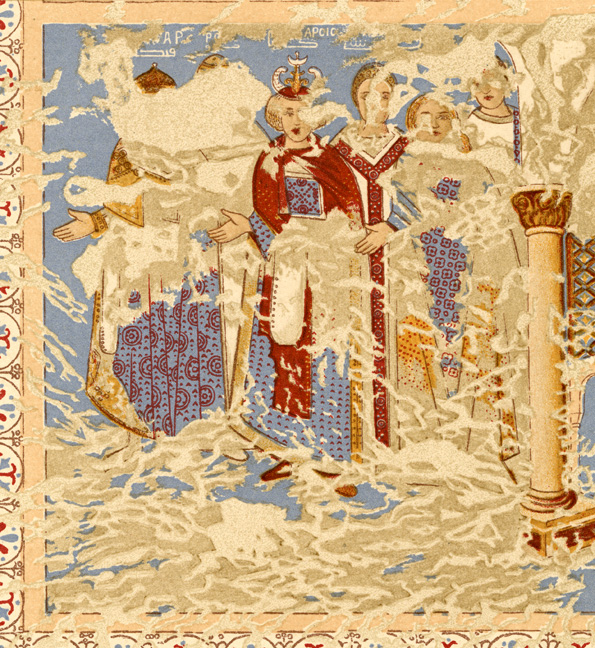
Muslims of the early Islamic period were aware that they were stepping into a world of powerful forces, and some examples of early Islamic art reflect the desire to stake a claim for Islam’s place in the world. For example, a wall painting from an early Islamic palace, in modern-day Jordan, shows how early caliphs positioned themselves in relation to the larger world.

This painting, known as the “Six Kings” painting, is in very poor condition today, partly because of some European travelers who saw it in the early twentieth century and tried to chisel it off the wall and take it with them. (This is why we can’t have nice things.) Working from the painting in its current damaged state and an impressionistic copy made by those travelers, though, we can get a sense of what the original looked like.

Six Kings painting, photopgraph by Ghazi Bisheh via Wikimedia (Qasr Amra, Jordan; 710-740 CE; wall painting)
Copy of Six Kings painting via Wikimedia (1907; by Alois Musil)

Six royal figures stand together, all gesturing toward the caliph’s throne. The six figures were originally labeled in both Arabic and Greek. While not all of them can be identified now, we can tell that they include the Byzantine emperor, the Sassanian Persian emperor, the Visigothic king of Spain, and the king of Axum, a nation in what is today Ethiopia that was a powerful political and commercial state at the time.

This painting comes from the early 700s, a time when Islam was barely a century old but the caliphate had already become a major world power. By placing these figures on the wall, the caliphs were placing themselves among the great powers of the day, even positioning themselves as leaders of a world whose boundaries stretched from Spain to Persia and Constantinople to the horn of Africa. That was no small claim for such a young polity to make. The message was clear: Islam had arrived and was ready to be taken seriously as a world power.

Out There is an occasional feature highlighting intriguing art, spaces, places, phenomena, flora, and fauna.

Visual Inspiration: Dark Nights in the North

During my years in the U.S., I’ve been asked more than one variation of the question “Is it always cold?” in Finland. (The short answer, of course, is No; the long answer is It depends on your definition, and when and where in Finland you are. It CAN be cold, but “always”, no.)

What southern people don’t usually realize is that it’s not the winter cold but the long dark that affects you most. (Of course, as a counterpoint, we do also have the magical light summer nights.)

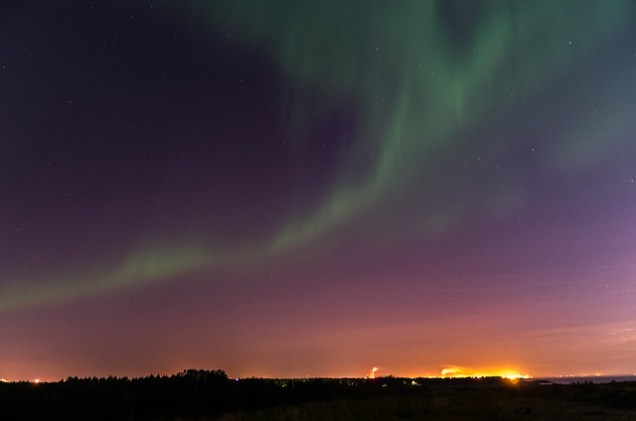
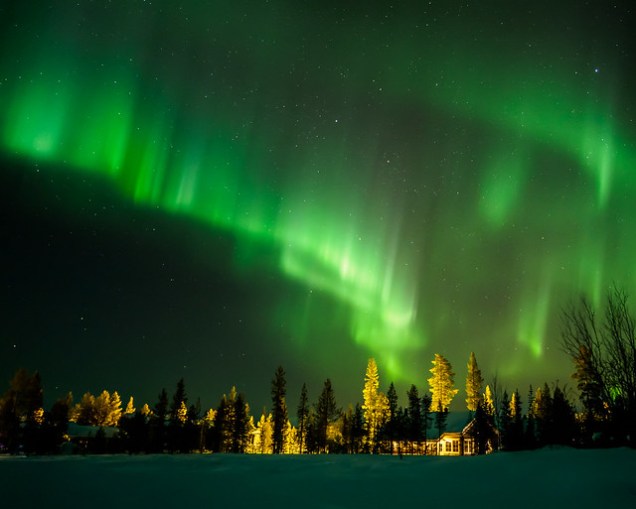
Besides, the dark isn’t all bad. Away from light pollution there is the Milky Way on clear nights, and the further north you go, the higher are your chances of seeing northern lights. The latter can range from faint whisps to quite a light show.

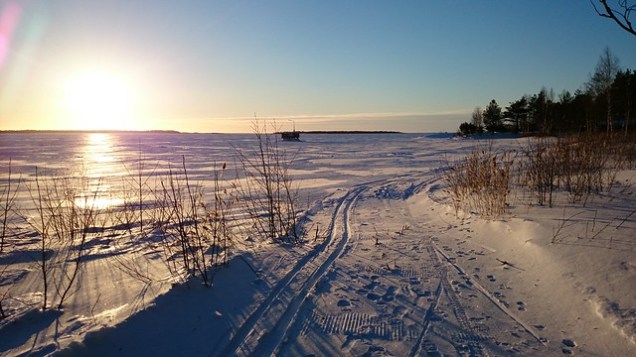
For your potential worldbuilding inspiration, here is a small selection of Flickr photos roughly from around where I grew up, including travel destinations in the north.

Flickr Juho Holmi Ritosuo 2

Flickr Juho Holmi Northern Lights over Oulu

Flickr Timo Newton-Syms Northern Lights

Flickr Heikki Holstila Northern Lights II

For me, and indeed most other Finns, winter starts some time in November to December, depending on the temperatures each year. And even though technically I didn’t grow up with the polar night (when the sun doesn’t rise above the horizon at all), it was quite dark especially before the snow fell—which is exactly why getting snow on the ground was such a relief.

Flickr pikkuanna Rantavehnää

Flickr pikkuanna Hiihtolatu

Images via Flickr: Ritosuo 2 and Northern Lights over Oulu by Juho Holmi (CC BY-ND 2.0). Northern Lights by Timo Newton-Syms (CC BY-SA 2.0). Northern Lights II by Heikki Holstila (CC BY-ND 2.0). Rantavehnää and Hiihtolatu by pikkuanna (CC BY-SA 2.0).

The Visual Inspiration occasional feature pulls the unusual from our world to inspire design, story-telling, and worldbuilding. If stuff like this already exists, what else could we imagine?

Green and Orange Iridescent Turkeys

A lot of us in the U.S. and with U.S. connections are going to sitting down to a turkey dinner this week. A lot of us who live in the woodsier parts of North America also know that the farm-raised domesticated turkeys we put on the table are not the only kind of turkey out there. We have local flocks of wild turkeys around us who periodically come through our yard and entertain us with their antics. (We’re less entertained by the, shall we say, “fertilizer” they leave behind, but that has its uses, too.)

But did you know that there is a variety of wild turkeys found in the Yucatan Peninsula that has blue heads and irididescent turquoise-green and bronze-orange plumage? I didn’t until I stumbled across a reference to them this week. Look at these beauties!

Ocellated turkey, photograph by George Harrison via Wikimedia
Ocellated turkey, photograph by TonyCastro via Wikimedia

Ocellated turkeys, as they are called, are an important part of the local cuisine in addition to being extraordinary to look at.

The next time you’re writing a fantasy world and looking to spice up the local fauna, why not add some big shimmery-winged birds–that could end up roasted or stewed on the dinner table, too?

Out There is an occasional feature highlighting intriguing art, spaces, places, phenomena, flora, and fauna.

Just a Happy Little Sea Monster

Wherever you want it to be, there it will be.

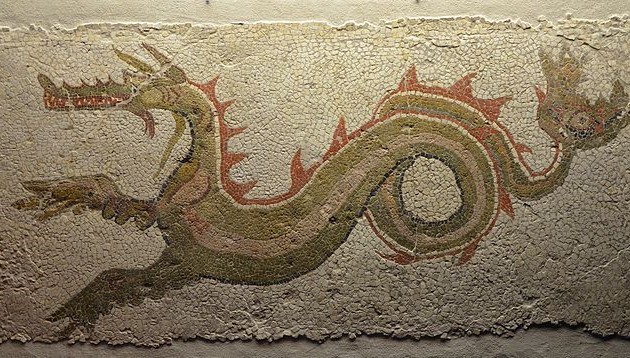
Sea monster, photograph by Carole Raddato via Wikimedia (Casa del Drago, Caulonia, Italy; 3rd c. BCE, mosaic)


This particular sea monster is in a mosaic from a house in the ancient Greek city of Caulonia in southern Italy from the third century BCE. Ancient depictions of sea monsters like this one often have long, snaky bodies, spiky fins, broad tails, and wings. These various pieces may have been cobbled together in the imagination from scattered sightings of whales, dolphins, sharks, squid, and other large sea creatures.

Out There is an occasional feature highlighting intriguing art, spaces, places, phenomena, flora, and fauna.

Visual Inspiration: Organic Shapes in a Garden Cottage

This ensuite cottage in Pali Hill, Mumbai, sits within a garden and literally brings the nature to your side. There are doors and windows, but both are oval or roundish, and even the former are see-through.

The White Room Garden Room Bed

It was created by the India-based architectural studio The White Room, run by Nitin Barchha and Disney Davis. The organic shapes immediately have an otherworldly effect—at least I’ve never been in and rarely seen a house like this.

The White Room Garden Room Entry Hall

The White Room Garden Room TV

And here’s the ensuite bathroom:

The White Room Garden Room Ensuite

I do have a vague recollection of maybe seeing something like this in Star Trek somewhere. Other than that, the closest existing visuals that come to mind are sets Weta Workshop created for The Hobbit and Lord of the Rings trilogies. It would be nice to see—or read of—more interiors that deviate so starkly from our own.

Found via Colossal.

Images by The White Room

The Visual Inspiration occasional feature pulls the unusual from our world to inspire design, story-telling, and worldbuilding. If stuff like this already exists, what else could we imagine?