 This is not the post I had intended for today. When I started working on this one, it was about some of the different ways of organizing basic labor that have existed in history, from slave gangs to independent peasant farmers. As I kept working on it, I found that I had more to say about slavery, especially in light of the public dialogue that has been happening in the United States lately surrounding symbols of the Confederacy. So I started working on a post specifically about slavery in historical context, but as I tried to write that post, it became clear to me that there is an even more fundamental issue in historical interpretation I needed to talk about, something that applies not just to slavery but to almost every historical phenomenon. It is so universal that we don’t really have a standard vocabulary for talking about it. You could call it variability, or you could call it norms and exceptions, but I prefer to think of it as solid centers and fuzzy edges.
Author: Erik
Do-It-Yourself Fantasy Place Name Generator
Writing a fantasy story or role-playing scenario? Need to come up with names for towns, rivers, mountain ranges and so on, but tired of thinking up new names all the time? Here’s a handy technique I use. It takes a little work up front, but then it makes coming up with new names really easy.
The thing about place names is: when you dig down deep into their meaning, they’re usually really obvious and descriptive. It’s only time and language change that obscures their meaning.
Look at a map of Europe and you’ll find Copenhagen (“merchant harbor”) and Dublin (“black pool”). In Asia there’s Shanghai (“above the sea”) and Samarkand (“stone fortress”). The same applies to the native names anywhere else in the world. In places that have experienced substantial colonization, the conquerors often imported old names that didn’t relate to the landscape (New York, Wellington), but in other cases the new names given by colonizers were just as descriptive (Cape Town, Salt Lake City).
The reasons for this naming pattern are fairly straightforward. If you live in a landscape where there are several rivers, but only one of them is muddy, or plenty of mountains, but there’s a big one with no trees on top, when you need to refer to that river or that mountain, you’re likely to say: “the black river” or “the bald mountain.” From there it’s only a short step to calling them “Black River” and “Bald Mountain”. As time goes on and language changes, place names tend to become fossilized and preserve older variants and meanings that the rest of the language has left behind.
So, put these facts to work for you. When you’re setting up your map, generate a list of place name elements and then you can quickly combine them to make new names for whatever you need.
Here’s how it works:
Some Notes on Gender and Power (Part 2)
Picking up from where we left off last week, here are some more notes on gender and power. First, a refresher on where we started:
1. There is a lot of bad theorizing out there about gender and power relations
Primordial matriarchies, evo-psych patriarchies — all bunk.
2. Patriarchy is not inherent in human societies.
Patriarchy is a historical development, not a biological imperative.
Carrying on now:
3. There are many different kinds of patriarchy
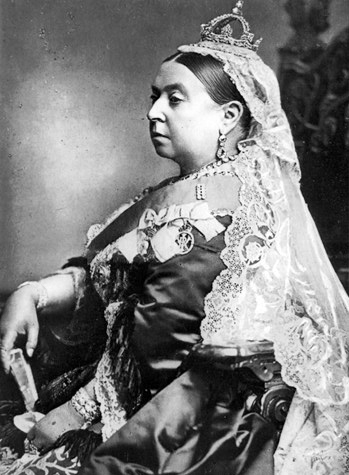 As I explained last week, patriarchy is not a universal of human societies but rather a product of specific historical circumstances. As a result, there are as many different varieties of patriarchy as there are cultures that practice it. There is no “the patriarchy” any more than there is “the democracy” or “the music.” Some democracies have parliaments, some have electoral colleges, and some just have town meetings. Some music has violins, some has taiko drums, and some has beatboxing. Patriarchies are just as variable.
Consider, if you will, Victorian Britain and the Roman empire. Both were unquestionably patriarchal, but that doesn’t mean they worked the same way.
Some Notes on Gender and Power (Part 1)
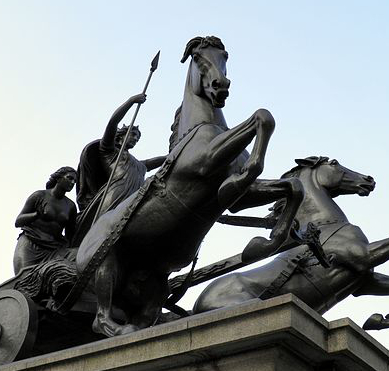 Gender and power are two very big and complicated topics. Put them together and you get something even bigger and complicateder. (Yes, I said “complicateder.” Deal with it.) They are also two topics that have become very important in a lot of contemporary speculative fiction. I’m not going to try to take on the whole subject here, but I would like to offer a few points that can be useful for thinking about gender, power, and how they fit both into the world we live in and into the worlds we write about.
Favorite Characters: Star Trek Edition
Favorite Star Trek characters. Go!
Star Trek (Original Series)
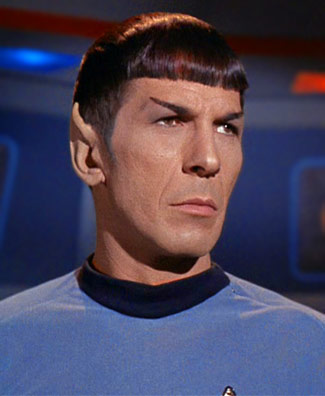 Erik: Mr. Spock. Hands down, Spock. When I first discovered the original Star Trek in afternoon reruns, I was in elementary school, the shy, quiet kid who spent recess reading and didn’t understand the social rules hat other kids lived by. I identified with Spock so hard. After growing up on cartoons that always stigmatized the smart characters as snooty, unsympathetic Brainy Smurf types, Spock was proof that being the thoughtful, unemotional observer of humanity could be awesome, too.
Eppu: This is a tough one. I don’t think I really have one. In general, I’m more drawn to the supporting characters in stories than the main character / protagonist, and ST:TOS is most definitely one of those cases. I find Kirk intolerable and McCoy a little too emotional for my preference, but the rest of the core cast offers more qualities I like: Spock’s cool head and nuggets of extremely dry humor; Uhura’s patience and dedication; Sulu’s enjoyment of life; Checkov’s nonchalance and ability to roll with the punches; Scotty’s inventiveness and flexibility in the face of an unrelenting barrage of technical problems.
The Next Generation
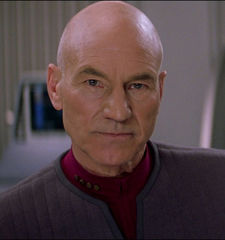 Erik: Captain Picard. I’ll admit, it’s mostly Patrick Stewart’s acting chops that make the character for me, but I love Picard’s gravitas, his cool head in a crisis, and his humanity. I came of age with Next Generation, in the post-Cold-War world that believed in hope and human progress, and despite what we have lived through in the last few decades, I still carry some of that optimism with me. Picard’s compassion and level-headedness are the solid ground on which the moral universe of Next Generation rests.
 Eppu: Guinan! She stares in the face of her people’s diaspora and stays serene, but is not shy about pulling out the rifle stashed behind the bar when needed. Even if she was written as a supporting cast member, Guinan gets some brilliant moments of character development, like when she begins to question her black-or-white attitude to the Borg in the season 5 episode I Borg. Also, Whoopi Goldberg’s performance is fa-bu-lous. Every scene where Patrick Stewart and Goldberg appear together, no matter how simple, is golden.
Deep Space Nine
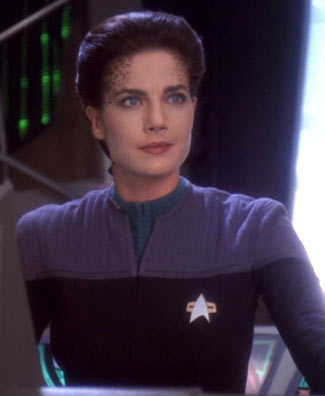 Erik: Jadzia Dax. Specifically the later-seasons’ Jadzia Dax: not the ethereal above-it-all beauty of the first season, but the wise-cracking, tongo-playing, bat’leth-slinging, unflappable smart-ass and scientist extraordinaire that she developed into by the third. Not that I’m much for practicing Klingon martial arts or playing Ferengi card games into the wee hours, but I love the self-possession with which she does everything. She reminds me of some of the great professors I had in college, the ones who loved teaching their subjects, did it with passion and commitment, and didn’t much care what anyone outside the classroom thought of them.
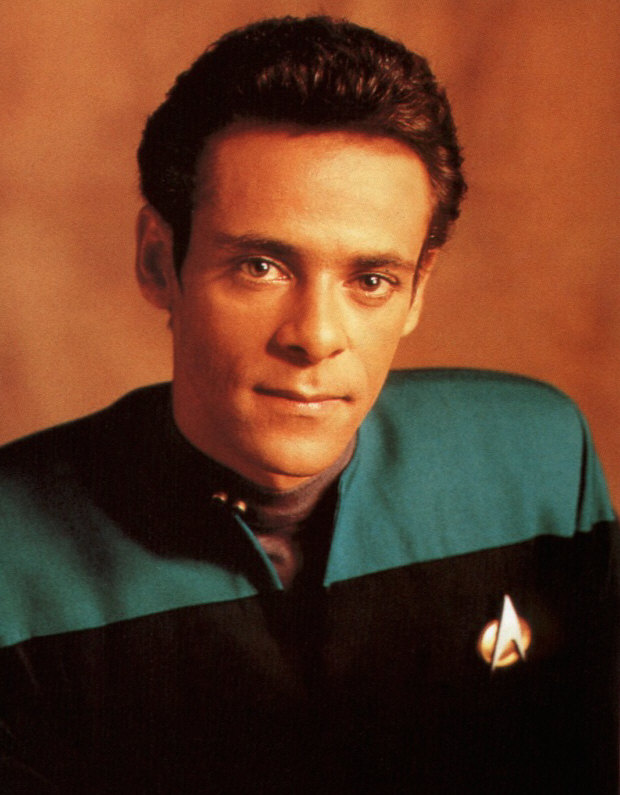 Eppu: Doctor Bashir. We rarely get to see such a full personal growth arc as we see with Bashir. When he arrived to the station, he was so wet behind the ears his whole being basically emanated green. To follow him from firmly planting his foot in his mouth in those early episodes, to his worshipful puppy-love towards Dax, to his growing confidence in his position and friendships, to adjusting to the fact that his much-appreciated intellectual abilities were grafted onto him in an illegal procedure and not in-born, to maturing into a confident, capable officer, supportive and loyal to his friends, is a delight. I also love Bashir’s relationship with Garak, and how the spy-turned-tailor educates our man Bashir about the larger world beyond the Federation.
Voyager
 Erik: Tuvok. Tim Russ did a masterful job taking up the Vulcan mantle from Leonard Nimoy. While many actors cast as Vulcans come off as robotic or bored, Russ’s Tuvok showed us that self-control can be just as interesting as unbridled passion. As someone who isn’t often emotionally expressive, it’s nice to see a similar character on screen (and without the presumption that he is damaged or needs to “loosen up.”)
 Eppu: Chakotay. He embodies quiet get-it-done effectiveness and deep emotions without being abrasive. Respectful towards and supportive of – even if not always in complete agreement with – Captain Janeway through thick and thin. It’s also very refreshing that no romance was artificially forced into the relationship between Janeway and Chakotay: they just slowly became and remained friends.
Enterprise
Erik: I don’t have one. The show never really worked for me, which is too bad, because I love the concept and some of the details. I kind of wish whoever owns the franchise now would stuff Enterprise into the memory black hole and start over from the basic concept of humanity’s first interstellar exploration and the founding of the Federation instead of the soulless reboot movies we’re getting.
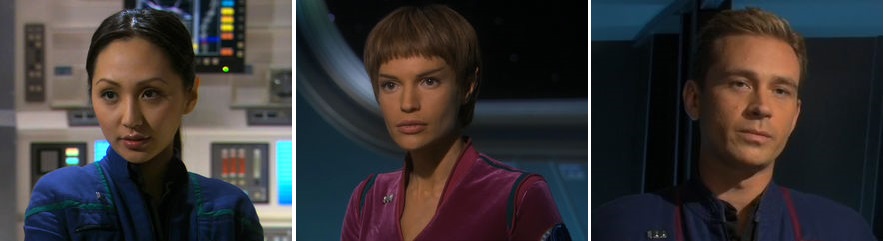
Eppu: Never saw all of it, and I don’t remember it well. As much as I can have a favorite character, it’s a three-way tie between Hoshi Sato, T’Pol, and Tucker.
Who are your favorites and why? Share in the comments!
Images: Spock via Memory Alpha. Picard via Memory Alpha. Guinan via Memory Alpha. Jadzia Dax via Memory Alpha. Julian Bashir via TrekCore. Tuvok via Memory Alpha. Chakotay via Memory Alpha. Hoshi Sato via Memory Alpha. T’Pol via Memory Alpha. Tucker via Memory Alpha
Creative Differences is an occasional feature in which we discuss a topic or question that we both find interesting. Hear from both of us about whatever’s on our minds.
World of Warcraft Class Theme Music
Some years ago, back on the old WoW Insider which is no more, there was once a fun post suggesting theme songs for the various character classes. As a classical music fan, I’ve tried to come up with a classical version of the same. Here are my suggestions.
Warrior – Bartok, Hungarian Suite “Bear Dance”
The warrior is an iconic archetype in role-playing games and the World of Warcraft version is much like its ancestors: a heavily-armed fighter who charges into the midst of battle. Bartok’s “Bear Dance” may sound more like a druid thing, but the music carries a feel of martial power fitting to a warrior.
“Bear Dance” via P. András
The Pre-Gunpowder Rock-Paper-Scissors
 Gunpowder changed the world. It took a while — the earliest gunpowder arms were too unwieldy and unpredictable to have much of an effect on the ways people fought, but in time the weapons got better and armies adapted their tactics and organization in response. Before firearms, though, the battlefield operated on a basic rock-paper-scissors relationship among three different types of troops: infantry, cavalry, and missile troops.
Before getting into the types of troops, we need to lay out a few things about pre-modern warfare.
Size Matters
 We got married in my small home town in New England, population about 3,000. In preparing to go get our license at the town office, we had gathered all the necessary documents to prove that we were who we said we were, that we were old enough, that we weren’t already married, and so on. We were all prepared to fill out paperwork and turn the slow gears of bureaucracy. When we walked into the office, though, the town clerk looked at us and said: “Oh, Erik, I saw your mother the other day and she said you’d be coming in for a marriage license. I’ve got it right here for you.” That’s life in a small town for you.
Small societies and large societies work in different ways. Historians and anthropologists have terms for categorizing different sizes of societies: bands, tribes, chiefdoms, and states. Like all such divisions, it’s a simplification, but it’s a useful one for getting a handle on how cultures of different scales work.
Some Random Thoughts on Jurassic World
In no particular order. Spoiler warnings in effect.

- There is a point at which running from killer dinosaurs in the jungle in heels crosses the line from “This character is a professional businesswoman who isn’t at ease with the wild nature of the animals she supervises” to “This character is a moron.” That point is: the very moment you start running from killer dinosaurs in the jungle in heels.
- The only time Claire actually seems to know what she’s doing is when she’s coordinating things in the control room. This movie could have been much better if Owen had stayed out in the field doing what he’s good at and Claire had stayed in the control room doing what she’s good at. Or maybe have Claire in the field and Owen in the control room, each of them desperately trying to coach the other through a job they’re not prepared for. As it is, it feels too much like the script is saying: “Silly woman, stop trying to do a man’s job.”
- Kids are annoying. Badly-behaved kids are even more annoying. Badly behaved kids who run away from the adults who are supposed to be taking care of them (even if those adults are doing a crummy job of it) are annoyinger still. That said, these particular kids were a tiny bit less annoying than they could have been. They were still pretty annoying, though.
- The nods to the original Jurassic Park were for the most part nicely done and not too obtrusive. I have a fond nostalgia for the original movie (not so much the first two sequels), and I was touched.
- That said, what made the original Jurassic Park work so well was that the dinosaurs were not characters. They were animals. They didn’t have motivations beyond the animal drives to hunt and defend their territory. The raptors’ stealthy pack hunting was the limit of their intellectual abilities. They were easy enough to understand; what made them scary was mass, speed, claws and teeth. It didn’t matter if you were smarter than a dinosaur. All the smarts in the world didn’t make you any bigger, faster, or less squishy. The sequels have turned the dinosaurs into characters and it has not served them well. Jurassic World is the worst yet in this regard. When a giant dinosaur starts just messing with the humans (decoy tactics, camouflage, velociraptor subversion), it becomes less scary because it’s entering a contest of smarts, not power, and that’s a fight Indominus rex can’t win, no matter what genes they spliced into that thing.
- Either that dinosaur is bulletproof or In-Gen is recruiting straight from the Imperial Stormtrooper Marksmanship Academy. Either way, bad move, guys.
- Rolling fields full of Apatosaurs, Stegosaurs, and Triceratopses can still send me straight to six-year-old bliss land, and this movie delivers.
- I’m of two minds about the Mosasaurus-ex-machina ending. On one hand, it was well set up and executed. On the other hand, after bringing the old T. rex onto the field, it feels like a Hail Mary too far.
- If ever there was movie calling out for a “sudden but inevitable betrayal” joke, this was it. We got robbed.
- Watching the trailers, I nursed a hope that Bryce Dallas Howard’s character was a grown-up Lexie from Jurassic Park. Nope.
- The movie is better than The Lost World and Jurassic Park 3 and feels like a worthy successor to the original. It’s still one competent professional woman, one hurricane, and one Samuel L. Jackson short of measuring up.
Image via comingsoon.net.
In the Seen on Screen occasional feature, we discuss movies and television shows of interest.
The Black Widow Movie We Have
I know I’m not alone in wanting a Black Widow movie, but it seems pretty clear that we’re not getting one. Marvel films have been announced out to 2019 and there’s nothing in sight with our favorite red-headed assassin in the lead. So, since we’re not getting the Black widow movie we want, we will have to make do with the Black Widow movie we have. Here’s what we’ve got:
 Co-Geeking


You must be logged in to post a comment.