Quotes: I Only Regret […] Making My Detective a Finn

Christie Cards on the Table Excerpt

“[…] I only regret one thing—making my detective a Finn. I don’t really know anything about Finns and I’m always getting letters from Finland pointing out something impossible that he’s said or done. They seem to read detective stories a good deal in Finland. I suppose it’s the long winters with no daylight.”

– author Mrs. Oliver in Agatha Christie’s Cards on the Table

This excerpt comes from a Hercule Poirot novel. It’s a page-long burst by an imaginary author who doesn’t really care about getting certain details wrong, for example when one would use a dictograph vs. phonograph. That, of course, leads to feedback from more knowledgeable readers.

Being a Finn, I guffawed! Finns are busy readers indeed these days; it may already have been the case back in the 1930s as well.

(But, good grief, way to insult Romanians and Bulgarians, Christie! There’s a lot of interest in Christie’s writing, but on the other hand a lot of it hasn’t aged well, especially the racism and bigotry.)

Christie, Agatha. Cards on the Table. New York, NY: HarperCollins Publishers, 2011 [1936], p. 66.

Image by Eppu Jensen

Serving exactly what it sounds like, the Quotes feature excerpts other people’s thoughts.

In Defense of Peter Jackson’s Hobbit Trilogy

There’s a lot wrong with Peter Jackson’s Hobbit trilogy, make no mistake. It is an overstuffed, poorly structured jumble of unnecessary action sequences, juvenile humor, and tedious subplots, all ending in an interminable final battle that makes neither narrative nor tactical sense. Still, not all the problems are of Jackson’s making, and there are some things it does right that deserve notice.

Many of the structural weaknesses in the plot come from Tolkien’s original. The Hobbit was a children’s book about Bilbo Baggins and a band of Dwarves having a series of random encounters on their way to a spectacularly poorly planned heist. The characters are for the most part so flat as to be interchangeable and the plot is little more than an excuse to trundle from one retold Nordic folktale to another. I loved the book as a child and I still have a great fondness for it, but it does not have the depth or cohesion of The Lord of the Rings. Jackson’s writing team put in heroic efforts to make thirteen distinct characters out of Tolkien’s lyrical list of Dwarf names and to fill in much of the background story that makes sense of Bilbo’s disjointed adventures. (To be fair, this fleshing-out work is also the source of many of the movies’ problems. On one hand, developing the Dwarves’ characters too often just provided more opportunities for out-of-place slapstick. On the other hand, filling in the gaps in Tolkien’s plot led to inventing new characters, which Jackson’s team too often fell in love with and allowed to take over the story.)

Despite these problems, some of the best moments in the trilogy are iconic scenes from Tolkien’s original that were put on screen with very few changes. Scenes like Bilbo’s riddling contest with Gollum in the depths of the Misty Mountains, Gandalf’s wily approach to Beorn, and Bilbo’s conversation with Smaug are rendered with a fidelity that shows a real love and respect for Tolkien’s creation. They are a delight to watch, even if they can’t make up for the rest of the films around them.

Even the less authentic scenes are often elevated by the quality of the performances. Ian McKellen, Hugo Weaving, Cate Blanchett, and Christopher Lee reprise their roles as Gandalf, Elrond, Galadriel, and Saruman with intelligence and gravitas. Andy Serkis gets to present a less desperate, more playful version of Gollum while Orlando Bloom performs a younger Legolas who is, as Tolkien said of the Mirkwood Elves, “more dangerous and less wise” than the character we remember from The Lord of the Rings. The newcomers to the series give it their best, too. Martin Freeman shows us how Bilbo finds his courage and taste for adventure without ever losing his Hobbitish love of home and comfort. The Dwarf actors, for all that they mostly get used for broad comedy, give their characters an individuality and personality that Tolkien never did. Benedict Cumberbatch is smoothly menacing as the voice of Smaug. Sylvester McCoy’s Radagast does a bit too much slapstick, but he also gives us a wild fresh take on wizardry that sits at the other end of the spectrum from Saruman’s aloof grandeur.

The sets, props, costuming, and other art direction live up to the high standards set by Weta in the first trilogy. From the ancient depths of Erebor to the workaday fishing village of Lake Town, from the rugged traveling gear of the Dwarves to the cold glamour of the Elvish king Thranduil, there isn’t a place, character, or object on screen that doesn’t show the art department’s commitment to creating a world that feels real and lived-in. Over it all, Howard Shore’s music is as rich and operatic as ever.

But the best thing about the Hobbit trilogy, though, the thing that redeems the whole troubled production and its many missteps, is not the films themselves but the discs full of extras that come with the extended editions. Most studios are content to slap in a few deleted scenes, a handful of trailers for unrelated movies, and maybe a couple five-minute promo interviews with the big-name stars talking about how awesome the movie is (seriously, movie studios, you don’t need to market your movie to the people who have already bought the DVD), but not Jackson & Co. Each of the Hobbit films comes with hours upon hours of in-depth documentaries on every aspect of the production, from concept art to final edits. These documentaries do more than go behind the scenes in the usual self-promoting Hollywood way. They also show us the false starts, the mistakes, the ideas that went nowhere and the things that went seriously wrong. You get a fuller appreciation of the good things in the movies when you see how hard it was to get some of them on screen.

The extra features are also well designed for usability. Everything is subtitled, which is great for those of us who don’t always hear well. The menus are easy to use and it’s obvious which item you’re choosing, unlike some discs which make you do a lot of tedious scrolling back and forth and use only a slight difference in color to tell you what button you’re about to hit. Every section tells you how long it is, so you can plan your watching accordingly. The Hobbit extras are the gold standard of how to do bonus features and I wish that more studios and franchises would take as much care both in what they offer for extra material and the functionality of their products.

The Hobbit trilogy is not great cinema. The whole does not measure up to the sum of its parts, but some of those parts are in themselves fascinating and beautiful. They make it worth going there and back again.

Image: Promotional still from The Hobbit: An Unexpected Journey via IMDb

In the Seen on Screen occasional feature, we discuss movies and television shows of interest.

Gender-Flipped Black Panther

One of the great things about Black Panther is that it allows plenty of room for both male and female characters, but what if we flipped them? Here’s our imaginary cast for a gender-flipped Black Panther.

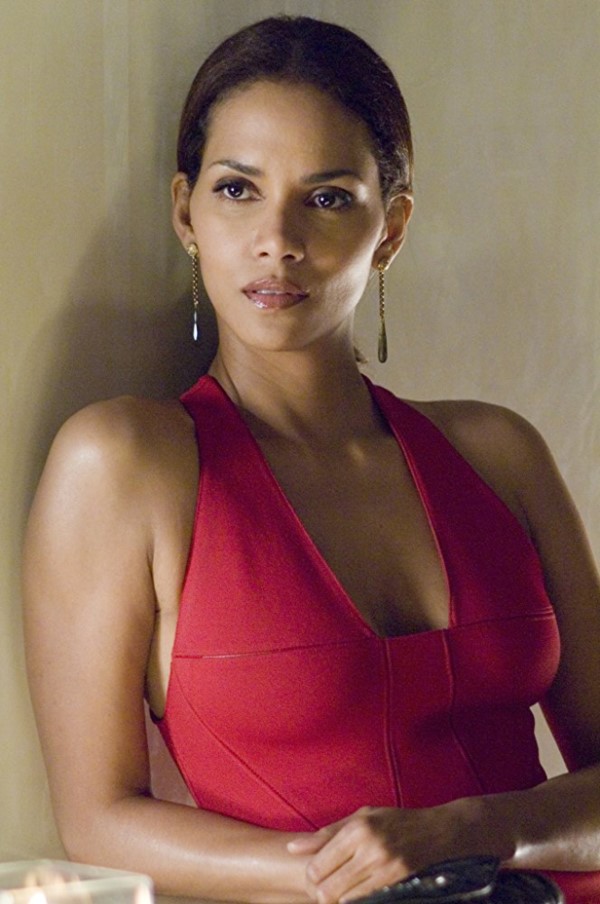
Halle Berry as T’Challa / Black Panther

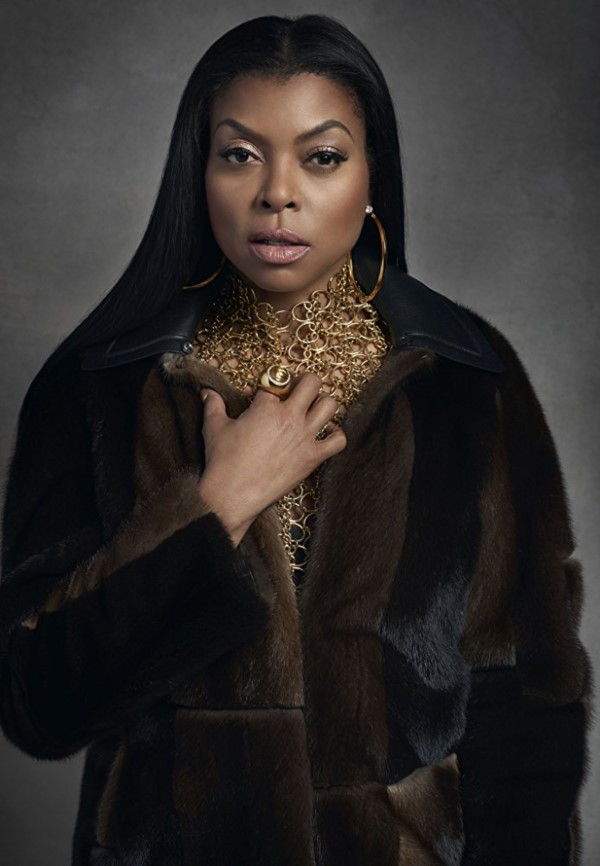
Taraji P. Henson as Killmonger

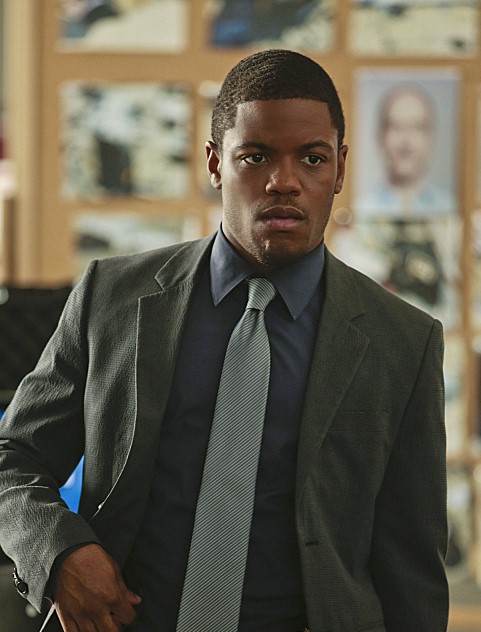
Jon Michael Hill as Nakia

Idris Elba as Okoye

Emily Blunt as Eve Ross

Alfre Woodard as W’Kabi

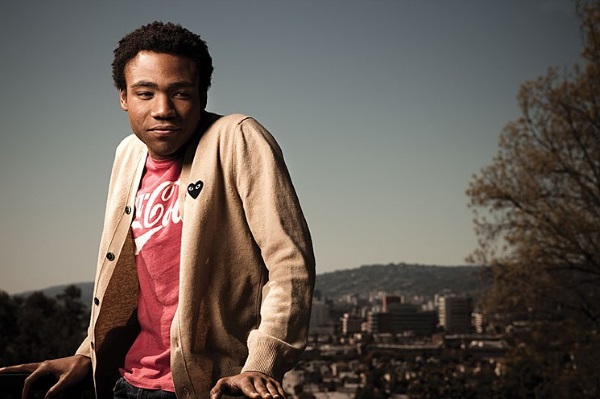
Donald Glover as Shuri

LA Weekly Donald Glover

Ann Wolfe as M’Baku

IMDB Ann Wolfe in Wonder Woman

Whoopi Goldberg as Zuri

IMDB Whoopi Goldberg in Ghost

Denzel Washington as Ramonda

IMDB Denzel Washington in The Book of Eli

Amanda Abbington as Penelope Klaue

Fandom Observations Amanda Abbington in Sherlock

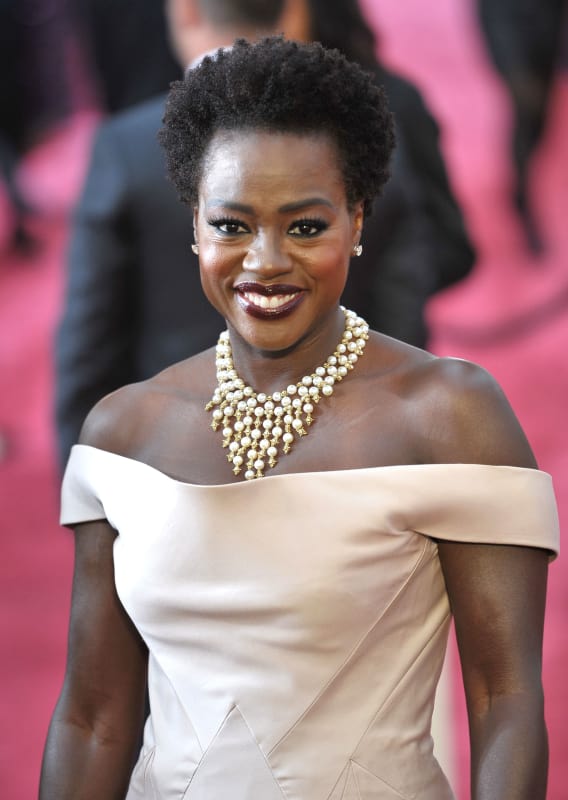
Viola Davis as T’Chaka

The Hollywood Gossip viola-davis-at-the-2015-oscars

Images: Halle Berry in Perfect Stranger via IMDB. Taraji P. Henson in Empire via IMDb. Jon Michael Hill in Elementary via IMDb. Idris Elba in Pacific Rim via IMDb. Emily Blunt in The Five Year Engagement via IMDb. Alfre Woodard in Luke Cage via IMDb. Donald Glover via LA Weekly. Ann Wolfe in Wonder Woman via IMDB. Whoopi Goldberg in Ghost via IMDB. Denzel Washington in The Book of Eli via IMDB. Amanda Abbington as Mary Watson in BBC’s Sherlock via Fandom Observations. Viola Davis at the 2015 Oscars via The Hollywood Gossip.

Creative Differences is an occasional feature in which we discuss a topic or question that we both find interesting. Hear from both of us about whatever’s on our minds.

A Wonder Woman – Renaissance Garb Crossover

Jenn at Ms. Makes mashed up Wonder Woman and Renaissance garb with brilliant results:

Instagram Msjennmakes Wonder Woman Renaissance Full
Ms. Jenn Makes on Instagram; photo by Angela (wanderings_in_wonderland).
Instagram Msjennmakes Wonder Woman Renaissance Portrait
Ms. Jenn Makes on Instagram; photo by Angela (wanderings_in_wonderland).

It’s a version of late fifteenth century Florentine dress. Jenn describes the details:

“The outfit is based on those common in 1490’s Florence, largely documented by Domenico Ghirlandaio, and consists of a camicia, side lacing gamurra (with bead and sequin embellished neckline decoration), a set of tie on sleeves (also embellished), a velvet giornea, and a #tambourbeading embellished and faux leather belt! Other accessories include a lasso holder, faux hair braid, and a diadem […]”


She also shared some details of the costume, like the beaded collar piece

Instagram Msjennmakes Wonder Woman Renaissance Neck Beading
Ms. Jenn Makes on Instagram.

…and detachable sleeves, lined, with another set of embellishments from Wonder Woman’s costume:

Instagram Msjennmakes Wonder Woman Renaissance Sleeves
Ms. Jenn Makes on Instagram.

 Absolutely breathtaking! Jenn mentions using a beading technique called tambour beading, which I hadn’t heard of before. I just love learning new things from my fellow textile geeks!

Visit Jenn’s Instagram for more views and details or the Ms. Makes website for more sewing talk and tips.

This post has been edited.

Images from Instagram: full view and portrait by Angela (wanderings_in_wonderland) via Ms. Jenn Makes. Collar detail and sleeves by Ms. Jenn Makes.

In Making Stuff occasional feature, we share fun arts and crafts done by us and our fellow geeks and nerds.

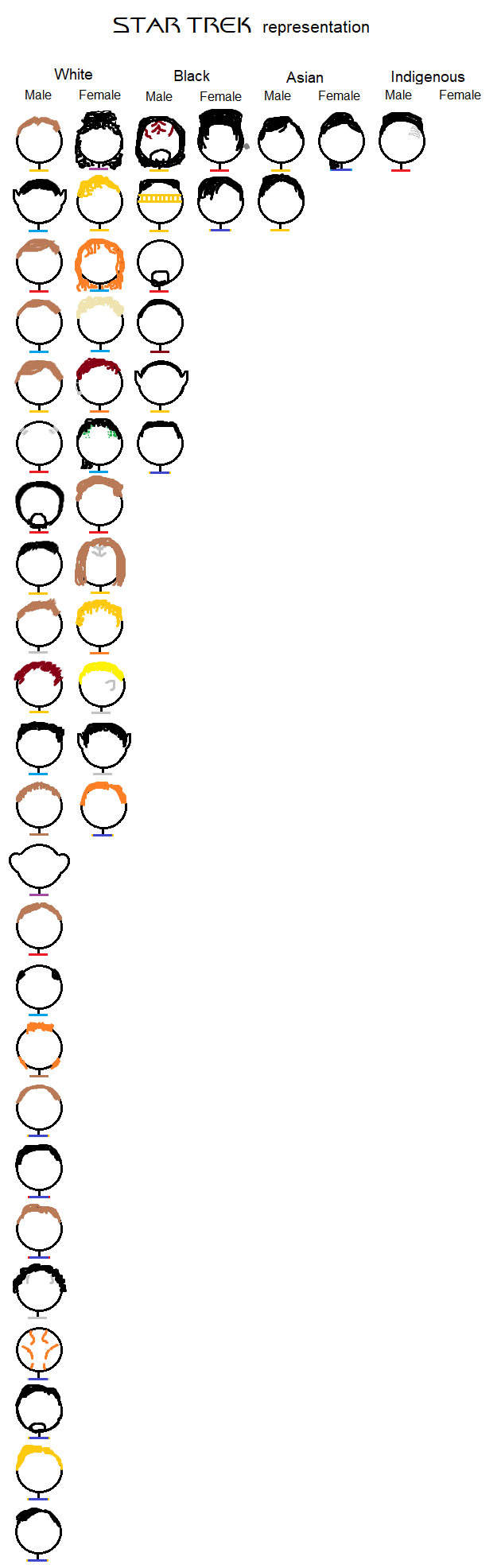
Representation Chart: Star Trek

We all know that the representation of people of different genders and races is imbalanced in popular media, but sometimes putting it into visual form can help make the imbalance clear. This is the first of a series breaking down, in basic terms, who’s represented and who isn’t.

Here’s Star Trek. I’ve included the credited main cast from all the live-action television series.

Notes

Characters included

  • Star Trek: Kirk, Spock, Scotty, McCoy, Checkov, Uhura, Sulu
  • Star Trek: The Next Generation: Picard, Riker, Data, Wesley, Troi, Yar, Crusher, Pulaski, Worf, La Forge
  • Star Trek: Deep Space Nine: O’Brien, Bashir, Odo, Quark, Kira, Dax, Sisko, Jake
  • Star Trek: Voyager: Paris, Doctor, Neelix, Janeway, Torres, Kes, Seven, Tuvok, Kim, Chakotay
  • Star Trek: Enterprise: Archer, Reed, Tucker, Phlox, T’Pol, Mayweather, Sato
  • Star Trek: Discovery: Saru, Tyler, Stamets, Lorca, Tilly, Burnham

Corrections and suggestions welcome.

Rules

In the interests of clarity, here’s the rules I’m following for who to include and where to place them:

  • I only count characters portrayed by an actor who appears in person on screen in more or less recognizable form (i.e. performances that are entirely CG, prosthetic, puppet, or voice do not count).
  • For human characters that can be reasonably clearly identified, I use the race and gender of the character.
  • For non-human characters or characters whose identity cannot be clearly determined, I use the race and gender of the actor.
  • I use four simplified categories for race and two for gender. Because human variety is much more complicated and diverse than this, there will inevitably be examples that don’t fit. I put such cases where they seem least inappropriate, or, if no existing option is adequate, give them their own separate categories.
  • “White” and “Black” are as conventionally defined in modern Western society. “Asian” means East or South Asian. “Indigenous” encompasses Native Americans, Polynesians, Indigenous Australians, and other indigenous peoples from around the world.
  • There are many ethnic and gender categories that are relevant to questions of representation that are not covered here. There are also other kinds of diversity, including sexuality, language, disability, etc. that are equally important for representation that are not covered here. A schematic view like this can never be perfect, but it is a place to start.

Messing with numbers is messy.

A Random Find: Ancient and Early Medieval Persian or Iranic Women’s Clothing

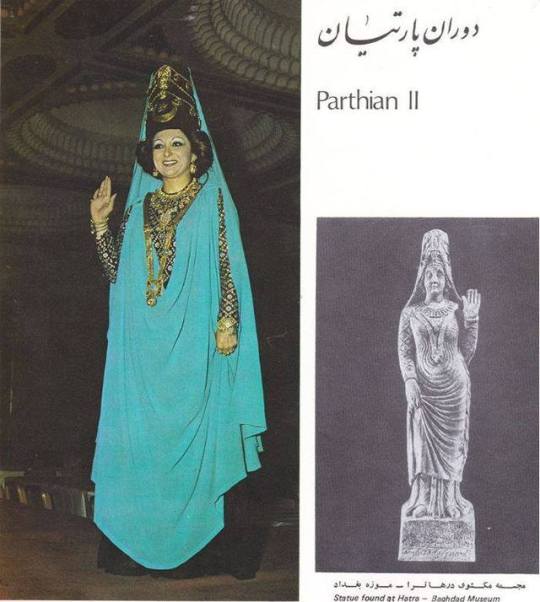
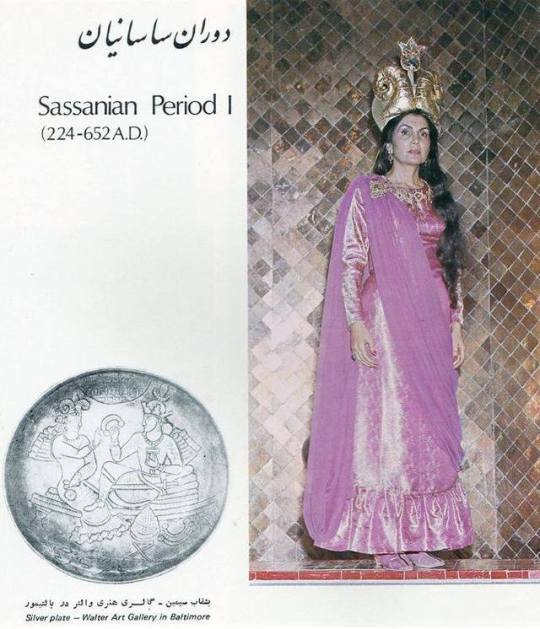
I randomly ran into a collection of recreations of Persian or Iranic women’s clothing from different eras, from ancient times to a few hundred years ago. Below are the five oldest outfits.

Tumblr Non-West Hist Persian Iranic 2nd Millenium BC
“Second Millennium B.C. From the collection of Ph. Ackerman”

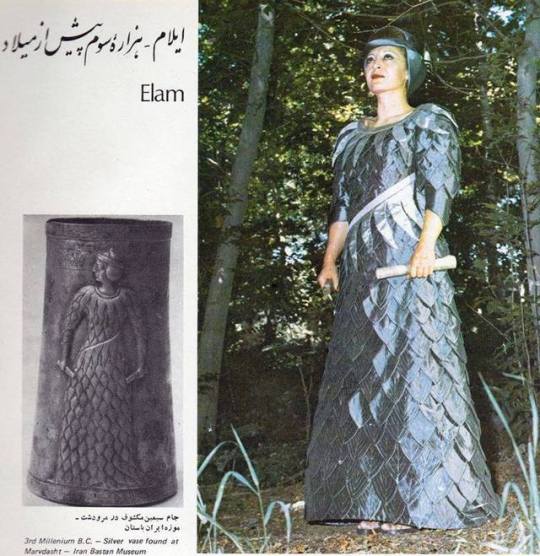
Tumblr Non-West Hist Persian Iranic Elam
“Elam. 3rd millennium B.C. – Silver vase found at Marvdasht – Iran Bastan Museum”

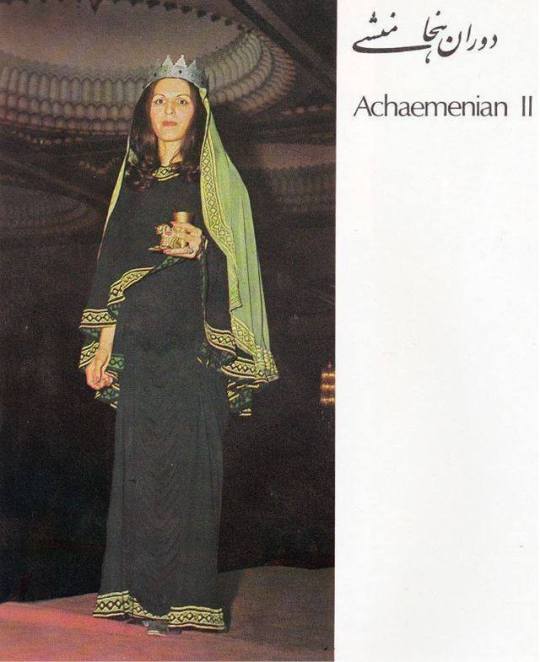
They seem to be images of modern interpretations based on artwork of various kinds: statuettes, carvings, reliefs, paintings, and drawings.

Tumblr Non-West Hist Persian Iranic Achaemenian
“Achaemenian II”

Tumblr Non-West Hist Persian Iranic Parthian
“Parthian II. Statue found at Harta – Baghdad Museum”

Tumblr Non-West Hist Persian Iranic Sassanian
“Sassanian period I (224-652 A.D.). Silver plate – Walter Art Gallery in Baltimore”


Aren’t they fascinating? The images clearly come from a print publication, but apart from that I unfortunately don’t have any source information.

I don’t know much about these eras and areas, but I can’t escape the impression that these recreations may be relatively old and, perhaps, not entirely reliable. For instance, the Sassanian dress seems very polyester-like (too shiny). On the other hand, a lot of the draping looks very plausible. It would be so interesting to read an analysis on each outfit by the researchers / creators.

I’ve long been into early history, specifically of textiles and clothing, usually the older the better. Sadly, it’s an area that we tend to have very spotty evidence. I’m so glad digitization and the Internet help get more information out to interested audiences. There are so many more sources and preserved fragments than many may realize, and now we get to see them!

Images found via Non-Western Historical Fashion on Tumblr.

Out There is an occasional feature highlighting intriguing art, spaces, places, phenomena, flora, and fauna.

Race in Antiquity: Who Were the Greeks?

“What race were the ancient Greeks and Romans?”

It sounds like a simple question that ought to have a straightforward answer, but both the question and its answer are far more complicated than they appear. In these posts, I dig into the topic to explore what we know, what we don’t know, and what we mean by race in the ancient Mediterranean world.

Part 5: Who Were the Greeks?

As we have discussed before, modern racial categories are not easy to apply to the ancient Mediterranean world. Ancient peoples like the Greeks and Roman had complicated ideas about their own identities, but those ideas do not readily line up with the ways in which we modern people define race. If we want to better understand the identity of the ancient Greeks—in ancient or modern terms—we first have to know who we’re talking about. That may sound like a silly question. Isn’t the answer obvious? The Greeks! But who was a Greek?
This is a more difficult question than it may seem. In the modern world, nations have citizenship laws to regulate who is, say, an American, a Canadian, a Belgian, etc. Even today, though, not everyone’s identity is easily defined. Immigrants, expatriates, refugees, and other people who travel between nations can have complicated relationships to the places they come from and the places they end up. Individual feelings and societal attitudes are not always in line with the letter of the law.

The situation was even more complicated in ancient Greece. The people of ancient Greece were never politically unified on their own initiative. Individual city-states like Athens, Sparta, Corinth, and Thebes had their own citizenship laws, but these regulations varied widely between cities and changed in response to political pressures. Spartans who fled from battle could lose their citizenship. In Athens, challenging a rival’s citizen status was a common tactic in the tussle of political and family feuding. New citizens were enfranchised to serve political and military needs. The nearest thing there was to a central arbiter of Greekness was the Hellanodikai, the judges who oversaw the Olympic Games, in which only Greeks were allowed to compete. The judgments they made, though, were individual and only applied to the athletes. Decisions could also be swayed by political considerations: the Hellanodikai judged King Alexander I of Macedonia (great-great-great-grandfather of Alexander the Great) to be a Greek, while holding that the people of Macedonia themselves were not. (Herodotus, Histories 5.22)

The standards used for arguing about Greekness could also change with time and circumstances. In the sixth century BCE, most discussions of Greek identity were framed in terms of descent, specifically descent from particular mythic ancestors. The crucial figure was Hellen (a son of either the god Zeus and a human woman, Pyrrha, or Pyrrha and a human man, Deucalion—and not to be confused with the beautiful Helen, who sparked the Trojan War). Those who claimed descent from Hellen were counted among the Greeks, while those who did not were excluded. One of the fullest renderings of this tradition is in the poem known as the Catalogue of Women, a sixth-century poem known today only in fragments, which presented an account of the Greek heroic age structured around the genealogies, marriages, and progeny of certain women. This poem identified various groups of Greeks with three sons of Hellen: Dorus, Xuthus, and Aeolus.

The Catalogue, though, was not the final word on Greekness. As a primarily oral tradition, Greek myth had no canonical texts, and the family lines of gods and heroes were always up for debate. Other sources rearranged the family trees to change the determination of who did or did not count as Greek. (Thucydides, History 2.80.5-6; Pausanias, Description of Greece 1.11.1) Nor did ancestry remain the only way of asserting Greek identity. In the fifth century, many writers also began to refer to shared language, culture, and ways of life as defining who was Greek. (Herodotus 8.144) By the fourth century, we find the Athenian orator Isocrates explicitly rejecting common ancestry as a way of determining who was a Greek or not:

[Athens] has caused the name of “Greek” to apply not to a tribe but to a way of thought, so that those who are called Greeks are those who share our education rather than those who share our origins.

– Isocrates, Panegyric 50

(All translations my own)

In the Successor Kingdoms of the Hellenistic age (the remnants of Alexander’s empire in the Aegean, Egypt, and southwestern Asia), Greekness took on new meanings. In Egypt under the Ptolemaic kings, “Greek” was an administrative rather than ethnic designation applied to anyone who was not a native Egyptian. Thus not only immigrants from Greece and Macedonia were classed as “Greeks,” but also, for instance, Jews, Syrians, and Persians. Being designated Greek carried certain legal and tax benefits, so even members of the native Egyptian aristocracy who supported the Ptolemaic regime were granted Greek status. In the Seleucid kingdom, centered on Mesopotamia and Syria, Greekness was a communal rather than individual status. Certain cities founded by immigrants from Greece and Macedonia were recognized as “Greek,” which brought some administrative benefits to everyone who lived there, regardless of their origins.

Many different people lived with identities that were more complex than simply “Greek” or “not Greek.” From the seventh century BCE on, many individuals with special skills left the small, economically underdeveloped cities of the Aegean to find employment elsewhere, including mercenaries, physicians, courtesans, artisans, and actors. These emigrants settled in places ranging from the Iberian peninsula to the Iranian plateau and integrated themselves into local societies. Their descendants tended to adopt local names, languages, and cultures, such as Wahibre-em-Akhet, the son of two Greek-named parents who was buried in Egypt in a traditional Egyptian sarcophagus. Larger groups of emigrants founded colonies around the Mediterranean and Black Seas. While some of these colonies asserted a strong sense of Greek identity, many had more complex cultures, such as the Geloni of the Black Sea steppes, a fusion of Greek settlers and local peoples who spoke a Greek-Scythian creole language. (Herodotus 4.108)

Many people from the greater Mediterranean world also settled in the Greek cities of the Aegean. By the fourth century BCE there were Egyptian and Thracian immigrant communities in Athens that were substantial enough to successfully petition for the right to build temples to their own goddesses, Isis and Bendis. (Inscriptiones Graecae II2 337) The Carthaginian philosopher Hasdrubal moved to Athens and, in 129 BCE, became head of Plato’s Academy. Like Wahibre-em-Akhet in Egypt, Hasdrubal accommodated himself to the local culture by adopting the Greek name Clitomachus. (Cicero, Academica 2.31; Diogenes Laertius, Lives and Opinions of Eminent Philosophers 4.10) At the other end of the social scale, the Aegean cities of Delos and Rhodes were major centers for the slave trade. Captive people from origins stretching from Gaul to Persia and Scythia to Egypt are recorded passing through their harbors. Farther afield, Hellenistic-era Jews claimed to have proof that they shared a common ancestry with the Spartans and that sons of the Jewish patriarch Abraham had accompanied the Greek hero Heracles on his adventures. (1 Maccabees 12.5-23; Josephus, Jewish Antiquities 1.240-41, 12.225-27)

Greek culture and identity did not stand alone and aloof from others. The sense of cultural interconnection and flexibility was expressed in Egypt by a poem written in Greek but addressed to the Egyptian goddess Isis which explicitly identified Isis with the goddesses of several other peoples:

The Syrians call you Astarte, Artemis, and Nanaia,

the people of Lycia address you as Queen Leto,

men of Thrace call you the mother of the gods,

and the Greeks name you great-throned Hera, sweet Aphrodite,

good Hestia, Rhea, and Demeter,

but the Egyptians call you The Only One, for you are the one who is all

other goddesses named by humanity.

– Supplementum Epigraphicum Graecum 8.584.18-24

The multiplicity of ways in which Greekness could be claimed may be best exemplified by comparing two examples. On one hand, there were descendants of Hellenistic settlers in India in the last centuries BCE and early centuries CE who had assimilated into Indian culture but who still identified themselves as “Yavana,” the word for Greek in the local language. This term appears in inscriptions on offerings made to Indian gods in local temples. In terms of culture, language, and ways of life, these Yavana had become thoroughly Indian; it was only through their ancestry that they still identified as Greek. On the other hand, the philosopher Favorinus, in the second century CE, argued that he counted as Greek despite his Gaulish ancestry because he had adopted a Greek culture, language, and way of life. (Favorinus, Corinthian Oration 25-26)

Greekness was never a racial identity; it was a cultural identity, and one that was open to many different interpretations, not all of them compatible with one another. Any questions we ask about the racial identity of the ancient Greeks are bound to have complex answers. Nor are we, as modern people, in a position to dispute the lived and felt identities of ancient peoples. To impose our own rules on whose Greekness was legitimate and whose was not would simply be begging the question. The idea that people can be categorized into coherent ethnic groups with well-defined boundaries that were stable over time and across great distances is a figment of the imperialist and Romantic nationalist imagination. If we are serious about investigating the identity of the ancient Greeks, we have to be prepared for the bewildering and irreducible complexities involved in defining exactly who we mean.

Other posts on Race in Antiquity:

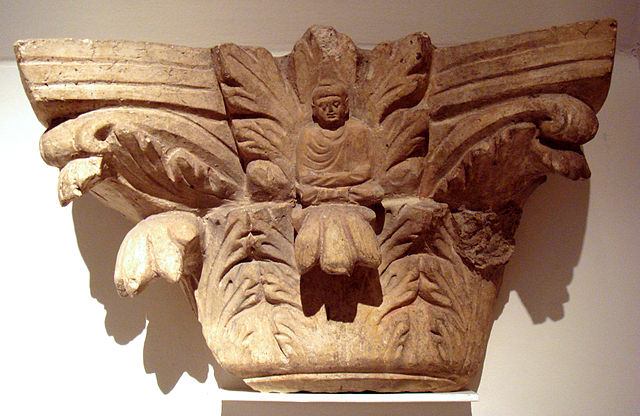
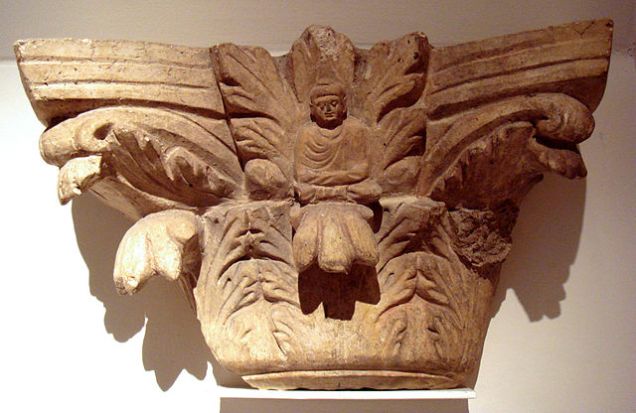
Image: Corinthian capital with seated Buddha, via Wikimedia (originally Gandhara, currently Musée Guimet, Paris; 3rd-4th c. CE; stone)

History for Writers is a weekly feature which looks at how history can be a fiction writer’s most useful tool. From worldbuilding to dialogue, history helps you write. Check out the introduction to History for Writers here.

Trailers for Solo: A Star Wars Story

Another Star Wars franchise singleton movie is about to hit the big screen: Solo: A Star Wars Story opens May 25, 2018. Here’s the first trailer (from February):

Solo: A Star Wars Story Official Trailer by Star Wars

And the second (from April):

Solo: A Star Wars Story Official Trailer by Star Wars

I’m not entirely sure what to think on the basis of the trailers. Alden Ehrenreich sure ain’t got Harrison Ford’s charisma, but perhaps that’s because we are only seeing very short snippets. It’s also impossible to tell how big of a part Donald Glover’s Lando Calrissian will have; I hope the writers are not only using him for a quick and dirty “this is how Han got the ship now bye” scene. Emilia Clarke’s Qi’Ra seems both competent and charming. And I believe this is the second time my fellow Finn Joonas Suotamo gets to portray Chewbacca on his own (without coaching by Peter Mayhew).

Solo: A Star Wars Story | “190 Years Old” Clip by Star Wars

Yay, Joonas!

Like with Rogue One, the special effects and directing look stunning, so at least there’ll be that. Here’s hoping the writing will also work.

Two more weeks!

Hey, look! We found a thing on the internet! We thought it was cool, and wanted to share it with you.

Rating: Doctor Who, Season 7

We’re back at it, rewatching and rating season 7 of new-series Doctor Who. Here’s our take on this season’s episodes:

  1. “The Doctor, the Widow, and the Wardrobe” – 1.5
  2. “Asylum of the Daleks” – 6
  3. “Dinosaurs on a Spaceship” – 5
  4. “A Town Called Mercy” – 5
  5. “The Power of Three” – 2
  6. “The Angels Take Manhattan” – 3
  7. “The Snowmen” – 6.5
  8. “The Bells of Saint John” – 6.5
  9. “The Rings of Akhaten” – 3
  10. “Cold War” – 5
  11. “Hide” – 6.5
  12. “Journey to the Center of the Tardis” – 2
  13. “The Crimson Horror” – 4
  14. “Nightmare in Silver” – 4
  15. “The Name of the Doctor” – 3

The average rating for this season is an unimpressive 4.2, a slight comedown from season 6’s 4.4, though better than season 5’s 3.7. On the whole, this season just feels half-baked. There are some great ideas here that are just wasted on meandering, unfocused, episodes. An evil living sun! A Martian warrior on a Soviet submarine at the height of the cold war! Dinosaurs on a freakin’ spaceship! All of these ideas must have sounded great when first pitched, but the episodes developed from them just feel like underdeveloped first drafts. There are also some episodes that start out with great potential and then just flop. Mysterious black cubes appear all over the world and no one knows what they do! A pulp crime novel predicts the future! Despite their promising starts, these episodes just fizzle out in the end. Many of these episodes feel like they could have been standouts if more attention had been paid to developing the script.

At the bottom of the heap this time around is the Christmas episode “The Doctor, the Widow, and the Wardrobe,” at 1.5, about the Doctor trying to inject some delight into the lives of a grieving family by giving the children a magical trip to a winter wonderplanet. This episode’s problems are many, including misplaced comedy, uninteresting characters, and mediocre child acting. The biggest problems, though, run deeper. The whimsy is forced, and the story never quite decides how close it wants to hew to the C. S. Lewis original. Unlike some of this season’s other disappointing episodes, it’s hard to see this one’s problems being solved with another draft or two.

For best episodes of the season, it’s a three-way tie among “The Snowmen,” “The Bells of Saint John,” and “Hide,” all at a decent-if-not-outstanding 6.5. “The Snowmen” finds the Doctor grieving the loss of his companions Amy and Rory by hiding out in Victorian London, while sentient snow threatens a family whose governess is one version of Clara Oswald. “The Bells of Saint John” brings the Doctor and Clara together properly with a story of a nefarious company stealing people’s minds through wi-fi. “Hide” is a ghost-hunting story with a time-travel twist.

All of these episodes have their strengths. “The Snowmen” does a better job playing with it’s Mary Poppins inspiration than “The Doctor, the Widow, and the Wardrobe” does with Narnia. It also allows Clara’s character plenty of room to breathe and brings back the ever-delightful Madame Vastra, Jenny, and Strax. “The Bells of Saint John” is a tightly-paced paranoia thriller with lots of good action (even though the wi-fi mind-stealing plot never makes the least bit of sense). “Hide” begins as an atmospheric haunted house story that slowly unfolds to reveal surprising layers of complexity. While they all could have done with a bit more development, there are satisfying moments in each.

There are also some good long-term developments this season. Curious, resourceful Clara is a much more enjoyable companion to watch than Amy the bully. There is also much less hero-worshiping of the Doctor than in previous seasons.

That’s our take on Doctor Who‘s seventh season. What’s yours? Do you have favorites (or unfavorites) this season? Let us know!

Image: Doctor Who Season 7 cover via IMDb

In the Seen on Screen occasional feature, we discuss movies and television shows of interest.

Quotes: The Brain Requires a Constant Flow of Oxygen. Or Tea

“The brain requires a constant flow of oxygen. Or tea.”

– Dr. Ogden in Murdoch Mysteries s. 3 ep. 10, “The Curse of Beaton Manor” (written by Paul Aitken)

That certainly was my mood this morning. Still not quite sure I’m awake a few hours afterwards…!

Introverted Tea Mug

Image by Eppu Jensen

Serving exactly what it sounds like, the Quotes feature excerpts other people’s thoughts.