Racism and Ancient Aliens

The notion that ancient monuments, myths, and artworks reflect the visitation of Earth by alien beings is not one that is taken very seriously in the world of scholarly history, nor much outside of it, either. Still, it is one of those fictions, like astrology or vaccine scares, that continue to float through popular culture and appeal to some people because they offer simple answers to difficult questions. Who built the pyramids? Who drew the Nazca lines? Aliens!

It’s easy to dismiss ancient aliens as just another silly idea that most people don’t take seriously, but even silly ideas can be insidious. How we think about people in the past shapes and is shaped by how we think about people in the present. Especially when we’re looking to the past to inspire works of speculative fiction, we have to be conscious of the assumptions that underlie our ways of interpreting and explaining history. As harmless and even goofy as the ancient alien hypothesis may seem, it operates on a logic that is fundamentally racist and entangled with imperialist ideology.

160530racismI’ve written before about the dynastic race theory of Egyptian history. In brief, Europeans of the eighteenth through early twentieth centuries didn’t believe that Africans were capable of creating an advanced civilization on their own, so they invented a superior race of foreign invaders who they believed had conquered and ruled Egypt, bringing their advanced culture with them. This theory justified European imperialism by creating a historical precedent: the brown people of the world needed superior white rulers to teach them how to be civilized, both in the past and the present.

The racism and imperialism inherent in dynastic race theory is obvious to us today, but the ancient alien hypothesis rests on the same assumption: that those people couldn’t possibly have been capable of creating such sophisticated artworks, monuments, and cultures on their own. Although ancient alien crackpots can conjure little green men to explain anything from the past, you’ll notice that the popular examples are all things created by non-Europeans: the pyramids of Egypt, the temples of the Maya and Aztecs, the Nazca lines, the Rapa Nui (Easter Island) stone heads, and so forth. You don’t often hear arguments that aliens built the Parthenon in Greece or the Cathedral of Notre Dame de Paris.

(The one European monument that regularly gets the ancient alien treatment is Stonehenge, which is a complicated case. The invasion theory of European history, which also clings on in popular culture despite being thoroughly discredited in scholarship, posits that the people who built Stonehenge were overrun and replaced by invaders from continental Europe, which makes them not really like modern Europeans and Euro-Americans. Some versions of the invasion theory even explicitly call the pre-invasion population non-white.)

But, some might say, that’s just because we know who built the Parthenon and we don’t know who built the pyramids, so the alien hypothesis is just filling in a mystery. Except that we do know. Egyptians built the pyramids. Mayans built the Maya temples and Aztecs built the Aztec temples. The Nazca people created the Nazca lines and Polynesians erected the stone heads on Rapa Nui. We have a pretty good understanding of how and why they all did those things, too, even if we’re still piecing together some of the details. None of this has ever seriously been in doubt. There is no mystery, just a reluctance on the part of white westerners to acknowledge the cultural attainments of non-white non-westerners. No aliens need apply.

The ancient alien hypothesis does much the same work for a modern audience that dynastic race theory did for an earlier one: it reassures us descendants of European imperialists and colonizers that the peoples our ancestors conquered, subjugated, and destroyed weren’t really up to snuff anyway. They didn’t build great monuments, figure out sophisticated mathematics and physics, or organize labor on a massive scale, space aliens did it for them. They didn’t compose great works of literature and mythology, they just handed down hazily-remembered stories about men from the sky. Invoking ancient aliens saves us the trouble of respecting other peoples’ cultures or acknowledging the tragedy of their destruction by assuring us that they don’t really count.

Thoughts for writers

We have a responsibility to the people of the past and to our audience in the present. False interpretations of history have underlain some of the worst atrocities that human beings have committed against one another. We have a duty not to perpetuate harmful assumptions, even when they come dressed up like silly alien stories. This duty lies upon us even when we aren’t doing serious scholarly study and are just mining history for interesting storytelling material. The stories we tell matter.

This doesn’t mean that ancient aliens are off-limits for storytelling. I have no doubt that there are good fantasy and sci-fi stories to be told about aliens visiting Earth in the past, stories that don’t deny the agency, ingenuity, and persistence of ancient peoples. Let’s see some of those.

Image by Erik Jensen, based on “Ancient Aliens Guy” via Know Your Meme

History for Writers is a weekly feature which looks at how history can be a fiction writer’s most useful tool. From worldbuilding to dialogue, history helps you write. Check out the introduction to History for Writers here.

Connections: Denmark and Egypt

More than 3,500 kilometers separate the tombs of the Valley of the Kings in Egypt from the village of Ølby in Denmark, but thousands of years ago they were connected by trade.

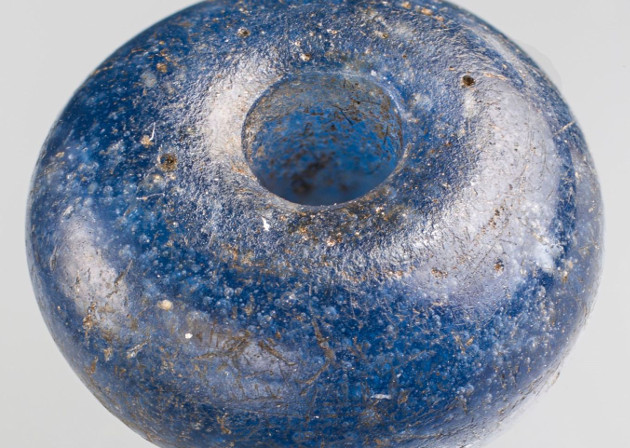
160523mapRecent archaeological work has identified a blue glass bead found in a bronze age woman’s grave in Ølby as originally Egyptian. In fact, based on the composition of the glass, researchers have suggested that the glass bead was made in the same workshop that produced the blue glass inlay on Pharaoh Tutankhamun’s gold funerary mask. Similar beads are known from several other Danish burials. In an age when glass-making as a skill known only in a few regions, colorful glass beads were as precious as gemstones.

160523glassGlass beads like these could have come to Denmark in exchange for amber from the shores of the Baltic Sea. Amber was highly prized in the ancient Mediterranean and not just as jewelry. It was sometimes fashioned into amulets for warding away evil or burned like incense. (The Roman naturalist Pliny the Elder complained about his fellow Romans’ superstitions about it; see: Pliny, Natural History 37.11.)

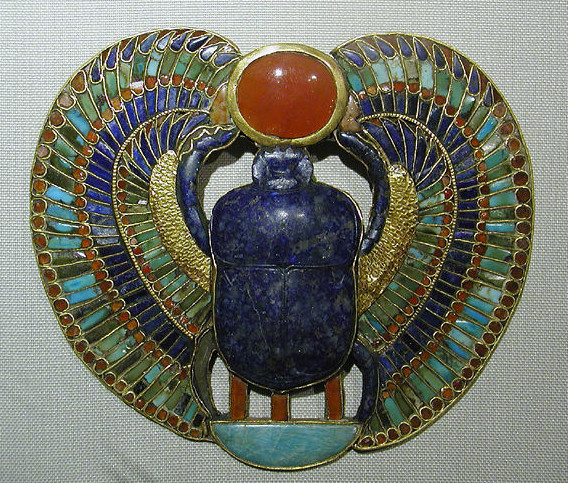
Amber has not been found in large quantities in Egypt, but it was used in some jewelry. In fact, one of the pectorals (pendants worn over the chest as amulets) wrapped up in the linen with Tutankhamun’s mummy is set with a piece of amber.

160523scarabIt’s unlikely that many Danes traveled to Egypt or Egyptians to Denmark in the bronze age. More likely both amber pieces and glass beads were carried short distances by chains of traders in between. Small, easily portable, but high-value objects like beads and gemstones are perfectly suited to this sort of down-the-line trade. A ship that was wrecked off the coast of Turkey around the same time as Tutankhamun’s burial (known as the Uluburun or Kaş Shipwreck) may have been part of that trade network. The ship, whose home port may have been in northern Syria or on Cyprus, was carrying both blue Egyptian glass and Baltic amber when it went down. Also in the ship’s cargo, interestingly, was a gold scarab inscribed with the name of Nefertiti, queen to Tutankhamun’s father Akhenaten (though she was not Tutankhamun’s mother).

Thoughts for writers

The evidence of archaeology is always a bit haphazard in nature. So much is unpredictable about what artifacts survive and what gets found. We are lucky to have the evidence from both the tombs of Tutankhamun and the woman in Ølby, as well as the Uluburun shipwreck, to help us trace out the lines of connection between Egypt and the Baltic. There is no question that connections between different peoples in the distant past were deeper and stronger than we know, but the evidence to document those connections has been lost.

Historians (at least those of the responsible sort) are limited by evidence, but fiction writers don’t have to be. When building your fictional worlds, let the fragments of evidence from our own inspire you to imagine far-flung connections and enterprising traders. Connections like these have always been important.

Images: Map by Erik Jensen based on Portable Atlas. Blue glass bead, detail of photograph by Roberto Fortuna and Kira Ursem via Haaretz (Ølby; 14th c. BCE; glass). Scarab pectoral, photograph by Jon Bodsworth via Wikimedia (tomb of Tutankhamun; 14th c. BCE; gold, glass, and precious stones)

History for Writers is a weekly feature which looks at how history can be a fiction writer’s most useful tool. From worldbuilding to dialogue, history helps you write. Check out the introduction to History for Writers here.

Travel: Water

160516junkTraveling over land is familiar. Many of us do it every day (even if we don’t do it as part of an army or with pack animals), but travel over water, though vital to the modern economy, isn’t part of daily life for most of us. Sometimes, though, the characters in your stories or games need to ride a raft downriver, strike out across the ocean in an outrigger canoe, or hoist the sails of a ship of the line. In this installment of the travel series, we look at types of pre-industrial water transport, the speeds and distances ships can travel, how much cargo ships can carry, and what it takes to make a successful voyage over water.

Speed

Ship speeds are conventionally measured in knots, equivalent to 1 nautical mile (1.151 statute miles or 1.852 km) per hour. 1 km/h is equal to 0.54 knots. In this post, I have given all speeds in terms of km/h for consistency with the other travel posts.

Types of transport

There are many different types of watercraft, from one-person rafts to massive cargo ships, but one essential way of distinguishing them is by means of propulsion. Pre-modern vessels had four basic options for propulsion: current, wind, paddles/oars, or draft.

Continue reading

Stave Churches

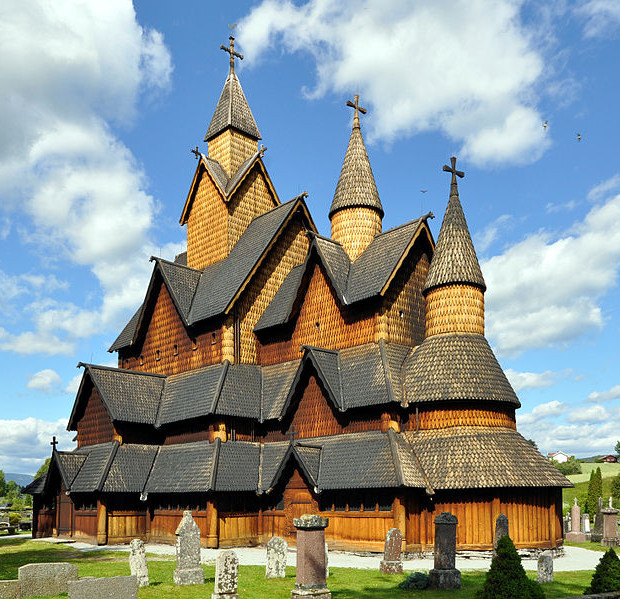
When we think of ancient architecture, we tend to think of stone and brick: the pyramids of Egypt, the amphitheatres of Rome, the Great Wall of China, the temples of the Aztecs and Maya. These are structures that have endured. We have many fewer models of wooden architecture from the distant past, even though wood—cheaper, lighter, and easier to work that stone or brick—was what most people built with in many parts of the world. Wooden buildings burn, rot, or just fall down if not maintained. Good examples of wooden buildings from more than a few centuries ago are very hard to find. One set of buildings that help fill that gap are the stave churches of Norway.

Heddal stave church, photograph by Micha L. Rieser via Wikimeida (Heddal, Norway; 13th c.)

Continue reading

The Trouble With Primary Sources

160425hoplitePrimary sources are great. They are essential. Without them, we would know vastly less about history than we do.

Because primary sources are so essential to our knowledge of history, it is easy to make the mistake of taking them too much at their word. Primary sources are like every other piece of writing: limited by the author’s perspective and subject to scrutiny and challenge. The trouble isn’t even just that primary sources can be wrong (although they can), but that the really interesting questions rarely have just one right answer. The answer we get from one primary source may be incomplete, even if it’s not wrong.

For example, suppose you’re writing a story about an ancient Greek who ran away from a battle. What would his fellow Greeks think of him? What would he think of himself? With a little research you might come across this fragment of a poem by Tyrtaeus:

Continue reading

How We Got Here, or A Field Guide to World History

The term world history may send your mind spinning back to high school, but world history is an important genre of historical study. It means history that is not bounded by the past of one nation or people. It is the story of how we got here as a whole, enmeshed world, not just as discrete national or ethnic groups. If you’re researching historical topics that connect different peoples together, you’re looking for world history. (World history is related to but not the same as universal history, which is a history of the entire world; world history may be selective about what parts of the world it covers, as long as it isn’t limited by national/cultural boundaries. Yes, it’s confusing.)

There are many different approaches to world history, however, and which one you want to look for depends on what you need. Here’s a brief spotter’s guide to some of the main varieties of world history you’ll find in the scholarship, how to recognize them, and what you might want to go to them for as a writer. These are not the only varieties of world history out there, but knowing these types will help you sort through the sources you will come across in your research.

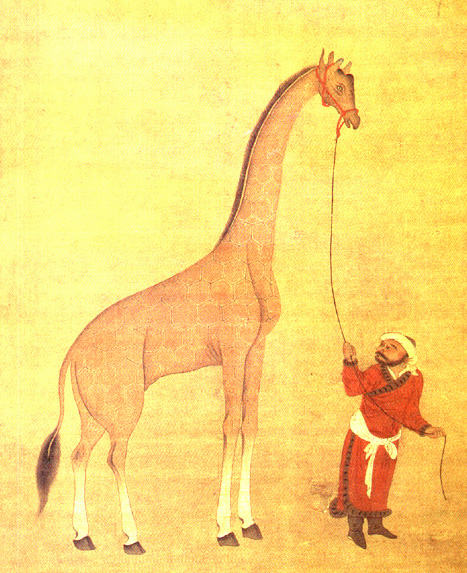
160418giraffe

1. Interconnected History

Or: “Whoa, This Stuff Is All Connected And Stuff, Man”

Historical events don’t happen in a vacuum. Cultures communicate and trade with each other. People travel, taking goods and ideas with them. Interconnected History is about tracing these lines of communication and commerce and discovering how events in one part of the world affected other parts.

Continue reading

Recommended Reading: Medea

160407MedeaOne of the hallmarks of modern storytelling is toying with the conventions of a genre. Familiar stories get retold with surprising twists and the tropes that everyone can see coming are turned upside-down and inside-out. It’s not just a modern game, though. Older stories can be just as cunning with their twists. When I’m trying to think about how to do something different with a familiar tale, one of the examples I look back to is Euripides’ tragedy Medea.

Medea is one of the classics of ancient Greek theatre. There are plenty of good translations available and it’s not hard to get your hands on one. If you’re looking for an online edition, here are a few. I discussed the play before in comparison to Star Wars, so I won’t bore you with summarizing the whole plot again (check the link if you want a quick reminder). Rather, I want to talk about two interesting things Euripides does with the story.

Continue reading

Fantasy Religions: Sacrilege, Blasphemy, and Heresy

160321SibylWhen creating religions for our stories, one of the things to think about is how the people who follow that tradition respond to offenses against its rules and principles. Is your character running the risk of torture and death if they question the accuracy of the sacred texts, or are they just going to get a stern glare from their grandmother for using the wrong hand to swirl the incense at the family altar?

Just as there are lots of different religious traditions that people practice in many different ways, there are lots of different ways of disrespecting religious ideas and offending the people who hold them. I’m going to talk about three kinds of religious transgression today that are often confused with one another. The differences between them are important, though. Which of these kinds of transgression a society recognizes and how it responds to them reflect important things about its history and religious traditions. These three are: sacrilege, blasphemy, and heresy.

(Or, as we call it my house, Saturday night.)

Continue reading

Connections: Rome and the Arctic

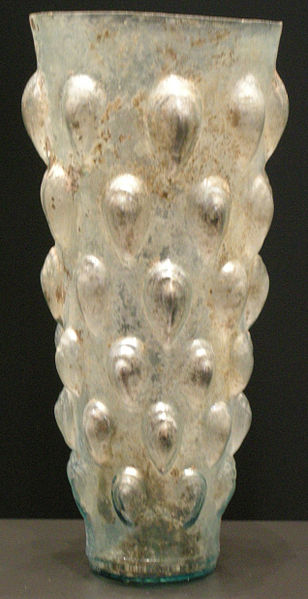
160314glassFrom the city of Rome to the Arctic circle is a distance of about 2,750 km. At its greatest extent, the northernmost tip of the Roman empire was more than 1,000 km from the Arctic. Even across such a distance, however, there were connections. A couple of little pieces of evidence show us how knowledge of Rome could reach the far north, and how knowledge of the far north could reach Rome.

In Føre, Nordland, on an island in far northern Norway, is an ancient burial site. Over several centuries in the late iron age around 10 mound burials were raised of earth and stone. (The number is uncertain because some of the mounds have been destroyed by erosion and farming.) Not all have been excavated, but those that have have yielded the evidence of extraordinary wealth by local standards, including a Roman drinking glass buried in the only female grave so far known at the site. (The glass pictured is of a similar type, but not from the same site.)

It is very unlikely that Føre had any direct connection to the Roman world. Rather it was at the northern extreme of a network of trade and alliances that spanned Scandinavia and the Baltic Sea region which used Roman imports as high-status trade goods and diplomatic gifts. The people of Føre may have had very little idea of what the Roman empire was, but they had some access to Roman goods and valued them as precious objects.

Continue reading

Inca Rope Bridges and the Importance of Landscape

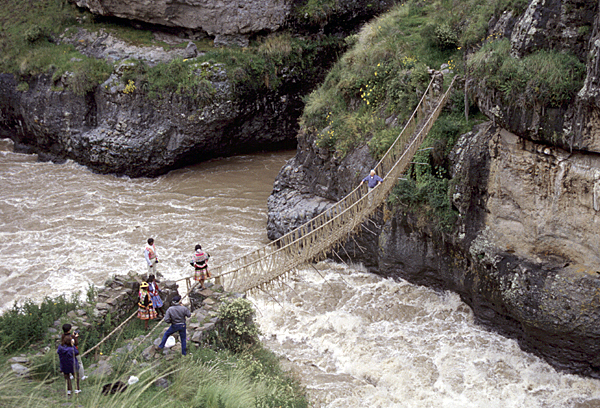
The Inca empire of South America was connected by a network of roads used by chasqui runners and pack llamas carrying messages and supplies around the empire. The Inca, creating their empire in the Andes mountains, faced challenges unlike those of flat-land and river-valley empires, among which was the problem of crossing numerous steep mountain valleys and rivers that ran dangerously swift in the flood season. Their solution to this problem was: rope bridges.

160229QiswaChaka

Suspension rope bridges spanned rivers and valleys, the longest reaching a length of 45 meters. They were made with ropes twisted out of grass and had to be rebuilt every year or two. The rebuilding was dangerous work that was assigned to local villagers as part of their obligation to the empire. Most Inca bridges have long since been replaced with modern structures, but one, the Q’iswa Chaka over the Apurimac River in Peru, is still rebuilt every year by local people as a way of preserving their heritage.

Continue reading