On the Use and Misuse of Primary Sources

Sometimes you come across someone making interesting claims about history, and it’s hard to tell whether you should take them seriously or not. If you’re not an expert in the field, how do you know whether to believe what you’re reading? There’s no perfect answer, and basic critical thinking will take you a long way, but here area few tips that can help set you on the right path.

Since I’m a historian of the ancient Mediterranean, my advice is particularly focused on the use of ancient texts when making claims about ancient history, but many of the fundamental principles outlined here are applicable to historical claims in any time period.

One important thing to look at is how people use primary sources, that is: documents and other texts written in the time period of the events or people in question. Here are some questions you can ask about the use of primary sources to help evaluate historical claims.

Do they engage with primary sources at all?

This is a basic one. All historical argument is based on evidence drawn from primary sources. If someone’s making claims without any primary sources to back them up, that’s reason to be suspicious.

A lack of primary sources does not necessarily mean that a historical claim is unfounded. People, especially non-historians, may cite secondary sources and modern research, but you should be able to trace the claim back through those sources and find the primary source evidence that it is based on. Some scholarship, if it is more historiographical and theoretically based, may not engage with primary sources directly, but then it will not be making claims about specific events, places, or people in history.

Do they cite their sources?

This is another basic one. In casual conversation, you don’t need to back up every assertion with footnotes and bibliography, but if someone wants their claims about history to be taken seriously, they should tell you what evidence those claims are based on. In particular, they should be able to point you to a source that you can look up for yourself to verify that it actually says what they claim it says.

Different kinds of sources have different standards for citation. With ancient texts, there are established ways of referencing specific passages. Shorter works are divided into sections or lines; longer works are divided into books, which are further subdivided into sections or lines. We never cite ancient sources by page number, since page numbers vary between different editions and translations. If someone is citing an ancient source by reference to the page numbers of a modern edition, that’s a warning sign that they may not be knowledgeable enough about the topic to interpret an ancient source with appropriate attention to its context, influences, and biases.

Do they use sources appropriate to their subject?

You should always use the right tool for the job and the right source for the claim. When someone is using a source that isn’t relevant to their argument, or isn’t using a source that is relevant, you should question whether they know what they’re talking about.

For example, our main primary source on the Peloponnesian war between Athens and Sparta is Thucydides’ History of the Peloponnesian War. Some other sources, like the comedies of Aristophanes, also provide relevant insights, but if someone is making a claim about the Peloponnesian war and doesn’t mention Thucydides, they should have a good reason why not.

Do they use non-literary sources?

The most accessible primary sources are literary sources composed with the intent of engaging readers, like the folk stories in Herodotus’ Histories or the palace gossip in Suetonius’ Lives of the Twelve Caesars. There are many other kinds of textual sources that are not literary, such as coin texts, building inscriptions, graffiti preserved in places like Pompeii, and dedicatory texts on religious offerings.

Specialized fields of study, such as epigraphy, papyrology, and numismatics, focus on finding, interpreting, and contextualizing such sources. Using such sources is often more difficult and requires more expertise and study than reading literary sources. Not every historical question has relevant non-literary sources to refer to, but if someone does reference non-literary sources in their arguments, that is a good sign that they have some real knowledge of the subject and have undertaken serious research.

Do they situate their sources in time, space, and social context?

All primary sources were produced by specific people in specific social and historical settings. We can use them most effectively as evidence for things that those people had good reason to know about. The farther the writer of a source is from the topic they wrote about, the less confidence we can have in what they tell us.

The Greek historian Herodotus and the Macedonian rhetorician Polyaenus give different accounts of how the Persian Empire conquered Egypt in 525 BCE. Herodotus traveled in Egypt less than a century after the Persian conquest and interviewed local priests about Egypt’s history. Polyaenus wrote in the second century CE, almost seven hundred years after the events, and, as far as we know, never traveled in Egypt or had any contact with Egyptians. These facts shape the weight that we should give to their different accounts, and anyone who does not acknowledge the difference is not practicing responsible scholarship.

Do they engage with the sources in their original language?

Many ancient texts are available today in good translations, and, simply for the sake of efficiency, most practicing historians will begin their research with modern translations. Serious historical scholarship must go beyond translations, however. The more that an argument relies on the meaning of particular words or on the details of what an ancient author did or did not say, the more crucial it is that we pay attention to the original words in the original language and linguistic context.

For instance, people sometimes make much of the fact that Herodotus describes the ancient Egyptians as “black-skinned.” This is a literal translation of the ancient Greek word Herodotus uses, melanchroies, but the Greek word has a different set of associations than the modern translation. To an ancient Greek, melanchroies meant ‘deeply suntanned.’ It had none of the racial implications that the English word Black has today, and historical arguments that depend on the modern translation risk misunderstanding what Herodotus was saying (and not saying).

Do they engage with sources that don’t support their argument?

Few things in history are simple. Almost any claim we can make about historical events, people, or societies is going to be contested, and there will be sources that both support and contradict it. People who want to put forth dubious claims tend to cherry-pick the sources that support (or can be made to sound like they support) those claims while ignoring the ones that don’t. How a historian deals with those contradictions is an important mark of good scholarship.

People sometimes make claims about the role of women in the Celtic-speaking societies of northwestern Europe on the basis of passing references in some ancient authors, but the writers who give us the fullest and most detailed accounts of societies in those regions—Polybius, Caesar, and Tacitus—do not describe societies in which gender relations were significantly different from those of the Mediterranean. There are sound reasons to critique those authors and question the accuracy of their ethnographic knowledge, but someone who doesn’t engage with those sources is not making a good historical case.

Do they critically examine the sources?

Just because someone wrote something down doesn’t make it true. Sometimes people don’t know what they’re talking about. Sometimes they lie. If a historian is relying on a primary source to support a particular claim, part of the argument they need to make is that the writer they’re citing actually knew what they were talking about and were telling the truth about what they knew.

The Roman historian Tacitus famously wrote that the Germanic peoples of Rome’s northern border were of pure stock, having never mixed their bloodlines with any other people. This claim has been uncritically and enthusiastically embraced by modern nationalists and racists of various stripes, but a critical reader needs to ask: how would Tacitus, a Roman aristocrat who didn’t speak any Germanic languages and probably never even visited the northern frontier, actually know anything about the long-term genetic history of the peoples he was writing about? What other ideological or literary agendas might Tacitus’ claims about the people of the empire’s northern frontier be serving–either for Tacitus himself or for whoever he relied on for his information?

As I said above, there is no perfect technique for separating good historical scholarship from bad, but these questions are a useful place to start, and applying them thoughtfully to both online discussions and claims you may come across in your research will help you find better historical arguments and avoid worse ones.

Quotes: To End That Was to End Their History, Their Present, Their Future

“All that was left of a person’s life was recorded on paper, in annals, in almanacs, in the physical items they produced. To end that was to end their history, their present, their future.”

– Aster Grey in An Unkindness of Ghosts by Rivers Solomon

…Which is why the attitudes and words of those writing our world’s history matter; why social sciences, humanities, and languages matter (and not just STEM); why diversity, inclusion, and empathy matter.

Solomon, Rivers. An Unkindness of Ghosts. Brooklyn, NY: Akashic Books, 2017, p. 327.

Serving exactly what it sounds like, the Quotes feature excerpts other people’s thoughts.

Historiography (With Comics)

I encourage anyone who wants to write SFF to read history, and to go beyond popular history to good scholarly history. Historical scholarship has its challenges for non-specialists, though, first among them: historiography.

It’s a rather intimidating word. The bane of history majors everywhere and a source of confusion to ordinary folks who pick up an academic history book trying to learn a little more about people and places in the past. It doesn’t have to be so intimidating, though. Historiography just means the ways in which we explain history.

There are many different theories of history with bewildering and unhelpful names: Marxism (which is not the same as Marxist economic theory), the Annales school, Whig history (which has nothing to do with wigs), and many more. Each of these theories encompasses a different set of questions that historians ask about the past, a different way of organizing evidence, and a different approach to interpreting cause and effect. At the most basic level, though, they are all just different ways of explaining change.

The study of change is, fundamentally, what the study of history is about. The past was not the same as the present. People lived in different ways, they held different beliefs about the world and made different decisions. When you take all of the individual choices that individual people made while going about the business of their daily lives and add them all together, the result is large-scale changes over time.

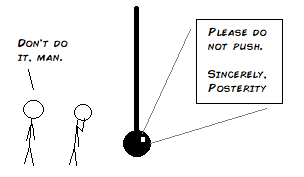
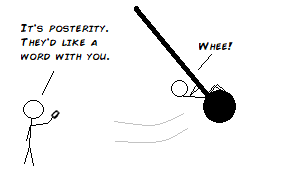
Different historical theories see that change differently. While every school of historical thought has its own specific approaches, some of the basic differences can be summed as the difference between seeing history as a pendulum, a circle, or a line.

Pendulum

Pendulum theories are based on the idea that most societies most of the time are basically static. People get up, go to work, come home, go to bed, and not much changes from one day, year, or generation to the next. Occasionally something will happen that upsets that equilibrium, like an outbreak of deadly disease or the introduction of a new crop, and it takes time for people to adjust to the new circumstances. Eventually, though, things settle down and people get back to the business of getting up, going to work, coming home, and going to bed. The population recovers as survivors acquire immunity to the disease or markets catch up as farmers start growing the new crop instead of some old ones.

From this point of view, the thing that’s important to study is the resting state of the pendulum, the condition that everything will tend back towards when it’s not being knocked about. We study history in order to understand basic things about human nature and society. The things that bump the pendulum are less important than where it will eventually come back to.

Circle

Circle theories believe that rather than one natural state to which societies return, there is a cycle that societies repeatedly go through. Each generation is shaped by the circumstances it grew up in and makes different choices than the generation that came before, but eventually things come back around again. A generation of spendthrifts, for instance, leaves its children in debt. When those children grow up, they tend to pinch their pennies. Their children grow up free from the fear of privation and more willing to take risks. Some of them get rich and raise children who grow up spoiled and irresponsible with money, which starts the cycle again.

To historians of this persuasion, the study of history is not about identifying a basic state we will return to but recognizing where we are in the cycle so we can better prepare for what comes next.

Line

Line theories believe that history is going somewhere and it won’t turn back. Small changes accumulate over time. Every choice that people make creates a new set of circumstances that future people have to respond to, and things will never go back to the way they were before. From this point of view, changes in society whether small, like a new drink becoming popular, or big, like industrial production taking over from individual crafting, have consequences that roll forward and are impossible to ever entirely undo. The demand for tea in England, for instance, created new incentives for trade, which led to new imperialist policies in Asia, which destroyed some local governments and elevated others, and so on. Even if Brits someday stop drinking tea, none of these effects will be undone.

Some line historians see the line pointing towards progress and an ultimate good for all humanity; others see it pointing towards degeneration and the collapse of the human race. Others simply see it as a process of ongoing and inevitable change. The point of studying history for all of them, though, is that we can make better choices for the future by understanding how we got to the present. The past is never going to come around again, but if we can tell which way the wind is blowing, we know which way to spit.

If this still seems a bit too theoretical, here’s an example in practice. How would historians of these different persuasions approach a particular historical event? Let’s take, say, the American Revolution.

To a pendulum historian, not much really changed because of the revolution. After several years of fighting that killed many people and interfered with daily life, Anglo-American men replaced one distant aristocracy with a slightly closer one who only inherited land and wealth, not land, wealth, and titles. For many colonial denizens, the revolution simply changed who they paid their taxes to and which politicians they grumbled about over their beer after coming in from the fields or workshops at the end of the day. For women, poor folks, enslaved Africans, indigenous peoples, and anyone else outside the landowning elite, hardly anything was different in the years after the war compared with the years before it.

To a circle historian, the revolution was an example of an ongoing pattern in which the inability to reconcile political differences leads to violence. Stresses had been building up over time as the British government had different needs and priorities than the American colonists. Eventually these stresses reached a breaking point where negotiation and accommodation failed. The only way forward was turn to violent revolt. This pattern had played out before in English history going back at least as far as the Magna Carta and would continue to play out in American history, leading to the Civil War and to unrest in the late twentieth and early twenty-first centuries. The same cycle of stress, failed attempts at reconciliation, and violent upheaval has occurred all across the world in societies large and small

To a line historian, the revolution was a turning point which changed everything that came after. There are many different ways of understanding that change. One historian might call it the beginning of American exceptionalism while another might see it as a step in the disintegration of European empires in the western hemisphere. Another historian might see it as cutting off American law from the progress Britain was making toward ending slavery, or changing the focus of American trade towards the Pacific Ocean rather than the Atlantic. Whatever the focus, the war created a new set of circumstances that led people to behave in new ways.

Of course, there’s more to it than that. Not all histories fall neatly into one of these categories, but these basic ideas are at the core of many. Understanding what kind of history you’re reading can help you get what you want out of it, and knowing what kind of histories are out there can help you find the one you’re looking for. Happy history reading!

Comics by Erik Jensen

History for Writers is a weekly feature which looks at how history can be a fiction writer’s most useful tool. From worldbuilding to dialogue, history helps you write. Check out the introduction to History for Writers here.

How We Got Here, or A Field Guide to World History

The term world history may send your mind spinning back to high school, but world history is an important genre of historical study. It means history that is not bounded by the past of one nation or people. It is the story of how we got here as a whole, enmeshed world, not just as discrete national or ethnic groups. If you’re researching historical topics that connect different peoples together, you’re looking for world history. (World history is related to but not the same as universal history, which is a history of the entire world; world history may be selective about what parts of the world it covers, as long as it isn’t limited by national/cultural boundaries. Yes, it’s confusing.)

There are many different approaches to world history, however, and which one you want to look for depends on what you need. Here’s a brief spotter’s guide to some of the main varieties of world history you’ll find in the scholarship, how to recognize them, and what you might want to go to them for as a writer. These are not the only varieties of world history out there, but knowing these types will help you sort through the sources you will come across in your research.

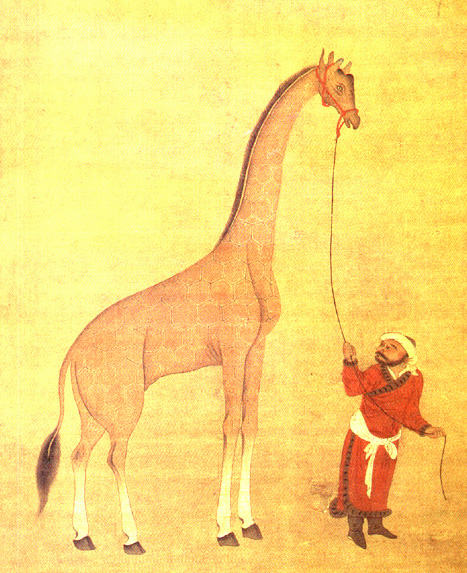
160418giraffe

1. Interconnected History

Or: “Whoa, This Stuff Is All Connected And Stuff, Man”

Historical events don’t happen in a vacuum. Cultures communicate and trade with each other. People travel, taking goods and ideas with them. Interconnected History is about tracing these lines of communication and commerce and discovering how events in one part of the world affected other parts.

Continue reading →