In addition to the two acts, I was surprised to find that Finns have had their fingers in other countries’ Eurovision pies, too: besides Erika Vikman’s stage show, designer Ari Levelä has participated in creating the visuals for Austria and Cyprus, and Estonia’s song Espresso Macchiato is co-written and produced by Finnish songwriter Johannes Naukkarinen. It is indeed a very exciting Eurovision year for Finland!
The grand finale takes place late tonight, 22.00 / 10 p.m. our time, and it’s going to run at least four hours. (Gosh, I almost have a headache from the mere thought of staying up that late!)
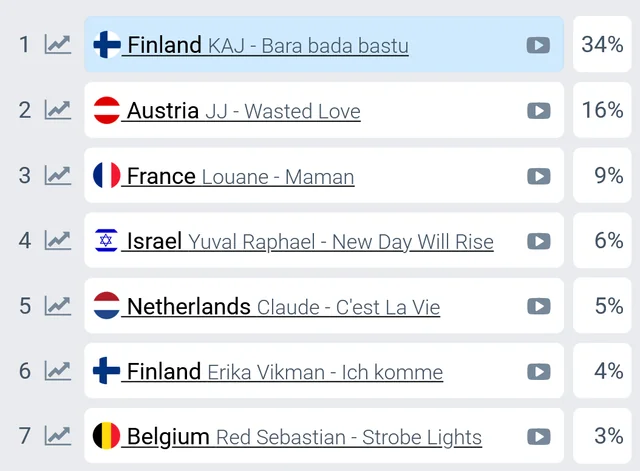
I’m really torn. I really hope KAJ wins, because Bara bada bastu is so joyful, cozy, and sweet, exactly what the world needs right now. But only if KAJ guys get to keep their quirkiness, happiness, and wholesomeness, because it’s part of their charm, and you can’t do that if you’re sleep deprived and exhausted and harangued by media and fans alike. Plus, it would give Sweden their 8th Eurovision win, pushing them ahead of Ireland (both have seven wins ATM), which as a Nordic person I would LOVE.
At the same time, though, Erika Vikman’s win would be stupendous—it would be the second time Finland wins, the first win for a female solo artist from Finland, and a win for female empowerment. It’s a catchy song with a great beat at the end, and a challenging tune (i.e., meant for a skilled singer). Apparently, after Thursday’s second semifinal there’s been a surge of interest; some have even wondered whether she might really turn out to be this year’s dark horse.
Moreover, Erika’s is an act where a grown-up woman dresses and sings how she wants, instead of a serving of bare female flesh centered around stereotypical male sexual desire (i.e., a slip of a girl decked up in barely-there sparkly cover-ups furiously gyrating and tossing her hair). (*cough* Cyprus 2018, Cyprus 2019, Cyprus 2021 *cough*) Acts are acts, sure, but like KAJ’s, Erika’s seems to contain a certain amount of authenticity that people respond to.
Ohwell. In the end, I suspect I’ll just be overjoyed that Finland has two such strong contenders this year. Following Käärijä’s second place in 2023, recent years have been exceedingly good from the point of view of Finnish Eurovision fans, and that’s not something to sneeze at. 🙂
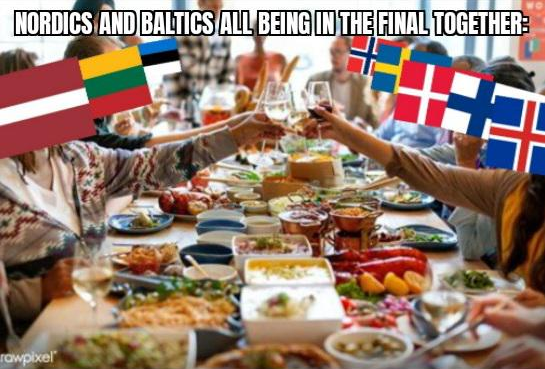
As a cherry on top, all of the Nordic countries (Finland, Sweden, Norway, Denmark, and Iceland) AND all of the Baltic countries (Estonia, Latvia, and Lithuania) qualified for the grand final. All at the same time, for the first time. Yay for us smaller countries in the north! 🙂
(A super-short recap of his post: the song Bara bada bastu, ‘Just having a sauna’, despite representing Sweden, is in fact performed by the Finnish comedy group KAJ. As a result of KAJ’s popularity, Swedes and Finns are finding a new spirit of Eurovision togetherness, and it has also brought some international recognition to the little-known Swedish-speaking minority in Finland.)
Here, as a companion post, is a listing of cultural references in KAJs song and in the performance.
I’m pulling some of this from my own experience growing up in Finland, but others from online commentary, or my Swedish-Finnish friends’ stories. This list is, therefore, likely not to be complete. Additions are very welcome!
KAJ—which rhymes with the English word guy—is made up of Kevin Holmström, Axel Åhman, and Jakob Norrgård, who all originally hail from Vörå, Ostrobothnia, Finland. The idea behind the song is to gently poke fun at how Swedes view Finns and our culture. Here we go! 🙂
Bara bada bastu by KAJ is the song representing Sweden in the Eurovision Song Contest 2025, and it’s been shaking things up in Sweden, Finland, and the Eurovision bubble as a whole. If you haven’t been following the run-up to Eurovision 2025, you may not know the story of Bara bada bastu and why it matters so much to so many people. Here’s a short introduction to get you caught up.
Finland, Sweden, and Swedish-speaking Finns
Finland and Sweden have a long and complicated history, grounded in the fact that what is today Finland was conquered by Sweden in the Middle Ages and ruled as part of the Swedish kingdom for centuries. Until recently, Finland was largely a poor and undeveloped area compared with metropolitan Sweden. The elite in Finland were traditionally Swedish transplants or had close social ties to Sweden. As a result, the typical Finnish stereotype of a Swede is a stuck-up, rich dandy, while the Swedish stereotype of a Finn is an uncultured, violent drunk. It is an old joke in Finland to say (of a hockey game, or some other equally serious contest) “I don’t care who wins as long as Sweden loses.”
Relations are not purely hostile. The two countries also have a history of cooperation and mutual support. Sweden supported Finland’s self-defense against and recovery from Russian invasion in World War II, and it has long been a commonplace that Finland is Sweden’s first line of defense. Despite this solidarity, there is still a lingering antagonism. When Finland and Sweden joined NATO in response to Russian aggression in Ukraine, it was important to both sides that they join together. It was also important to Finns that Finland was accepted into the alliance first.
Caught in the midst of this sibling rivalry are the Swedish-speaking Finns. Finland has a minority population who speak Swedish as their mother tongue, mostly concentrated in the cities in the south and along the western coast and islands. They make up about five percent of the population. Some are descended from the old Swedish aristocracy, but most of them these days are just ordinary folks, not much different from other Finns. Because of this population and Finland’s historical ties to Sweden, Swedish is the second official language in Finland, and Finnish-speakers are required to learn Swedish in school (just as Swedish-speakers are required to learn Finnish). Many Finnish-speaking Finns resent this language requirement, and some turn that resentment against their Swedish-speaking neighbors. Swedish-speaking Finns are stereotyped in much the same way as Swedes: rich, snobby, and stuck-up. While Swedish-speaking Finns are subject to this sort of low-level resentment and caricaturing at home, they are practically invisible to the rest of the world. Even in Sweden, not everyone knows that some of their Finnish neighbors speak Swedish as their first language.
The Eurovision Song Contest
Leaving aside the world of frosty Finns and snooty Swedes for a moment, let me introduce you to the next thing you need to know about: the Eurovision Song Contest. The Eurovision Song Contest (commonly just called Eurovision) is an annual multinational extravaganza in which countries from around Europe and beyond (G’day, Australia!) compete in putting on musical performances. The exact format and rules have changed frequently since the contest was first held in 1956, but if you’re not up on Eurovision, here are the essentials you need to know.
Every participating country sends one stage act with a song (not longer than three minutes).
Every country chooses its competing act in whatever way it likes. Many production and performance teams are international, and while at least some members of the overall team usually come from the country they are representing, nothing requires the artists appearing onstage to come from or be in any way connected with that country. (Write this down! It’ll be important later!)
The participating acts compete against one another in two semifinals. The viewing audience votes a set number of acts from each semifinal into the four-hour grand final, where they join a small set of acts from countries who get an automatic place by paying the major costs of the broadcast (currently: France, Germany, Italy, Spain, and the United Kingdom).
After all the acts have performed in the grand final, two sets of votes are collated. In each participating country, a jury made up of music industry professionals awards points to their top ten favorite songs. The top song gets 12 points, the second 10, and rest from 8 down to 1. The viewing audience in each country also gets to vote on their favorite songs, with points awarded in the same way. (Neither juries nor audience are allowed to vote for their own country.)
The points are announced onstage in dramatic fashion, and the country with the most combined points wins.
Traditionally, the winning country each year hosts the next year’s contest, although exceptions are sometimes made (such as in 2023, when Ukraine won the contest, but because of the ongoing war, the runner-up, United Kingdom, stepped in as host).
The Eurovision Song Contest has been a venue for good-spirited competition between nations, using music to foster both national pride and international solidarity in much the same way the Olympic Games use sports. It has also created its own subculture with traditions, factions, customs, and quirks of its own.
One of the long-running truisms of Eurovision is that juries and audiences tend to favor different kinds of songs. Conventional wisdom says that juries like serious songs that demonstrate artistic virtuosity and range, while audiences like wacky stage hijinks, fun gimmicks, and a danceable beat. Neither assumption is entirely borne out by the voting results, but Eurovision acts often try to court one set of votes or the other. The way points are divided often means that a song that would have won on the strength of audience votes doesn’t win because the juries favor something else, sometimes to ire of some fans who feel their favorite was cheated.
Finland has traditionally done quite poorly in Eurovision. The country has only one win to its credit, 2006, when the monster metal band Lordi unexpectedly pulled off a win in what is seen as the audience rebelling against a contest they felt had grown stale with too much bland, predictable pop music.
Finland has become a semi-reliable source of audaciously weird contributions to Eurovision, most of which fall absolutely flat in the voting results, but which appeal to some parts of the audience by standing out against a background of highly-polished pop.
Sweden, on the other hand, is a Eurovision powerhouse, with a current total of seven wins to its credit. Highly-polished pop is Sweden’s Eurovision bread and butter, and they pull it off better than most other countries, earning frequent recognition from juries. Sweden is home to a major pop music industry, and Swedish composers, lyricists, and choreographers are frequently found working on other countries’ Eurovision entries.
Recent Eurovision history
With the stage set, we turn to the recent history of the Eurovision Song Contest to see how these deeply-rooted forces have played out to lead us to this year.
In 2012, the Eurovision Song Contest was hosted in Azerbaijan and won by the Swedish singer Loreen with her song Euphoria. While Euphoria leaned a little to the weird side for Sweden, it was still highly produced and sung in English, making it easy for an international audience to follow. Euphoria swept both the audience and the juries.
Sweden took home the trophy again just three years later in 2015, when Austria was hosting. The singer Måns Zelmerlöw won with his song Heroes. Like the usual Swedish entry, Heroes was an immaculate pop anthem with a clever stage show, but it caught the heart of Europe. While Italy and Russia did better in the audience vote, Heroes soared with the juries, and Måns’s telegenic charisma won over even those fans who didn’t place Sweden first.
The next year, 2016, Sweden hosted the contest. Måns returned to the stage not just as a performer but as co-host of the festivities along with comedian Petra Mede. The 2016 show was carried off brilliantly and established Måns as not just a beloved past winner but one of the contemporary faces of the contest. He reappeared in several following contests as part of the general entertainment and the interval acts that fill up time while votes are counted. (2016 also gave us Peace Peace, Love Love, a loving parody of the contest itself, performed by Petra and Måns.)
In the following years, Finland and Sweden continued their usual patterns. Swedish songs routinely scored well with juries, and Finland’s songs occasionally excited some fans while mostly ending up near the bottom of the vote tallies. Then came Käärijä.
Finland chooses its Eurovision act with a televised national contest called Uuden Musiikin Kilpailu (New Music Contest, abbreviated UMK). In 2023, a young Finnish rapper/singer known as Käärijä had a runaway victory at UMK with his song Cha Cha Cha and quickly became a sensation among Eurovision fans. Cha Cha Cha was a challenging song: unabashedly weird, sung in Finnish rather than internationally-friendly English, and reflecting in complicated ways on Finnish alcohol and dance culture, but something about it spoke to a wide and adoring audience in Europe.
Sweden selects its competitor with Melodifestivalen (Melody Festival, casually known as Melfest or Mello), a multi-week tournament of songs which finally crowns a winner after several rounds. In 2023, Loreen returned to Eurovision by winning Melfest with Tattoo, a smooth jury-pleasing vocal performance.
Going into Eurovision 2023 (hosted in the United Kingdom on behalf of Ukraine), Finland was in the strange position of audience favorite. The outpouring of fan love for Käärijä and Cha Cha Cha was unheard-of in Finland’s Eurovision history. It quickly became clear that Tattoo was also gathering momentum. In the final voting tally, Finland came out way ahead with the audience, but the juries showed Finland much less love and delivered the victory to Sweden.
The 2023 contest felt like an encapsulation of the Finland-Sweden relationship: Finland the scrappy, weird underdog went up against Sweden the polished, practiced former winner, and the juries swung for Sweden. In the days after the contest there was a lot of resentment from Eurovision fans who felt the juries had cheated Käärijä of a win and the audience of their favorite. Finns felt deflated, and losing to Sweden rankled especially hard. Unkind things were said. In time, tempers cooled, and Finns and Swedes got back to the usual routine of quiet mutual disdain.
The 2024 contest, hosted again by Sweden, did what it could to soothe tempers. The Swedish hosts (Petra Mede again and actress Malin Åkerman) had plenty of self-deprecating jokes about Sweden’s Eurovision obsession, and Käärijä himself performed in one interval act.
It was a turbulent contest, however. Protesters demonstrated against Israel’s participation, and there were rumors about the Israeli delegation at the contest harassing other performers. The biggest cause of discontent, however, was when the Dutch performer, Joost Klein, an audience favorite and one of the leading contenders for victory, was suddenly booted from the contest after an altercation with a camera operator. The details of the incident are murky, but it was widely seen as an overreaction by Eurovision’s governing body. The live audience at the event was vocal with its displeasure, and in the aftermath many Finns enjoyed some schadenfreude at Sweden’s expense.
When do we get to the sauna brothers?
We’re almost there! I promise!
Finally we come to 2025. This year, Finland selected Erika Vikman’s Ich komme (I’m coming) to represent the country. Ich komme is a pumping, upbeat song celebrating a woman’s sexual desire. Sexiness is no stranger to the Eurovision stage, but it traditionally caters to the male gaze. Ich komme, though plenty sexy, is very clear in being about a woman’s own joy in her body and does it without disparaging men, either, a novelty for Eurovision. After UMK, Ich komme gathered some positive buzz, and, while probably not a winner, looks like it may do well at the contest.
And then came this year’s Melfest. As usual, it was a smörgåsbord of well-known Swedish pop music talent, but the star attraction was the return of Måns Zelmerlöw. Måns competed with Revolution, another highly-polished pop anthem in the same spirit as his winning Heroes.
Other great names in Swedish music filled the roster, including John Lundvik, a former Eurovision contestant who came close to winning in 2019. And then there was KAJ.
KAJ is a Finnish comedy group made up of three Swedish-speaking Finns from one of the smaller municipalities on Finland’s west coast. The group takes its name from the first letters of its performers’ names: Kevin, Axel, and Jakob. Although they were locally popular, they were not well known even on the national stage, and were practically unheard-of outside of Finland. KAJ was invited to join Melfest by one of the festival’s producers, and the trio figured it might be a good way to increase their name recognition and maybe score a few more gigs in Sweden but without much hope of anything more. KAJ joined the contest with Bara bada bastu (Just having a sauna), a light-hearted but sincere tribute to the joys of relaxing in sauna after a long day, performed in their own regional dialect of Finland Swedish. KAJ and Måns went up against each other in one of the last rounds of the competition and both passed through to the final.
KAJ stood out from the other performers in the final. Surrounded by media-sexy pop stars and their slickly-produced English-language international hits, the performers in KAJ were self-consciously nerdy, unfashionably authentic, and the only contestants so gauche, so outré, so utterly unsophisticated as to show up to the Swedish song-selection contest and sing in Swedish! Yet the audience loved them! When the votes were counted (Melfest uses a voting system similar to Eurovision’s), it came down to KAJ and Måns. It felt like Käärijä and Loreen all over again: the weird, provincial Finnish nobodies singing a niche but heartfelt little song in their own language up against Eurovision royalty with a whole national pop music industry behind him belting out a focus-group-perfect anthem in English.
And then the impossible happened: KAJ won! The juries broke just barely in Måns’s favor, but the Swedish audience went for KAJ by a million votes, giving KAJ the most audience votes in Melfest history! In this year’s Eurovision Song Contest, Sweden will be represented by a little-known humor group from Finland!
(Måns was less than gracious about his loss. One might have forgiven him for a few unguarded comments in the heat of emotion after a tense contest, but in the weeks since the Melfest final Måns’s wife has announced a divorce with allegations of abuse and drug use that have tarnished Måns’s reputation. Many Swedes are relieved that he will not be representing them on the international stage, especially not with the bitter aftertaste of 2024’s contest.)
The effects of the win have been remarkable to witness. Coming after the rancor of 2023 and chaos of 2024, Swedes and Finns are finding a new spirit of Eurovision togetherness. KAJ’s win has gone some way to patch over old resentments and break down timeworn stereotypes. It has also brought some international recognition to the little-known Swedish-speaking minority in Finland.
This year’s Eurovision Song Contest will be held in Switzerland in the middle of May. We will see what the rest of Europe makes of Ich komme and Bara bada bastu. At this moment, the boys in the sauna are running strong for the top spot, and if they win, then for once Finns will be just as happy for Sweden’s victory as the Swedes are.
An occasional feature on music and sound-related notions.
Did you know that Sweden used to be a major power in northern Europe? A major power as in having land holdings pretty much all around the Baltic Sea and even beyond? If I hadn’t learned that at school, I probably wouldn’t know; it’s really not talked about much these days.
Anyway. One fascinating detail from my classes that has stayed with me is the large riksdaler plate money (Swedish: plåtmynt). They were circulated in the 17th to 18th centuries to reduce the costs of minting coins and ease the transportation of money.
The riksdaler could be quite large. For example, according to my old history book, the 1644 coin measured 20 x 70 cm (approximately 8″ x 27″) and weighed 19,7 kg (approx. 43-44 lbs). The one pictured below is from 1744 and obviously not nearly as big as that.
What if in your secondary fantasy world, instead of chests of thousands of coins, your intrepid adventurers had to deal with large metal sheet money, a dozen or so to a chest? Wouldn’t that be an interesting worldbuilding detail?
Image: Anja Laurila et al. Historia kurssi III. Porvoo: WSOY, 1990, p. 73.
History for Writers is a weekly feature which looks at how history can be a fiction writer’s most useful tool. From worldbuilding to dialogue, history helps you write.
Astoundingly—to my mind at least—Sven Hjerson is going to get his own series! Produced in Sweden, the series is called Agatha Christies Hjerson (unsurprisingly, Agatha Christie’s Hjerson in English). The series was created by Patrik Gyllström; he has also written some of the scripts along with Jakob Beckman, Martin Luuk, and Björn Paqualin, and there are two co-directors, Lisa Farzaneh and Lisa James Larsson. Hjerson is starred by Johan Rheborg and Hanna Alström, the latter of which has some international renown as the Swedish Princess in Kingsman: The Secret Service and Kingsman: The Golden Circle.
The titular character Hjerson is a Swedish-speaking Finn who has had a long career as a criminal investigator in Sweden and now lives a retired, uneventful life in the Åland Islands. A Swedish reality tv producer Klara Sandberg is on the lookout for a new hit series and decides on Hjerson as her new star. Naturally, murders ensue.
Agatha Christie’s Hjerson is a C More original production. The series was filmed in Stockholm and Åland Islands (Ahvenanmaa) and is described as a combination of Christie and Nordic noir. Season one consists of four 90-minute episodes, which for tv have each been split into two parts.
So far the IMDB reviews are not flattering. Have you seen Hjerson? Do share!
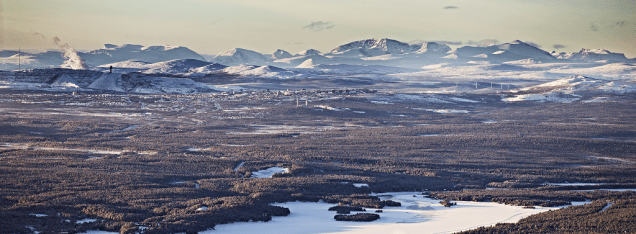
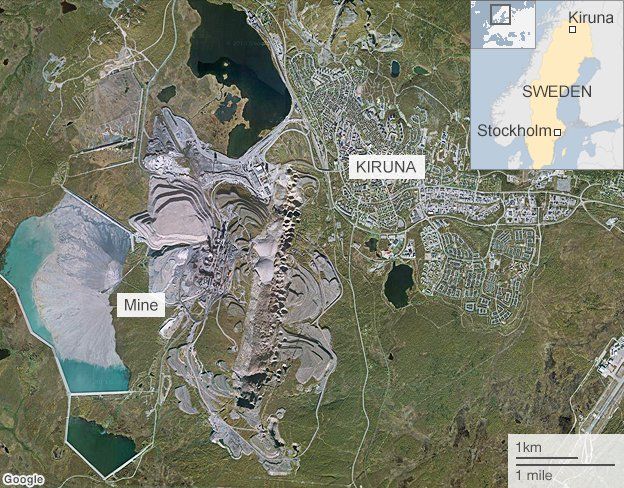
Kiruna is a small Swedish town of about 17,000 people in the Norrbotten county and the northernmost town in Sweden. And it’s on the move to escape a literal undermining.
The Kirunavaara iron ore mine (run by the state-owned LKAB) is expanding too close to the town center. Already in 2004, it was decided that a new center would be built; a site some 3 km away was since selected.
Also, according to the 2010 decision by the municipal council, some of the westernmost areas of town—in fact, if I’ve understood it correctly, most of them—would also be razed and new areas built eastwards, so that the town gradually moves away from the mine. At least if things go according to an ambitious plan that runs up to the year 2100.
The new areas were planned to be more walkable, with better public transit, close to shops and other amenities that are hoped to attract residents. The move also involves moving the railroad and the local highway.
The map diagrams below show projections for high-density (red) and low-density (green) population areas from 2018 to 2100, and serve as an easier way to wrap one’s head around a massive moving project like this:
At this writing, a new town hall (called Kristallen or The Crystal), the first building in the relocated city center, has been in use for about a year and a half. Some of the valuable heritage buildings have been disassembled and/or moved intact to a new location.
It sounds like a staggering project, doesn’t it? But it’s not like we humans haven’t dreamed up and then built on a massive scale before.
Images: Scenic view of Kiruna environs via Kiruna kommun (Kiruna municipality). Location of the mine and the town via BBC. Projection of population areas from 2018 to 2100 by White Arkitekter AB with Ghilardi + Hellsten Arkitekter AS via Ghilardi + Hellsten.
How It Happens is an occasional feature looking at the inner workings of various creative efforts.
I’ve been meaning to share this for a while now, but something or other was always supposedly more important or interesting. No more! 🙂
The Viking Age Sigtuna, Sweden, was formally founded around 980 AD, and it was a much more cosmopolitan city than thought before. According to new DNA analysis, approximately half of city’s population were immigrants.
The study looked at the remnants of 38 individuals who lived and died in Sigtuna between the 900s and 1100s CE, and included other scientific approaches as well (like analysing the strontium isotope contents of the residents’ teeth).
Roughly half of the population grew up in the near-by region Mälardalen (the Mälaren Valley, or Stockholm-Mälaren Region). The other half arrived either from southern Scandinavia (including Norway and Denmark) or further away. The long-distance immigrants came from the British Isles, Ukraine, Lithuania, northern Germany, and other parts of central Europe, and were more likely to be women than men (approx. 70 percent of women vs. 44 percent of the men).
Read more on the Stockholm University research news page: article in Swedish / article in English.
I guess I’m by far not the first woman to fall in love with a Viking and to move far away with him. 🙂
I first became aware of Adrian Tchaikovsky when he won the Arthur C. Clarke Award in 2016. I’ve been meaning to check out his writing since then. Ironclads, a limited-edition hardcover novella, finally made it to the top of my TBR pile last month.
The novella was great in several respects, but I was especially tickled by the American POV character’s descriptions of Finland and Finns. For example:
“All the middle of Nordland is the bit we’ve got problems with, basically: Sweden and Finland, say the maps. Sweden is where the fighting is, and the other place… Finland is weird. Finland is different.“
– Adrian Tchaikovsky: Ironclads
The version of U.S. in the story is fighting in Scandinavia, and, due to having laxer laws on genetic modification, Finland apparently has become home to very interesting types of special forces.
But the best, the absolutely best detail is mentioned in this section:
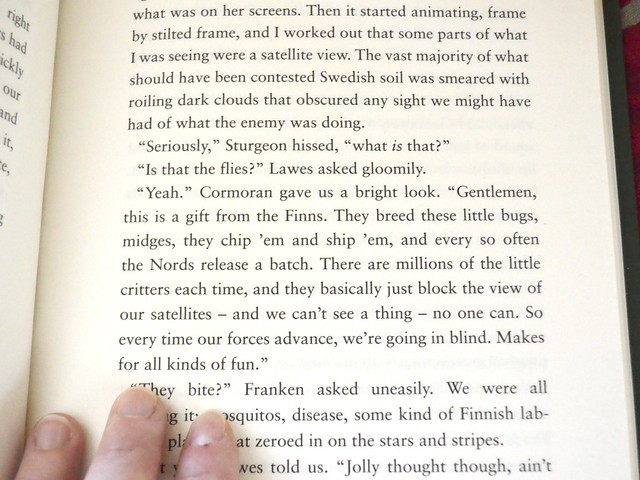
“[F]or a long time I couldn’t even work out what was on her screens. Then it started animating, frame by stilted frame, and I worked out that some parts of what I was seeing were a satellite view. The vast majority of what should have been contested Swedish soil was smeared with roiling dark clouds that obscured any sight we might have had of what the enemy was doing.
“’Seriously,’ Sturgeon hissed, ‘what is that?’
“’Is that the flies?’ Lawes asked gloomily.
“’Yeah.’ Cormoran gave us a bright look. “Gentlemen, this is a gift from the Finns. They breed these little bugs, midges, they chip ’em and ship ’em, and every so often the Nords release a batch. There are millions of the little critters each time, and they basically just block the view of our satellites – and we can’t see a thing – no one can. So every time our forces advance, we’re going in blind. Makes for all kinds of fun.’
“’They bite?’ Franken asked uneasily. We were all thinking it: mosquitoes, disease, some kind of Finnish labgrown plague that zeroed in on the stars and stripes.
“’Not yet,’ Lawes told us. ‘Jolly thought though, ain’t it?’”
– Adrian Tchaikovsky: Ironclads [original emphasis]
The militarization of mosquitoes! We already joke—as a way of dealing with an irritant that’s just a part and parcel of life—that mosquitoes are the Finnish air force. Finally, someone did it! 😀
It makes perfect sense in a world with aggressive biological research to turn a ubiquitous pest into an asset. Come to think of it, it sounds very much like the strategies that Finns used in the Winter War of 1939-1940 against Soviet forces—making native conditions work for you and against the enemy.
Of course, no one person can disapprove or approve of any characterization on behalf of their whole group. However, in My Official Opininon As a Finn, Tchaikovsky managed to balance well the view of Finland as part of Scandinavia with Finns being distinctly different from their Swedish, Norwegian, and Danish cousins. Also, he got so many little details right, like the way the Finnish language sounds, or our deep appreciation of nature.
I practically tore through the book. Kudos!
Tchaikovsky, Adrian. Ironclads. Oxford: Solaris, 2017, p. 22 and p. 29.
This post has been edited to correct a typo.
Serving exactly what it sounds like, the Quotes feature excerpts other people’s thoughts.
Swedish fantasy and weird author Karin Tidbeck is giving book talks on her debut novel Amatka in the United States.
Amatka was originally released in Swedish in 2012. It was first published in English a few weeks ago, at the end of June 2017. The publisher describes the novel as follows:
“A surreal debut novel set in a world shaped by language in the tradition of Margaret Atwood and Ursula K. Le Guin.
“Vanja, an information assistant, is sent from her home city of Essre to the austere, wintry colony of Amatka with an assignment to collect intelligence for the government. Immediately she feels that something strange is going on: people act oddly in Amatka, and citizens are monitored for signs of subversion.
“Intending to stay just a short while, Vanja falls in love with her housemate, Nina, and prolongs her visit. But when she stumbles on evidence of a growing threat to the colony, and a cover-up by its administration, she embarks on an investigation that puts her at tremendous risk.”
In connection with the book birthday, Tidbeck will do a short publicity tour in the U.S. First, she’ll appear at Readercon 28 in Quincy, south of Boston, on July 13-16, 2017. (No further details at this writing.)
“I had spent some years collecting dream notes, and I found myself wondering if they could be mapped. What did my dream country look like? I found that some places showed up again and again, although the geography, events and people shifted. I ended up ordering the notes according to an imagined compass: north, south, east and west, and finally, a central city. […]
“Vanja, a somewhat reluctant protagonist, agreed to be my guide. But what was the world? Dreams, as I thought of them, are ruled by language. What would Vanja’s life be like? What would a society be like in a world where language ruled over matter? The story of Amatka began to unfold. It broke loose from my dream continent and became a world of its own.”
On the surface it sounds a bit like Le Guin’s The Left Hand of Darkness and Emmi Itäranta’s The Weaver. The way Tidbeck talks of language ruling over matter also reminds me of the way mathematics rules over reality in Yoon Ha Lee’s The Ninefox Gambit. As a linguist, I’m doubly intrigued and excited to read Amatka!
This post has been edited to correct a spelling error.
A new museum focusing on Vikings opened in Stockholm, Sweden, at the end of April 2017. The Vikingaliv museum is divided into two parts, a static exhibit and a ride, and it highlights details of everyday life besides just the warrior men of bloody repute, including dwellings, farming, cooking, travel, the lives of children and women, slave trade, and religious practices.
Perhaps the most intriguing part of the museum is Ragnfrid’s Saga, an 11-minute long ride through dramatized settings with sound and light effects. The ride follows the story of Ragnfrid and her husband Harald, and takes visitors across the Baltic Sea from Sweden to Kiev and Miklagård (Constantinople) and finally back to Scandinavia and the British Isles. It’s currently available in Swedish, English, Finnish, Russian, German, and Chinese.
Privately owned and operated, Vikingaliv sits west of central Stockholm on the island of Djurgården conveniently close to other museums and destinations. Visit the Vikingaliv and Visit Stockholm websites for more.






 Co-Geeking
You must be logged in to post a comment.