Making Food in the Wild

Here’s a look at how we made yesterday’s Food in the Wild.

The menu

  • Pan-braised game hens with root vegetables
  • Leaf and herb salad
  • Blackberries with mint leaves

erikchef1Our heroes were in too much of a hurry to do any good eating in the wild between Bree and Rivendell, but we’ve tried to imagine what a ranger might have been able to cook up in better times. Strider mentions four different kinds of wild food: berries, roots, herbs, and game, and we’ve used a little of each in this meal. (1.11)
Dinner4 Main

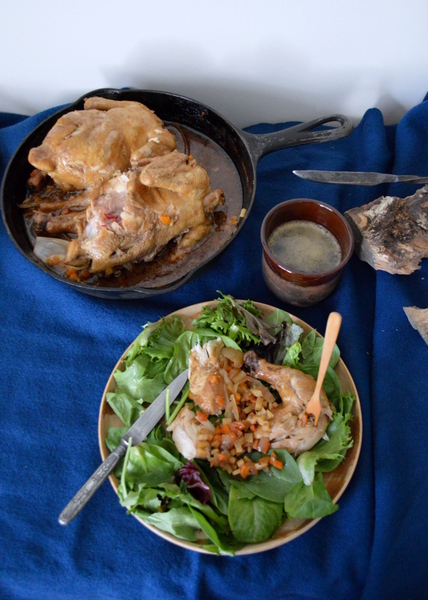
The main course is pan-braised game hens. It is the only dish that needs cooking and can be cooked in a shallow pan over a campfire. We used commercially raised game hens and farmed roots for our version, but wild-caught birds and carefully dug wild root vegetables would also do. We also used farmed greens and blackberries, but there are many wild-growing plants whose young leaves can be eaten (the full-grown leaves of most edible wild plants, in contrast to their cultivated cousins, are too tough or bitter to be eaten raw, but may still be useful for cooking). Wild blackberries are common in many forested areas—and they seem to be especially common in Middle Earth, as Bilbo frequently wishes for blackberries while traveling and the Prancing Pony offers a blackberry tart (H4, H6, 1.9)

Continue reading

Dining in Middle Earth: Food in the Wild

“‘There is food in the wild,’ said Strider; ‘berry, root, and herb; and I have some skill as a hunter at need.’”

LotR Dinner4

For this month’s dinner, we take up Strider on his offer and imagine what sort of a meal a ranger could have created in the wild at the best of times. This is what Strider might have cooked up for a party of hungry Hobbits if they hadn’t been running for their lives from ringwraiths: pan-braised game hens with root vegetables on a bed of green leaf and herb salad with fresh blackberries for dessert.

LotR Dinner4 Drink

Cooking would’ve been done with a cast iron spider, and light-weight wooden plates and small utensils wouldn’t add too much to the burden. Small pieces of fabric and sacks provide storage, and a rough piece of firewood functions as a makeshift stool or table. Everything is laid on rich, deep blue wool blend that nods towards Aragorn’s high status as the heir of Elendil.

Check out what’s it about in the introduction, or read the how-to!

Images by Eppu Jensen

Geeks eat, too! Second Breakfast is an occasional feature in which we talk about food with geeky connections and maybe make some of our own. Yum!

Quotes: Shrug off the Condescension that People Have toward ‘Lower’ Genres

“On the verge of débuting his late, lamented sci-fi series ‘Firefly,’ which was cancelled after less than one season of Fox mismanagement, Joss Whedon remarked that his goal was not to create ‘grownup’ TV but to ‘invade people’s dreams’ – to create mythologies, which last so much longer than the mortal form of a TV series. Cult shows, such as ‘Doctor Who’ and ‘Community,’ often have this quality: they shrug off the condescension that people have toward their ‘lower’ genres, using their constraints to find a greater freedom. When you look at a show like that from a distance, it might seem too narrow to contain much of interest. But it’s so much larger when you’re on the inside.”

– Emily Nussbaum

Two thoughts. One: Ha, Joss Whedon wants to do a George Lucas. Two: Just like, say, fly fishing might look narrow on the outside, there are hidden depths and intricacies in just about any hobby or interest. Not sure why it’s still such a surprise to those condescending types.

Nussbaum, Emily. “Fantastic voyage: ‘Doctor Who,’ ‘Community,’ and the passionate fan,” The New Yorker (June 4 & 11, 2012) 127.

Serving exactly what it sounds like, the Quotes feature excerpts other people’s thoughts.

Race and Culture in Hannibal’s Army

160322elephantTor.com published an article online today about diversity in Hannibal’s army written from the point of view of historical wargaming. It is a interesting article and well worth a read, but unfortunately it misses the opportunity to really address questions of racial and cultural diversity in ancient warfare. Here is a quick attempt to address some of the things that were lacking.

Race and culture

Race is a term with a lot of baggage, as we are all painfully aware, but it means different things in different contexts. In modern parlance, it describes a socially-constructed division of human beings into more or less arbitrary categories, largely on the basis of skin color and other physical features. In a fantasy context, it refers to distinct species of intelligent creatures like Elves, Orcs, Dwarves, and so on.

The unaddressed problem in the Tor.com article is the conflation of race and culture. In the nineteenth and early twentieth century, overtly racist theories of history posited that people of different genetic backgrounds naturally had different qualities. Many of these stereotypes still linger in our popular culture: the stoic Indian, the mischievous Irishman, the passionate Italian, etc. This belief in racial character was encoded in early classic works of fantasy like Tolkien’s Lord of the Rings, which gave us the stubborn Dwarf, the ethereal Elf, the vicious Orc, etc.

Even as we struggle to root out this conflation of race and culture from our modern life, it lingers on in works of fantasy and science fiction: the logical Vulcan, the boisterous Klingon, the decadent Centauri, the proud Dothraki. As we look back at history, we have to think of the people of the past not in terms of racial qualities but in terms of cultural contexts. People of different origins often do behave differently, but those differences are explained by the cultures they lived in, not the races they represent.

Continue reading

Making Supper at the Prancing Pony

Here’s a look at how we made yesterday’s Supper at the Prancing Pony.

The menu

  • Root vegetable soup
  • Cold chicken and ham
  • Bread and butter
  • Cheese
  • Blackberry tart
  • Beer

erikchef1No meal in The Lord of the Rings is more clearly described than the supper laid on by Butterbur of Bree at the Prancing Pony, and we have stuck to the letter of the description: a hearty vegetable soup and cold chicken and ham served up with bread, butter, and cheese, with home-brewed stout to drink and a blackberry tart for dessert. (1.9)

Continue reading

Dining in Middle Earth: Supper at the Prancing Pony

“In a twinkling the table was laid. There was hot soup, cold meats, a blackberry tart, new loaves, slabs of butter, and half a ripe cheese: good plain food, as good as the Shire could show, and homelike enough to dispel the last of Sam’s misgivings (already much relieved by the excellence of the beer).”

LotR Dinner3 Dessert

Barliman Butterbur serves up a filling supper of good home cooking at the Prancing Pony and we’ve done our best to do his fare justice. We have a soup of roasted root vegetables, cold chicken and ham, and bread with butter and cheese. A simple blackberry tart makes a satisfying dessert and a home-brewed blackberry stout goes with it all.

LotR Dinner3

We imagined a material culture in Bree-land that combines Hobbit and Bree Human features, possibly with some Dwarven-made touches. The color white is pulled from Mr. Butterbur’s white apron and the white tablecloth on the four Hobbits’ dinner table. Expanding on that, we used mostly white dishes, white candles, and clear glass. The soup bowl with leaf imprints on its inner surface is similar to the green one in the Long-Expected Party. A fabric-lined basket holds a variety of bread, and half a wheel of cheese invites nibbling.

LotR Dinner3 Main

And there’s pie!

LotR Dinner3 BW

Check out what’s it about in the introduction, or read the how-to!

Images by Eppu Jensen

Geeks eat, too! Second Breakfast is an occasional feature in which we talk about food with geeky connections and maybe make some of our own. Yum!

What If There Was White Moose Cavalry for Fantasy Winter Warfare?

What if there was a fantasy world where moose were tamed and selectively bred for cavalry? I spent some time pondering it after a couple of things found online collided in my head.

First, there’s this animated gif of a moose rushing through a deep snow-filled field:

moose rushing through a snow-filled field

Their size, speed, and ability to gallop through deep snowbanks make moose fearsome and pretty near unstoppable. Imagine a line of ginormous moose thundering at full tilt towards you across a field – that’s a truly frightening thought! Also bogs don’t slow them down by much, I believe, which might conceivably tip the scales in the right kind of a campaign.

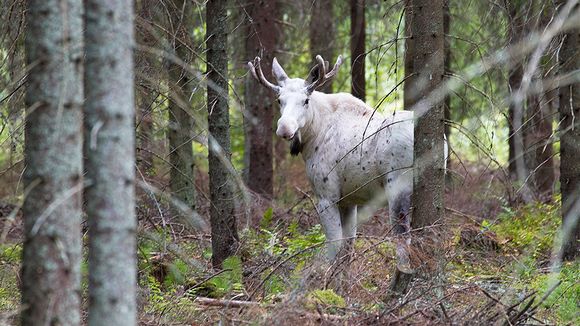
Then, I saw this photo of an albino moose:

Yle Antti Terava valkoinen hirvi

Natural snow camouflage. Hmmm.

It’s not that far-fetched an idea, apparently. The Soviet Union attempted to build a moose cavalry in the first half of the 20th century, but they were unsuccessful. In our world, the solitary habits of moose seem to be standing in the way of domestication. If we’re talking about a fantasy world, however, I don’t see why not.

Images: Rushing moose gif via Crazy Hyena. White moose by Antti Terävä via Yle

The Visual Inspiration occasional feature pulls the unusual from our world to inspire design, story-telling, and worldbuilding. If stuff like this already exists, what else could we imagine?

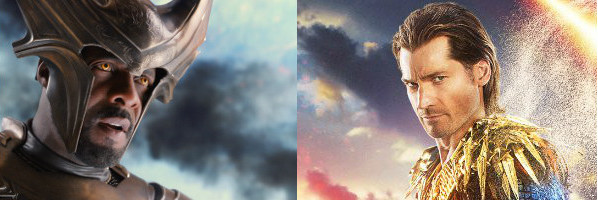
Why White Horus Bothers Me More Than Black Heimdall

In 2011’s Thor, Idris Elba, despite not looking typically Norse, plays the Norse god Heimdall. In 2016’s Gods of Egypt, Nikolaj Coster-Waldau, despite not looking typically Egyptian, plays the Egyptian god Horus. The casting of Elba as Heimdall surprised me the first time I saw the movie, but it has never bothered me as a fan or as a historian. Coster-Waldau as Horus really bothers me and I think it’s worth taking a minute to explain why.

160310HeimdallHorus

I have nothing against Coster-Waldau as an actor. I haven’t seen Gods of Egypt and don’t plan to, so I have nothing to say about his performance in this particular role, but he’s not the problem here. The problem is in the casting of the movie as a whole.

Continue reading

Making A Farewell Feast in Bag End

Here’s a look at how we made yesterday’s Farewell Feast in Bag End.

The menu

  • Fish and chips
  • Boiled cabbage wedges with rosemary mint sauce
  • Blueberry soup

erikchef1As with last month’s party, we have very little to go on in the text for an actual menu. Once again, this requires some imagination, but this time I’m trying to imagine a small, intimate dinner for friends, not a grand party.

Continue reading

Dining in Middle Earth: A Farewell Feast in Bag End

“In the evening Frodo gave his farewell feast: it was quite small, just a dinner for himself and his four helpers… The dining-room was bare except for a table and chairs, but the food was good, and there was good wine: Frodo’s wine had not been included in the sale to the Sackville-Bagginses.”

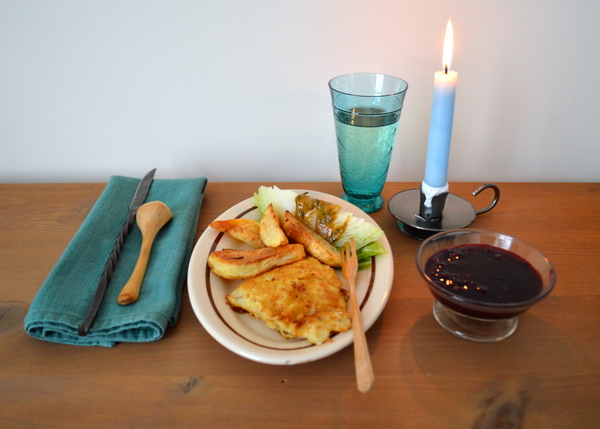
LotR Dinner2Our take on Frodo’s last dinner in Bag End has Sam Gamgee’s fish and chips at the center, accompanied by boiled cabbage wedges with rosemary mint sauce. For dessert there is a simple blueberry soup. And with it all, a glass of wine for toasting the good old hole farewell.

LotR Dinner2 Simple

Since this is quite a small, pre-long-distance-move dinner, the props are mostly simple, too: plain ceramics, plain glass, and wooden utensils on a bare table. Since the “good wine” was explicitly not included in the sale, we went with the spirit of indulgence and picked a fancier glass for it.

LotR Dinner2 Drink

Check out what’s it about in the introduction, or read the how-to!

Images by Eppu Jensen

Geeks eat, too! Second Breakfast is an occasional feature in which we talk about food with geeky connections and maybe make some of our own. Yum!