In between seasons 4 and 5 of new-series Doctor Who there is a series of specials starring David Tennant, but our copy of the discs turned out to be defective, so while we wait for a good opportunity to replace them, our rewatching and rating project carries on to season 5.
“The Eleventh Hour” – 3
“The Beast Below” – 3
“Victory of the Daleks” – 4
“The Time of the Angels” – 6
“Flesh and Stone” – 1.5
“The Vampires of Venice” – 2
“Amy’s Choice” – 2
“The Hungry Earth” – 5
“Cold Blood” – 2
“Vincent and the Doctor” – 5
“The Lodger” – 4
“The Pandorica Opens” – 5
“The Big Bang” – 6
The average rating for this season is a rather dismal 3.7, a big come-down from season 4’s 6.9. Nothing rises above a ho-hum 6, and almost half the episodes this season rate less than a 4, which is pretty much our minimal cut-off for ever wanting to see an episode again.
This season of Doctor Who poses one big question, and that question is: what on Earth happened to Stephen Moffat?? Many of our favorite episodes of previous season were written by Moffat: “The Empty Child” / “The Doctor Dances” in season 1, “The Girl in the Fireplace” in season 2, “Blink” in season 3, “Silence in the Library” / “The Forest of the Dead” in season 4. All these episodes were intricately-constructed masterpieces in which every piece fit, every tantalizing question had a satisfying answer, and the gee-whizery of the sci-fi was balanced with sensitive emotional stories. We had great expectations for Moffat’s first season a showrunner, and instead we got… this? The writing is clunky, the plots are full of janky bits that don’t fit, the characters are unpleasant, and the whimsy feels forced. We wonder whether the demands of production didn’t leave him time to develop his scripts more fully, or if perhaps the quality of his earlier scripts depended in part on good editing by the previous production team.
The new cast doesn’t improve matters. We don’t care for Matt Smith’s interpretation of the Doctor, which relies too much on surface wackiness and feels emotionally hollow. But even worse is the new companion, Amy Pond, played by Karen Gillan. All credit to Ms. Gillan for her acting, but the character is written as a whiny, self-centered bully. Both of these characters reflect an unappealing turn in Moffat’s writing, also visible in his series Sherlock: the belief that if a person is very clever or otherwise special, they get a pass on basic human decency. That’s a position we can’t get behind.
The lowest-rated episode of this season is “Flesh and Stone,” at 1.5. It’s the second part after the rather decent “The Time of the Angels,” following the Doctor’s adventures with a band of futuristic warrior priests in an underground labyrinth filled with Weeping Angels. The first episode give us a reasonably good set-up which the second just fails to pay off. The momentum built up in the first part sputters out as the second part pays its dues to the season-long “crack in the universe” arc. The Weeping Angels were one of Moffat’s most interesting creations in “Blink,” but they would have been better left alone than recycled for this episode.
The best episodes, both at 6, are “The Time of the Angels” and “The Big Bang.” “The Big Bang” does a better job of delivering the old Moffat magic with a complicated time-woven story about the Doctor and his friends racing to stop the end of the universe that was set off in the previous episode. It has some good moments and finally gives Amy’s Stockholm Syndrome victim boyfriend Rory something to do, but it never quite rises to its potential.
All in all, a real let-down of a season for us, but we know there are other folks out there who feel differently, including fans of Amy Pond and Matt Smith’s Doctor. What episodes this season did you love (or not)? Let us know in the comments!
“[Nakia]’s been doing it all alone, with no backup, even insisting on not being disturbed as she trots about the globe, righting capitalist neo-imperialist wrongs through her own wits. Nakia sees the value of providing a more lasting sense of peace for the disenfranchised, and knows that the late stage of that goal requires the commitment of Wakanda—not to wage war on other countries, but to seek out the downtrodden and lift them up and out of struggle. In her first scene in the film, she even has the empathy to see a child soldier as a boy first and an aggressor second, preferring to send him back home than to fight him.”
“Black Panther, however, is a revolution. Not merely in the sense that “it is revolutionary to see blackness this way,” though it is. But also in the sense that this movie is a revolutionary dialogue. […]
“Most of the introductions in the film happen in a very particular way. When Wakandans ask each other ‘Who are you?’, it happens not with any distrust or confusion, but with a display of pride. They are asking you to confess yourself, to admit that you are one of their own with the gusto of someone who deeply values what that means. You get to be someone. You get to be.”
“In the 1800s, there was an all-female army in modern-day Benin that pledged a similar loyalty to the throne [as Dora Milaje did]. They were known as the Dahomey Warriors and were praised for their bravery and strength by local leaders and European colonizers alike who encountered them.”
“For many Africans, the film brought to the big screen a reality that they see every day—the Basotho blankets the warriors used as a protective shield, the queen’s Zulu hat, the ochre-dyed locks of the Himba, the flowing fabrics of the Wolof. It was the sheer Pan-Africanism of it all that astounded me. The cinematic display of the diversity of Africanness was beautiful.”
“In the last half of the movie alone, [Shuri] saved a man’s life—even if the man was ‘another broken white boy.’ She guided said primitive white boy on how to use the advanced technology she created, which ultimately helped save the entire planet from mass war and anarchy. And then she went out and literally fought (and held her own for a while) against a supervillain. Cinderella ain’t got shit on her. [original emphasis]”
“You could call it Shakespearean, you could call it mythic, but that’s not where the film lives. It’s not about the broad strokes, it’s about the details. It’s about all the little choices in concert, creating something brand new, and creating it on a scale that cinema has never seen before.”
“[T]he emotion that Michael B. Jordan left me with was more powerful than anything I’ve felt at the movies. That painful rage, that feeling of angst that builds up when the topic of slavery or Jim Crown is brought up. That acrimonious tension that resonates in my gut when I see videos of police brutality or ignorant politicians fueling a race war. That feeling was replaced. A resolve, a euphoric feeling of relief spread from inside me instead.”
“It’s also a film that, while it centres on a man—and on questions of kingship, legitimacy, and responsibility—is the first superhero film I’ve ever seen to surround its main male character with women who are in many ways equally powerful, and who don’t depend on him for purpose or characterisation. No, seriously: this is the first superhero film I’ve ever seen—maybe the first SFF film I’ve ever seen—where pretty much the hero’s entire back-up team, his entire support network, were women. Women who teased him and challenged him and demanded he do better.”
“[…] Black Panther shows Black characters in an unusual way. In the movie, not only are we not drug dealers and pimps and rapists, we are intellectuals and leaders and heroes—but not only are we intellectuals and leaders and heroes, we multifaceted and complicated. We are human. Black Panther celebrates the humanity of Blackness.”
“In a world that centers all things white, whiteness and proximity to whiteness, a blockbuster film that centers Blackness and uplifts Black women is a much-needed paradigm shift. It is not just a new way to re-envision our world through the lens of Afro-futurism but it is also an opportunity to take stock of the Nakia’s, Okoye’s and Shuri’s who are already in our midst but who are often overlooked. I imagine a world where a Black woman won’t feel that she is traveling life without a roadmap as an anomaly but instead will know that she is another in a long line of changemakers because Blackness will not be relegated to the margins.”
Finally, a great video clip where co-writer and director Ryan Coogler breaks down a section of the casino fight scene:
Black Panther’s Director Ryan Coogler Breaks Down a Fight Scene | Notes on a Scene | Vanity Fair
“Modernist manuals of writing often conflate story with conflict. This reductionism reflects a culture that inflates aggression and competition while cultivating ignorance of other behavioral options. No narrative of any complexity can be built on or reduced to a single element. Conflict is one kind of behavior. There are others, equally important in any human life, such as relating, finding, losing, bearing, discovering, parting, changing. Change is the universal aspect of all these sources of story. Story is something moving, something happening, something or somebody changing.”
– Ursula K. Le Guin
I’d like my speculative fiction actually inventive, you know. Just like a human being is rarely reducible to one trait, yet that treatment is often used in storytelling as a shortcut, especially when it comes to characters deemed less important, like women, children, old people, or minorities of various stripes.
Which is not to say that stereotypes, caricatures, or the like don’t or cannot have a place in storytelling. However, if the majority of storytelling focuses on nothing else than characters or story elements reduced to their bare bones, it’s bound to become boring and empty.
There is so much more to our world, let alone imaginary worlds!
Excitement over the thirteenth Doctor is ramping up! Here’s a short fan video of how she should begin her tenure:
Doctor Who Series 11 – Episode 1 Opening Scene – The Girl Who Fell From The Stars! by Vlogzy
Maker Vlogzy explains:
“There are many great stories, but none as great as this. This is the story of the girl who fell from the stars. And this is how it begins…
“Without the Tardis and without hope, the Doctor is sent plummeting towards the planet below. The Doctor must come to terms with her new body quickly and escape her incoming demise.
“Here is a concept scene I’ve created for the upcoming debut episode for the Thirteenth Doctor! Just a bit of fun really but actually turned relatively believable. I have this theory in my mind that the Tardis would materialise underneath the Doctor as she’s falling and catches her. I’ve tried to imagine this as best as possible in this video!
“What do you think will happen in episode 1? How will the Doctor get out of this one? Would love to hear your thoughts/theories below!”
Really great job! The sequence could almost be copypasted into canon as-is.
I confess I haven’t even watched all of Capaldi’s Who because the stories couldn’t keep my interest after the eighth season. I hope Jodie Whittaker is given outstanding material to show her acting chops with.
I do have one quibble about the metadata for this video, though: calling adult women girls is infantilizing. We’re grown-ass women; ergo, call us women.
An official from a Western superpower arrives in a rich and powerful African kingdom and offers his respect and support to a royal woman. It may sound like Everett Ross from Black Panther, but it’s actually two millennia older:
Good fortune to the Lady Queen, may she live happily for many years. Acutus came from the city and [saw the place (?)] on the 15th of April.
(My own translation)
This inscription, the southernmost Latin inscription yet discovered, comes from Musawwarat es-Suffra in modern-day Sudan, which in antiquity was part of the kingdom of Kush. Kush, often called Meroë by Greek and Roman authors after its capital city, was a powerful state on the central Nile river. After the Roman conquest of Egypt in 30 BCE, the Roman Empire and Kush fought a brief border war, but the Kushan Queen Amanirenas soon made a peace treaty with Rome that was respected by both sides for centuries to come. (Greco-Roman authors mistakenly call Amanirenas “Candance,” which is not a name but a Kushan title for a royal woman.)
This inscription, which is in rather poor condition and cannot be read fully, probably dates to sometime in the third century CE. The Acutus who dedicated it was most likely a Roman envoy (“the city” being Rome) who had come to Kush on diplomatic business. His effusive good wishes to another (unnamed) ruling queen were in keeping with how Roman ambassadors demonstrated respect for foreign rulers. This inscription shows that Rome regarded its relationship with Meroë as worth maintaining with proper diplomatic dignity. Kush profited handsomely from facilitating trade between the Roman Mediterranean and both sub-Saharan Africa and the Indian Ocean, and had every reason to encourage ongoing good relations.
The history of interactions between Europeans and Africans is filled with bloodshed and inhumanity. It is understandable how appealing Black Panther‘s fantasy of an isolated African state untouched by European invasion or interference is to many fans. But it is also worth remembering that isolation is not the only option, and history also contains examples of European-African contacts that were peaceful and respectful.
Image: CIL III 83 via Adam Łajtar and Jacques van der Vliet, “Rome-Meroe-Berlin. The Southernmost Latin Inscription Rediscovered (“CIL” III 83),” Zeitschrift für Papyrologie und Epigraphik, 157 (2006), 193-198.
Serving exactly what it sounds like, the Quotes feature excerpts other people’s thoughts.
Pacific Rim Uprising opens in four weeks (March 23, 2018) and even the second trailer has been out for a few weeks now. First things first, though:
Pacific Rim Uprising – Official Trailer (HD) by Legendary
And here’s the second trailer:
Pacific Rim Uprising – Official Trailer 2 [HD] by Legendary
Pacific Rim Uprising is directed and co-written by Steven S. DeKnight; other writers credited with the screenplay are Emily Carmichael, Kira Snyder, and T.S. Nowlin. I have seen some of DeKnight’s writing and directing for Dollhouse and possibly even story editing for Buffy the Vampire Slayer. The rest of the writing team are entirely new to me however (apart from having at least heard of one of Snyder’s latest producing credits, The Handmaid’s Tale).
While I’m mostly not in the mood, now and then I like lots of smacking monsters around and busting buildings. But not only that—destruction without a reason gets tiresome faster than you can say marmalade sandwich. Among the falling skyscrapers and lurching jaegers in these trailers I’m left wondering about the human stories.
The features of the first Pacific Rim that most strongly attracted me to the story were specifically that—human stories. One was Learning to Work Together and the other was the respect that Raleigh Becket showed Mako Mori. I’ve seen interviews with Guillermo del Toro and the design team where everyone kept calling Mako Raleigh’s “love interest”. Come on, dudes. Reducing a character to her gender and relationship to a male character is the worst kind of dismissal. She has a name and you know it, not to mention that Mako would kick your butt eight days in a week. (It’s sad when a fictional character has to take his creators to school on how to respect women as people.)
I really hope Uprising will be a case of Never Trust a Trailer, and the movie will be at minimum tolerable. Granted, the first trailer is more people- than fight-heavy, so that’s a reason to stay positive. At the very least we’ll see more of Rinko Kikuchi, John Boyega—looking forward to seeing what kind of depth he has—and Tian Jing, whose performance in The Great Wall I enjoyed but for whose character there was pitifully little to do in Kong: Skull Island.
This post has been edited for clarity.
Hey, look! We found a thing on the internet! We thought it was cool, and wanted to share it with you.
WoWable has a fun new thing going on: a transmog contest! This edition’s theme is the Love Is in the Air, an in-game version of Valentine’s Day.
I had a tough time with this until I was doodling around in Suramar on my arcane mage. I’ve long loved the star-filled under-canopies that some of the trees have in Suramar City, but for some reason I hadn’t noticed before that the stars slowly rotate. (Manna from the heavens, almost literally. They rotate! It’s a WoW planetarium! Or plant-etarium…?)
The stars in the under-canopies alone made me love the City. And as if that’s not enough, Suramar City has so much more to offer: interesting buildings and streets, parks, intricate textiles, little squares, shops and residences, plus canals and gondolas. It’s an intriguing place to wander around, but the rotating (did I say already that they rotate?!) starfield canopies made the City go to the top of my romantic places list.
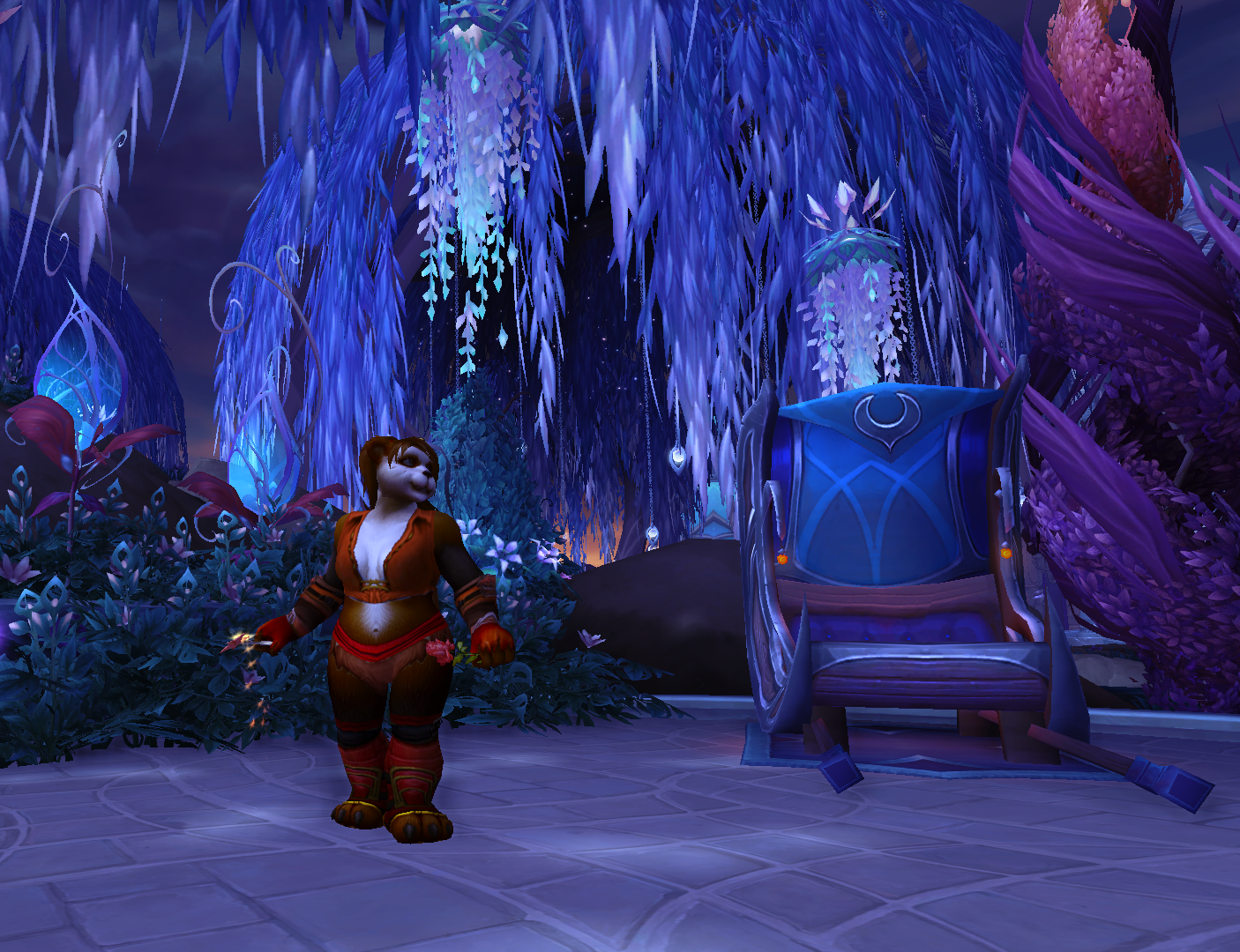
My screencap is from a small area in the outer rim of the City in the south west. (I haven’t noticed whether it has a name. It’s an outer edge of the Lunastre Estate.) It’s not a park or garden or anything fancy, just a widening of the promenade. However, it happened to have the right combination of elements that appeal to me: the gorgeous Suramar paving stones, lots of flowerbeds and bushes, those plants that look like ornate lanterns, hovering planters, the trees with the rotating star canopies, and a sunset (as it happened) in the background, as well as palanquins that look just right for two people to have a ride in. Just perfect for a mage moonlighting as a singing telegram for the holiday to stop and rest in between delivering messages and flowers.
(I’m having trouble with Wowhead’s Dressing Room, but as soon as it behaves, I’ll add the link to the set. Ok: here, finally, is the singing telegram set in the Dressing Room.)
It’s just over two weeks ’till A Wrinkle in Time opens at theaters (March 09, 2018). The movie is based on a young adult novel of the same name by Madeleine L’Engle. It was first published in 1962, and starts a series called Time Quintet.
While the book wasn’t for me, I have higher hopes for the screen adaptation. Here’s the U.S. teaser trailer…
A Wrinkle In Time Official US Teaser Trailer by Disney Movie Trailers
…and the official U.S. trailer:
A Wrinkle in Time Official US Trailer by Disney Movie Trailers
The adaptation was written by Jennifer Lee (of Frozen and Zootopia fame) and directed by Ava duVernay. A favorite actor I’m most looking forward to seeing is Gugu Mbatha-Raw, whom I loved in Doctor Who as Tish Jones (Martha’s sister) and Belle.
Hey, look! We found a thing on the internet! We thought it was cool, and wanted to share it with you.



 Co-Geeking