“What race were the ancient Greeks and Romans?”
It sounds like a simple question that ought to have a straightforward answer, but both the question and its answer are far more complicated than they appear. In these posts, I dig into the topic to explore what we know, what we don’t know, and what we mean by race in the ancient Mediterranean world.
Part 5: Who Were the Greeks?
As we have discussed before, modern racial categories are not easy to apply to the ancient Mediterranean world. Ancient peoples like the Greeks and Roman had complicated ideas about their own identities, but those ideas do not readily line up with the ways in which we modern people define race. If we want to better understand the identity of the ancient Greeks—in ancient or modern terms—we first have to know who we’re talking about. That may sound like a silly question. Isn’t the answer obvious? The Greeks! But who was a Greek?
This is a more difficult question than it may seem. In the modern world, nations have citizenship laws to regulate who is, say, an American, a Canadian, a Belgian, etc. Even today, though, not everyone’s identity is easily defined. Immigrants, expatriates, refugees, and other people who travel between nations can have complicated relationships to the places they come from and the places they end up. Individual feelings and societal attitudes are not always in line with the letter of the law.
The situation was even more complicated in ancient Greece. The people of ancient Greece were never politically unified on their own initiative. Individual city-states like Athens, Sparta, Corinth, and Thebes had their own citizenship laws, but these regulations varied widely between cities and changed in response to political pressures. Spartans who fled from battle could lose their citizenship. In Athens, challenging a rival’s citizen status was a common tactic in the tussle of political and family feuding. New citizens were enfranchised to serve political and military needs. The nearest thing there was to a central arbiter of Greekness was the Hellanodikai, the judges who oversaw the Olympic Games, in which only Greeks were allowed to compete. The judgments they made, though, were individual and only applied to the athletes. Decisions could also be swayed by political considerations: the Hellanodikai judged King Alexander I of Macedonia (great-great-great-grandfather of Alexander the Great) to be a Greek, while holding that the people of Macedonia themselves were not. (Herodotus, Histories 5.22)
The standards used for arguing about Greekness could also change with time and circumstances. In the sixth century BCE, most discussions of Greek identity were framed in terms of descent, specifically descent from particular mythic ancestors. The crucial figure was Hellen (a son of either the god Zeus and a human woman, Pyrrha, or Pyrrha and a human man, Deucalion—and not to be confused with the beautiful Helen, who sparked the Trojan War). Those who claimed descent from Hellen were counted among the Greeks, while those who did not were excluded. One of the fullest renderings of this tradition is in the poem known as the Catalogue of Women, a sixth-century poem known today only in fragments, which presented an account of the Greek heroic age structured around the genealogies, marriages, and progeny of certain women. This poem identified various groups of Greeks with three sons of Hellen: Dorus, Xuthus, and Aeolus.
The Catalogue, though, was not the final word on Greekness. As a primarily oral tradition, Greek myth had no canonical texts, and the family lines of gods and heroes were always up for debate. Other sources rearranged the family trees to change the determination of who did or did not count as Greek. (Thucydides, History 2.80.5-6; Pausanias, Description of Greece 1.11.1) Nor did ancestry remain the only way of asserting Greek identity. In the fifth century, many writers also began to refer to shared language, culture, and ways of life as defining who was Greek. (Herodotus 8.144) By the fourth century, we find the Athenian orator Isocrates explicitly rejecting common ancestry as a way of determining who was a Greek or not:
[Athens] has caused the name of “Greek” to apply not to a tribe but to a way of thought, so that those who are called Greeks are those who share our education rather than those who share our origins.
– Isocrates, Panegyric 50
(All translations my own)
In the Successor Kingdoms of the Hellenistic age (the remnants of Alexander’s empire in the Aegean, Egypt, and southwestern Asia), Greekness took on new meanings. In Egypt under the Ptolemaic kings, “Greek” was an administrative rather than ethnic designation applied to anyone who was not a native Egyptian. Thus not only immigrants from Greece and Macedonia were classed as “Greeks,” but also, for instance, Jews, Syrians, and Persians. Being designated Greek carried certain legal and tax benefits, so even members of the native Egyptian aristocracy who supported the Ptolemaic regime were granted Greek status. In the Seleucid kingdom, centered on Mesopotamia and Syria, Greekness was a communal rather than individual status. Certain cities founded by immigrants from Greece and Macedonia were recognized as “Greek,” which brought some administrative benefits to everyone who lived there, regardless of their origins.
Many different people lived with identities that were more complex than simply “Greek” or “not Greek.” From the seventh century BCE on, many individuals with special skills left the small, economically underdeveloped cities of the Aegean to find employment elsewhere, including mercenaries, physicians, courtesans, artisans, and actors. These emigrants settled in places ranging from the Iberian peninsula to the Iranian plateau and integrated themselves into local societies. Their descendants tended to adopt local names, languages, and cultures, such as Wahibre-em-Akhet, the son of two Greek-named parents who was buried in Egypt in a traditional Egyptian sarcophagus. Larger groups of emigrants founded colonies around the Mediterranean and Black Seas. While some of these colonies asserted a strong sense of Greek identity, many had more complex cultures, such as the Geloni of the Black Sea steppes, a fusion of Greek settlers and local peoples who spoke a Greek-Scythian creole language. (Herodotus 4.108)
Many people from the greater Mediterranean world also settled in the Greek cities of the Aegean. By the fourth century BCE there were Egyptian and Thracian immigrant communities in Athens that were substantial enough to successfully petition for the right to build temples to their own goddesses, Isis and Bendis. (Inscriptiones Graecae II2 337) The Carthaginian philosopher Hasdrubal moved to Athens and, in 129 BCE, became head of Plato’s Academy. Like Wahibre-em-Akhet in Egypt, Hasdrubal accommodated himself to the local culture by adopting the Greek name Clitomachus. (Cicero, Academica 2.31; Diogenes Laertius, Lives and Opinions of Eminent Philosophers 4.10) At the other end of the social scale, the Aegean cities of Delos and Rhodes were major centers for the slave trade. Captive people from origins stretching from Gaul to Persia and Scythia to Egypt are recorded passing through their harbors. Farther afield, Hellenistic-era Jews claimed to have proof that they shared a common ancestry with the Spartans and that sons of the Jewish patriarch Abraham had accompanied the Greek hero Heracles on his adventures. (1 Maccabees 12.5-23; Josephus, Jewish Antiquities 1.240-41, 12.225-27)
Greek culture and identity did not stand alone and aloof from others. The sense of cultural interconnection and flexibility was expressed in Egypt by a poem written in Greek but addressed to the Egyptian goddess Isis which explicitly identified Isis with the goddesses of several other peoples:
The Syrians call you Astarte, Artemis, and Nanaia,
the people of Lycia address you as Queen Leto,
men of Thrace call you the mother of the gods,
and the Greeks name you great-throned Hera, sweet Aphrodite,
good Hestia, Rhea, and Demeter,
but the Egyptians call you The Only One, for you are the one who is all
other goddesses named by humanity.
– Supplementum Epigraphicum Graecum 8.584.18-24
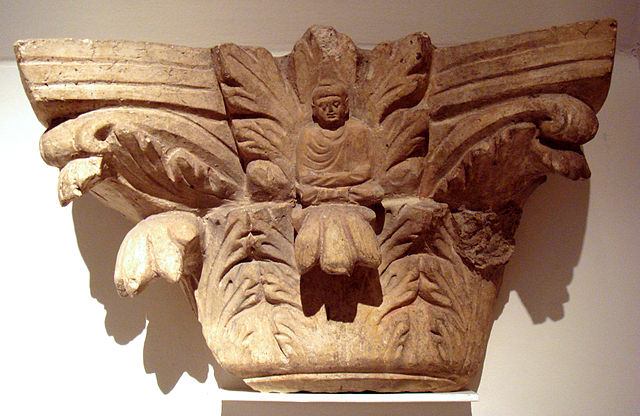
The multiplicity of ways in which Greekness could be claimed may be best exemplified by comparing two examples. On one hand, there were descendants of Hellenistic settlers in India in the last centuries BCE and early centuries CE who had assimilated into Indian culture but who still identified themselves as “Yavana,” the word for Greek in the local language. This term appears in inscriptions on offerings made to Indian gods in local temples. In terms of culture, language, and ways of life, these Yavana had become thoroughly Indian; it was only through their ancestry that they still identified as Greek. On the other hand, the philosopher Favorinus, in the second century CE, argued that he counted as Greek despite his Gaulish ancestry because he had adopted a Greek culture, language, and way of life. (Favorinus, Corinthian Oration 25-26)
Greekness was never a racial identity; it was a cultural identity, and one that was open to many different interpretations, not all of them compatible with one another. Any questions we ask about the racial identity of the ancient Greeks are bound to have complex answers. Nor are we, as modern people, in a position to dispute the lived and felt identities of ancient peoples. To impose our own rules on whose Greekness was legitimate and whose was not would simply be begging the question. The idea that people can be categorized into coherent ethnic groups with well-defined boundaries that were stable over time and across great distances is a figment of the imperialist and Romantic nationalist imagination. If we are serious about investigating the identity of the ancient Greeks, we have to be prepared for the bewildering and irreducible complexities involved in defining exactly who we mean.
Other posts on Race in Antiquity:
- The Question
- Identities
- Skin Color
- Skin Color in Art
- Who Were the Romans?
- Bad Answers, Part 1
- Bad Answers, Part 2
- The Ivory Bangle Lady
- Short Answers
Image: Corinthian capital with seated Buddha, via Wikimedia (originally Gandhara, currently Musée Guimet, Paris; 3rd-4th c. CE; stone)
History for Writers is a weekly feature which looks at how history can be a fiction writer’s most useful tool. From worldbuilding to dialogue, history helps you write. Check out the introduction to History for Writers here.