Quotes: Trail Goes Down Between Two Hills

“[T]he Pima of Central Arizona have historically embedded in their landscape the stories, histories, and lessons of their way of life and culture. Thus, the Pima, when they wish to remind someone of their past, or of a lesson they would like that person to remember, make what seem to white people abstract references to locations on their territory, such as ‘Trail Goes Down between Two Hills.’ The target of their comments, however, will know what they mean.”

– Matthew Barlow, Griffintown: Memory and Identity in an Irish Diaspora Neighbourhood, 11

Historian Matthew Barlow here cites the work of anthropologist Keith Basso on how memory can be embedded in a landscape to explain how the Irish-Catholic population of Montreal imbued the working-class neighborhood of Griffintown with meanings important to their identity as Irish-Canadians, such that even after the neighborhood was redeveloped, Irish-Montrealers could invoke generations worth of memories by reference to churches, pubs, streets, and other landmarks.

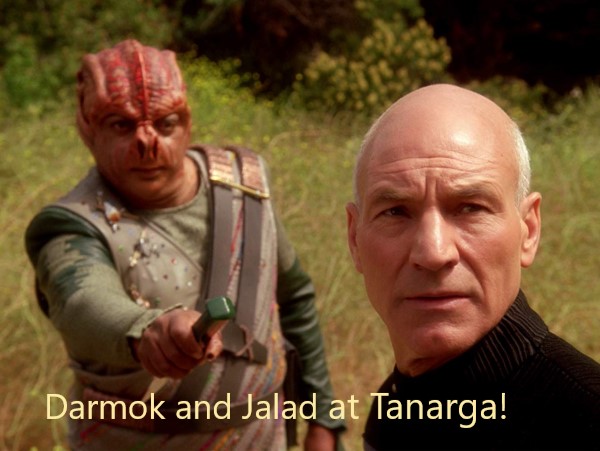
It’s a fascinating way of thinking about how we relate the landscape we live in, but, of course, the first thing I thought of was:

Image: Still from Star Trek: The Next Generation episode “Darmok” via IMDb, text added by Erik Jensen

Serving exactly what it sounds like, the Quotes feature excerpts other people’s thoughts.

Cheddar Man: A European Mesolithic Male with Blue Eyes and Brown Skin

I saw these headers go by earlier this spring, but didn’t really have time to really dive into it until now. Well, better late than never, as they wisely say. 🙂

Despite the name, the Cheddar Man isn’t some silly cheese ad bloke. Instead, he has opened doors to very intriguing discoveries about European population during the later Stone Age.

The remains of an anatomically modern human male from about 10,000 years ago were found near Bristol in Gough’s Cave in Cheddar Gorge, Somerset, England in 1903. Recent DNA analysis of the skeleton—Britain’s oldest (almost) complete one—suggests that he had blue eyes, dark curly or wavy hair, and dark brown to black skin.

Natural History Museum Tom Barnes Cheddar Man Bust Closeup

They also found that the Cheddar Man belonged to the same population as Mesolithic individuals whose bones were recovered from Spain, Luxembourg, and Hungary, usually referred to as western European Mesolithic hunter-gatherers or European early modern humans.

Hannah Devlin at The Guardian writes most aptly:

“The discovery shows that the genes for lighter skin became widespread in European populations far later than originally thought – and that skin colour was not always a proxy for geographic origin in the way it is often seen to be today.

“Tom Booth, an archaeologist at the Natural History Museum who worked on the project, said: ‘It really shows up that these imaginary racial categories that we have are really very modern constructions, or very recent constructions, that really are not applicable to the past at all.’”

A new bust model of Cheddar Man was made by Kennis & Kennis Reconstructions. (See a photo of the previous model made by a team at the University of Manchester here.) They took measurements of the skeleton, scanned the skull, and 3D printed a base for their model. Then they applied certain conventions to shape the face.

I fully confess I’m having a hard time keeping track of the exact timespans and geographical limits of the various Stone Age eras in Eurasia and Africa—what’s paleolithic, mesolithic, or neolithic and where and at what time. But it is so fascinating (and delightful!) that we continue to develop new methods of finding more about our past, and that so many different disciplines seek to understand where we came from and what makes us tick.

Image: closeup of the model of Cheddar Man by Tom Barnes / Channel 4 via Natural History Museum, London

Jane Austen, Mystery Writer

The great mystery novelist P. D. James has noted that Jane Austen’s novel Emma has all the essential elements of a mystery novel: the plot revolves around secrets which are revealed at the climax but to which the heroine and the readers have been given clues all along. I think we can extend that idea further and say that most of Austen’s novels are, in spirit, mysteries.

The plots of most of Austen’s completed novels are about heroines becoming wiser about themselves and the world, usually by discovering things that make them reevaluate the people around them. Elizabeth Bennet discovers that Wickham is a scoundrel and Mr. Darcy has an honorable soul under his proud manner. Marianne Dashwood discovers that Willoughby is a scoundrel and her sister Elinor has feelings as deep as her own. Catherine Morland discovers that Northanger Abbey is not a Gothic haunted house. Other discoveries and reevaluations made by the heroines and other characters also propel the plots along. Darcy learns that Jane Bennet was actually in love with Bingley all along. John Thorpe learns that Catherine was not in line for a fortune after all. Anne Elliot learns that William Elliot is responsible for her friend’s financial difficulties.

Austen also leaves some clues hidden in plain sight, unremarked upon in the novels but waiting for the clever reader to put together for themselves. Why is Mr. Darcy in such an ill humor when Lizzie first meets him at the Meryton ball? Austen never lays it out for us, but once you know his history it becomes clear that only a few months have passed since his beloved younger sister Georgiana nearly eloped with the scheming Mr. Wickham. Of course the sight of young women his sister’s age freely dancing with men they have barely met puts him in a sullen mood, and it is this mood rather than his natural character on which Lizzie first judges him.

Austen’s great literary innovation, the “free indirect style” in which the narrator stands apart from the point of view character but reflects their judgments and perceptions in the narration, represents a careful balance between objectivity and subjectivity that is important in mystery writing. The job of a mystery author working in the classic style is to present the reader with all the necessary facts to resolve the mystery themselves, but to obscure those facts in such a way that the reader does not get ahead of the detective in working out what happened. Austen’s free indirect style achieves precisely this goal, letting the readers in on what is going on in the world around her characters but coloring the facts with the main characters’ own perceptions and biases.

Austen framed her social satires and ethical critiques in the genre of romantic novels since those were popular in her day. I sometimes wonder, if she were alive and writing today, would she have chosen to write mysteries instead?

Image: Portrait of Jane Austen via Wikimedia (National Portrait Gallery, London; c. 1810; pencil and watercolor; by Cassandra Austen)

Story Time is an occasional feature all about stories and story-telling. Whether it’s on the page or on the screen, this is about how stories work and what makes us love the ones we love.

Christopher Robin Trailers with Thoughts on Gender

The movie Christopher Robin opens in a week, on August 03, 2018.

Here’s a trailer from the end of May:

Christopher Robin Official Trailer by Disney Movie Trailers

And a sneak peek from July:

Christopher Robin “Adventure” – Sneak Peek by Disney Movie Trailers

I remember liking Nalle Puh stories (as they were translated into my native language) quite a bit, so I wonder what my reaction to the voice acting will be, since I didn’t grow up thinking of the characters in terms of gender.

You see, Finnish does not have grammatical gender at all; we only have gender-neutral third-person pronouns (singular hän or plural he). This means that for me the only explicitly female character in the gang was Kengu because she was a mother, and the only explicitly male character was Risto Reipas because he was a human boy. The others were their own individual, quirky, stuffed-animal selves.

I guess the closest I can come is associating the stuffed animal characters with the non-binary gender identity. They didn’t need categorization into male or female, because that’s not how I saw their world working. I still don’t, even though talking about them in English forced me to learn which pronouns English associates with each.

It’s fascinating to notice myself using gendered English-language pronouns and yet at the same time still thinking of the stuffed animal characters as not fitting into those divisions. Eating too much honey and getting stuck in someone’s doorway, or figuring out that a popped balloon and an empty jar of honey go splendidly together do not require the gendering of anybody in the story.

I really do wonder how my perception changes after hearing voice actors and their intonational choices—or whether it will change at all.

Hey, look! We found a thing on the internet! We thought it was cool, and wanted to share it with you.

Quotes: Violence Is a Tool That … Begs You to Use It Again and Again

“Violence is a part of our trade, yes. It is one tool of many. But violence is a tool that, if you use it but once, it begs you to use it again and again. And soon you will find yourself using it against someone undeserving of it.”

– Ashara Komayd, former operative for and prime minister of Saypur in City of Miracles by Robert Jackson Bennett

Yup. I’ve been thinking along similar lines with regard to the racism in the U.S. and the ridiculous, racist non-reasons some racist-ass whites justify their calling of police on people of color, especially blacks. It’s racist, wasteful, racist, reprehensible, racist, entitled, racist, cruel, racist, wrong, and racist. It has to stop.

Bennett, Robert Jackson. City of Miracles. New York: Broadway Books, 2017, p. 177.

Serving exactly what it sounds like, the Quotes feature excerpts other people’s thoughts.

Hoplites

The hoplite was the definitive soldier of ancient Greece. Hoplites are interesting not just for how they fought but for the social conditions that created them and the consequences that the hoplite style of warfare had for ancient Greek society.

A hoplite was a heavily-armored infantry soldier equipped with a large, round shield and a thrusting spear a little over two meters in length. While the shield and spear were the two crucial pieces of equipment, most hoplites also wore heavy armor including a helmet, breastplate, and greaves (armor for the shins). Altogether this armor weighed as much as 30 kilograms. Weighed down by so much equipment, hoplites were slow-moving and not adept at maneuvering. A lone hoplite was easy prey for a more mobile skirmisher or cavalry soldier. Hoplites were only effective when fighting as a group.

Hoplites fought in a tightly-packed formation called a phalanx. Their equipment was designed to be most effective in this formation: the center of the large round shield rested at the elbow, meaning that only half of a hoplite’s shield was protecting their body. The other half of the shield protected the soldier standing to their left, while they were sheltered by the shield of the soldier to their right.

The phalanx formation was designed first and foremost to offer as much protection as possible to the soldiers fighting in it. As long as the phalanx kept its order, casualties were low. When phalanges fought, they clashed head-on in a massive shoving match that was usually quickly resolved when one side lost its nerve, broke formation, and fled. Fleeing hoplites typically dropped their heavy shields to get away faster, but once one phalanx started to flee, the soldiers of the opposing phalanx were ill-equipped to give chase. The goal of a hoplite battle was to drive the enemy from the field, not kill them.

In order to fight effectively, hoplites needed several things in addition to their equipment. First of all, they needed lots of training. Maintaining the phalanx formation while advancing into the fray and clashing with opposing forces was difficult. Even more important, it required cohesion among the individual hoplites. A formation that depended on every individual in it standing firm and protecting those around them could only work when those in it felt they could trust and rely on their fellow soldiers. That kind of unit cohesion could be created in several ways. Spartans created it through a brutal indoctrination into a culture of conformity. Companies of mercenary hoplites created it through shared experience in the field. But in most Greek cities, the solidarity of hoplite warfare was intertwined with democracy.

Hoplites appear quite suddenly in Greek history around 650 BCE, so suddenly that they seem to have been a deliberate innovation rather than a gradual development out of earlier traditions. There were other dramatic changes happening in Greek society at the time. For centuries, Greek society had been dominated by aristocratic families who monopolized both control of farmland and political power, but the growth of overseas trade undermined their authority. Some ordinary people began to get rich off of trade with the larger Mediterranean world and to demand more of a say in how things were run.

In many places, aristocrats who were on the outs took advantage of popular discontent to put themselves forward as sole leaders who could keep the other aristocrats in check and represent the interests of the common people. The Greeks called these rulers tyrants, a word that did not originally have the negative connotations it carries today. These tyrants organized the people into a political force that could overwhelm the old aristocracies, and it seems likely they were also responsible for organizing them into a military force for the same purpose. The old aristocrats had relied on followings of professional warriors to compete with one another and protect their power. The hoplite phalanx was made up not of professional soldiers but farmers, crafters, merchants, and other ordinary folks who paid for their own armor and took time away from their livelihoods to train together. Their cohesion and solidarity overwhelmed the aristocrats’ paid fighters.

The tyrants, backed by their hoplite forces, enjoyed a brief ascendancy, but most soon revealed themselves as little more than ambitious opportunists who had little real commitment to making life better for their supporters. The ordinary people turned against them. The experience of solidarity in common cause that had been instilled by the hoplite style of fighting became the core of a new way of organizing society, and after ousting their tyrants most Greek cities embraced forms of government that allowed for broad citizen participation. It is significant though that Greek democracy was always centered on the hoplite phalanx. People who did not have a role in the phalanx—women, the poor, slaves, resident foreigners—rarely had any role to play in Greek democracy.

Thoughts for writers

Human societies are complex systems. Their various parts interlock and affect one another. The ways in which people fight are shaped by the societies they live in, and shape them in turn. If your story has characters fighting in a particular way, you should construct your world to reflect the origins of that fighting style and its consequences. It is possible to have a hoplite phalanx without democracy (Sparta), and it is possible to have a democracy without a hoplite phalanx (medieval Iceland), but understanding how each one supported the rise of the other in ancient Greece will help you construct fuller and more believable alternatives.

Image: Chigi Vase, reconstructed frieze via Wikimedia (7th c. BCE; painted pottery)

History for Writers is a weekly feature which looks at how history can be a fiction writer’s most useful tool. From worldbuilding to dialogue, history helps you write. Check out the introduction to History for Writers here.
Rating: Doctor Who, Season 9

We’re back at it again, rewatching and rating another season of new series Doctor Who. Here’s our take on season 9.

  1. “The Magician’s Apprentice” – 4
  2. “The Witch’s Familiar” – 3
  3. “Under the Lake” – 6.5
  4. “Before the Flood” – 6.5
  5. “The Girl Who Died” – 4
  6. “The Woman Who Lived” – 4.5
  7. “The Zygon Invasion” – 2
  8. “The Zygon Inversion” – 2
  9. “Sleep No More” – 1
  10. “Face the Raven” – 1.5
  11. “Heaven Sent” – 5
  12. “ Hell Bent” – 2

This season is a real come down, with an average rating of just 3.5, the lowest yet. There are some reasons why many of this season’s episodes don’t rate very well. The showrunners made the interesting choice of making almost every episode in the season a two-parter. (Only “Sleep No More” stands alone.) This has the potential of allowing for more expansive and complex storytelling, which pays off in “Under the Lake” / “Before the Flood,” but in other cases, like “The Magician’s Apprentice” / “The Witch’s Familiar” and “The Zygon Invasion” / “The Zygon Inversion,” what we get is an episode-and-a-half worth of story with the Doctor filibustering to fill out the time.

The lowest-rated episode of the season is “Sleep No More,” which is trying to be a claustrophobic monsters-in-space horror story with a twist, but which can’t escape the absurdity of its premise. Doctor Who has managed to make a lot of mundane things scary, from children in gas masks to angel statues to repeated words, but this was a stretch too far. It doesn’t matter how much first-person shaky-cam footage you use or how much running through darkened hallways your characters do, there is just no way to make the crud that builds up at the corner of your eye when you sleep scary.

Special mention goes to the “Zygon Invasion / Inversion” two-parter, for being not only badly written and poorly paced but also having some troubling undertones. This pair of episodes picks up on the 50th anniversary special which ended with a colony of Zygons—shape-changing aliens that can mimic other life forms—settled on Earth in human form. Here, a splinter group of Zygons refuses to maintain the charade and begins waging a violent campaign against humans and conforming Zygons. The episode ends with the rebel Zygons agreeing to remain in human form. On one hand, the reversion to the status quo is necessary if the series is not prepared to deal with the ongoing consequences of a world full of humans finding themselves living next to starfish-like aliens. On the other hand, the implications of telling a group of immigrants that they can’t live openly and must hide their identity by conforming entirely to the culture of their new home is unsettling in these days of rising nativism and anti-immigrant hate. This is not the open-hearted, compassionate Doctor Who that we are used to.

The best episodes of the season are the two-parter “Under the Lake” and “Before the Flood,” both at 6.5. In this episode, the Doctor and Clara find themselves in an underwater station where a crashed alien ship is killing the crew and turning their ghosts into transmitters. It’s an intriguing mystery that develops slowly as the Doctor pieces together the clues. This episode is reminiscent of the season 2 two-parter “The Impossible Planet” / “The Satan Pit,” with the Doctor facing off against an ancient evil that uses written language to infect the crew of the station.

This is as far as we’ve gotten in our Doctor Who rewatching project. We’ll update with season 10 when we get around to it, and we’re looking forward to the upcoming season 11 and checking out Jodie Whittaker’s take on the wandering Gallifreyan.

This just wasn’t the season for us. How did it work for you? Feel differently about the season as a whole or an episode in particular? Let us know!

Image: Doctor Who season 9 cover via IMDb

In the Seen on Screen occasional feature, we discuss movies and television shows of interest.


Faves from a List of Upcoming Female-Lead Action Movies

Jordan Crucchiola at Vulture listed and tracked every upcoming female-lead Hollywood action movie. It’s divided into sections so that it’s easy to see what’s in development, in production, and postproduction (or coming soon).

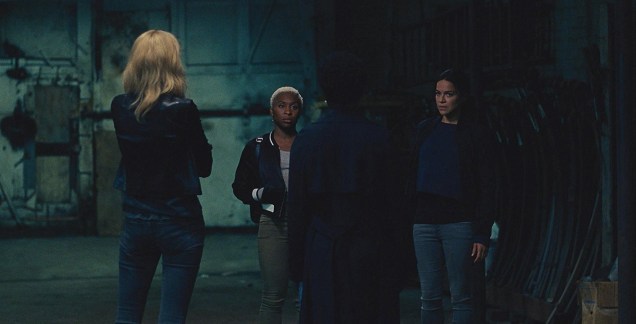
IMDB Widows Photo

It’s an impressive list. (I wish its scope were wider, though—gimme other genre subtypes, too, and productions from around the world, please?)

Below are a few of the ones that most tickle my fancy, with first a short description by Crucchiola and then my impressions.


The Aeronauts (preproduction)

  • “Eddie Redmayne and Felicity Jones star as a researcher and pilot team that goes on a science mission in a hot-air balloon. They ascend higher than anyone ever has, and have to fight for survival in the thinning atmosphere.”
  • Apparently set in the mid-1800s, this sounds like a non-mystery precursor to Murdoch Mysteries. I like Felicity Jones a lot, but am dubious of Amazon productions (mostly since I haven’t seen any so far, so take this with a bucket of salt).

A Black Widow stand-alone movie (screenwriter attached)

  • “It was announced earlier this year [2018] that Kevin Feige and Marvel had hired a writer for a Black Widow stand-alone screenplay.”
  • High time!

Captain Marvel (postproduction; U.S. release March 08, 2019)

  • “Marvel’s first female-lead superhero movie stars Brie Larson as Carol Danvers, a.k.a. Captain Marvel, an extremely powerful figure in the comics canon. We don’t know much—except that it’s set in the 1990s […].”
  • Again, high time! (According to Wikipedia, Captain Marvel has been in development since 2013.) I know extremely little of the character, but liked Brie Larson in Kong: Skull Island and Community.

Cleopatra Jones (in development)

  • “Details about the new film are not yet known, but in the 1973 original, Cleopatra Jones was a James Bond-type who worked as a special agent for the U.S. government and dealt with drug-related crimes.”
  • A reboot, although nothing I’ve heard of before. Hm. Maybe?

Enola Holmes (just announced at the start of the year)

  • “[A]daptation of Nancy Springer’s Enola Holmes Mysteries novel series. Enola is the baby sister of Sherlock and Mycroft Holmes, and wouldn’t you know it, a crack sleuth in her own right.”
  • Yes, please! Even more so, since Millie Bobby Brown (who outshone everyone else in Stranger Things) is set to star in and produce.

The Killer (in development)

  • “An assassin with a strict moral code can no longer abide the amoral ways of her employer, and so seeks to get out of the game.”
  • This might be amazing: John Woo is set to direct a reboot with Lupita Nyong’o in the head role.

Star Wars Episode IX (preproduction but definitely happening; U.S. release December 20, 2019)

  • “Star Wars remains an ensemble-powered saga, but this trilogy has always been about Rey’s journey.”
  • Yay! I’m just so sad we can’t have Carrie Fisher in it!

Widows (postproduction; U.S. release November 16, 2018)

  • “Brace yourself for this screen adaptation of a British mini-series from 1983, in which four widowed women plan to finish a heist job their dead husbands failed to complete.”
  • Ocean’s 8 was a great heist movie with a fantastic spread of women of all sorts (except the law-abiding type, heh heh) so this might be good, too.
  • Of the female cast, I recognize only Viola Davis (who’s awesome!); of the male, Collin Farrell (a meh performance in the 2012 Total Recall reboot and a suitably psycho Bullseye in the 2003 Daredevil), Daniel Kaluuya (W’Kabi in Black Panther), and Liam Neeson (who’s a turnoff for me, but perhaps he’s only got a small supporting role).

Wonder Woman 2 (in development)

  • “The timeline will reportedly move into the ’80s for the Wonder sequel, with the Cold War and USSR factoring in. Jenkins has also teased another love story.”
  • Am I the only one who’s noticed an uptick in movies where Russia (in one of its embodiments) is a bad guy? But: puh-leeeease stop writing forced love interests in movies! Love is great, but we don’t have to have an example of romantic love in every. single. story. Some stories work better without it, or with other types of love than the romantic variety.


Image: photo from the movie Widows from Twentieth Century Fox Film Corporation via IMBD

In the Seen on Screen occasional feature, we discuss movies and television shows of interest.

Quotes: Finland Is Weird. Finland Is Different

I first became aware of Adrian Tchaikovsky when he won the Arthur C. Clarke Award in 2016. I’ve been meaning to check out his writing since then. Ironclads, a limited-edition hardcover novella, finally made it to the top of my TBR pile last month.

The novella was great in several respects, but I was especially tickled by the American POV character’s descriptions of Finland and Finns. For example:

“All the middle of Nordland is the bit we’ve got problems with, basically: Sweden and Finland, say the maps. Sweden is where the fighting is, and the other place… Finland is weird. Finland is different.“

– Adrian Tchaikovsky: Ironclads

The version of U.S. in the story is fighting in Scandinavia, and, due to having laxer laws on genetic modification, Finland apparently has become home to very interesting types of special forces.

But the best, the absolutely best detail is mentioned in this section:

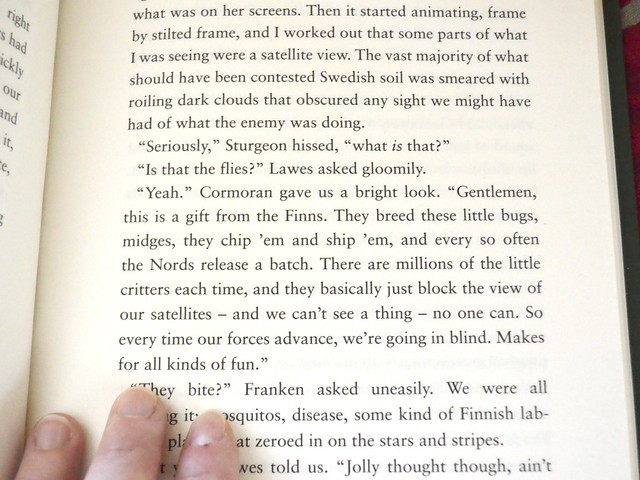
Quotes Tchaikovsky Ironclads

“[F]or a long time I couldn’t even work out what was on her screens. Then it started animating, frame by stilted frame, and I worked out that some parts of what I was seeing were a satellite view. The vast majority of what should have been contested Swedish soil was smeared with roiling dark clouds that obscured any sight we might have had of what the enemy was doing.

“’Seriously,’ Sturgeon hissed, ‘what is that?’

“’Is that the flies?’ Lawes asked gloomily.

“’Yeah.’ Cormoran gave us a bright look. “Gentlemen, this is a gift from the Finns. They breed these little bugs, midges, they chip ’em and ship ’em, and every so often the Nords release a batch. There are millions of the little critters each time, and they basically just block the view of our satellites – and we can’t see a thing – no one can. So every time our forces advance, we’re going in blind. Makes for all kinds of fun.’

“’They bite?’ Franken asked uneasily. We were all thinking it: mosquitoes, disease, some kind of Finnish labgrown plague that zeroed in on the stars and stripes.

“’Not yet,’ Lawes told us. ‘Jolly thought though, ain’t it?’”

– Adrian Tchaikovsky: Ironclads [original emphasis]

The militarization of mosquitoes! We already joke—as a way of dealing with an irritant that’s just a part and parcel of life—that mosquitoes are the Finnish air force. Finally, someone did it! 😀

It makes perfect sense in a world with aggressive biological research to turn a ubiquitous pest into an asset. Come to think of it, it sounds very much like the strategies that Finns used in the Winter War of 1939-1940 against Soviet forces—making native conditions work for you and against the enemy.

Of course, no one person can disapprove or approve of any characterization on behalf of their whole group. However, in My Official Opininon As a Finn, Tchaikovsky managed to balance well the view of Finland as part of Scandinavia with Finns being distinctly different from their Swedish, Norwegian, and Danish cousins. Also, he got so many little details right, like the way the Finnish language sounds, or our deep appreciation of nature.

I practically tore through the book. Kudos!

Tchaikovsky, Adrian. Ironclads. Oxford: Solaris, 2017, p. 22 and p. 29.

This post has been edited to correct a typo.

Serving exactly what it sounds like, the Quotes feature excerpts other people’s thoughts.

Some Random Thoughts on Ant-Man and the Wasp

In no particular order. Spoiler warnings in effect.

Erik’s random thoughts:

  • This was an excellent follow-up to the original Ant-Man, making the story deeper and more complex while keeping the wild fun caper tone.
  • As others have noted, it really should have been called The Wasp and Ant-Man. It’s Hope’s movie. Scott is the sidekick this time around, and that’s great.
  • Although Hope’s Wasp suit is form-fitting, it doesn’t overtly sexualize her in the way a lot of other Marvel women’s costumes do. The same goes for Ghost’s suit. I hope this is a sign of things to come.
  • Luis on truth serum (“It’s not truth serum”) may be the funniest thing to come out of the MCU yet.
  • In a media landscape oversaturated with father-son stories, it was a very welcome change to have a movie about fathers and daughters, husbands and wives, mothers and daughters, and found family, with nary a father-son story in sight.


Eppu’s random thoughts:

  • I found Ant-Man & the Wasp more enjoyable than Ant-Man (which I did like!) in many respects. The pacing felt more even, the villain slightly less corny, the cinematography as good or better, to mention a few.
  • AM&tW also felt more aware of itself in that it actively upended or joked about some conventions (e.g., some of the chase sequences, the long-running truth serum gag, even the name of Scott and Luis’ security company).
  • The antagonist setup was refreshingly different. Instead of one ham hock of a megalomaniac we’re treated to two forces grappling with Scott, Hope, and Hank: a woman trying to cope with years of pain and exploitation, plus a wannabe megalomaniac more in line with the usual cheesy MCU villain. Thankfully, the latter is used sparingly and isn’t allowed to lord it over everyone else.
  • The action sequences did so many funny and inventive things with size. I’ll also hazard a guess that the studio has improved their software since Ant-Man—at least to my untrained eye, the CGI looked smoother.
  • I loved how Cassie, Maggie, and Paxton’s family unit had—literally—embraced Scott. His cardboard fort / tunnel system treasure hunt with Cassie was so awesome! We tend not to see enough fathers enthusiastically play with their daughters on the big screen, let alone in superhero movies, so a big Thank You to the writing team for that.
  • I also loved the amount of screentime Hope got, and that there was no father-son story but a mother-daughter one and two father-daughter stories. You could even argue that Bill and Ava’s relationship amounted to an adoptive/adopted parent-child one (for the lack of a better term), or was moving in that direction by the end.
  • It was a funny flick, too. I sniggered all the way through.
  • Michael Peña’s Luis—oh, man! I don’t know how he can deliver the hyperspeed lines so fluently. He’s amazing! It was also nice to see how the ex-con gang worked together and that Dave and Kurt got a bit more development.
  • There’s one detail that stuck to my mind as a little too close to railroading: the countdown clock on Janet’s rescue window. Although, there’s plenty of Pym particle physics that’s merely handwaved aside, so it’s not like it’s alone in the MCU.
  • Finally, my two cents on the two stingers. The first one gave me the kind of genuine “Oh, shit” reaction that the end of Infinity War wasn’t able to. The second stinger felt cheaper, almost perfunctory.

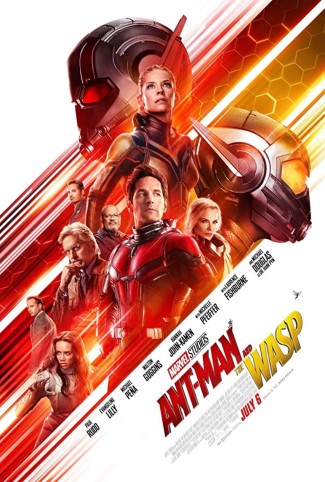
Image: Ant-Man and the Wasp poster via IMDb

In the Seen on Screen occasional feature, we discuss movies and television shows of interest.