Medieval Realism: Holding a Distaff Under One Arm While Feeding Chickens

As usual, some days ago while doing something quite different I found an intriguing detail I wanted to look into. Finally I had the time to chase it down.

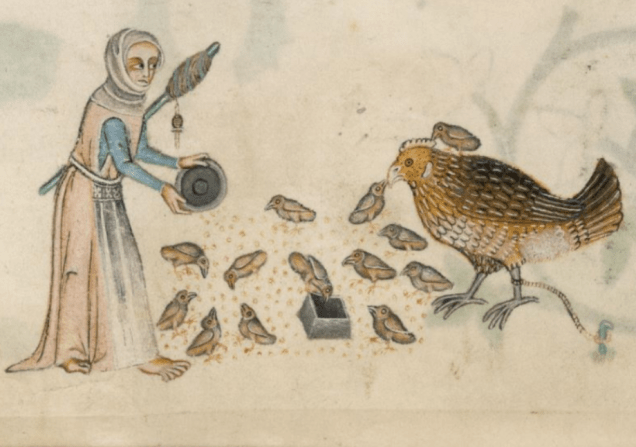
So: I was struck by this scene from an English illuminated manuscript.

British Library Add MS 42130 f166v Feeding Chickens
Add MS 42130, f.166v via British Library (England; 1325-1340; illuminated manuscript)

The way the woman in the image is holding a distaff under one arm while she feeds chickens from a bowl feels incredibly authentic. I may not have to spin my own yarn nor feed chickens in 2018, but I have often held a thing under my arm momentarily while taking care of a small, short task. Such a lovely, realistic detail.

I do have one question for the artist, though: what on earth is that chick doing, standing on top of the hen and pecking her? (“Mom, look, I’m up here! Mom? Mom? Mooom!”) LOL!

The manuscript is from England and known as The Luttrell Psalter. Fortunately for us, British Library has digitized the whole manuscript. In addition to the chicken-feeding one above, the illuminations include a slew of other everyday scenes, like a miller in his windmill, bear-baiting(!), a wattle pen full of sheep, and various stages of tending fields and preparing food.

Being a textile nerd, I enjoyed the image of two women preparing fibers into yarn: one is using a spinning wheel, the other is carding.

British Library Add MS 42130 f193r Spinning Carding
Add MS 42130, f.193r via British Library (England; 1325-1340; illuminated manuscript)

The coloring is quite lovely. I do wonder, however, what’s with the awkward poses. The chicken-feeding image felt much more natural in that respect, too.

Images via British Library

Out There is an occasional feature highlighting intriguing art, spaces, places, phenomena, flora, and fauna.

A Couple of My Favorite Sea Shanties

The nautical theme and music of Battle for Azeroth has put me in mind of sea shanties, traditional work songs used on large sailing vessels to coordinate sailors doing big jobs like hauling up the anchor or pumping out the bilge.

Shanties, like other work songs, tend to be rhythmic, repetitive, and easy to sing, which makes them great for singing in the car on long drives or while pottering around doing housework. As the songs of folks who had to live together in cramped quarters for months or years on end, they also often have a sly bit of humor to them to ease the tensions.

Here are a couple of personal favorites:

Roll the Old Chariot Along by The Fool via Jiří Šantora

Skipper Jan Rebeck by John Schomburg Shanty Man via John Locke

Hey, look! We found a thing on the internet! We thought it was cool, and wanted to share it with you.

Chance to Watch Coverage of InSight’s Mars Landing

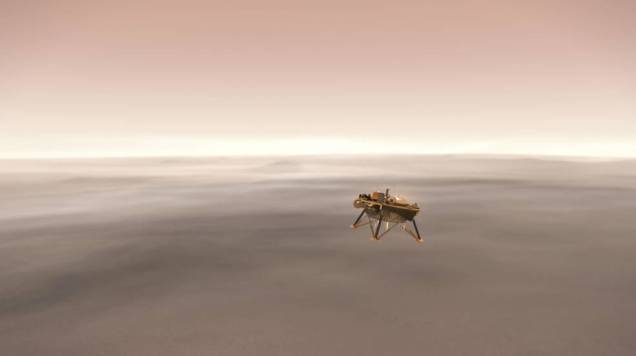
On Monday, November 26, 2018, NASA Television is bringing coverage of InSight’s Mars landing to a website or social media near you!

NASA JPL-Caltech Simulated InSight Landing on Mars

From NASA’s press release:

“NASA’s Mars Interior Exploration using Seismic Investigations, Geodesy and Heat Transport (InSight) lander is scheduled to touch down on the Red Planet at approximately 3 p.m. EST Nov. 26, and viewers everywhere can watch coverage of the event live on NASA Television, the agency’s website and social media platforms.”

There are a few pre-landing broadcasts, and on the landing day, coverage will start early in the morning. The landing itself is expected to take place from 2 to 3:30 p.m. EST, with post-landing news conference to wrap up the event.

Wow, sounds incredible. Even though the cameras are “only” inside JPL Mission Control and the mission itself will be covered by audio “only”, it’s the closest I can get to experiencing touching down on another celestial object. I will have to make time for this!

Found via File 770.

Image by NASA/JPL-Caltech.

Thanksgiving Break

Time for the annual turkey day!

Turkey Tom Being Handsome2

We will not be eating this handsome fella from our back yard. 🙂

We don’t necessarily get to see the turkeys displaying every spring, but often we do. It’s always such a sight—incredible birds in so many senses.

Happy Thanksgiving to our readers who celebrate!

Image by Eppu Jensen

Out There is an occasional feature highlighting intriguing art, spaces, places, phenomena, flora, and fauna.

Puquios

Out in the deserts of the Nazca region of southern Peru there are spiral-shaped holes bored into the ground. These holes are connected to networks of underground channels that bring fresh water from subterranean aquifers into the arid landscape. The spiral holes help the system work by channeling wind into the tunnels, which increases pressure and forces the water to move to where it is needed. These water systems are called puquios.

It is not known just when the puquios were constructed. Textual sources from the early days of the Spanish conquest do not mention them, but neither is there any record of them having been built post-conquest. They seem to be related to indigenous settlements that date to the first millennium CE, and some samples of organic material from the construction have been dated to the 6th-7th c. CE. On balance, the evidence suggests that they were built by precolonial cultures.

Despite their age, many of the puquios are still functioning and delivering water to desert communities today. What an interesting alternative they make for something so fundamental as water systems!

Image: Spiral entrance to the puquios, photograph by Ab5602 via Wikimedia

Out There is an occasional feature highlighting intriguing art, spaces, places, phenomena, flora, and fauna.

A WoW Mole Machine in Murdoch Mysteries?

After months of working on it, we opened up Dark Iron Dwarves last week. Yay! I’ve been leveling my new DI paladin a bit, getting a sense of the new-to-me racial abilities. They include Mole Machine, a way to quickly change locations by tunneling through the earth.

We’ve been rewatcing and rating Murdoch Mysteries for our project for a while now. A seventh-season episode, “Journey to the Centre of Toronto”, has a burrowing or boring machine that should look very familiar to World of Warcraft players.

Murdoch Mysteries s7 e11 Burrowing Machine

It’s a mole machine, right? Right!?!

WoW Westfall Sentinel Hill w Dark Iron Dwarf Mole Machine

The episode doesn’t actually ever call the device mole machine, but some of the characters do talk about hypothetical mole people who live underground. I wonder whether there are any WoWers in the writers’ room? 😀

In any case, even though the series seems to otherwise strive towards reasonable accuracy, now and then they definitely veer into SSFnal or steampunk-ish. I love the tongue-firmly-in-cheek attitude!

Images: screenshot from the tv series Murdoch Mysteries, season 7, episode 11, “Journey to the Centre of Toronto”. World of Warcraft screencap with Dark Iron Dwarf mole machine in Westfall.

In the Seen on Screen occasional feature, we discuss movies and television shows of interest.

Stockholm University: Research Reveals Half of Viking Age Sigtuna Residents Were Immigrants

I’ve been meaning to share this for a while now, but something or other was always supposedly more important or interesting. No more! 🙂

The Viking Age Sigtuna, Sweden, was formally founded around 980 AD, and it was a much more cosmopolitan city than thought before. According to new DNA analysis, approximately half of city’s population were immigrants.

Flickr Guillen Perez Sigtuna Viking Rune Stone

The study looked at the remnants of 38 individuals who lived and died in Sigtuna between the 900s and 1100s CE, and included other scientific approaches as well (like analysing the strontium isotope contents of the residents’ teeth).

Roughly half of the population grew up in the near-by region Mälardalen (the Mälaren Valley, or Stockholm-Mälaren Region). The other half arrived either from southern Scandinavia (including Norway and Denmark) or further away. The long-distance immigrants came from the British Isles, Ukraine, Lithuania, northern Germany, and other parts of central Europe, and were more likely to be women than men (approx. 70 percent of women vs. 44 percent of the men).

Read more on the Stockholm University research news page: article in Swedish / article in English.

I guess I’m by far not the first woman to fall in love with a Viking and to move far away with him. 🙂

Found via Yle uutiset.

Image: section of a Viking rune stone from Sigtuna by Guillén Pérez on Flickr (CC BY-ND 2.0)

Out There is an occasional feature highlighting intriguing art, spaces, places, phenomena, flora, and fauna.

Self-Help Law

“Self-help law” may sound like a book you would pick up to figure out how to make a will or file a lawsuit on your own, but it’s actually an important concept in history. Many societies in history have operated under a self-help legal system, especially small societies without developed governments, but even large, complex societies like the Roman Empire have operated under self-help law.

Most of us today live in legal systems that have mechanisms for enforcing legal judgments. If you take someone to court and win a judgment against them, you can rely on the police and courts to ensure that the judgment is fulfilled. Self-help legal systems don’t have those mechanisms. In a self-help system, you may take someone to court (or before a council of elders, or to a family tribunal, or whatever the system is) to get a judgment on who is legally in the right and what you are entitled to, but once the judgment is given it is up to you to carry it out. If the court decides that your neighbor owes you three bars of silver for cutting down your hedge, no one is going to come along and make them pay up. You have to go and get the silver from them yourself.

That may not sound like much of a legal system—if it all comes down to you having to barge into your neighbor’s house and grab their cash, it looks a lot like might making right. The difference, though, is that a self-help system requires you to get a legal judgment first. Once your neighbor cuts down your hedge, you can’t just bust in their door and take the silver. You have to present your case before a court (or council, or whatever the equivalent legal body is). You have to submit your grievance against your neighbor to someone who has the authority to represent the values of the community and judge how badly your neighbor has transgressed them. If you bust in and take the silver before going to court, that’s theft, and your neighbor has a case against you; if you do it after getting a judgment from the court, then you are executing justice and they have no case.

Self-help law accomplishes certain things that are useful in maintaining an orderly society. For one thing, it interrupts the cycle of vengeance by making people slow down, not act in the heat of anger but give wiser heads a chance to prevail. It offers a check on personal vendettas by submitting individual grievances to a neutral party. At the same time, though, it avoids burdening society with any kind of formal law enforcement, which could be a disruptive presence, especially in small-scale societies where disorder and crime are not everyday problems.

Self-help law also has its limitations. The obvious one is that some people are in a much better position to enforce their rights than others are. The rich and powerful have always been better able to wield the power of the law against the poor and humble, but under self-help law the weak often have very little real recourse against the strong. Another problem with self-help law is the tendency to escalate conflicts. Even with the intervention of a neutral party’s judgment, it’s hard for people to set aside their feelings of personal grievance. When your neighbor has cut down your hedge, even if you are legally entitled to go into their house and take three bars of sliver, it may be hard to resist urge to kick their dog and knock over their shelves while you do it, which just gives your neighbor a new legal claim against you. Self-help law may be described as a state of suspended violence, which carries within it the implicit threat of real violence breaking out.

A system of legal self-help also has broader social consequences. To be able to effectively carry out judgments (or resist people carrying out judgments against you), it’s useful to have a large network of friends and family you can rely on to stand up for you. Naturally, they’ll expect you to stand up for them in return. The bonds of friendship and family are more than sentimental in such a society; they can make the difference between living safe in your home and having your property under attack by your neighbors. They can also, on the other hand, drag you into conflicts that you had no part in beginning. As the old joke goes: “A friend will help you move; a good friend will help you move a body.” In a world of legal self-help, you might say: “A good friend will help you shove in your neighbor’s door and get the three silver bars that hedge-cutting menace owes you.”

Thoughts for writers

There is a lot of potential for drama in a self-help legal system. Modern law enforcement can sometimes create its own problems, but it also—by design—interrupts a lot of conflicts that would otherwise play out between individuals, families, and communities, sometimes violently. When you can’t just call the police on your annoying neighbors, interpersonal relationships evolve differently than we are used to today. A lot of stories from the past—the Mahabharata, the Iliad, Romeo and Juliet, etc.—have at their core the tensions that arise from the suspended violence and mutual obligations of a self-help society.

It is also important for us to understand that these tensions are real and have consequences. The conflicts that break out between feuding families or rival princes are not the result of overinflated egos but the consequence of living in a world where there is no one to guarantee your rights other than yourself and the friends and family you can count on to back you up.

Image: Balance scales, photograph by Mbiama via Wikimedia

History for Writers is a weekly feature which looks at how history can be a fiction writer’s most useful tool. From worldbuilding to dialogue, history helps you write. Check out the introduction to History for Writers here.
Quotes: If Anyone Hated Me and I Hated Them

As you may know, speakers of Modern English are struggling to find a non-clunky and commonly accepted gender-neutral third person singular pronoun to replace the generic use of he or she.

The issue’s been periodically debated for decades, really, but lately the calls seem to have gained more urgency. There are many contenders, among them e / em / eir and ze / hir / hir.

Singular they may be gaining some ground, or at least growing in popularity here in the U.S. I’ve seen references to a long history of using they in that manner, but these references usually give no examples. (Maybe I just haven’t been reading the better articles? Also, one sometimes wonders why the British use of one has fallen out in other world Englishes.)

In any case, as an Anglo-Saxonist, it’s beyond my era and/or expertise. Nevertheless, I’m curious about any early examples. Here’s the oldest I’ve noticed so far, from a 1938 Hercule Poirot novel:

“Pilar said gravely: ‘If I had an enemy—if anyone hated me and I hated them—then I would cut my enemy’s throat like this….’”

– Agatha Christie: Hercule Poirot’s Christmas, p. 18 (original emphasis)

This example is great, because it’s clear and unquestionable. I’m pretty sure there are a few singular theys in Jane Austen’s novels, but I can’t remember where. Maybe it’s the perfect time for a re-read. 🙂

Christie, Agatha. Hercule Poirot’s Christmas. New York, NY: Black Dog & Leventhal, 1938.

Serving exactly what it sounds like, the Quotes feature excerpts other people’s thoughts.

Battle for Azeroth: Our Thoughts So Far

The Battle for Azeroth expansion to World of Warcarft has been out for a couple of months now, long enough to play around with it, get used to its quirks, and discover some of its surprises. We have leveled up a few of our Alliance characters and just started playing through the Horde experience, so there are plenty of things we just haven’t seen yet, but here’s our take on what’s working, what isn’t, and what’s going on so far.

The Good

  • It’s beautiful. All of it. The landscapes, the buildings, the gear, the skies, everything is visually incredible. Since Mists of Pandaria, really, the visual design teams have been improving with every expansion, but in BfA the terrains really shine. We still spend so much of our playing time just pausing to look at the artwork.
  • The questline stories in the zones are great. We don’t usually read quest text too carefully, but this time it’s worth taking the time to see what the characters have to say. There are a lot of compelling and entertaining individual stories out in the world.
  • The Tortollans are the best new NPCs in a long time—crotchety old turtle people who want to play games and tell you stories! They add some wonderful comic relief to the more serious events going on in the world.
  • Boralus and Dazar’alor feel like real, living cities, full of people, with their own neighborhoods and back alleys and stories going on at the periphery of your adventure. Boralus is the quasi-British age-of-sail/smuggler/pirate town of your fantasy dreams, and Dazar’alor is a gorgeous Mesoamerican-inspired city of living gods and golden pyramids. They are both amazing places to spend time in and hands-down the most successful built environments we’ve seen in WoW so far.
  • The music is fabulous all-round. From epic and rousing to serene and unobtrusive, they all come with interesting real-world comparisons or sources of inspiration.
  • The number of female characters in the storytelling has increased noticeably, and women are depicted as active decision-makers. Because even though this is a fantasy world, a lot of it is based on our real one and you wouldn’t want to be historically inaccurate.
  • On the Alliance side, the combination of ferry stations and flight points is a great demonstration of world-internal logic at work, and it works really well from the UX (user experience) point of view. Do the Horde have anything similar?

WoW BfA Nazmir Azeroth World Q Nov 2018

The Meh

  • The mission table is back, stripped down and streamlined to just about the most efficient version you can imagine, but also feeling pretty pointless. There aren’t many followers to collect, the rewards are uninspiring, and getting War Resources to run the mission table is doable but tiresome. It doesn’t feel like compelling content, but it’s not a great drag, either.
  • The Heart of Azeroth is a similarly stripped down and streamlined version of the Artifact weapons from Legion. It works just fine, but it’s not very interesting. Leveling up the Heart of Azeroth with azerite is relatively painless, but there’s also nothing exciting about it.
  • The azerite gear tied to the Heart of Azeroth is a mixed bag. On one hand, it’s fun to pick bonus traits and some of the perks can really make a difference to how your character plays. On the other hand, the gear is hard to get and clunky to use. Having to wait an indeterminate amount of time to level up your Heart of Azeroth before your upgraded gear actually becomes an upgrade doesn’t feel good.
  • The two of us play together and we play strictly PvE. We’re not interested in doing larger group content or anything that even feels like PvP. This means that a lot of the new content this expansion—islands, warfronts, war mode—just isn’t for us. That’s fine, and we don’t mind there being content in the expansion that isn’t for us, but it does leave max-level content feeling a little threadbare.

The Bad

  • The faction conflict story is back. Again. There’s never been anything interesting about faction conflict and there’s still nothing interesting about it. Despite what Blizzard seems to think, “Horde vs. Alliance” is not the core of WoW. The core of WoW is beating up monsters and taking their stuff. We don’t need faction conflict to motivate us to go to Kul Tiras and Zandalar to beat up monsters and take their stuff. Just the fact there are monsters there who have stuff we can take is more than enough. If Blizzard really felt like they needed a story reason for us to go to these new places, having Jaina/the spirit of Vol’jin show up and say “Hey/Hey mon, there’s something strange in Kul Tiras/Zandalar and it don’t look good!” would be plenty.
  • Not only is Blizzard pushing hard on the faction conflict this time, they’ve chosen to do so in a heavy-handed, aggravating way. On both the Alliance and Horde sides, players have been made to play through content that is needlessly cruel but unskippable.
  • Fortunately, the actual content of Battle for Azeroth has very little to do with faction conflict, but that in itself is a problem. There are three narrative threads running through this expansion: the internal problems of Kul Tiras and the Zandalari, the Alliance vs. Horde faction conflict, and Magni’s attempts to heal the wounded Azeroth. None of these three threads is well integrated with the other two. While the Kul Tiras and Zandalari stores are compelling on their own, the faction conflict is annoying, and Magni’s planetary first aid is tedious and repetitive. It feels like Blizzard had three different ideas for this expansion, only had time to develop one, but tried to do all three anyway.
  • You can’t seem to be able to go beyond two advancements without doing at least some PvP group content (islands). Not a great design choice. (Corrected)
  • Did they have to destroy Teldrassil?

On balance, there’s a lot to like about Battle for Azeroth, and we’re certainly going to keep playing. At the same time, there are some annoying problems that are hard to ignore. Some people have speculated that Blizzard has an A team and a B team putting out expansions alternately. That may not be true, but there certainly are some aspects to BfA that remind of us of what went wrong back in Warlords of Draenor, when we got a beautiful new world to explore, but an overarching story best ignored and some poorly designed mechanics that dragged the experience down.

Of Dice and Dragons is an occasional feature about games and gaming.