Happy Holiday Wishes with Northern Lights Seen from the ISS

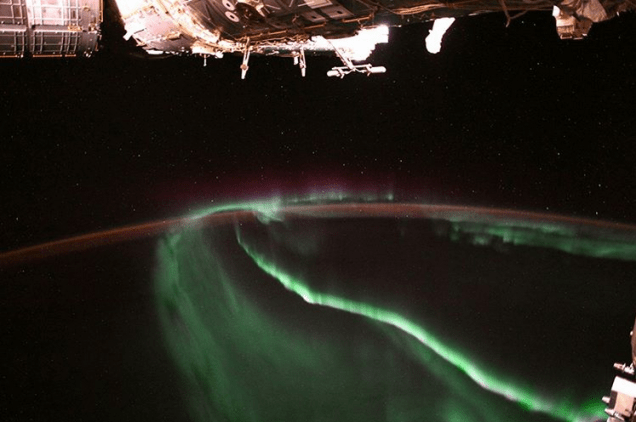
I grew up seeing Northern Lights every winter, so for me they’re not a novelty—except when seen from space.

NASA Instagram ESA Alexander Gerst Northern Lights from Space

This amazing photo was taken by the European Space Agency astronaut Alexander Gerst at the International Space Station.

I think it’s fair to say we’re living in an age quite unlike any previous one from a scientific and research perspective. It’s amazing and incredible.

We’re vacationing for a week or so. Until then, Happy Merry!

Image: Northern Lights from space ESA/NASA-A.Gerst via NASA at Instagram.

Out There is an occasional feature highlighting intriguing art, spaces, places, phenomena, flora, and fauna.

History for Writers Compendium: 2018

History for Writers explores world history to offer ideas and observations of interest to those of us who are in the business of inventing new worlds, cultures, and histories of our own. Here’s where we’ve been in 2018:

Thinking historically and mythically

Daily life

Crossing cultures

Women in the ancient world

Conflict and resolution

Race in Antiquity

Join us in 2019 for more history from a SFF writer’s perspective.

History for Writers is a weekly feature which looks at how history can be a fiction writer’s most useful tool. From worldbuilding to dialogue, history helps you write. Check out the introduction to History for Writers here.

Joy to the World (of Warcraft) 1

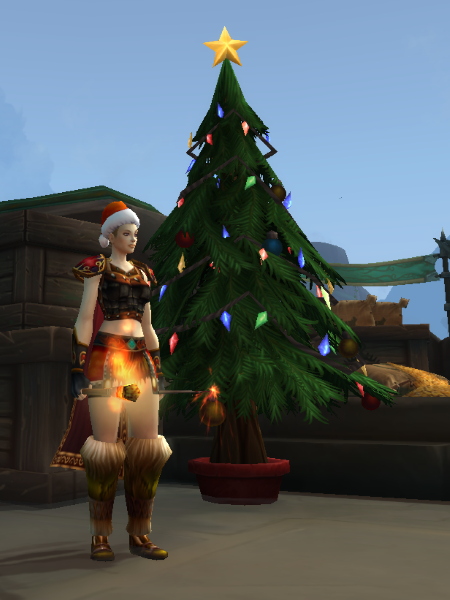
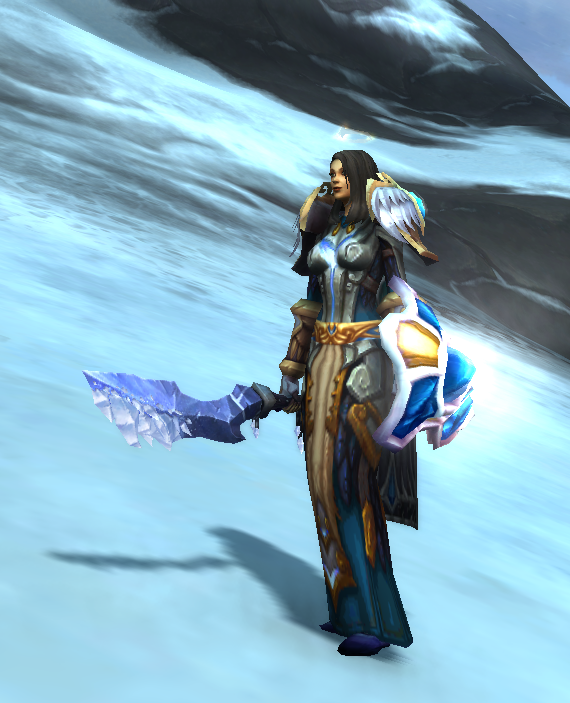
Alunaria, over at Alunaria’s Avenue, has proposed a holiday challenge: stay away from the griping, grousing, and general grinchiness about World of Warcraft that’s all to easy to find these days and post something positive instead. We’re always up for some kindness and fun, so here’s a contribution from us: some holiday-themed transmogs to light up the winter darkness.

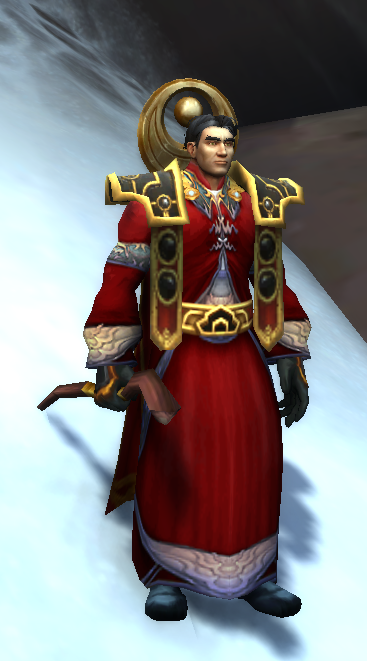
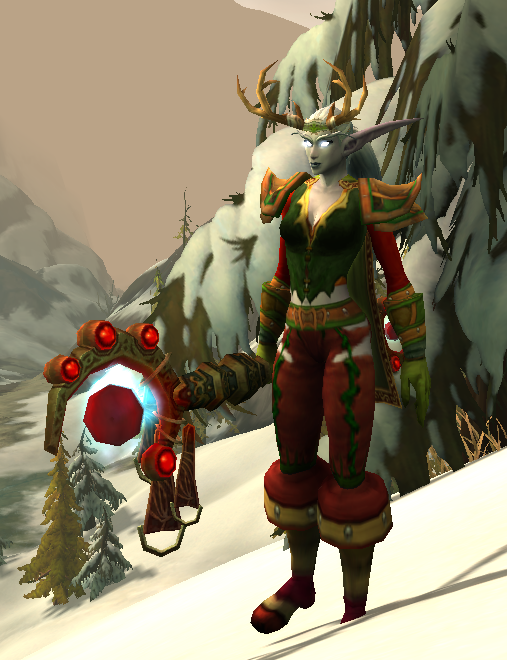
When you can already turn into a stag, a little Christmas spirit isn’t hard to find. Here’s my guardian druid in her Jolly Holly set.

Of Dice and Dragons is an occasional feature about games and gaming.
Large LED-Lit DIY Death Star Wall Art

This Star Wars wall art project is older, but a stunner nevertheless: Melissa DIYed an LED-illuminated Death Star for under $16.

320 Sycamore Melissa DIY Death Star w LED Lights

Wow; nicely done. Apparently Pottery Barn Kids used to list still sells a similar art piece for $299, except that one is stretched canvas while Melissa used particle board and an inexpensive engineer print.

Impressive; most impressive (done in my best Darth Vader imitation). Head to her site for the tutorial. Thanks for sharing, Melissa!

Found via Knock Off Decor.

Image by Melissa at 320 Sycamore.

In Making Stuff occasional feature, we share fun arts and crafts done by us and our fellow geeks and nerds

Avengers: Endgame Trailer

Whoa – Marvel Studios released the second Captain Marvel trailer and the first Avengers: Endgame trailer only four days apart.

Marvel Studios’ Avengers – Official Trailer by Marvel Entertainment on YouTube

It does make sense—Avengers: Infinity War was implying heavily that Captain Marvel will be there for the sequel—but I can’t remember a big studio doing anything similar before. It’s a good time to be a geek. 🙂

As for the trailer: I didn’t much care for AIW, and it came across particularly wooden after the glory of Black Panther. Also, we all know a lot of the events of AIW will have to be undone in Endgame. We’ve now seen a teeny glimpse.

I’m wondering whether the fact that Doctor Strange wasn’t in the trailer at all means the postproduction team is still furiously working on the scenes. More likely is that they’ll want to safeguard any hints of his involvement in the final reveal from leaking prematurely. Also, I have to admit that I was surprised to see Hawkeye return; looks like he might have been written an interesting story twist.

If there’s a major complaint I have, it’s Tony frigging Stark being plastered front and center. In a trailer that runs 2:25, he monologues / occupies the scene for almost a minute (0:55). That’s way too much; weren’t the Avengers supposed to be ensemble movies, after all?

In addition, I have some fleeting thoughts that don’t really go anywhere. (When did Cap shave? Why is Cap crying? And that’s so great—in my world, a man is nothing if they don’t allow themselves to cry. Huh—Scott Lang embiggened and out of the subatomic realm? Ok, there’s Black Widow and Nebula, but where are the rest of the women?)

Mostly, though, the trailer managed to re-ignite my interest in the sequel after the decidedly lackluster first part.

Hey, look! We found a thing on the internet! We thought it was cool, and wanted to share it with you.

Tali for Saturnalia

The ancient Romans celebrated the holiday of Saturnalia on this day, the 17th of December. (At least in early Roman history it was a one-day holiday; later, it was extended so that it started on the 17th and lasted through the 23rd.) Saturnalia was a festival of good cheer and relaxed social strictures, thought of as recreating a lost golden age ruled over by the god Saturn. Typical practices included feasting, gift-giving, and a holiday from the usual social rules: children got to order their parents around while adults played children’s games; the masters of the household served a feast to their slaves; and gambling, which was a popular passtime but not usually allowed in public, was freely tolerated.

Romans played many different gambling games, but some of the most popular involved dice. One common game, known as tali, was played either with the knucklebones of sheep or goats (called astragals) or with cubical six-sided dice marked with the numbers 1 through 6, like modern dice. Astragals had four sides. For gaming purposes, it seems they were assigned values of 1, 3, 4, and 6. When playing with six-sided dice, only those numbers were used; 2 and 5 were ignored.

The rules of tali are not entirely understood today. Probably there were many different variations with different rules, and all of them were so common that no one bothered to write down instructions for how to play. Here is a playable modern interpretation based on what we can gather from literary references and artistic depictions.

All you need for any version of the game is four six-sided dice and something to bet with (coins, poker chips, chocolates—whatever you like), although a pencil and piece of paper for each player to record their throws can also be useful.

Simple Tali

Each player pays an ante into the pot.

Each player then rolls four dice, either their own set or taking turns with a common set.

Each player’s roll is then scored, and the winner takes the pot. If no one wins a round, everyone rolls again. If two or more players tie, only those players roll again until someone wins.

Dice rolls are scored according to the following system in which “hands” of dice are ranked, much like hands of cards in the modern game of poker.

  • 6,4,3,1 – called Venus, the best roll, always wins.
  • Rolls that include at least one 6 (apart from 6,6,6,6, which is a Vultures—see below) are called Senio and are scored by totaling the numbers shown (excluding the numbers 2 and 5, which are not counted). Any Senio always beats a Vultures or a roll that includes no 6.
  • Rolls that show four of the same number, called Vultures, score at the bottom of the heap, but will win over other 6-less rolls.
    • 6,6,6,6 – called Vultures, beats only a lower Vultures, The Dog, or a roll without a 6.
    • 4,4,4,4 – called Vultures, beats only a lower Vultures, The Dog, or a roll without a 6.
    • 3,3,3,3 – called Vultures, beats only The Dog, or a roll without a 6.
    • 1,1,1,1 – called Vultures or The Dog, beats only a roll without a 6.
  • Any roll that has no 6 (except a Vultures) always loses.

Here’s how a sample round might play:

  • A rolls 6,1,1,1 – a Senio worth 9
  • B rolls 6,5,3,1 – a Senio worth 10 (because the 5 is not counted)
  • C rolls 3,3,3,3 – a Vultures
  • D rolls 4,4,4,3 – a losing roll

B wins this game with a Senio of 10. Even though D’s roll totals higher, it has no 6, and therefore automatically loses.

Tali variations

The version of tali described above is perfectly playable, but it’s a simple game of chance with no real strategy. Here are a few ways you can make it more interesting. (All these variations use the same scoring system described above.)

Liars’ tali

Each player rolls their dice in secret and hides the total (or, if using a common set of dice, records their roll in secret). After an initial bet, players raise, call, or fold in turn, as in poker, until everyone calls or folds. The players still in the game then reveal their rolls and the winner takes the pot.

Draw tali

Each player rolls their own dice (this variation is difficult to manage with common dice). Any player may then ante into the pot again for the chance to reroll a die. Repeat either for a limited number of rerolls or until everyone passes. The player with the best roll on the table wins the pot.

Stud tali

Each player rolls one die and either keeps it (if using individual dice) or records it (if using common dice). After all players have rolled once, each one either antes into the pot or folds. Repeat three more times until all players have rolled a full four dice. The player with the highest roll among those still in the game takes the pot.

Happy Saturnalia!

Image: Roman dice, photograph by Wendy Scott via Portable Antiquities Scheme (Leicestershire; 1-410 CE; lead)

History for Writers is a weekly feature which looks at how history can be a fiction writer’s most useful tool. From worldbuilding to dialogue, history helps you write. Check out the introduction to History for Writers here.

New Find: Most Uralic Speakers Share Siberian Ancestry

(This post is mostly a Note to Self—I don’t want to forget about the study below—but if other people are interested, that’s great.)

The majority of languages spoken in North Eurasia belong to three language families—Turkic, Indo-European, and Uralic. My native language Finnish is a part of the Uralic languages; the main branches of the family are the Finno-Ugric and the Samoyed.

While there’s rough agreement over where and how Uralic languages developed and spread, and over what types of material cultures were found in the corresponding areas, no-one’s done comprehensive studies on the genetic history of Uralic-speaking peoples before.

This interdisciplinary study, lead by Kristiina Tambets from the University of Tartu, Estonia, compared genome-wide genetic variation of nearly all extant Uralic-speaking populations from Europe and Siberia.

From the abstract:

“The genetic origins of Uralic speakers from across a vast territory in the temperate zone of North Eurasia have remained elusive. Previous studies have shown contrasting proportions of Eastern and Western Eurasian ancestry in their mitochondrial and Y chromosomal gene pools. While the maternal lineages reflect by and large the geographic background of a given Uralic- speaking population, the frequency of Y chromosomes of Eastern Eurasian origin is distinctively high among European Uralic speakers. The autosomal variation of Uralic speakers, however, has not yet been studied comprehensively. […]

“Here, we present a genome-wide analysis of 15 Uralic-speaking populations which cover all main groups of the linguistic family. We show that contemporary Uralic speakers are genetically very similar to their local geographical neighbours. However, when studying relationships among geographically distant populations, we find that most of the Uralic speakers and some of their neighbours share a genetic component of possibly Siberian origin. Additionally, we show that most Uralic speakers share significantly more genomic segments identity-by-descent with each other than with geographically equidistant speakers of other languages. We find that correlated genome-wide genetic and lexical distances among Uralic speakers suggest co- dispersion of genes and languages. Yet, we do not find long-range genetic ties between Estonians and Hungarians with their linguistic sisters that would distinguish them from their non-Uralic-speaking neighbours.”

Tambets et al Geo Distribution Uralic Populations w Lang Tree

And the conclusion:

“Here, we present for the first time the comparison of genome-wide genetic variation of nearly all extant Uralic-speaking populations from Europe and Siberia. We show that (1) the Uralic speakers are genetically most similar to their geographical neighbours; (2) nevertheless, most Uralic speakers along with some of their geographic neighbours share a distinct ancestry component of likely Siberian origin. Furthermore, (3) most geographically distant Uralic speaking populations share more genomic IBD segments with each other than with equidistant populations speaking other languages and (4) there is a positive correlation between linguistic and genetic data of the Uralic speakers. This suggests that the spread of the Uralic languages was at least to some degree associated with movement of people. Moreover, the discovery of the Siberian component shows that the three known major components of genetic diversity in Europe (European hunter-gatherers, early Neolithic farmers and the Early Bronze Age steppe people) are not enough to explain the extant genetic diversity in (northeast) Europe.”

I find the question of which material cultures may have spread together with which languages absolutely fascinating. Having my own small language / culture be a part of a larger study like this makes it even more special.

I was also surprised to learn that only three Uralic languages—Hungarian, Finnish, and Estonian—are not listed as endangered in the UNESCO Atlas of the World’s Languages in Danger. (I did know that several of the tiniest ones like Mari or the Permic languages have been endangered for decades, but I had thought that some of the Samoyed or Ugric languages had more speakers than that.)

While I doubt these three will go extinct very soon, there’s pressure at least in Finland to adopt more and more loanwords from English. Then again, we three may end up being rather rare, all in all, and I’m not quite sure whether to be alarmed over our potential disappearance or proud of our preciousness—or both.

Found via Helsingin Sanomat (NB. Finnish only). (Related article on the Siberian genes of Finns and the Sami in English via University of Helsinki.)

Tambets, Kristiina et al. 2018. “Genes reveal traces of common recent demographic history for most of the Uralic-speaking populations”. Genome Biology 19:139. DOI: https://doi.org/10.1186/s13059-018-1522-1. The article is openly accessible (CC BY 4.0).

Image screencapped from Kristiina Tambets et al.

On, of, and about languages.

Rating: Murdoch Mysteries, Season 3

Onward to season 3 of Murdoch Mysteries we go, rewatching and rating each episode. Here’s our take:

  1. “The Murdoch Identity” – 8
  2. “The Great Wall” – 6
  3. “Victor, Victorian” – 6.5
  4. “Rich Boy, Poor Boy” – 6
  5. “Me, Myself & Murdoch” – 8.5
  6. “This One Goes to Eleven” – 7.5
  7. “Blood and Circuses” – 5
  8. “Future Imperfect” – 4
  9. “Love and Human Remains” – 9
  10. “The Curse of Beaton Manor” – 7
  11. “Hangman” – 6
  12. “In the Altogether” – 4
  13. “ The Tesla Effect” – 8

The average rating for this season is a strong 6.6, a bit up even from last season’s quite good 6.2. Season 3 continues to build on the series’ strengths—complex mysteries, whimsical humor, and an eye for finding Victorian equivalents to modern issues—while also striking out in some new ways. One innovation this season is the introduction of an ongoing plot surrounding the newly-introduced character of James Pendrick, a visionary inventor who keeps getting tangled up in Detective Murdoch’s investigations. Starting halfway through the season, Mr. Pendrick’s misadventures lead up to a surprise finale that changes our perception of him and the preceding episodes in clever ways.

Unfortunately, the Pendrick storyline also gives us the two lowest-rated episodes of this season, both rating 4: “Future Imperfect,” in which Murdoch and company intersect with H. G. Wells and the eugenics movement, and “In the Altogether,” in which prostitutes and pornographers are caught up in a blackmailing scandal. Each episode has its merits and good moments, but they are dragged down by the need to serve the unfolding Pendrick drama, which leaves too little room for their own individual stories to develop.

By contrast, the best episode of the season, “Love and Human Remains,” at 9, tells a story that, for all its small and self-contained scope, offers a bounty of human drama and investigative intrigue. When the bodies of a murdered couple turn up at a building site, Murdoch goes digging through the past, peeling back layers of time to uncover a story of cruelty, desperation, and, ultimately, the triumph of love over adversity. It is one of the rare mysteries where you want the crime to be solved, but you end up glad that it goes unpunished.

Honorable mention goes to “Me, Myself & Murdoch,” the second best episode of the season at 8.5, which offers a similarly tangled tale of murder, abuse, mental illness, and the unbreakable bonds of love. In this episode, which nods to the historical Lizzie Borden case, a young woman is suspected of having murdered her father with an axe, only to turn out to have multiple personalities whose different perspectives allow Murdoch to piece together an older, even more grisly crime. Guest star Anastasia Phillips gives a virtuoso performance as the young woman under suspicion, whose shifts in personality from terrified to terrifying are amazing to watch.

Murdoch Mysteries remains a pleasure to watch and rewatch.

Image: Murdoch Mysteries main cast via IMDb

In the Seen on Screen occasional feature, we discuss movies and television shows of interest.

Rolling for Charity

What’s even better than gaming? Gaming for a good cause! Roll for Charity is an organization based in Buffalo, New York, USA, that sponsors gaming events with a good purpose: supporting food aid to combat hunger and food insecurity. One thing they do is host gaming events in which players can make charitable donations (in cash or canned food) to get special perks and powers to help them win. Has there ever been a better use of cheat codes?

We’re not close enough to Buffalo to take part in any of their activities (we heard about the organization by chance), but it’s a marvelous idea and we hope there are more people out there doing similar things. If you are in the Buffalo area, though, you might want to look them up.

These days when it can feel like the news is always bad, it’s good to see people working toward something that isn’t just in a good cause, but sounds like an awful lot of fun.

Image: Roll for Charity logo by Seijen

Hey, look! We found a thing on the internet! We thought it was cool, and wanted to share it with you

Quotes: [It’s] the Small Things … That Become Precious

“It’s the large things in life that drive us, that we measure ourselves by; but it’s the small things, the daily things that–that become precious to us.”

– Rowan in Rosemary Kirstein’s The Outskirter’s Secret

As I get older, I see more and more truth in this trite-sounding idea. Or you could say that it’s yet another way of putting the concept that life happens in the cracks of bigger things or while waiting for something grand to happen.

Kirstein, Rosemary. The Outskirter’s Secret. New York: Del Ray, 1992, p. 132.

Serving exactly what it sounds like, the Quotes feature excerpts other people’s thoughts.