Second Captain Marvel Trailer

Yesterday’s release of the second official Captain Marvel trailer caught me off guard. (It seems to happen to me a lot this fall.) No matter—it’s as AWESOME as the first.

Marvel Studios’ Captain Marvel – Trailer 2 by Marvel Entertainment on YouTube

My thoughts of the first trailer pretty much stand for this one, too—more of Nick Fury is great, and especially when he get gets cute with a cat! 😀 Also, again, it’s seriously sooo wonderful that Carol Danvers is shown as a soldier instead of sexy-woman-soldier (think of those silly Halloween costumes). I’m not at all interested in the Skrull and the Kree plot yet, but we’ll see.

Hey, look! We found a thing on the internet! We thought it was cool, and wanted to share it with you.

Race in Antiquity: The Ivory Bangle Lady

“What race were the ancient Greeks and Romans?”

It sounds like a simple question that ought to have a straightforward answer, but both the question and its answer are far more complicated than they appear. In these posts, I dig into the topic to explore what we know, what we don’t know, and what we mean by race in the ancient Mediterranean world.

Part 9: The “Ivory Bangle Lady”

In the past entries in this series, we have talked a lot about theories of identity, how we can interpret (and sometimes misinterpret) both written and artistic sources, and the problems in knowing just who we mean by Greeks and Romans in the first place. Today we approach the question from a different angle, looking at one individual and the world she lived in.

Around 400 CE, a wealthy lady was buried near the Roman city of Eburacum (modern York) in northern Britain. She was buried with jewelry including an assortment of bangles, some of white ivory from Africa, others of black jet from Britain. Her name is not recorded, but she has come to be known, because of her jewelry, as the Ivory Bangle lady.

Examination of the Lady’s remains using the techniques of forensic anthropology shows that she was of African ancestry and had spent her childhood in a warmer climate, perhaps somewhere in southern Europe or North Africa. Her skull has features typical of sub-Saharan African populations and in fact the reference measurements that most closely match her skeletal morphology come from nineteenth-century black Americans. Although no indication of her skin color survives, it is almost certain that, if we passed her on the street today, we would describe her as a woman of color.

Roman York may seem like the last place we would expect to find evidence of racial diversity. It was the northernmost city in the Roman empire, just a little over a hundred kilometers from the Scottish frontier. There are few places in the Roman world that were farther from the cosmopolitan centers of the Mediterranean, yet archaeology has revealed late Roman York to have been a vibrantly multi-ethnic city. Individuals from Gaul, Italy, and Egypt are mentioned in Roman-period inscriptions from around York. Local potters made cooking vessels characteristic of North African cuisine. A Germanic king with his retinue of warriors is attested in the city backing the emperor Constantine’s rise to power. Not far away, in the forts along Hadrian’s Wall, soldiers were worshiping gods imported from Syria and Persia. A North African woman of Sub-Saharn African descent would have been right at home in such a place.

What did she think of herself? We have no way of knowing except to try to interpret the circumstances of her burial. The bangles with which she was buried may suggest a consciousness of being both African and British, although ivory and jet were both prized in late Roman jewelry. They certainly, however, point to a family of wealth and status. The remains of a wooden box were also found in the grave, including a decorative mount carved with the text “Hail, sister, may you live in God” (AVE S[OR]OR VIVAS IN DEO). The text suggests a Christian connection, although the richness of the lady’s grave is at odds with the contemporary Christian preference for simple burial. The Lady may or may not have been Christian herself, but she certainly had contact with the Christian movement.

The most noteworthy thing about the Lady’s burial may be how unremarkable it is. It is in many ways an entirely typical late Roman provincial grave for a woman of high status. Her choice of jewelry may have been meant to say something about her origin, but it was a choice that would not have stood out among her peers. She was in touch with one of the major religious movements of the day but buried in a traditional fashion; she was neither ahead of nor behind the times. If we had only the grave goods and not the remains, there would be nothing to suggest that the deceased belonged to an ethnic minority.

The most important thing for us to learn from the Ivory Bangle Lady is this paradox: the relative scarcity of people of African origin in the ancient Mediterranean literary record is the product of their presence, not their absence. There were enough North Africans in York to influence the local pottery market, but in most respects they were just like other provincial Romans. They followed the same social trends and religious developments as their neighbors. They had come as soldiers in Roman service, as merchants, or as travelers, just like the Gauls, Italians, and Germans who also ended up in York. They were of all genders and lived at all levels of provincial society, from the bottom to the very top. Among them were people with features typical of sub-Saharan Africa and who would likely appear to us as black, but in their historical context, they were just Romans like everybody else.

If there were women like the Ivory Bangle Lady in York, the farthest Roman city from Africa, then people of black African descent cannot have been uncommon in the cosmopolitan cities of the Mediterranean. If they are not evident to us in the sources, it is in part because they were so commonplace and so thoroughly integrated into ancient Mediterranean culture that contemporary authors didn’t feel the need to mention them. People tend not to write about the ordinary. We know this well enough from modern social media: our Facebook friends and Twitter celebrities mostly post about the unusual things that happen to them, good or bad, not the everyday events of a typical day. The same principle applies, even more so, to ancient authors, given how much more costly and difficult it was to put their observations onto papyrus in ink than it is to fire off a tweet today.

Archaeology, especially with current developments in genetic research, may provide us with individual cases like the Ivory Bangle Lady, but most of the racial diversity of ancient populations will always be invisible to us because most graves don’t survive in good enough condition and the resources available for research are limited. But individual cases like late Roman York are a reminder that there was nothing the least bit unusual about people of many different backgrounds and—in modern terms—different races living side by side in antiquity.

Further reading

H. Cool, “An Overview of the Small Finds from Catterick,” in Cataractonium: Roman Catterick and its Hinterland ed. P. Wilson. York: Council for British Archaeology, 2002, 23-43

S. Leach et al., “A Lady of York: Migration, Ethnicity and Identity in Roman Britain,” Antiquity 84, no. 323 (March, 2010): 131-45.

Patrick Ottaway, Roman York. Stroud: Tempus, 2004.

V. G. Swan, “Legio VI and its Men: African Legionaries in Briatin,” Roman Pottery Studies, 5 (1992): 1-33

R. Warwick, “The Skeletal Remains,” in The Romano-British Cemetery at Trentholme Drive, York, ed. Leslie P. Wenham. London: Her Majesty’s Stationery Office, 1968, 113-76

Other posts on Race in Antiquity:

Image: Modern artist’s reconstruction of the burial of the Ivory Bangle Lady, from Leach, “A Lady of York.”

History for Writers is a weekly feature which looks at how history can be a fiction writer’s most useful tool. From worldbuilding to dialogue, history helps you write. Check out the introduction to History for Writers here.


Rating: Murdoch Mysteries, Season 2

Here we go, rewatching and rating season 2 of Murdoch Mysteries, the Canadian show about a scientifically-minded detective in Victorian Toronto.

  1. “Mild, Mild West” – 7.5
  2. “Snakes and Ladders” – 4
  3. “Dinosaur Fever” – 5.5
  4. “Houdini Whodunnit” – 4
  5. “The Green Muse” – 5
  6. “Shades of Grey” – 5
  7. “Big Murder on Campus” – 7.5
  8. “I, Murdoch” – 8
  9. “Convalescence” – 8
  10. “Murdoch.com” – 7
  11. “Let Us Ask the Maiden” – 6
  12. “Werewolves” – 6
  13. “Anything You Can Do…” – 7

Season 2 makes a strong showing with an average rating of 6.2, improving on season 1’s 5.3. While there are no truly outstanding episodes this season, there are none that really falter, either. Everything works pretty well. The characters continue to develop, building on the strengths of the first season, and this season offers further opportunities for Murdoch to tinker with technology that’s ahead of its time, for Dr. Ogden to assert herself in a man’s world, and for Constable Crabtree to pursue outlandish theories.

The lowest-rated episodes this season are a pair of 4s, “Snakes and Ladders,” about a serial killer who may be Jack the Ripper in Toronto, and “Houdini Whodunnit,” in which the titular magician is suspected of plotting a bank robbery. Neither of these episodes is really bad, but both suffer from some weaknesses. “Snakes and Ladders” turns us off because we’ve really lost interest in serial killer narratives, but it still works as an episode. “Houdini Whodunnit” has a clever heist for Murdoch to unravel, but is hampered by some uninspired guest performances, especially in the role of the great magician himself. Still, even these episodes have their moments.

The best of the season is a pair of 8s, “I, Murdoch,” in which a daring assassination in the streets of Toronto leads to an international conspiracy and an early attempt at robotics, and “Convalescence,” in which Detective Murdoch uncovers a daring plot while laid up in bed after a fall off a rooftop. Each of these episodes offers a great example of something Murdoch Mysteries does well: “I, Murdoch” gives us a steampunk-ish Victorian story of intrigue with a twist (and a clever nod to Marvel’s Iron Man franchise), while “Convalescence” lets us watch Murdoch think and tinker in a tale that is no less thrilling for being slow-paced.

This season throws a wrench into the budding romance between William Murdoch and Julia Ogden, as the devout Murdoch, who hopes to some day be a father, discovers that Dr. Ogden had an abortion when she was younger and now cannot have children. Unlike most such will-they-or-won’t-they narrative ploys, this one taps into real emotional issues and treats both characters with dignity and respect.

This season also adds some side characters to the series, some of whom we’ll see again and some we won’t. Dr. Ogden’s sister Ruby will pop up again now and then, though Detective Murdoch’s half brother Jasper Linney won’t. Physics student James Gillies makes his first appearance here, only to reappear a few times in later seasons.

Season 2 is a worthy continuation of season 1, and it prepares the way for more great adventures yet to come.

Image: Murdoch Mysteries main cast via IMDb

In the Seen on Screen occasional feature, we discuss movies and television shows of interest.

Medieval Realism: Holding a Distaff Under One Arm While Feeding Chickens

As usual, some days ago while doing something quite different I found an intriguing detail I wanted to look into. Finally I had the time to chase it down.

So: I was struck by this scene from an English illuminated manuscript.

British Library Add MS 42130 f166v Feeding Chickens
Add MS 42130, f.166v via British Library (England; 1325-1340; illuminated manuscript)

The way the woman in the image is holding a distaff under one arm while she feeds chickens from a bowl feels incredibly authentic. I may not have to spin my own yarn nor feed chickens in 2018, but I have often held a thing under my arm momentarily while taking care of a small, short task. Such a lovely, realistic detail.

I do have one question for the artist, though: what on earth is that chick doing, standing on top of the hen and pecking her? (“Mom, look, I’m up here! Mom? Mom? Mooom!”) LOL!

The manuscript is from England and known as The Luttrell Psalter. Fortunately for us, British Library has digitized the whole manuscript. In addition to the chicken-feeding one above, the illuminations include a slew of other everyday scenes, like a miller in his windmill, bear-baiting(!), a wattle pen full of sheep, and various stages of tending fields and preparing food.

Being a textile nerd, I enjoyed the image of two women preparing fibers into yarn: one is using a spinning wheel, the other is carding.

British Library Add MS 42130 f193r Spinning Carding
Add MS 42130, f.193r via British Library (England; 1325-1340; illuminated manuscript)

The coloring is quite lovely. I do wonder, however, what’s with the awkward poses. The chicken-feeding image felt much more natural in that respect, too.

Images via British Library

Out There is an occasional feature highlighting intriguing art, spaces, places, phenomena, flora, and fauna.

A Couple of My Favorite Sea Shanties

The nautical theme and music of Battle for Azeroth has put me in mind of sea shanties, traditional work songs used on large sailing vessels to coordinate sailors doing big jobs like hauling up the anchor or pumping out the bilge.

Shanties, like other work songs, tend to be rhythmic, repetitive, and easy to sing, which makes them great for singing in the car on long drives or while pottering around doing housework. As the songs of folks who had to live together in cramped quarters for months or years on end, they also often have a sly bit of humor to them to ease the tensions.

Here are a couple of personal favorites:

Roll the Old Chariot Along by The Fool via Jiří Šantora

Skipper Jan Rebeck by John Schomburg Shanty Man via John Locke

Hey, look! We found a thing on the internet! We thought it was cool, and wanted to share it with you.

Chance to Watch Coverage of InSight’s Mars Landing

On Monday, November 26, 2018, NASA Television is bringing coverage of InSight’s Mars landing to a website or social media near you!

NASA JPL-Caltech Simulated InSight Landing on Mars

From NASA’s press release:

“NASA’s Mars Interior Exploration using Seismic Investigations, Geodesy and Heat Transport (InSight) lander is scheduled to touch down on the Red Planet at approximately 3 p.m. EST Nov. 26, and viewers everywhere can watch coverage of the event live on NASA Television, the agency’s website and social media platforms.”

There are a few pre-landing broadcasts, and on the landing day, coverage will start early in the morning. The landing itself is expected to take place from 2 to 3:30 p.m. EST, with post-landing news conference to wrap up the event.

Wow, sounds incredible. Even though the cameras are “only” inside JPL Mission Control and the mission itself will be covered by audio “only”, it’s the closest I can get to experiencing touching down on another celestial object. I will have to make time for this!

Found via File 770.

Image by NASA/JPL-Caltech.

Thanksgiving Break

Time for the annual turkey day!

Turkey Tom Being Handsome2

We will not be eating this handsome fella from our back yard. 🙂

We don’t necessarily get to see the turkeys displaying every spring, but often we do. It’s always such a sight—incredible birds in so many senses.

Happy Thanksgiving to our readers who celebrate!

Image by Eppu Jensen

Out There is an occasional feature highlighting intriguing art, spaces, places, phenomena, flora, and fauna.

Puquios

Out in the deserts of the Nazca region of southern Peru there are spiral-shaped holes bored into the ground. These holes are connected to networks of underground channels that bring fresh water from subterranean aquifers into the arid landscape. The spiral holes help the system work by channeling wind into the tunnels, which increases pressure and forces the water to move to where it is needed. These water systems are called puquios.

It is not known just when the puquios were constructed. Textual sources from the early days of the Spanish conquest do not mention them, but neither is there any record of them having been built post-conquest. They seem to be related to indigenous settlements that date to the first millennium CE, and some samples of organic material from the construction have been dated to the 6th-7th c. CE. On balance, the evidence suggests that they were built by precolonial cultures.

Despite their age, many of the puquios are still functioning and delivering water to desert communities today. What an interesting alternative they make for something so fundamental as water systems!

Image: Spiral entrance to the puquios, photograph by Ab5602 via Wikimedia

Out There is an occasional feature highlighting intriguing art, spaces, places, phenomena, flora, and fauna.

A WoW Mole Machine in Murdoch Mysteries?

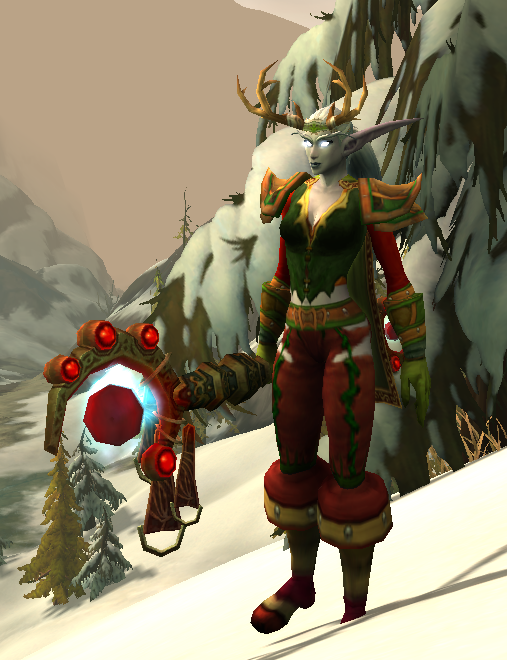
After months of working on it, we opened up Dark Iron Dwarves last week. Yay! I’ve been leveling my new DI paladin a bit, getting a sense of the new-to-me racial abilities. They include Mole Machine, a way to quickly change locations by tunneling through the earth.

We’ve been rewatcing and rating Murdoch Mysteries for our project for a while now. A seventh-season episode, “Journey to the Centre of Toronto”, has a burrowing or boring machine that should look very familiar to World of Warcraft players.

Murdoch Mysteries s7 e11 Burrowing Machine

It’s a mole machine, right? Right!?!

WoW Westfall Sentinel Hill w Dark Iron Dwarf Mole Machine

The episode doesn’t actually ever call the device mole machine, but some of the characters do talk about hypothetical mole people who live underground. I wonder whether there are any WoWers in the writers’ room? 😀

In any case, even though the series seems to otherwise strive towards reasonable accuracy, now and then they definitely veer into SSFnal or steampunk-ish. I love the tongue-firmly-in-cheek attitude!

Images: screenshot from the tv series Murdoch Mysteries, season 7, episode 11, “Journey to the Centre of Toronto”. World of Warcraft screencap with Dark Iron Dwarf mole machine in Westfall.

In the Seen on Screen occasional feature, we discuss movies and television shows of interest.

Stockholm University: Research Reveals Half of Viking Age Sigtuna Residents Were Immigrants

I’ve been meaning to share this for a while now, but something or other was always supposedly more important or interesting. No more! 🙂

The Viking Age Sigtuna, Sweden, was formally founded around 980 AD, and it was a much more cosmopolitan city than thought before. According to new DNA analysis, approximately half of city’s population were immigrants.

Flickr Guillen Perez Sigtuna Viking Rune Stone

The study looked at the remnants of 38 individuals who lived and died in Sigtuna between the 900s and 1100s CE, and included other scientific approaches as well (like analysing the strontium isotope contents of the residents’ teeth).

Roughly half of the population grew up in the near-by region Mälardalen (the Mälaren Valley, or Stockholm-Mälaren Region). The other half arrived either from southern Scandinavia (including Norway and Denmark) or further away. The long-distance immigrants came from the British Isles, Ukraine, Lithuania, northern Germany, and other parts of central Europe, and were more likely to be women than men (approx. 70 percent of women vs. 44 percent of the men).

Read more on the Stockholm University research news page: article in Swedish / article in English.

I guess I’m by far not the first woman to fall in love with a Viking and to move far away with him. 🙂

Found via Yle uutiset.

Image: section of a Viking rune stone from Sigtuna by Guillén Pérez on Flickr (CC BY-ND 2.0)

Out There is an occasional feature highlighting intriguing art, spaces, places, phenomena, flora, and fauna.