Top Five Posts of 2024

Happy New Year, everyone! We’ve closed the lid on 2024. Time to sit and reflect for a moment on the year that was.

Here’s a look at the posts we wrote in 2024 that got the most views from all of you:

  1. News on the Murderbot Screen Adaptation, with Thoughts. Nothing got a bigger audience this year than Eppu’s reflections on what we knew at the time about the upcoming tv adaptation of Martha Wells’s Murderbot Diaries, about the self-named killing machine who would actually rather just be left alone to watch media.
  2. Trailer for Megalopolis, with Thoughts. Eppu was underwhelmed by the trailer for Francis Ford Copola’s sci-fi man-epic. Given how the movie came and went with little visible effect on the public consciousness, it looks like she wasn’t alone in that feeling.
  3. A Homebrew Alchemy System for Dungeons & Dragons. Erik’s attempt at homebrewing an alchemical crafting system for tabletop role-playing. We hope some of you have found it useful in your own games.
  4. Night Elf Survival Hunter Transmog Tweak. Eppu put together a new dragon-y transmog for her survival hunter in the waning days of the Dragonflight expansion.
  5. Train Like a Spartan. Erik’s review of what we know about how the ancient Spartans trained themselves for war—which may not be quite what you would expect.

It’s been a pleasure to share our thoughts and ideas with you again this past year. We hope you’ve enjoyed it as well. May the new year bring you lots of new and interesting things to enjoy!

Quotes: Innumerable Shapes of Letters

There’s an old law of probability often phrased that if an infinite number of monkeys sat at an infinite number of typewriters pressing random keys for an infinite amount of time, they would at some point type out Shakespeare’s Hamlet. The point is that, given a large enough scope of opportunity, things that are very unlikely but not impossible can and do happen.

One of the earliest known expressions of this idea comes from the Roman statesman and philosopher Cicero, although Cicero takes the negative view. He poses the idea as a thought experiment to reject materialist philosophies, like Epicureanism, which held that the world was not created by the gods but was the product of random collisions of matter:

How can anyone look on these things yet convince themselves that certain solid and discrete bodies are carried by force and gravity, and the beautiful and exquisite world is made by the fortuitous arrangement of these bodies? If someone thinks this is possible, I don’t see why they shouldn’t also think that innumerable shapes of the twenty-one letters, made out of gold or whatever material, could be tossed down on the ground so that one could read the words of Ennius’ Annals in them. For myself, I doubt that chance could make a single verse out of them.

Cicero, On the Nature of the Gods 2.93

(My translation)

As unlikely as it is that just tossing letters down on the ground once will yield any comprehensible lines from Ennius’ early Roman historical epic, the infinite monkey theory tells us that if we threw an infinite number of letters an infinite number of times, some verses of Ennius would eventually emerge, not to mention lines from Cicero himself, or any other text that could be written in the Latin alphabet.

One might say that Cicero’s mistake was an insufficiency of monkeys.

Barbarian Migrations: Numbers

Barbarian migrations are a staple of popular histories of the ancient world. From early wandering groups like the Cimbri and Teutones in the late second century BCE to massive hordes of Goths, Vandals, Juthungi, and the like streaming across the map of the late Roman Empire, it seems that gathering up in huge masses and tromping around the world is just what barbarians do.

But is it? The popular image of migrating barbarian hordes comes from older scholarship, many of whose assumptions and conclusions have been challenged in recent generations. No one today doubts that people in antiquity moved, sometimes in groups, and sometimes long distances, but the idea of massive hordes pouring across the landscape is becoming less and less tenable.

To get an idea of why massive barbarian migrations are questionable, we’ll consider two interrelated issues: numbers and logistics. How large were the groups that moved long distances in antiquity? And how did those groups manage the practical problems that come with moving long distances? This post addresses numbers. In the next post, we’ll talk about logistics. Finally, we’ll see what conclusions we can draw about how and why large groups of people moved around the ancient world.

Ancient sources are notoriously unreliable when it comes to estimating the numbers of people in large groups. Greek and Roman writers trying to describe the movements of large groups of potentially hostile outsiders are especially unreliable. Even today it is difficult to estimate the size of crowds, and we have much better tools at our disposal than ancient authors did. Most writers who report figures for the movement of large groups were not eyewitnesses, and were certainly not in a position to get an accurate count.

Greek and Roman authors had reasons to exaggerate the scale of forces they perceived as hostile intruders. A large movement was more dramatic to write about, and the defeat of a large hostile force reflected more glory on the Greek and Roman armies and leaders who fought them. The literary mood of late antiquity was particularly pessimistic, influenced both by the competition for power among rival generals who needed to claim that they had triumphed over unbeatable odds and the Christian hope for an apocalyptic end of the world. The image of massive hordes of invading barbarians suited the needs of contemporary writers, but that does not mean that barbarians were actually invading in massive hordes. The same dire language was used to describe urban unrest, rural banditry, undisciplined soldiers, even overzealous monks.

Still, there was nothing new about Greek and Roman authors wildly overestimating the size of outside groups on the move. The Greek historian Herodotus in the fifth century BCE famously estimated the size of the Persian king Xerxes’ expeditionary force in Greece (army and navy combined) at a ludicrously high figure of 5,283,220; modern estimates vary, but generally put the total at less than 100,000.

Given these facts, we should be skeptical of ancient sources that breezily conjure up 80,000 Vandals, 150,000 Goths, or 400,000 followers of Radagaisus. While any of these figures could theoretically be correct, and we cannot categorically reject them, none of them is any better than an estimate by an outside observer passed through several hands and recounted by a writer with literary and political axes to grind.

So, how large were the actual groups of people moving around the ancient world? It is impossible to say with any certainty, but we can make a few suggestions. To begin with, the lower literary estimates are a workable upper bound. 80,000 is repeated by enough sources in enough different contexts that it probably represents a literary convention for “a very big number of people.” If we suppose that this literary convention is derived from actual experience of the practicalities of moving large groups of people, then it makes sense to suggest that few if any moving groups in antiquity numbered more than 80,000, and most were much smaller.

Accounts of some late antique battles give figures of approximately 10,000 fighters in the “barbarian” armies. These figures are questionable for all the same reasons described above, but they are not out of proportion to the sizes of known ancient armies. Fighting forces represent only a fraction of an entire population, conventionally estimated at an eighth, or perhaps as much as a quarter in extreme circumstances. A fighting force of 10,000 would then represent a total population of 40,000-80,000. Since the “barbarian” armies in these battles were often temporary alliances of disparate groups, the constituent groups themselves must have been smaller.

Our numbers can only be speculative, but drawing together these inferences, we are probably not terribly far wrong if we imagine most migrating groups in antiquity on the scale of 10,000-20,000 people, with some temporary alliances adding up to 80,000 or so.

In the next post, we’ll think about what it would actually take for even a group of 10,000 or so people in ancient conditions to migrate from one place to another.

Image: Ludovisi sarcophagus, photograph by Jastrow via Wikimedia (currently Museo Nazionale Romano di Palazzo Altemps, Rome; c. 251 CE; marble)

Top Five Posts of 2023

2023 is behind us now, so we’ve had look back at what posts got the most attention this year. Among the things we posted during 2023, here’s the ones that got the most views:

  1. A Competence Porn Viewing List. Eppu’s list of some of her favorite movies and shows to watch that are about awesome characters being awesome together.
  2. Completely New Night Elf Balance Druid Transmog. Eppu’s butterfly-winged transmog for her druid.
  3. Visual Inspiration: Bohemian Waxwing in White. A bit of striking nature photography shared by Eppu.
  4. Are You Aware of National Velociraptor Awareness Day? A silly little comic by Erik for a silly little holiday.
  5. A Compelling Mashup of Columbo and Star Trek: TOS. Some fun cross-fandom stuff found by Eppu.

The lion’s share of views on our site in this past year, though, went to posts from a few years back. Here are the posts that got the most views overall in 2023:

  1. Testing Witches with Water. A whole bunch of you are still really interested in how (or how not to) determine if someone is a witch; this post from 2019 still gets a lot of attention.
  2. Race in Antiquity: Skin Color. A post from 2018 about the complex intersection of skin color and racial diversity in the ancient Mediterranean.
  3. Race in Antiquity: Who Were the Romans? Another 2018 historical post about identity and its convolutions in the Roman world.
  4. Tali for Satrunalia. A post from 2018 about how to play the ancient Roman game of tali.
  5. A Random Find: Ancient and Early Medieval Persian or Iranic Women’s Clothing. An interesting find we posted in 2018 showing some reconstructions of women’s clothing from the cultures of ancient Iran.

Thanks for visiting in 2023. We’ll do our best to keep sharing things worth reading and looking at in 2024!

Making Clothes 9: Calculations

This post is a part of our Making Clothes series.

Now that we’ve gone through the process of producing raw materials, turning those materials into textiles, and turning those textiles into clothing, we’re rounding out this series with a little math. Given the labor and resources that went into making one outfit, how long would it have taken to make, from start to finish, and how much land did it take to grow everything on?

Our figures here are necessarily approximate. There are too many variables to take them all into account. A good year’s flax harvest or a clumsy hand at wool-carding could make a difference to how fast workers could gather and process materials. We’re also generally working with optimistic estimates. A more thoroughly realistic assessment would have to allow for lost time and material from shrinkage, breakage, wastage, crop failures, inclement weather, and so on. We’re aiming here to get a rough sense of just how much of an investment of labor time and productive land, at minimum, one set of clothes represented in the pre-modern world.

We are also assuming a community of skilled agriculturalists and crafters who know their trade and do not need to be taught or to experiment with processes of production. The passing on of such knowledge to new generations was in itself an important part of historical agricultural and textile production, but we leave that labor out of our calculations.

Pixabay Jo-B Medieval Man

Our example outfit consists of several pieces, each of which required materials and labor to make:

  • A long-sleeved linen undertunic reaching to the mid-thigh
  • A long-sleeved silk overtunic reaching to the knees
  • Leather footwear
  • A rectangular wool cloak of about knee-length

To see what it would take to produce this outfit, it is helpful to think backwards: the dimensions of our imaginary wardrobe tell us how much raw material would be needed to make it, which in turn dictates how much work would go into producing that material. We’re imagining this outfit for a person of any gender of about medium height and build. It does not represent any specific historical outfit, and does not belong to any particular place or time; a certain amount of vagueness in the design allows our outfit to reasonably stand in for clothes that could be found in many places and historical eras.

We calculate the following dimensions for the items in our wardrobe:

  • Undertunic: The undertunic is made from a piece of fabric measuring 210 x 75 cm, which is cut to yield two sleeve pieces and a long piece folded poncho-style for the front and back, with a hole cut for the head. The whole piece of fabric amounts to 1.575 square meters.
  • Overtunic: The overtunic is similarly cut from a piece of fabric measuring 225 x 90 cm, with two sleeve pieces and one long piece for front and back, amounting to 2.025 square meters of fabric.
  • Footwear: Our shoes are made from approximately one third of a square meter or leather per shoe, thus two thirds of a square meter for a pair.
  • Cloak: Our cloak is a rectangle 1 meter by 2 meters, for 2 square meters of wool.
T-Tunic Patterns Small

Finished clothes

Undertunic and overtunic – The construction method of these two garments is essentially identical, so the amount of time spent cutting, sewing, and finishing each one is approximately the same. With some reconstructed historical pieces for reference, we estimate that sewing a tunic-style garment such as these takes about 6 to 9 hours. We’ll take the average of the range and estimate that each garment takes 7.5 hours to cut and sew. The two together add up to 15 labor hours.

Footwear – Leather is slower to sew than fabric, but shoes are smaller than tunics. Our shoe models have around 120 cm of seam, and reconstructions show a leather stitching speed of 50 cm per hour. Allowing time for cutting and shaping (but omitting time for fitting to the wearer), each shoe would take about 2 hours to make, thus 4 labor hours for the pair.

Cloak – The cloak is straightforward, since it is simply a rectangular piece of woven cloth needing no sewing beyond the finishing of the edges. If the fabric was woven at a width of 1 meter, the selvages would make the long sides of the cloak; only the short sides would require hemming. At a hand-sewing speed of 1 meter per hour, sewing the cloak would take 2 labor hours.

Total cutting, sewing, and finishing time: 21 labor hours.

Fabrics/leather

Many factors affect the speed at which woven cloth is produced, from the size of the loom to the skill of the weaver. Historical recreations yield a range of weaving speeds from 180 to 255 square cm per hour. For the purposes of our project, we use an estimate of 200 square cm per hour for all types of fabric.

Linen – We need 1.575 square meters of woven linen, or 15,750 square cm, which would take approximately 79 hours to weave. Allowing time for set-up and maintenance of the loom and other necessary by-work, the production of the linen fabric from thread would require around 90 labor hours.

Silk – The calculations are similar for our silk. Weaving 2.025 square meters of silk would take a bit over 101 hours. With additional by-work, we can estimate about 110 labor hours to produce the silk fabric.

Wool – Likewise for our wool, the 2 square meters of wool we need would take about 100 hours to weave, coming to around 110 labor hours with additional work.

The time that it takes to spin the thread needed for weaving depends on how much thread goes into the finished fabric, which is affected by a host of factors: the thickness of the thread, the density of the weave, the width and length of the fabric, and so on. Rather than try to calculate all these possible elements, we work with a rough estimate that each of our fabric pieces required 10 km of thread, a measure based on both modern textile production and historical reconstructions. The further thread needed for sewing is a negligible addition. This rough figure allows for the possibility of variations in how each individual textile was produced while still giving us a reasonable estimate for the total investment of labor.

Spinning by hand yields around 40 to 60 meters of thread per hour. Taking the average of 50 m per hour, the 30,000 meters of linen, silk, and wool thread needed for our three pieces of fabric would take some 600 labor hours to spin.

Dyeing is a further step in the production process. The amount of time it takes to dye cloth depends on what dyestuffs are used, what kind of fabric is being dyed, and what the desired result is. Sourcing dyestuffs and preparing the dye bath also add to the labor. We estimate 10 hours of labor for each piece of fabric, and soaking in the dye bath adds several days of passive production time.

Flickr Shawn Harquail Spinning and dyeing the fibers

LeatherLeather production is complicated, as we outlined in our post about it. The two thirds of a square meter we need for our shoes could come from a single sheep hide (which typically yield 0.8 square meters of leather), but a lot of preparation and processing would have gone into making that hide into usable leather.

The amount of time it takes to produce leather from a fresh hide is widely variable depending on how the hide is treated and what steps are desirable for finishing it. Much of the time that it takes to prepare leather is passive time, as the hide sits on a rack or in various liquid treatments. For our purposes, we estimate that producing the leather for the shoes took 30 days from beginning to end, during which there were 12 hours of active labor. The passive production time for the leather can overlap with the passive dyeing time.

Total textile and leather production time: 952 labor hours, 30 days passive production.

Raw materials

We are estimating 10 km of thread of each fiber type for our complete outfit, but we must make a further calculation to determine how much raw material went into producing that thread. Threads can be spun at different thicknesses, so to get a sense of how much raw material went into our threads we need to convert length into weight. This conversion is expressed in a unit called tex, which gives the weight in grams of 1,000 m of a thread or yarn. Thinner threads are suitable for finer fabrics, while thicker threads can produce bulkier, rougher textiles. We consulted historical reconstructions to assign texes to our different threads.

Linen – For the linen undergarment, we want a fine fabric that feels good against the skin. For this purpose, we use a tex of 55, which means the 10 km of thread weighs 550 g. To get 550 g of spun linen thread we have to start with a much larger amount of flax, since flax processing removes as much as 90% of the material gathered from the field. Our 550 g of linen thread would require around 5.5 kg of flax.

Modern experiments with historical farming methods have yielded flax harvests of about 1 kg per square meter of field, so 5.5 kg of flax would need only about 5.5 square meters of field to grow in, which would take less than an hour both to plant and to harvest. Flax processing takes several steps, but for a modest amount of flax like this, the total active work time is not great. We can estimate 15 labor hours for flax processing from planting until the fiber is ready to spin. Along the way there is also about 100 days growing time for the plants, and some weeks passive time for retting.

Silk – For the silk tunic, we chose to use a coarser and heavier fabric with a tex of 180, which amounts to 1.8 kg in 10 km of thread. This amount of silk fiber represents the output of around 5,400 silkworms consuming the leaves of some 540 mulberry trees, which would need roughly 2 hectares of land to grow on. If starting silk cultivation from scratch, these trees would need a year to grow to maturity from the planting of cuttings, but we will assume that our silk comes from an established grove, and not count the planting, tree tending, or growing time into our estimates.

What we do need to account for, however, is the growth cycle and tending of the silkworms. Silkworms take 28 days from hatching until they are ready to spin, and require care as they grow. For our purposes, we estimate that caring for the silkworms takes at least eight hours of labor every day, between preparing food, feeding, and management. Once the cocoons are spun, a skilled hand can unreel their fiber quickly. Altogether, we estimate that the production of silk fiber takes 225 labor hours and 28 days of passive production.

Wool – Our wool cloak is a sturdy outer garment meant for warmth and protection against the elements. For this purpose we choose a tex of 500, which makes for 5 kg of wool thread. Historic breeds of sheep yield between 1 and 1.5 kg of wool per shearing, and some of that weight is lost in processing. We estimate that one sheep could yield 0.5 kg of wool fiber fit for spinning, so the 5 kg of fiber needed for our cloak represents one year’s fleece from 10 sheep.

A flock of 10 sheep would need some 10 hectares of grazing land. Sheep are sturdy animals and fairly self-reliant, but they do need tending to keep them safe from hazards and fed during the winter. We are being optimistic (perhaps even unrealistically so) and estimating 100 labor hours for sheep tending in a year. Once the fleece has grown, shearing is quick for a practiced hand. Based on various numbers given by modern shearers using hand shears, we estimate that a skilled shearer would be able to shear our 10 sheep in two hours. For the needs of wool production, then, we count 102 labor hours, a year of passive production, and 10 hectares of land.

Leather – The leather for our shoes could come from one of the sheep in the flock. Since the labor for tending the sheep is already accounted for, and slaughter and skinning are quick processes for an experienced hand, we add only 1 more labor hour to account for the production of the hide for tanning.

Total raw material production time and land needs: 343 labor hours, 1 year passive production, 12 hectares of agricultural and grazing land.

Final calculations

As we have noted many times, a lot of our figures are rough estimates at best. The actual production time for an outfit like ours would depend on numerous real-world factors that are beyond the scope of our project to account for. We are also largely discounting the effects of loss, wastage, and natural or human disaster—a flooded flax field or a neighboring people’s raid on the sheep pastures would throw all our calculations into disarray. Nevertheless, here is a rudimentary good-faith estimate of the time and land investment involved in making a single set of clothes in pre-modern conditions:

Active working time: 1,316 labor hours

Passive time: 1 year

Land requirements: 12 hectares

1,316 labor hours represents over 164 full 8-hours days of work for one person. Some of the work could be shared among several people, but there is a limit to how much efficiency could be gained by division of labor—you can’t make sheep grow fleece faster by adding more shepherds, for instance.

Once raw fibers have been produced, it would take some 973 labor hours to turn those fibers into finished clothes, or nearly 122 full 8-hour days. Even with a worker dedicated full-time to each material type (wool, linen, silk, leather), it would still take more than a month to finish the whole ensemble.

For one outfit, for one person to wear.

Flickr Billy Wilson Small Herculaneum Woman

Furthermore, every labor hour devoted to clothing production was an hour of labor not available to produce food, construct or maintain buildings, care for children or elders, or engage in other activities that were necessary for the safety and well-being of a community. Clothing was not just something to wear for historical people; it was a statement about the prosperity of their own families and the communities they lived within.

Further Reading

Ejstrud, Bo (ed.). From Flax to Linen: Experiments with Flax at Ribe Viking Centre. Esbjerg: Ribe Viking Centre and University of Southern Denmark, 2011. https://ribevikingecenter.dk/media/10424/Flaxreport.pdf

Köhler, Carl. A History of Costume. New York: Dover, 1963.

Mallory, J. P. & Victor H. Mair. The Tarim Mummies: Ancient China and the Mystery of the Earliest Peoples from the West. London: Thames & Hudson, 2000.

Mannering, Ulla & Charlotte Rimstad. Fashioning the Viking Age 2: From Analysis to Reconstruction. Copenhagen: The National Museum of Denmark, 2023. https://natmus.dk/fileadmin/user_upload/Editor/natmus/oldtiden/Fashioning_the_Viking_Age/From_Analysis_to_Reconstruction_-_high_resolution.pdf

Owen-Crocker, Gale R. Dress in Anglo-Saxon England [revised and enlarged ed.]. Woolbridge: Boydell Press, 2004.

Pasanen, Mervi & Jenni Sahramaa. Löydöstä muinaispuvuksi [From Finds to Reconstructed Dress]. Salakirjat, 2021.

Postrel, Virginia. The Fabric of Civilization: How Textiles Made the World. New York: Basic Books, 2020.

Strand, Eva Andersson & Ida Demant. Fashioning the Viking Age 1: Fibres, Tools & Textiles. Copenhagen: The National Museum of Denmark, 2023. https://natmus.dk/fileadmin/user_upload/Editor/natmus/oldtiden/Fashioning_the_Viking_Age/Fibres__Tools_and_Textiles_-_high_resolution.pdf

Walton Rogers, Penelope. Textile production at 16-22 Coppergate. York: Council for British Archaeology, 1997. https://www.aslab.co.uk/app/download/13765738/ASLab+PWR+1997+AY17-11+Textile+Production+for+web.pdf

Images: Medieval man via Jo Justino at Pixabay. Sample T-tunics by Eppu Jensen. Hand-stitching leather shoes, photograph by Jeff Mandel via ExIT Shoes (CC BY 4.0). Spinning and dyeing in Chinchero, Peru, by Shawn Harquail via Flickr (CC BY-NC 2.0). July, from the Grimani Breviary via Wikimedia (Biblioteca Nazionale Marciana; 1490-1510; illumination on parchment). Small Herculaneum Woman, reconstruction of a marble statue, by Billy Wilson via Flickr (CC BY-NC 2.0).

Top Five Posts for 2022

2022 was… well, it was certainly a year. It didn’t have the apocalyptic awfulness of 2020 or the confused energy of 2021. 2022 had some good parts and some terrible parts, but for a lot of us the year just kind of happened.

It was a calmer year for the two of us, being finally settled in our new home. We haven’t done a top five post in the last few years, but now that 2022 is coming to a close, we thought we’d have a look at what you guys have been looking at here.

Here are our posts from 2022 that got the most views this year:

  1. World of Warcraft Dragonflight Talent Calculator. Eppu posted a link to Wowhead’s talent calculator in the run-up to Dragonflight along with some of her own thoughts, and it looks like a lot of you found that helpful.
  2. Blood Elf Protection Paladin Transmog. Erik’s flashy paladin transmog got some views.
  3. Gold and Silver in Fantasy Coinage. Erik wrote about why gold and silver make historical sense for coinage in a fantasy setting.
  4. Fine Art as a Three-in-One Quilt. Eppu shared an amazing piece of textile art that has to be seen to be believed.
  5. Ukraine Is at War, and I’m Not Okay. Eppu’s heartfelt post about how one of the year’s worst stories touches her as a Finn.

The most viewed posts overall this year also include some older posts. Here’s the all-time Co-Geeking posts that got the most views this past year:

  1. Testing Witches with Water. A lot of you are still really interested in how (or how not to) determine if someone is a witch; this post from 2019 still gets a lot of views.
  2. Race in Antiquity: Skin Color. A post from 2018 about an important topic: looking for evidence of racial diversity in the ancient Mediterranean.
  3. Race in Antiquity: Who Were the Romans? Another 2018 historical post about coming to terms with the complexities of identity in the Roman world.
  4. World of Warcraft Dragonflight Talent Calculator. This 2022 post got a lot of traction this year!
  5. A Striking Greek Gods Photoshoot. A post from 2020 celebrating some beautiful design and photography.

That’s our last word for 2022. Thanks, everyone, for being with us this year. We’ll see you in the next one!

Messing with numbers is messy.

Top Five Posts for 2019

That’s 2019 done and dusted. Here are this year’s posts that got the most views:

  1. Behind the Name: Erebor Erik’s post about the possible linguistic roots behind Erebor, the Lonely Mountain of the Dwarves in Tolkien’s Middle Earth.
  2. Spring 2019: Tolkien Exhibition at The Morgan in NYC Eppu’s post on the exhibit in early 2019 including letters, photographs, and other documents related to Tolkien’s life and work.
  3. Disney Princess Cosplayers Wearing Mandalorian Armor Eppu’s post sharing some creative cosplay blending Disney princesses with Star Wars bounty hunters.
  4. An Example of the Infinite Possibilities of Writing Systems: Mandombe Eppu’s post on a writing system inspired by the look of bricks in a wall.
  5. The Graceful Curves of the Vogelherd Horse Eppu’s post sharing an image of a beautiful prehistoric carving of a horse.

Some of our old posts remain perennial favorites, too. Here are the overall top five Co-Geeking posts that people viewed in 2019:

  1. Do-It-Yourself Fantasy Place Name Generator Erik’s name-generating technique from back in 2015 still gets a lot of attention. Apparently a lot of you out there are still making up names for things!
  2. Custom is King Erik’s translation of a favorite passage from Herodotus’ Histories, posted in 2017.
  3. Hogwarts Dueling Club Tablecloth Transformed into Wall Hanging Eppu’s post about a home-made version of the moon-phase dueling cloth from Harry Potter, posted in 2016.
  4. Sean Bean on the LotR Joke in The Martian Eppu’s 2015 post on Finland’s Yle News interview with the delightful Sean Bean on the Lord of the Rings joke in The Martian. Such a treat, and still well worth watching today.
  5. Greek Myth, Etruscan Tomb Erik’s post from 2017 about the multicultural connections of a wall painting from ancient Etruria.

Thanks, all, for coming by this year. We hope you’ll drop in again in 2020.

Messing with numbers is messy.

Happy Pi Day!

Happy Pi Day!

I’m the kind of geek you can (within reason) egg on to doing something by saying most people don’t act in a particular way or do whatever it is you’re describing.

Case in point: our high school math teacher told us that most people won’t ever learn the approximation for pi further than 2 or 4 decimals places. So, I had to go and memorise it to 8 decimal places. I can still remember it: 3.14159265.

Dinner3 Dessert

Don’t ask me why it was so important to me—I can’t remember anymore. I am, however, surprised that I can still produce it without any hesitation whatsoever even though I haven’t used it in decades. (It only works in Finnish, though; clearly there’s some connection with the rhythm and sounds that made it easy for me to memorize.) I wish I was as speedy with my U.S. social security number, for instance. 🙂

P.S. For a full appreciation of my dorkiness, look at the tags for this post. :p

Messing with numbers is messy.

Top Five Posts for 2018

Well, that was 2018! Here are our posts from the year that have gotten the most attention:

  1. Call for Help: Where is Miss Sherlock? Eppu’s post about a new mystery series that transposes the characters of Holmes and Watson to modern-day Japan and makes them both young women for good measure. Unfortunately, we’re still not sure where or how we can watch it, but it’s nice that so many other people are also excited by the idea.
  2. Arisia: A Point of No Return for Us Our statement in support of Crystal Huff and against the repeated failure of the Boston-based Arisia convention to effectively address problems of sexual harassment and stalking not just at the con but by members of the con staff itself.
  3. Quotes: Finland is Weird. Finland is Different All together now, Finland fans! A gratifyingly bewildered quote from Adrian Tchaikovsky’s Ironclads.
  4. “At Least It Made You Feel Something” Erik’s rant against creators who justify storytelling choices that aggravate fans by patting themselves on the back for making us feel something.
  5. Barbarians in the Greek and Roman World Preview A preview of Erik’s book, published in September, about the concept of the barbarian and the realities of cross-cultural interactions in the ancient Mediterranean.

Some of our old posts remain perennial favorites, too. Here are the overall top five Co-Geeking posts that people viewed in 2018:

  1. Do-It-Yourself Fantasy Place Name Generator Erik’s name-generating technique from back in 2015 still gets a lot of attention. Apparently a lot of you out there are making up names for things!
  2. Sean Bean on the LotR Joke in The Martian Eppu’s 2015 post on Finland’s Yle News interview with the delightful Sean Bean on the Lord of the Rings joke in The Martian. Such a treat, and still well worth watching today.
  3. Hogwarts Dueling Club Tablecloth Transformed into Wall Hanging Eppu’s post about a home-made version of the moon-phase dueling cloth from Harry Potter, posted in 2016.
  4. Custom is King Erik’s translation of a favorite passage from Herodotus’ Histories, posted in 2017.
  5. Call for Help: Where is Miss Sherlock? Eppu’s post from this year

Thanks for hanging out with us this year. We hope you’ll join us again in 2019.

Messing with numbers is messy.

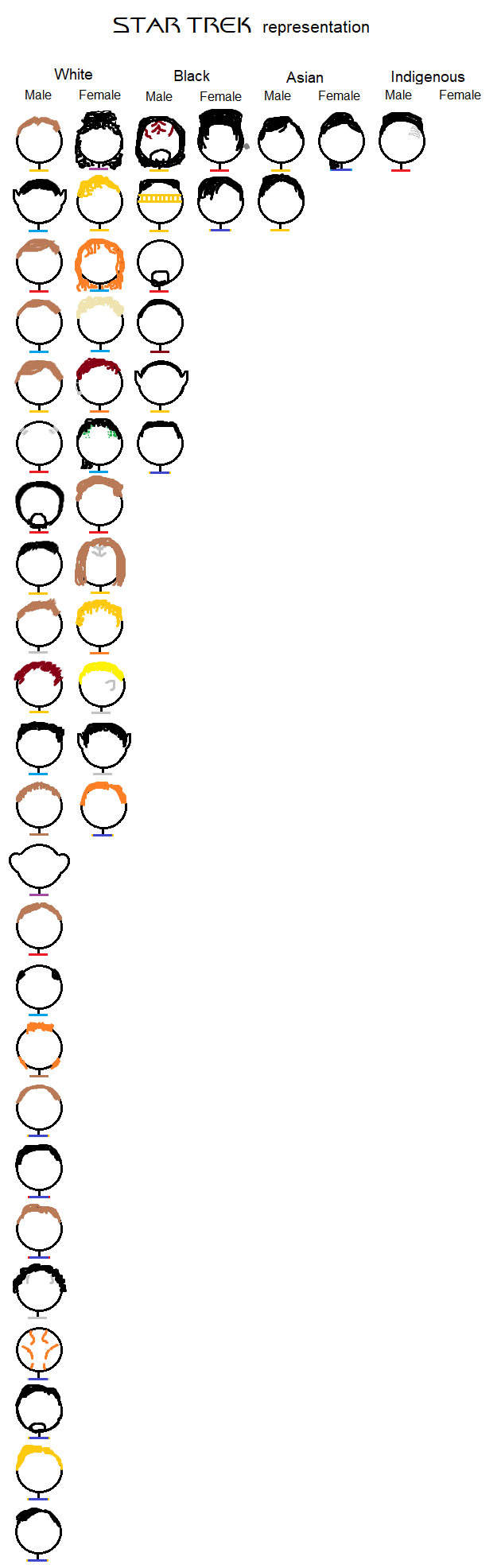
Representation Chart: Star Trek

We all know that the representation of people of different genders and races is imbalanced in popular media, but sometimes putting it into visual form can help make the imbalance clear. This is the first of a series breaking down, in basic terms, who’s represented and who isn’t.

Here’s Star Trek. I’ve included the credited main cast from all the live-action television series.

Notes

Characters included

  • Star Trek: Kirk, Spock, Scotty, McCoy, Checkov, Uhura, Sulu
  • Star Trek: The Next Generation: Picard, Riker, Data, Wesley, Troi, Yar, Crusher, Pulaski, Worf, La Forge
  • Star Trek: Deep Space Nine: O’Brien, Bashir, Odo, Quark, Kira, Dax, Sisko, Jake
  • Star Trek: Voyager: Paris, Doctor, Neelix, Janeway, Torres, Kes, Seven, Tuvok, Kim, Chakotay
  • Star Trek: Enterprise: Archer, Reed, Tucker, Phlox, T’Pol, Mayweather, Sato
  • Star Trek: Discovery: Saru, Tyler, Stamets, Lorca, Tilly, Burnham

Corrections and suggestions welcome.

Rules

In the interests of clarity, here’s the rules I’m following for who to include and where to place them:

  • I only count characters portrayed by an actor who appears in person on screen in more or less recognizable form (i.e. performances that are entirely CG, prosthetic, puppet, or voice do not count).
  • For human characters that can be reasonably clearly identified, I use the race and gender of the character.
  • For non-human characters or characters whose identity cannot be clearly determined, I use the race and gender of the actor.
  • I use four simplified categories for race and two for gender. Because human variety is much more complicated and diverse than this, there will inevitably be examples that don’t fit. I put such cases where they seem least inappropriate, or, if no existing option is adequate, give them their own separate categories.
  • “White” and “Black” are as conventionally defined in modern Western society. “Asian” means East or South Asian. “Indigenous” encompasses Native Americans, Polynesians, Indigenous Australians, and other indigenous peoples from around the world.
  • There are many ethnic and gender categories that are relevant to questions of representation that are not covered here. There are also other kinds of diversity, including sexuality, language, disability, etc. that are equally important for representation that are not covered here. A schematic view like this can never be perfect, but it is a place to start.

Messing with numbers is messy.