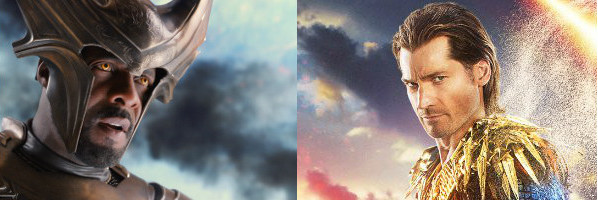
In 2011’s Thor, Idris Elba, despite not looking typically Norse, plays the Norse god Heimdall. In 2016’s Gods of Egypt, Nikolaj Coster-Waldau, despite not looking typically Egyptian, plays the Egyptian god Horus. The casting of Elba as Heimdall surprised me the first time I saw the movie, but it has never bothered me as a fan or as a historian. Coster-Waldau as Horus really bothers me and I think it’s worth taking a minute to explain why.
I have nothing against Coster-Waldau as an actor. I haven’t seen Gods of Egypt and don’t plan to, so I have nothing to say about his performance in this particular role, but he’s not the problem here. The problem is in the casting of the movie as a whole.
As the middle of the semester approaches and assignments start coming due, the e-mails start coming in. Students start coming to me before or after class or poking their heads into my office between classes. I know what they’re going to ask. Some of them know the word for it; others just know what they need: a few more days to work on their papers and projects. An extension.
There’s always a reason. The flu. Grandmother passed away. Father in the hospital. Car trouble. I know pretty much what they’re going to say before they even open their mouths. And I know what I’m going to say, too: yes. Always yes. I never ask for proof (though my students will often bring me notes and I will look at them out of respect). Anyone who asks can have a few extra days.
I have known professors who take pride in never having granted an extension, or if they do they want to see the doctor’s note and the obituary in the newspaper and they will run the story down like an investigative journalist tracking a political scandal. For them, deadlines are deadlines: the line past which you’d better be dead and have a note from God if your paper isn’t done. I respect my fellow professors who teach this way, but it’s not my way.
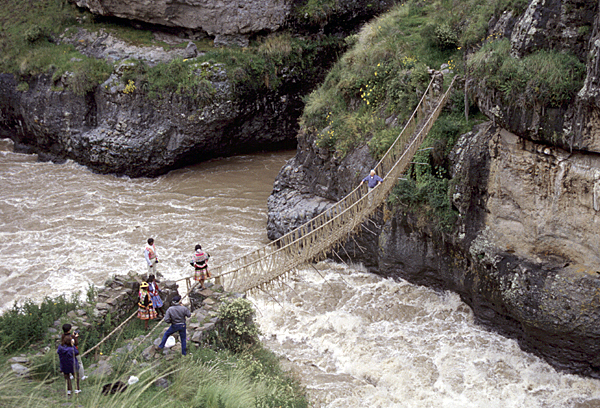
The Inca empire of South America was connected by a network of roads used by chasqui runners and pack llamas carrying messages and supplies around the empire. The Inca, creating their empire in the Andes mountains, faced challenges unlike those of flat-land and river-valley empires, among which was the problem of crossing numerous steep mountain valleys and rivers that ran dangerously swift in the flood season. Their solution to this problem was: rope bridges.
Suspension rope bridges spanned rivers and valleys, the longest reaching a length of 45 meters. They were made with ropes twisted out of grass and had to be rebuilt every year or two. The rebuilding was dangerous work that was assigned to local villagers as part of their obligation to the empire. Most Inca bridges have long since been replaced with modern structures, but one, the Q’iswa Chaka over the Apurimac River in Peru, is still rebuilt every year by local people as a way of preserving their heritage.
From the grand howdah-backed elephant to the plodding pack pony, from the solitary stallion to the caravan of a thousand camels, animals are often a part of how our characters get around. In previous entries to the travel series we’ve considered small and large groups traveling on foot. This time we bring animals into the mix.
Animals can be useful for travel, but they also bring their own challenges with them. The first thing we need to consider is what kinds of animals are useful for long-distance travel. Then we’ll look at the three main ways of using animals for travel: riding, pack, and draft. Finally, a word on the care and feeding of transport animals. As usual in this series, we are looking at real-world history: no griffins or dragon-drawn chariots. Take the information here and adjust as necessary for whatever setting you happen to be writing.
As with last month’s party, we have very little to go on in the text for an actual menu. Once again, this requires some imagination, but this time I’m trying to imagine a small, intimate dinner for friends, not a grand party.
So, you’re creating a fantasy religion for a story or game. When your characters need to interact with their gods, where do they go—if anywhere at all? Down the street to the local temple? To the top of a windswept mountain? To a corner of their kitchen? Today we look at religious sites in historical cultures to inspire our imaginations.
We can start by looking at religion in today’s world. Look at the religious life of a modern western community and you will find some people attending their local church, synagogue, or mosque, some people praying quietly in their own homes, some feeling inspired by solitary walks in the woods, some debating points of theology over the internet, some participating in celebrations of religious holidays, and some not involved at all. Many people will do more than one of the above. No culture or religious tradition is monolithic, and this is just as true in the past as the present. The history of religious expression is one of incredible variety both across and within cultures.
In this variety, though, there are some patterns that recur in varying forms. People use different kinds of religious sites for different needs. Many different traditions have used similar kinds of religious sites, and within any given tradition different sites are used for different purposes. Today we will look at four common types of religious site out of the wide variety of possibilities: assemblies, temples, household shrines, and natural spaces.
Assembly
The “assembly” type of religious space will be recognizable to anyone familiar with major variants of the modern monotheistic religions. It is a space where a community of believers gathers to perform collective rituals such as praying, singing hymns, hearing sermons, feasting, and witnessing or participating in ritual enactments.
Grand Mosque, Djenne, photograph by BluesyPete via Wikimedia
I’m really the wrong person to say anything about Pride and Prejudice and Zombies, since I am not a fan of zombie stories to begin with, but having a fondness for Jane Austen I went to the movie hoping for something entertaining. I was not entirely disappointed, but something about the movie bothers me.
It’s not just that it feels like a joke that has gone on too long without getting to a punchline. It is Pride and Prejudice with zombies added, exactly as advertised. The confined and unvarying quality of the movie is a feature, not a bug, and I can live with that. What bothers me about it is what it does to Austen’s characters and in particular the female characters.
Myths, legends, fairy tales, and other stories passed down through the generations are at the root of our storytelling tradition. They are the earliest stories in our literature and some of the first stories we learn as children. It is no wonder that we keep going back to mythology looking for deeper meanings. The drive to find hidden meaning in myth leads to some misguided interpretations. Two common mistakes are Freudian theory and the “forgotten history” theory.
Freudian slips
Freudian theory holds that myths are expressions of universal human drives which we have suppressed in the name of civilization. As the things that we cannot talk about openly come out in our stories, we can hold up mythology as a mirror to our own subconscious in order to see our hidden impulses better. Sigmund Freud’s attempts to explain the human psyche by reference to dreams, myths, and other supposed insights into the unconscious are at the root of this approach, but there are other classic exemplars, such as Bruno Bettelheim’s The Uses of Enchantment, which applies the theory to the Grimms’ fairy tales. (Note that I am speaking of Freudian theory as a way of interpreting myth; I am not in any position to judge Freudianism as a psychological theory.)
I have to write a biographical paragraph for a conference. Ugh. I hate writing about myself in the third person.
I’m trying to be all
but feeling more like
Oh well. It goes with the territory, I guess. I like to think that being awkward about your own accomplishments is one of the tests of being a decent person. (But, then, does congratulating myself on being a decent person mean I’m actually not..? Argh! Why is it so hard?!)
Oh well. That’s my dose of self-pity for the day.
Images: Bust of Caesar, photograph by Andrea Wahra via Wikimedia (Naples; 1st c. BCE; marble) and text from Caesar, Gallic War 1.54, collage by Erik Jensen. Harriet Jones via brittaperry
It’s a good time to be a Sherlock Holmes fan. There are now plenty of adaptations to choose from. There’s the BBC’s Sherlock if you like visual inventiveness and whip-crack dialogue. For a more traditional procedural that does interesting things with characters, there’s CBS’s Elementary. For Hollywood thrills you can go back a few years to the films starring Robert Downey Jr. as the great detective. For series in the Holmesian spirit without the same characters there’s the medical drama House or the mystery/comedy Psych.
However the setting may change, there are some key elements of Sherlock Holmes’s character that remain the same: the keen powers of observation and deduction, the cycles of intense focus on a problem and lethargic dissipation, the antisocial habits that make him near impossible to live with.
Oh, and Sherlock Holmes is a total jerk-ass.
The standard interpretation of Holmes in modern media is that he is an asshole with no patience for anyone else, either because he’s not neurotypical in some fashion or because he just can’t be bothered to care about anything so pedestrian as decent manners. He gets away with it because he’s just so brilliant.
Well, lately I’ve been rereading the original Sherlock Holmes stories by Conan Doyle, something I’ve been meaning to do for years. I’ve gotten very used to the modern Holmes, so I was surprised to rediscover that the original Holmes wasn’t like that at all. In fact, Conan Doyle’s Holmes is compassionate and generous.


 Co-Geeking
#/media/File:A_classical_dictionary_of_Greek_and_Roman_biography...revised.._(1894)_(14779978921).jpg)

