Stave Churches

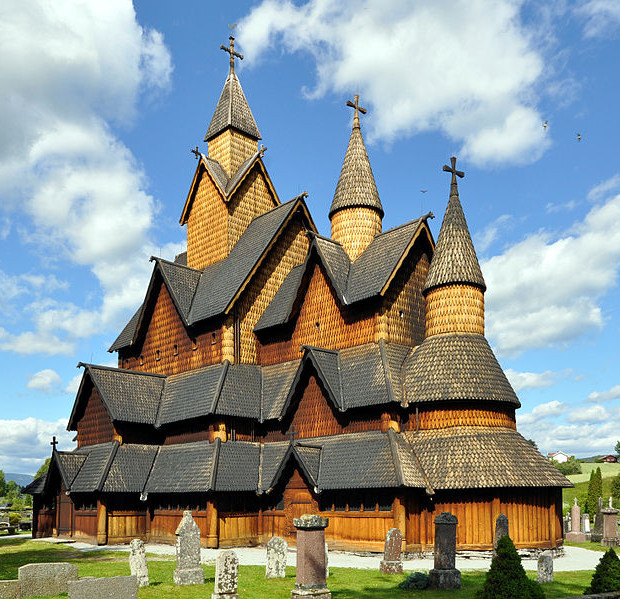
When we think of ancient architecture, we tend to think of stone and brick: the pyramids of Egypt, the amphitheatres of Rome, the Great Wall of China, the temples of the Aztecs and Maya. These are structures that have endured. We have many fewer models of wooden architecture from the distant past, even though wood—cheaper, lighter, and easier to work that stone or brick—was what most people built with in many parts of the world. Wooden buildings burn, rot, or just fall down if not maintained. Good examples of wooden buildings from more than a few centuries ago are very hard to find. One set of buildings that help fill that gap are the stave churches of Norway.

Heddal stave church, photograph by Micha L. Rieser via Wikimeida (Heddal, Norway; 13th c.)

Continue reading

Who’s That Guy?

In the course of my life, I’ve become aware that I experience mild face blindness. It’s nothing I’ve ever been diagnosed with and it isn’t severe enough for me to seek any kind treatment for, I just know that, compared with other people, I have trouble recognizing faces that I haven’t seen a lot of. I mostly identify people by their hair, their clothing and movements, and, especially, their voices. In day-to-day life it’s not much of a problem. (Learning a hundred new students every semester is a challenge, but I have the advantage of getting to take attendance at the start of every class.) When it bothers me the most is in entertainment.

When there are multiple characters with similar appearances, I tend to get them mixed up. (Especially middle-aged white men, since they’re all over the place.) I also have trouble recognizing people we’ve seen before in different settings.

160505buckyFor example, there’s a moment in Captain America: The Winter Soldier when the Winter Soldier’s mask comes off revealing that it’s the Captain’s best friend and fellow soldier Bucky Barnes. It’s a powerful moment and a shocking reveal, but the first time I saw the movie, I had no idea who that guy was. Even having seen the first Captain America movie, and having Bucky reintroduced via the museum exhibit/infodump earlier in Winter Soldier, I didn’t know who I was looking at on screen. As the movie went on, it became clear to me that the Winter Soldier was someone Captain Rogers knew from his past, an old friend, but I still couldn’t connect the character with Bucky. (Cap said his name, but it went by too fast for me to catch.) It wasn’t until I rewatched the movie on DVD that I finally realized who the Winter Soldier was. Even today, looking at the two characters on screen, I can’t visually tell that they’re the same person.

It’s an odd way to watch movies and television, knowing that there is information up there on the screen that I can’t interpret. I’m lucky to have a co-geek to turn to and ask: “Who is that guy?” One of the many pleasures of being married to someone who loves nerdy stuff as much as I do!

We’re off to see Captain America: Civil War on opening night tonight. It looks like there’s going to be a lot of familiar faces in this movie. I might even recognize some of them.

Images: Bucky Barnes via tvtropes; Winter Soldier via playbuzz

In Character is an occasional feature looking at some of our favorite characters from written works and media to see what drives them, what makes them work, and what makes us love them so much.

Unreal Elwynn Forest

Elwynn Forest is the starting zone for humans in World of Warcraft, a sun-dappled wood with little villages and outposts. Like a lot of other players, I have fond memories of leveling up some of my first characters through Elwynn. Here are a couple of screenshots from in game of what the area looks like.

160502inn160502farmNow, feast your eyes on Daniel L’s gorgeous and detailed reconstruction of the zone using the Unreal Engine 4:

Elwynn Forest in Unreal 4: Update 2 by Daniel L

Post edited for formatting

Hey, look! We found a thing on the internet! We thought it was cool, and wanted to share it with you.

Quotes: Archers String Their Bows Only When They Need Them

This was how Amasis managed the affairs of the Egyptians: from dawn until midday he handled all the matters that were brought before him; the rest of the day he gave over to drinking and joking with his companions.

His advisers, being vexed by his behavior, admonished him: “Majesty, it is not right that you should behave so foolishly. You should be seated on your august throne throughout the day conducting affairs of state. Thus the Egyptians would be certain that they are ruled by a great man and you would have a better reputation. What you do now is not at all kingly.”

But he replied: “Archers string their bows only when they need them. If they were kept strung all the time, bows would snap and be of no use when needed. It is the same with people: if you try to be serious all the time and not allow yourself a share of relaxation, you will surely either go insane or fall dead of a stroke. Knowing this, I take both business and leisure in turn.”

– Herodotus, The Histories 2.173


The Egyptian king Amasis, as reported by Herodotus, giving some good advice about making time for yourself.

The Trouble With Primary Sources

160425hoplitePrimary sources are great. They are essential. Without them, we would know vastly less about history than we do.

Because primary sources are so essential to our knowledge of history, it is easy to make the mistake of taking them too much at their word. Primary sources are like every other piece of writing: limited by the author’s perspective and subject to scrutiny and challenge. The trouble isn’t even just that primary sources can be wrong (although they can), but that the really interesting questions rarely have just one right answer. The answer we get from one primary source may be incomplete, even if it’s not wrong.

For example, suppose you’re writing a story about an ancient Greek who ran away from a battle. What would his fellow Greeks think of him? What would he think of himself? With a little research you might come across this fragment of a poem by Tyrtaeus:

Continue reading

How We Got Here, or A Field Guide to World History

The term world history may send your mind spinning back to high school, but world history is an important genre of historical study. It means history that is not bounded by the past of one nation or people. It is the story of how we got here as a whole, enmeshed world, not just as discrete national or ethnic groups. If you’re researching historical topics that connect different peoples together, you’re looking for world history. (World history is related to but not the same as universal history, which is a history of the entire world; world history may be selective about what parts of the world it covers, as long as it isn’t limited by national/cultural boundaries. Yes, it’s confusing.)

There are many different approaches to world history, however, and which one you want to look for depends on what you need. Here’s a brief spotter’s guide to some of the main varieties of world history you’ll find in the scholarship, how to recognize them, and what you might want to go to them for as a writer. These are not the only varieties of world history out there, but knowing these types will help you sort through the sources you will come across in your research.

160418giraffe

1. Interconnected History

Or: “Whoa, This Stuff Is All Connected And Stuff, Man”

Historical events don’t happen in a vacuum. Cultures communicate and trade with each other. People travel, taking goods and ideas with them. Interconnected History is about tracing these lines of communication and commerce and discovering how events in one part of the world affected other parts.

Continue reading

Making Food in the Wild

Here’s a look at how we made yesterday’s Food in the Wild.

The menu

  • Pan-braised game hens with root vegetables
  • Leaf and herb salad
  • Blackberries with mint leaves

erikchef1Our heroes were in too much of a hurry to do any good eating in the wild between Bree and Rivendell, but we’ve tried to imagine what a ranger might have been able to cook up in better times. Strider mentions four different kinds of wild food: berries, roots, herbs, and game, and we’ve used a little of each in this meal. (1.11)

Dinner4 Main

The main course is pan-braised game hens. It is the only dish that needs cooking and can be cooked in a shallow pan over a campfire. We used commercially raised game hens and farmed roots for our version, but wild-caught birds and carefully dug wild root vegetables would also do. We also used farmed greens and blackberries, but there are many wild-growing plants whose young leaves can be eaten (the full-grown leaves of most edible wild plants, in contrast to their cultivated cousins, are too tough or bitter to be eaten raw, but may still be useful for cooking). Wild blackberries are common in many forested areas—and they seem to be especially common in Middle Earth, as Bilbo frequently wishes for blackberries while traveling and the Prancing Pony offers a blackberry tart (H4, H6, 1.9)

Continue reading

Recommended Reading: Medea

160407MedeaOne of the hallmarks of modern storytelling is toying with the conventions of a genre. Familiar stories get retold with surprising twists and the tropes that everyone can see coming are turned upside-down and inside-out. It’s not just a modern game, though. Older stories can be just as cunning with their twists. When I’m trying to think about how to do something different with a familiar tale, one of the examples I look back to is Euripides’ tragedy Medea.

Medea is one of the classics of ancient Greek theatre. There are plenty of good translations available and it’s not hard to get your hands on one. If you’re looking for an online edition, here are a few. I discussed the play before in comparison to Star Wars, so I won’t bore you with summarizing the whole plot again (check the link if you want a quick reminder). Rather, I want to talk about two interesting things Euripides does with the story.

Continue reading

Hannibal’s Route Identified?

160407didrachm In 218 BCE, the Carthaginian general Hannibal led an army across the Alps into Italy, touching off the Second Punic War. On the question of exactly where Hannibal crossed the Alps, there’s always been a lot of, for lack of a better term, horse pucky. The ancient sources are vague and of dubious reliability. In the absence of solid evidence, numerous distinct schools of thought on the question have emerged. There are the military professionals who argue that Hannibal must have taken the easiest, most straightforward route open to him. There are the romantics who insist that Hannibal’s army must have taken a difficult and dangerous route befitting such a momentous expedition. The folklorists are persuaded by local legends in the Alps while the textualists wrangle over which of the literary sources is more reliable. Now some literal horse pucky may be getting us closer to an answer.

The whole route hangs on the identification of two specific points. One is an area called the “island” somewhere in the valley of the Rhone river. The other is the pass by which Hannibal’s army crossed the Alps. While the “island” is still uncertain, recent archaeological work may have identified the Alpine pass. As reported in Archaeometry in March, 2016, a large deposit of horse manure and disturbed soil near the Col de la Traversette indicates the passage of a large number of horses dated to the period of the Second Punic War. If this finding stands up to further scrutiny, it may allow us to pin down Hannibal’s Alpine crossing.

Identifying the Traversette as the pass Hannibal’s army took would have some interesting implications for our interpretation of the war as a whole. Although favored by some scholars (notably Sir Gavin de Beer), the Traversette has usually been dismissed as too high, narrow, and difficult for Hannibal’s army, especially when several lower, wider, easier passes were available within a few days’ march. The military-history school in particular has argued that Hannibal would not have set out on his march without good advance intelligence about the Alpine passes and that intelligence would have persuaded him never to attempt the Traversette. If Hannibal did indeed take his army by the Traversette, it suggests that his advance intelligence was not as good as modern historians imagine (whether because Hannibal didn’t know enough about the available passes or because he allowed his army to get into such desperate straits that he had to take a pass he knew was a bad choice).

If Hannibal’s intelligence-gathering was less than optimal, that would also help to explain the major strategic failure of his campaign: overestimating the central Italian cities’ readiness to cast off Roman hegemony. Hannibal’s strategy against Rome depended on stripping Rome of its allies and conquests. While he found ready support in the areas of northern and southern Italy that had only recently been conquered by Rome, very few cities in Rome’s core central Italian territory were willing to join him.

It’s always important to take new findings with caution. Further research may cast doubt on this new evidence. For now though, the poop looks promising.

Post edited for clarity

Image: Tarentine didrachm struck during the Second Punic War, photograph by Classical Numismatic Group via Wikimedia (c. 212-209 BCE; silver)

Hadrian’s Wall… In Legos!

Brick to the Past is a British Lego-building group that bases their creations on historical landscapes and architecture. One of their builds from last year was inspired by Hadrian’s Wall. The layout combines a stretch of wall, a Roman fortress and town, a milecastle (one of the fortified gateways placed at one-mile intervals), and a native village.

Hadrian's Wall by Brick to the Past
Hadrian’s Wall by Brick to the Past

The buildings are full of delightful details and clever Legosmithing, like the use of a cogwheel over the main door of the bathhouse to represent the wild-haired head that was often associated with springs and baths in Roman Britain, like this fine example from Aquae Sulis (present-day Bath).

The bathhouse by Brick to the Past
Pediment from Aquae Sulis
Pediment from Aquae Sulis, detail of photograph by Velvet via Wikimedia (Bath; 1st c. CE; stone)

Hadrian would be proud. Here’s a picture of the original, from Milecastle 37. They do kind of look like Legos, don’t they?

Milecastle 37, photograph by Erik Jensen

Hey, look! We found a thing on the internet! We thought it was cool, and wanted to share it with you.