“Hating didn’t change things. The world went on regardless, far beyond the feeble lives of humankind. People could change only if they changed what lay in themselves.”
– Mai in Spirit Gate by Kate Elliott
I’ve been thinking of emotions this summer, especially negative ones. Partly it stemmed from having had to enforce my personal boundaries against an insistent violator and the outcomes from that, partly from the upsurge of racist and hateful behavior in the U.S.
I know hatred can feel like a driving force, but I also know how draining it is to live with such a strong emotion long term. I suppose in the end the universal “too much” rule of thumb applies: too much of one thing at the expense of others will lead to atrophy, both on small and large scale.
Elliott, Kate. Spirit Gate. New York, NY: Tor, 2006, p. 434.
Serving exactly what it sounds like, the Quotes feature excerpts other people’s thoughts.
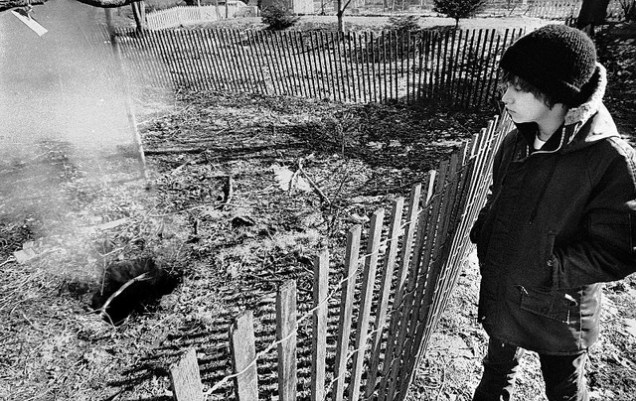
Apparently in Pennsylvania, there’s a town—Centralia—all but abandoned due to a coal mine fire that’s been burning underground since 1962.
There is disagreement over the cause of the fire. It seems that one way or another a surface fire moved into the system of mining tunnels below the town.
The effects are indisputable and scary: unstable ground, sink holes, damaged roads, plumes of hot steam, vents of smoke and toxic gases (like lethal levels of carbon monoxide), and, finally, evictions plus abandoned and/or demolished buildings.
Speculative fiction that takes place in a post-catastrophy world of some sort immediately comes to mind, and no wonder. Even the little that I read gave me a glimpse on the variety of reactions people can have to major environmental disruptions and their aftermath. Not to mention that photos of the abandoned parts of Centralia are stunning. They remind me of Pripyat after the Chernobyl nuclear accident, which is the closest equivalent I can think of from my childhood in Finland.
The Visual Inspiration occasional feature pulls the unusual from our world to inspire design, story-telling, and worldbuilding. If stuff like this already exists, what else could we imagine?
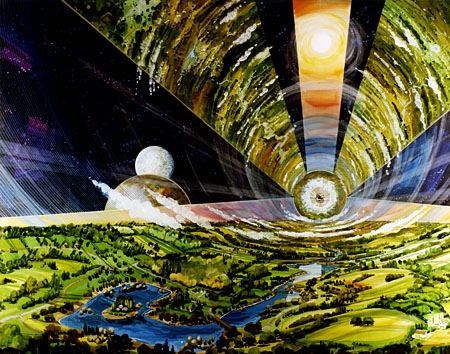
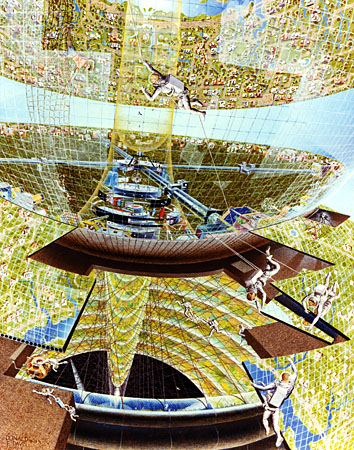
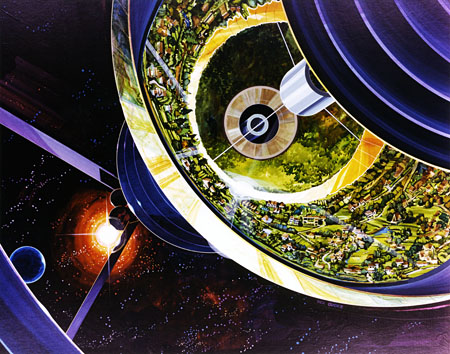
In the 1970s, NASA designed potential space habitats in three basic shapes—toroid, Bernal sphere, and cylinder. Artwork depicting some of the plans has now been published in several sizes without copyright restrictions. Here’s the NASA description of the images:
“A couple of space colony summer studies were conducted at NASA Ames in the 1970s. Colonies housing about 10,000 people were designed. A number of artistic renderings of the concepts were made.”
Below are some of my favorites.
A version of cylindrical habitats has since been seen in popular media—Babylon 5, anyone?
The residential buildings look kind of cutely 1970s. (And I say this as a non-fan of the 70s aesthetic!)
Apparently all of these designs were meant for thousands of people: the toroid and spherical stations could house around 10,000 and the cylinder a million. Wow. They certainly did not dream small!
All images courtesy of NASA Ames Research Center: Cylindrical habitat / interior view looking out through large windows (NASA ID number AC75-1086) and toroidal / cutaway view exposing the interior (NASA ID number AC75-1086-1) by Rick Guidice. Bernal sphere / construction crew at work (NASA ID number AC76-1288) by Don Davis. Bernal sphere / cutaway view (NASA ID number AC76-1089) by Rick Guidice.
Out There is an occasional feature highlighting intriguing art, spaces, places, phenomena, flora, and fauna.
Oh, goodness! An illumination from a 15th-century French manuscript shows two black Amazons. Have a look:
Le secret de l’histoire naturelle, France, ca. 1480-1485, BnF, Français 22971, fol. 2r; via discarding images on Tumblr.
This image has clearly been cropped and edited. My source, discarding images on Tumblr, says the two women are Amazons but gives no more details.
Being an early history nerd, I did some additional digging. Below is the whole page via Gallica, the digital library for the national library of France (Bibliothèque nationale de France, or BnF).
Le secret de l’histoire naturelle, France, ca. 1480-1485, BnF, Français 22971, fol. 2r.
The full title of the manuscript is Le secret de l’histoire naturelle contenant les merveilles et choses mémorables du monde. It was created between 1401-1500, and is currently stored at BnF. The illumination comes from the first part of the book, which presents the great countries and the great provinces of the old world.
Unfortunately, my French isn’t good enough anymore to be confident in my reading; I can understand a word here and there, but not the whole. However, it does look like the first word below the illumination is Amazon.
I’ve cropped into a separate image the bottom left corner of the illumination with the text following immediately after it:
Le secret de l’histoire naturelle, France, ca. 1480-1485, BnF, Français 22971, fol. 2r; cropped.
I just cannot make out the full spelling of the first word due to the ligatures that squish up the last two or three letters. It definitely looks like it’s inflected, though. The sequence ma definitely follows the capital A, with most likely a z and o further along.
It also looks there’s a sigil marking an abbreviation on top of the o, which was very common in handwritten Medieval documents to mark inflectional endings, among others. (Unless it’s a diacritic like in modern French – were they even used in Medieval French? If so, maybe Amazonye? Amazònye? Amazónye?? Amazônye???)
Anyway, it seems that Amazons are indeed talked about on the same page. The larger block of text above the illumination mentions the word affricà, too. (Again, not sure whether that’s a sigil or diacritic on the final a.)
In any case, if the two women aren’t Amazons, at the very least they are heralds of some sort leading a column of warriors. The image details, like the mi-parti dresses, are really neat, too.
And speaking of MedievalPOC, I’ve found it a truly valuable source for types of art imagery that’s not usually included in the canon from the Middle Ages onwards. The site is sometimes a little too interesting: on several occasions, I’ve spent much longer than intended there, happily chasing intriguing details down the rabbit hole. If you’ve got the time to spare, I wholeheartedly recommend it. 🙂
I saw these headers go by earlier this spring, but didn’t really have time to really dive into it until now. Well, better late than never, as they wisely say. 🙂
Despite the name, the Cheddar Man isn’t some silly cheese ad bloke. Instead, he has opened doors to very intriguing discoveries about European population during the later Stone Age.
The remains of an anatomically modern human male from about 10,000 years ago were found near Bristol in Gough’s Cave in Cheddar Gorge, Somerset, England in 1903. Recent DNA analysis of the skeleton—Britain’s oldest (almost) complete one—suggests that he had blue eyes, dark curly or wavy hair, and dark brown to black skin.
They also found that the Cheddar Man belonged to the same population as Mesolithic individuals whose bones were recovered from Spain, Luxembourg, and Hungary, usually referred to as western European Mesolithic hunter-gatherers or European early modern humans.
“The discovery shows that the genes for lighter skin became widespread in European populations far later than originally thought – and that skin colour was not always a proxy for geographic origin in the way it is often seen to be today.
“Tom Booth, an archaeologist at the Natural History Museum who worked on the project, said: ‘It really shows up that these imaginary racial categories that we have are really very modern constructions, or very recent constructions, that really are not applicable to the past at all.’”
A new bust model of Cheddar Man was made by Kennis & Kennis Reconstructions. (See a photo of the previous model made by a team at the University of Manchester here.) They took measurements of the skeleton, scanned the skull, and 3D printed a base for their model. Then they applied certain conventions to shape the face.
I fully confess I’m having a hard time keeping track of the exact timespans and geographical limits of the various Stone Age eras in Eurasia and Africa—what’s paleolithic, mesolithic, or neolithic and where and at what time. But it is so fascinating (and delightful!) that we continue to develop new methods of finding more about our past, and that so many different disciplines seek to understand where we came from and what makes us tick.
I remember liking Nalle Puh stories (as they were translated into my native language) quite a bit, so I wonder what my reaction to the voice acting will be, since I didn’t grow up thinking of the characters in terms of gender.
You see, Finnish does not have grammatical gender at all; we only have gender-neutral third-person pronouns (singular hän or plural he). This means that for me the only explicitly female character in the gang was Kengu because she was a mother, and the only explicitly male character was Risto Reipas because he was a human boy. The others were their own individual, quirky, stuffed-animal selves.
I guess the closest I can come is associating the stuffed animal characters with the non-binary gender identity. They didn’t need categorization into male or female, because that’s not how I saw their world working. I still don’t, even though talking about them in English forced me to learn which pronouns English associates with each.
It’s fascinating to notice myself using gendered English-language pronouns and yet at the same time still thinking of the stuffed animal characters as not fitting into those divisions. Eating too much honey and getting stuck in someone’s doorway, or figuring out that a popped balloon and an empty jar of honey go splendidly together do not require the gendering of anybody in the story.
I really do wonder how my perception changes after hearing voice actors and their intonational choices—or whether it will change at all.
Hey, look! We found a thing on the internet! We thought it was cool, and wanted to share it with you.
“Violence is a part of our trade, yes. It is one tool of many. But violence is a tool that, if you use it but once, it begs you to use it again and again. And soon you will find yourself using it against someone undeserving of it.”
– Ashara Komayd, former operative for and prime minister of Saypur in City of Miracles by Robert Jackson Bennett
Yup. I’ve been thinking along similar lines with regard to the racism in the U.S. and the ridiculous, racist non-reasons some racist-ass whites justify their calling of police on people of color, especially blacks. It’s racist, wasteful, racist, reprehensible, racist, entitled, racist, cruel, racist, wrong, and racist. It has to stop.
Bennett, Robert Jackson. City of Miracles. New York: Broadway Books, 2017, p. 177.
Serving exactly what it sounds like, the Quotes feature excerpts other people’s thoughts.







 Co-Geeking
You must be logged in to post a comment.