Space Archaeologist Discovers Potential Viking Site in Southern Newfoundland

A team of archaeologists has unearthed a potential new Viking site in Newfoundland, Canada with the help of satellites. Dr. Sarah H. Parcak, an archaeologist, space archaeologist, and Egyptologist, lead the effort to take infrared images from space to find new archaeological sites.
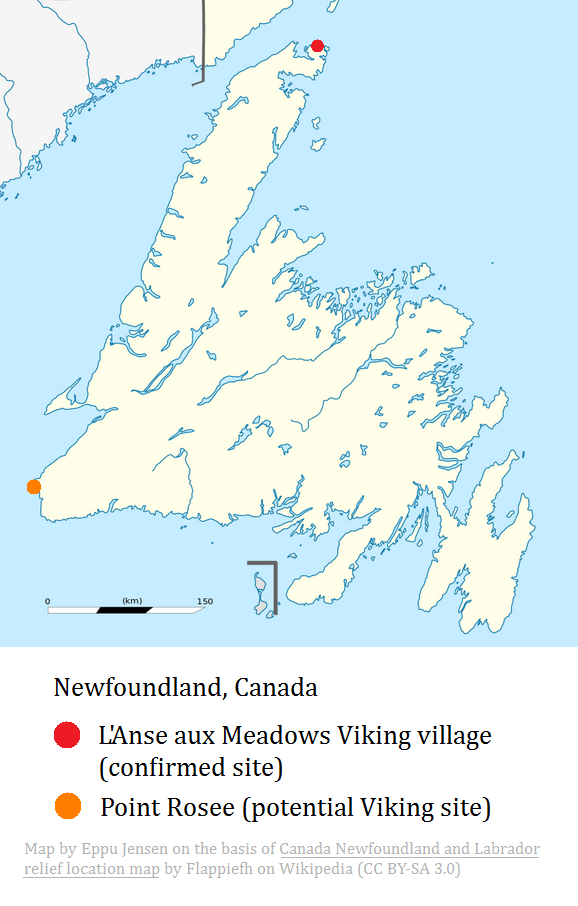
Newfoundland with Viking Activity
Newfoundland with Viking activity. Map by Eppu Jensen on the basis of Canada Newfoundland and Labrador relief location map by Flappiefh on Wikipedia (CC BY-SA 3.0)

According to The New York Times, while searching the coastlines from Baffin Island (in the Canadian territory of Nunavut, west of Greenland) to Massachusetts, she found

“hundreds of potential ‘hot spots’ that high-resolution aerial photography narrowed to a handful and then one particularly promising candidate — ‘a dark stain’ with buried rectilinear features.

“Magnetometer readings later taken at the remote site […] showed elevated iron readings. And trenches that were then dug exposed Viking-style turf walls along with ash residue, roasted ore called bog iron and a fire-cracked boulder — signs of metallurgy not associated with native people of the region.

“In addition, radiocarbon tests dating the materials to the Norse era, and the absence of historical objects pointing to any other cultures, helped persuade scientists involved in the project and outside experts of the site’s promise.”

Point Rosee is approximately 700 km (approximately 400 miles) away from L’Anse aux Meadows, the only currently confirmed Viking site in North America. The Norsemen staying at L’Anse must have traveled further south, though, because butternuts and worked pieces of butternut wood – which are not native to Newfoundland – were found among the Norse objects at the settlement.

CBC News reports that evidence of a Norse-like hearth and 8 kilograms (approx. 16 pounds) of bog iron was found at Point Rosee during a dig in 2015. It isn’t yet known for sure whether the site was a temporary base camp or a settlement, or whether it even was associated with Vikings. If confirmed, Point Rosee would be the second known Viking site in North America.

The evidence is still clearly on the scant side. Digging at Point Rosee is to resume this summer, so maybe they’ll find more.

As a sidenote, isn’t it so cool that we now have space archaeologists?!

Hadrian’s Wall… In Legos!

Brick to the Past is a British Lego-building group that bases their creations on historical landscapes and architecture. One of their builds from last year was inspired by Hadrian’s Wall. The layout combines a stretch of wall, a Roman fortress and town, a milecastle (one of the fortified gateways placed at one-mile intervals), and a native village.

Hadrian's Wall by Brick to the Past
Hadrian’s Wall by Brick to the Past

The buildings are full of delightful details and clever Legosmithing, like the use of a cogwheel over the main door of the bathhouse to represent the wild-haired head that was often associated with springs and baths in Roman Britain, like this fine example from Aquae Sulis (present-day Bath).

The bathhouse by Brick to the Past
Pediment from Aquae Sulis
Pediment from Aquae Sulis, detail of photograph by Velvet via Wikimedia (Bath; 1st c. CE; stone)

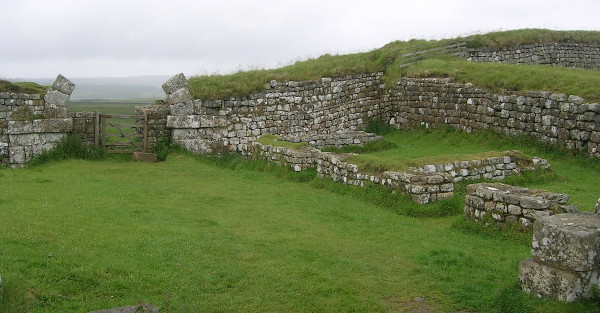
Hadrian would be proud. Here’s a picture of the original, from Milecastle 37. They do kind of look like Legos, don’t they?

Milecastle 37, photograph by Erik Jensen

Hey, look! We found a thing on the internet! We thought it was cool, and wanted to share it with you.

“The Celts” and the Victorian Hangover

160328WandsworthNo, this is not a post about how ladies and gentlemen of the nineteenth century recovered after too many pints of Guinness. Rather, it is about how nineteenth-century ideas about culture and identity have held on so tenaciously in popular history that even now, over a century later, we still have to struggle against them when trying to talk about peoples of the past. One of the subjects that often brings up these outdated ideas is “the Celts.”

Searching for the Celts

Here’s how the Victorian version of history goes. Between 500 and 400 BCE, a new group of people known as the Keltoi to the Greeks or the Gauls to the Romans, whom we call the Celts, emerged in the area of southern Germany, Austria, and Switzerland. From this homeland, they expanded explosively outwards in all directions led by aggressive warrior princes who fought from two-wheeled chariots with long iron swords. They raided Italy and Greece but were prevented from conquering those regions by the armies of the Greeks and Romans. In the west and north, however, the native peoples were far less sophisticated and could not resist the invaders. The Celts conquered France and Belgium, northern Spain, and the British Isles until at the western shores of Ireland their expansion was finally halted by the Atlantic Ocean.

Continue reading

Race and Culture in Hannibal’s Army

160322elephantTor.com published an article online today about diversity in Hannibal’s army written from the point of view of historical wargaming. It is a interesting article and well worth a read, but unfortunately it misses the opportunity to really address questions of racial and cultural diversity in ancient warfare. Here is a quick attempt to address some of the things that were lacking.

Race and culture

Race is a term with a lot of baggage, as we are all painfully aware, but it means different things in different contexts. In modern parlance, it describes a socially-constructed division of human beings into more or less arbitrary categories, largely on the basis of skin color and other physical features. In a fantasy context, it refers to distinct species of intelligent creatures like Elves, Orcs, Dwarves, and so on.

The unaddressed problem in the Tor.com article is the conflation of race and culture. In the nineteenth and early twentieth century, overtly racist theories of history posited that people of different genetic backgrounds naturally had different qualities. Many of these stereotypes still linger in our popular culture: the stoic Indian, the mischievous Irishman, the passionate Italian, etc. This belief in racial character was encoded in early classic works of fantasy like Tolkien’s Lord of the Rings, which gave us the stubborn Dwarf, the ethereal Elf, the vicious Orc, etc.

Even as we struggle to root out this conflation of race and culture from our modern life, it lingers on in works of fantasy and science fiction: the logical Vulcan, the boisterous Klingon, the decadent Centauri, the proud Dothraki. As we look back at history, we have to think of the people of the past not in terms of racial qualities but in terms of cultural contexts. People of different origins often do behave differently, but those differences are explained by the cultures they lived in, not the races they represent.

Continue reading

Fantasy Religions: Sacrilege, Blasphemy, and Heresy

160321SibylWhen creating religions for our stories, one of the things to think about is how the people who follow that tradition respond to offenses against its rules and principles. Is your character running the risk of torture and death if they question the accuracy of the sacred texts, or are they just going to get a stern glare from their grandmother for using the wrong hand to swirl the incense at the family altar?

Just as there are lots of different religious traditions that people practice in many different ways, there are lots of different ways of disrespecting religious ideas and offending the people who hold them. I’m going to talk about three kinds of religious transgression today that are often confused with one another. The differences between them are important, though. Which of these kinds of transgression a society recognizes and how it responds to them reflect important things about its history and religious traditions. These three are: sacrilege, blasphemy, and heresy.

(Or, as we call it my house, Saturday night.)

Continue reading

Connections: Rome and the Arctic

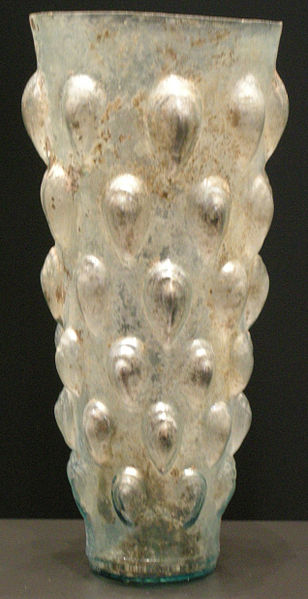
160314glassFrom the city of Rome to the Arctic circle is a distance of about 2,750 km. At its greatest extent, the northernmost tip of the Roman empire was more than 1,000 km from the Arctic. Even across such a distance, however, there were connections. A couple of little pieces of evidence show us how knowledge of Rome could reach the far north, and how knowledge of the far north could reach Rome.

In Føre, Nordland, on an island in far northern Norway, is an ancient burial site. Over several centuries in the late iron age around 10 mound burials were raised of earth and stone. (The number is uncertain because some of the mounds have been destroyed by erosion and farming.) Not all have been excavated, but those that have have yielded the evidence of extraordinary wealth by local standards, including a Roman drinking glass buried in the only female grave so far known at the site. (The glass pictured is of a similar type, but not from the same site.)

It is very unlikely that Føre had any direct connection to the Roman world. Rather it was at the northern extreme of a network of trade and alliances that spanned Scandinavia and the Baltic Sea region which used Roman imports as high-status trade goods and diplomatic gifts. The people of Føre may have had very little idea of what the Roman empire was, but they had some access to Roman goods and valued them as precious objects.

Continue reading

An End and a New Beginning for Bede’s World

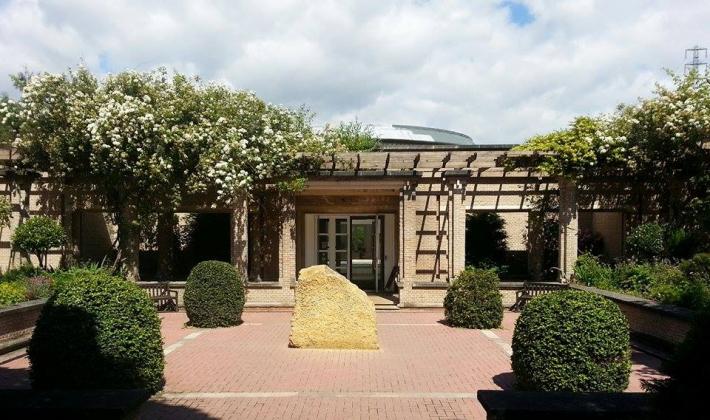
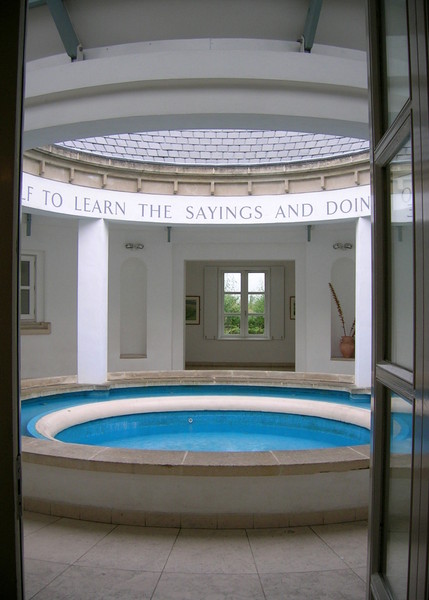
Bede’s World, a small museum in Jarrow, Tyne & Wear, Northumbria, dedicated to the Venerable Bede and 7th-century England, shut down its operations in February 2016.

Bedes World Main Entry

Bedes World Entrance Inside

In addition to indoor exhibits, the museum includes several replica wattle and daub buildings, modeled on structures excavated in Anglo-Saxon Northumbria and built with original materials and contemporary methods. On the grounds there is also a herb garden and a working farm with a small collection of rare breed animals resembling those that lived 1,300 years ago.

Bedes World Collage

The museum issued the following statement:

“It is with great regret that the Trustee Board took the decision for Bedes World [sic] to cease operation from Friday 12 February 2016 due to a lack of funds.

“Steps are being taken to put the company into administration through the appointment of an Insolvency Practitioner.

“The Trustee Board have made arrangements for the immediate care of the farm animals and the security of the site.

“The Board would like thank all staff, volunteers and stakeholders for their hard work and dedication to Bedes World. [sic]”

Fortunately, only a few weeks afterwards better news surfaced: a new operator was found to run the site. At this writing it isn’t clear what their plans for Bede’s World are, though. (Follow this link to read the statement by Groundwork South Tyneside and Newcastle, the new operator.)

Found via Anne Bennett and BBC.

Images: Bede’s World main entrance, outside view via Bede’s World. Other photographs by Eppu Jensen

Quality Research Resources by Private Individuals

I wrote last week about what a fantastic thing it is to have a wealth of primary sources stored in libraries and museums, nowadays increasingly being made available online. For completeness’s sake, it needs to be mentioned that it’s not only library and museum professionals that share quality research or materials online.

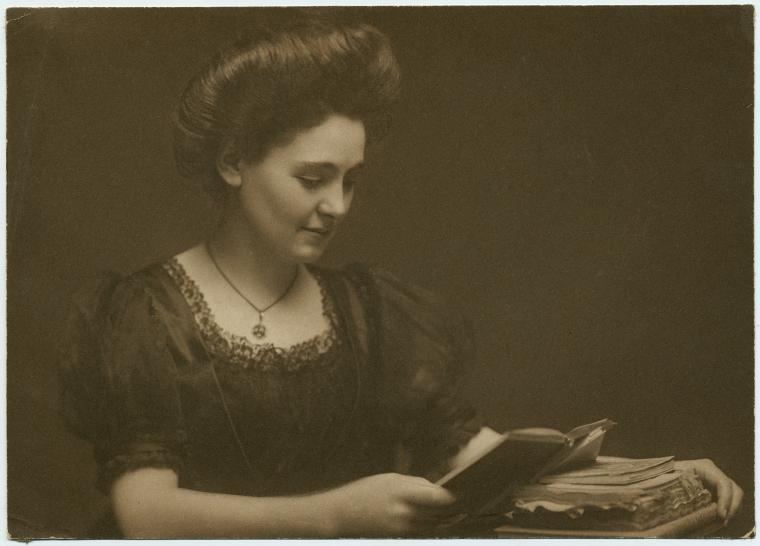
nypl-unidentified-woman-reading-a-book
Unidentified woman reading a book via NYPL, Manuscripts and Archives Division (1913; photograph)

Below I list a (very) few linguistic and historical resources put together by dedicated private individuals. They’re all diligent in documenting their steps and sources, and providing info and links for those interested in finding more. Thorough documentation is, again, not a surefire way to avoid mistakes, but it does allow tracking sources and re-creating the research.

A short list, to be sure, but what better than that to add to. 🙂

Out There is an occasional feature highlighting intriguing art, spaces, places, phenomena, flora, and fauna.

Inca Rope Bridges and the Importance of Landscape

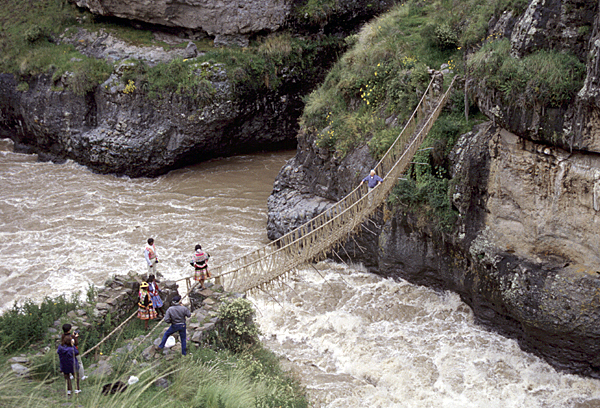
The Inca empire of South America was connected by a network of roads used by chasqui runners and pack llamas carrying messages and supplies around the empire. The Inca, creating their empire in the Andes mountains, faced challenges unlike those of flat-land and river-valley empires, among which was the problem of crossing numerous steep mountain valleys and rivers that ran dangerously swift in the flood season. Their solution to this problem was: rope bridges.

160229QiswaChaka

Suspension rope bridges spanned rivers and valleys, the longest reaching a length of 45 meters. They were made with ropes twisted out of grass and had to be rebuilt every year or two. The rebuilding was dangerous work that was assigned to local villagers as part of their obligation to the empire. Most Inca bridges have long since been replaced with modern structures, but one, the Q’iswa Chaka over the Apurimac River in Peru, is still rebuilt every year by local people as a way of preserving their heritage.

Continue reading

Museum Materials: Volcano Day in Pompeii

Speaking of the excellence of museum and library collections: below are resources on the destruction of Pompeii I found by visiting only two museum sites.

“A Day in Pompeii” is an 8-minute high-definition video on how a series of eruptions wiped out Pompeii over 48 hours, produced by Museum Victoria (Melbourne Museum) and Zero One Animation for an exhibition at Melbourne Museum in 2009.

A Day in Pompeii – Full-length animation via Zero One Animation

It would’ve been more stunning with changes in the POV rather than a static camera, but it was still interesting.

To accompany the exhibit, Melbourne Museum produced a wealth of additional online material.

Melbourne Museum Day in Pompeii Box

Unfortunately there’s currently no index page, but articles are still available on the Museum website (do a search for Pompeii). For example, House of the Vine is a nifty virtual recreation of a beautiful Pompeian house. And did you know that Pompeii had running water and lavatories? There is even a replica of a loaf of bread from Pompeii:

Melbourne Museum Day in Pompeii Loaf of Bread

After Melbourne, the exhibition traveled to other places. The Western Australian Museum also built a helpful site, still fully available, to go with their 2010 version in Perth.

Complementary views can be found from photos of the current state of the city at Pompeii in Pictures, website by Jackie and Bob Dunn. (Getting to the photos themselves takes a bit of clicking through the menus, but they’re there.)

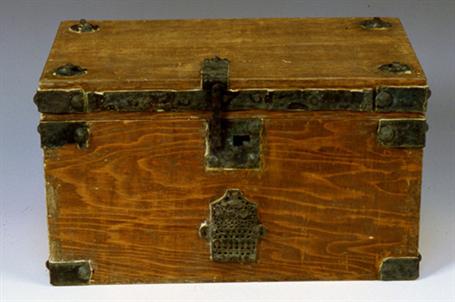
Images: Box, (c) Soprintendenza Speciale per i Beni Archeologici di Napoli e Pompei via Melbourne Museum (House of Julius Polybius, Pompeii; original iron and bronze fittings and wood reconstruction). Loaf of bread via Melbourne Museum (bakery in Pompeii; plaster copy of an original, carbonized loaf)

The Visual Inspiration occasional feature pulls the unusual from our world to inspire design, story-telling, and worldbuilding. If stuff like this already exists, what else could we imagine?