When characters in fantasy fiction sit down to a meal, we have a pretty god idea of what to expect. If the setting is Europe-ish, you can count on hearty bowls of stew, roasted meats dripping with savory juices, ripe wheels of cheese, and maybe a little bread to dab up the sauce with. If the setting is Asia-ish, expect sizzling pans of vegetables and fish, skewers of meat steaming with spices both hot and sweet, and maybe a little rice to dab up the sauce with. (And I’m sure some of you out there who have read books I haven’t can tell us what food to expect in Africa-ish, Americas-ish, or other-ish settings.) The trouble with this picture of food is, historically speaking, it’s backwards. The sizzling meats, steaming vegetables, and spicy sauces are not the food. The bread, rice, and other grains are the food.
history

Fantasy Religions: Religious Experts
If you’re inventing a fantasy religion for a story or game, you’ll probably want more than just buildings and rituals. Who uses those buildings? Who performs those rituals? Not just the everyday believers but the people whose job it is to carry out the functions of the faith. For many of the stories we tell that involve imagined religions, knowing something about the people who have expertise in that religion is important.
There are many different kinds of religious experts, even within most religious traditions, and their roles and lives can vary enormously, from the highest priest of a central temple to the attendant who sweeps the dirt off a rural roadside shrine. Some cultures have complex hierarchies of religious people or divide them into many different roles, while in others all people who follow a religious life are the same. Some religious traditions have no special personnel at all.
To try to list all the possible variations of religious people would be overwhelming and unhelpful. Instead, I’d like to offer a way of thinking about different kinds of religious experts that is flexible and practical, especially for worldbuilding. To that end, consider this question: what is it about a person with a special religious role that makes them special? Here are a few possible answers, and bear in mind that more than one of these can apply to the same person.
Special powers
 Some religious experts are believed by the adherents of their faith to be endowed with a special ability to invoke divine aid, at least under certain conditions. Historically, it is common to refer to religious experts with such special powers as priests, but different traditions have their own terms.
A familiar example in the modern west is the priests of Catholic Christianity who have the power to, among other things, invoke the miracle of transubstantiation. Many other religions practiced today also have priests who perform important rites, such as Hinduism, Zoroastrianism, Shinto, and Ifa. The priests of most historical religions with an organized structure also fall into this category, including those of ancient Greece, Rome, Egypt, Persia, the Aztecs and the Maya. Many traditions require specific circumstances, locations, and rituals in order for the invocation of divine aid to be effective, but others hold that every act of a holy individual is imbued with divine force.
Hidden Youth Kickstarter
Life is tough as a flute girl working the streets of Athens—and that’s before the monsters attacked. When the city’s guardian statues suddenly come to life and start rampaging through the city, Mnestra, an Egyptian girl, and her Thracian friend Lampedo get separated in the chaos. Can Mnestra find the courage to rescue her friend and confront not only the monsters tearing up the city but also the most powerful man in Athens?
My short story “How I Saved Athens from the Stone Monsters” will be published this fall in the anthology Hidden Youth, a collection of 22 short fantasy and science fiction stories about young people from marginalized groups throughout history. This anthology follows the previous collection Long Hidden which told the stories of people who are often left out of speculative fiction.
I am honored to have my work chosen for Hidden Youth, but this anthology needs our help to make it out into the world. Check out the Kickstarter for Hidden Youth and consider supporting this work.
Announcements from your hosts.
Medieval Texts Hidden inside Newer Books?
After the invention of the printing press, old handwritten books and documents were commonly recycled as reinforcements in new bookbindings made in the 15th through 18th centuries. Now, thanks to an x-ray technique developed in the Netherlands, these hidden manuscript fragments are readable without destroying the book they’re a part of.
It’s all possible with macro x-ray fluorescence spectrometry (MA-XRF), which allows even pages glued to each other to be read. Dr. Erik Kwakkel at Leiden University, one of the academics behind the Hidden Library project attempting to uncover more of these fragments, has both been interviewed and written about the process.

Dr. Kwakkel describes the importance of this discovery for The Observer like this:
“Every library has thousands of these bindings, especially the larger collections. If you go to the British Library or the Bodleian [in Oxford], they will have thousands of these bindings. So you can see how that adds up to a huge potential.”
He blogs about his projects and findings at Tumblr and at medievalbooks; see the latter e.g. for the exclusive behind-the-scenes post on the Hidden Library project.
Now I’m hoping we will eventually find a wealth of medieval texts in bookbindings. It’s really fascinating what we can discover with modern technology!
Image: A printed book with medieval manuscript fragments inside the spine, photograph by Erik Kwakkel (Leiden, University Library, nr. 583; 16th c. with 12th c. fragments)
Land Tenure
 Land tenure. The very words sound boring. Perhaps they conjure images of gray-haired men in tweed jackets with elbow patches picnicking beside a barley field. But stick with me for a minute here, because land tenure is an important thing to know about in understanding historical cultures and for building your own fictional worlds.
Land tenure is one of several terms historians use to describe the legal structures surrounding the control of land. (Technically, the term land tenure is only used in British common law. Other legal systems use different terms, but this is one you’ll see a lot of in English-language history texts.) The question of who controls a piece of land is always important, but it is especially vital in agrarian societies in which land, specifically farmland, is the basis of wealth. Land tenure is about figuring out who gets to use a piece of land and under what conditions.
In some cultures this isn’t an issue. Some legal systems allow only an either-or choice, you either own a piece of land or you don’t. Under other traditions, no one owns land at all. But in certain kinds of societies, the question of who controls a plot of land and under what conditions they hold it is at the heart of many conflicts.
It’s the same basic principle that applies today when you rent an apartment. As a tenant, you have certain rights in the use and enjoyment of the apartment, but the landlord also has rights they can enforce such as demanding rent and keeping the apartment in a usable condition. Landlords have good reason to want to keep as much control over their property as they can. They don’t want tenants messing things up and making it harder to rent the apartment profitably in the future, plus they want to be able to easily get rid of tenants who make trouble or don’t pay their rent. At the same time, renters also have good reason to want as much control as possible over their apartments. They want the security of knowing they won’t suddenly be thrown out and have to look for a new place and they want to know that no one’s going to be coming in and messing with their stuff. There is a tug-of-war between different interests and the balance of legal rights between landlords and tenants reflects the balance of power in larger society.
Racism and Ancient Aliens
The notion that ancient monuments, myths, and artworks reflect the visitation of Earth by alien beings is not one that is taken very seriously in the world of scholarly history, nor much outside of it, either. Still, it is one of those fictions, like astrology or vaccine scares, that continue to float through popular culture and appeal to some people because they offer simple answers to difficult questions. Who built the pyramids? Who drew the Nazca lines? Aliens!
It’s easy to dismiss ancient aliens as just another silly idea that most people don’t take seriously, but even silly ideas can be insidious. How we think about people in the past shapes and is shaped by how we think about people in the present. Especially when we’re looking to the past to inspire works of speculative fiction, we have to be conscious of the assumptions that underlie our ways of interpreting and explaining history. As harmless and even goofy as the ancient alien hypothesis may seem, it operates on a logic that is fundamentally racist and entangled with imperialist ideology.
 I’ve written before about the dynastic race theory of Egyptian history. In brief, Europeans of the eighteenth through early twentieth centuries didn’t believe that Africans were capable of creating an advanced civilization on their own, so they invented a superior race of foreign invaders who they believed had conquered and ruled Egypt, bringing their advanced culture with them. This theory justified European imperialism by creating a historical precedent: the brown people of the world needed superior white rulers to teach them how to be civilized, both in the past and the present.
The racism and imperialism inherent in dynastic race theory is obvious to us today, but the ancient alien hypothesis rests on the same assumption: that those people couldn’t possibly have been capable of creating such sophisticated artworks, monuments, and cultures on their own. Although ancient alien crackpots can conjure little green men to explain anything from the past, you’ll notice that the popular examples are all things created by non-Europeans: the pyramids of Egypt, the temples of the Maya and Aztecs, the Nazca lines, the Rapa Nui (Easter Island) stone heads, and so forth. You don’t often hear arguments that aliens built the Parthenon in Greece or the Cathedral of Notre Dame de Paris.
(The one European monument that regularly gets the ancient alien treatment is Stonehenge, which is a complicated case. The invasion theory of European history, which also clings on in popular culture despite being thoroughly discredited in scholarship, posits that the people who built Stonehenge were overrun and replaced by invaders from continental Europe, which makes them not really like modern Europeans and Euro-Americans. Some versions of the invasion theory even explicitly call the pre-invasion population non-white.)
But, some might say, that’s just because we know who built the Parthenon and we don’t know who built the pyramids, so the alien hypothesis is just filling in a mystery. Except that we do know. Egyptians built the pyramids. Mayans built the Maya temples and Aztecs built the Aztec temples. The Nazca people created the Nazca lines and Polynesians erected the stone heads on Rapa Nui. We have a pretty good understanding of how and why they all did those things, too, even if we’re still piecing together some of the details. None of this has ever seriously been in doubt. There is no mystery, just a reluctance on the part of white westerners to acknowledge the cultural attainments of non-white non-westerners. No aliens need apply.
The ancient alien hypothesis does much the same work for a modern audience that dynastic race theory did for an earlier one: it reassures us descendants of European imperialists and colonizers that the peoples our ancestors conquered, subjugated, and destroyed weren’t really up to snuff anyway. They didn’t build great monuments, figure out sophisticated mathematics and physics, or organize labor on a massive scale, space aliens did it for them. They didn’t compose great works of literature and mythology, they just handed down hazily-remembered stories about men from the sky. Invoking ancient aliens saves us the trouble of respecting other peoples’ cultures or acknowledging the tragedy of their destruction by assuring us that they don’t really count.
Thoughts for writers
We have a responsibility to the people of the past and to our audience in the present. False interpretations of history have underlain some of the worst atrocities that human beings have committed against one another. We have a duty not to perpetuate harmful assumptions, even when they come dressed up like silly alien stories. This duty lies upon us even when we aren’t doing serious scholarly study and are just mining history for interesting storytelling material. The stories we tell matter.
This doesn’t mean that ancient aliens are off-limits for storytelling. I have no doubt that there are good fantasy and sci-fi stories to be told about aliens visiting Earth in the past, stories that don’t deny the agency, ingenuity, and persistence of ancient peoples. Let’s see some of those.
Image by Erik Jensen, based on “Ancient Aliens Guy” via Know Your Meme
History for Writers is a weekly feature which looks at how history can be a fiction writer’s most useful tool. From worldbuilding to dialogue, history helps you write. Check out the introduction to History for Writers here.
Connections: Denmark and Egypt
More than 3,500 kilometers separate the tombs of the Valley of the Kings in Egypt from the village of Ølby in Denmark, but thousands of years ago they were connected by trade.
 Recent archaeological work has identified a blue glass bead found in a bronze age woman’s grave in Ølby as originally Egyptian. In fact, based on the composition of the glass, researchers have suggested that the glass bead was made in the same workshop that produced the blue glass inlay on Pharaoh Tutankhamun’s gold funerary mask. Similar beads are known from several other Danish burials. In an age when glass-making as a skill known only in a few regions, colorful glass beads were as precious as gemstones.
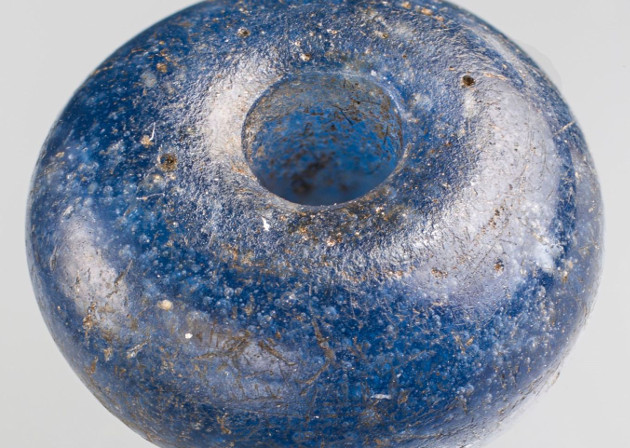 Glass beads like these could have come to Denmark in exchange for amber from the shores of the Baltic Sea. Amber was highly prized in the ancient Mediterranean and not just as jewelry. It was sometimes fashioned into amulets for warding away evil or burned like incense. (The Roman naturalist Pliny the Elder complained about his fellow Romans’ superstitions about it; see: Pliny, Natural History 37.11.)
Amber has not been found in large quantities in Egypt, but it was used in some jewelry. In fact, one of the pectorals (pendants worn over the chest as amulets) wrapped up in the linen with Tutankhamun’s mummy is set with a piece of amber.
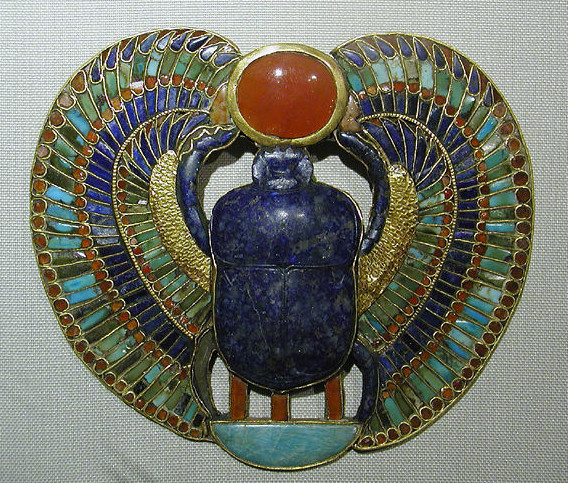 It’s unlikely that many Danes traveled to Egypt or Egyptians to Denmark in the bronze age. More likely both amber pieces and glass beads were carried short distances by chains of traders in between. Small, easily portable, but high-value objects like beads and gemstones are perfectly suited to this sort of down-the-line trade. A ship that was wrecked off the coast of Turkey around the same time as Tutankhamun’s burial (known as the Uluburun or Kaş Shipwreck) may have been part of that trade network. The ship, whose home port may have been in northern Syria or on Cyprus, was carrying both blue Egyptian glass and Baltic amber when it went down. Also in the ship’s cargo, interestingly, was a gold scarab inscribed with the name of Nefertiti, queen to Tutankhamun’s father Akhenaten (though she was not Tutankhamun’s mother).
Thoughts for writers
The evidence of archaeology is always a bit haphazard in nature. So much is unpredictable about what artifacts survive and what gets found. We are lucky to have the evidence from both the tombs of Tutankhamun and the woman in Ølby, as well as the Uluburun shipwreck, to help us trace out the lines of connection between Egypt and the Baltic. There is no question that connections between different peoples in the distant past were deeper and stronger than we know, but the evidence to document those connections has been lost.
Historians (at least those of the responsible sort) are limited by evidence, but fiction writers don’t have to be. When building your fictional worlds, let the fragments of evidence from our own inspire you to imagine far-flung connections and enterprising traders. Connections like these have always been important.
Images: Map by Erik Jensen based on Portable Atlas. Blue glass bead, detail of photograph by Roberto Fortuna and Kira Ursem via Haaretz (Ølby; 14th c. BCE; glass). Scarab pectoral, photograph by Jon Bodsworth via Wikimedia (tomb of Tutankhamun; 14th c. BCE; gold, glass, and precious stones)
History for Writers is a weekly feature which looks at how history can be a fiction writer’s most useful tool. From worldbuilding to dialogue, history helps you write. Check out the introduction to History for Writers here.
Travel: Water
 Traveling over land is familiar. Many of us do it every day (even if we don’t do it as part of an army or with pack animals), but travel over water, though vital to the modern economy, isn’t part of daily life for most of us. Sometimes, though, the characters in your stories or games need to ride a raft downriver, strike out across the ocean in an outrigger canoe, or hoist the sails of a ship of the line. In this installment of the travel series, we look at types of pre-industrial water transport, the speeds and distances ships can travel, how much cargo ships can carry, and what it takes to make a successful voyage over water.
Speed
Ship speeds are conventionally measured in knots, equivalent to 1 nautical mile (1.151 statute miles or 1.852 km) per hour. 1 km/h is equal to 0.54 knots. In this post, I have given all speeds in terms of km/h for consistency with the other travel posts.
Types of transport
There are many different types of watercraft, from one-person rafts to massive cargo ships, but one essential way of distinguishing them is by means of propulsion. Pre-modern vessels had four basic options for propulsion: current, wind, paddles/oars, or draft.
Stave Churches
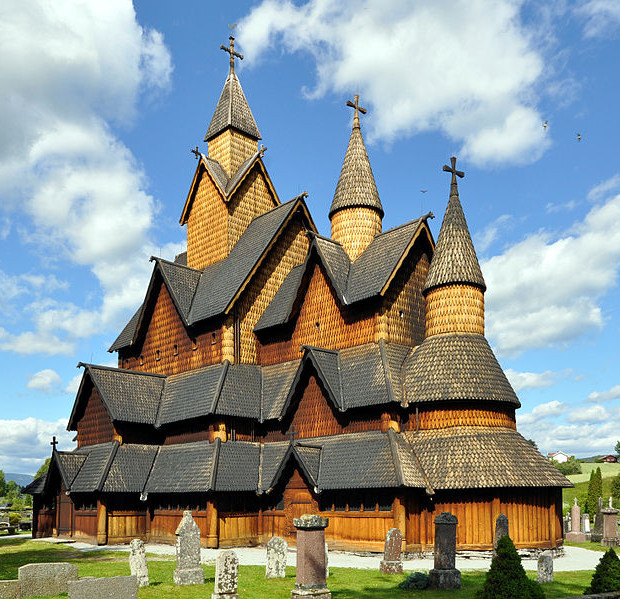
When we think of ancient architecture, we tend to think of stone and brick: the pyramids of Egypt, the amphitheatres of Rome, the Great Wall of China, the temples of the Aztecs and Maya. These are structures that have endured. We have many fewer models of wooden architecture from the distant past, even though wood—cheaper, lighter, and easier to work that stone or brick—was what most people built with in many parts of the world. Wooden buildings burn, rot, or just fall down if not maintained. Good examples of wooden buildings from more than a few centuries ago are very hard to find. One set of buildings that help fill that gap are the stave churches of Norway.
New Ancient Mediterranean Database: Public Monuments in Roman Greece
A new project called Monuments of Roman Greece is under development at the University of Oxford. It covers about four centuries, c. 200 BCE – 200 CE, from when Rome began to expand into the Greek area of influence to the height of the Roman Empire, and will result in a series of articles plus a database.

From the project website:
“Under the Roman Empire the marketplaces, streets, gymnasia and theatres of the cities of Greece were full of monuments such as tombs, inscribed stelai and – most numerous of all – statues. There were statues of bronze and of marble, portraying gods, heroes, emperors, kings and local dignitaries. Some of these monuments had already stood for centuries; others were fairly recent. Arguably no urban culture in history, with the possible exception of Rome itself, has set up such vast numbers of monuments in its public spaces. The nearest modern analogy for the amount of cultural material on display in the Roman period polis would be the museum. Yet the analogy falls short – the settings where these monuments stood were not places designed primarily for the passive viewing of works of art, they were vibrant public spaces, alive with the tumult and commotion of the city. If we are to understand the society and culture of these cities it is vital that we understand the impact of public monuments on the people who moved about them in their daily lives.“
The work is carried out by Dr. C. P. Dickenson at the Faculty of Classics, with Prof. R. R. R. Smith as scientific adviser. Both the website and the database are still in progress. Also, it sounds like the final home of the database is not finalized at the time of this writing; however, a browsable version is currently up on the University of Oxford website.
Visit the Public Monuments in Roman Greece website for scope and instructions on searching plus more info, or read Dr. Dickenson’s blog for behind-the-scenes tidbits on the development work, among other things.
Image: Bronze statuette of a veiled and masked dancer, from the collections of The Metropolitan Museum of Art, bequest of Walter C. Baker in 1971, accession number 1972.118.95, by Eppu Jensen (Greek; 3rd-2nd century BCE)


