The Rules of (Ancient) Magic

Not too long ago I was perusing a post by the fantasy author N. K. Jemisin about magic in fantasy. (The post is from several years back, but it only came to my attention recently—it’s well worth reading both the post and the comments after, if you’re interested in fantasy writing.) Jemisin takes issue with contemporary writers who obsess over rules and systems for magic rather than letting magic be the strange, unpredictable, sometimes frightening force that it often was in older fantasy by authors like Tolkien and Le Guin.

Naturally, being a historian of the ancient Mediterranean by training and a fantasy fan and author by inclination, it got me thinking about how magic is used in ancient Greek and Roman literature. The first problem is how to define magic. Lots of strange things happen in classical myths, but most of those are the action of gods, to whom turning people into peacocks or birthing fully-armed daughters out of their heads comes naturally. Ancient societies also widely believed that humans had the ability to invoke the gods to take action on their behalf through rituals including offerings, prayers, curses, and dances. I’m taking a more limited definition of magic, however: supernatural powers and events produced directly by humans at their will without requiring the aid and participation of gods or other superhuman entities. Using this definition, magic is actually quite rare in ancient literature, but here are a few examples.

In the Odyssey by Homer, the witch Circe uses enchanted food and a magic wand to transform Odysseus’ crew into animals. The god Hermes points Odysseus to a special herb which protects him from Circe’s magic as long as he is holding it, which allows him to overcome Circe and force her to restore his crew. (As a side note, this part of the epic may ultimately derive from Babylonian myths about the god Marduk, who held a sweet-smelling herb to protect himself from the poisonous blood of the dragon Tiamat and her monstrous children.)

In Euripides’ drama Medea, the sorceress Medea, abandoned by her husband Jason, sends a poisoned robe and crown to Jason’s new bride, Glauce. When Glauce dons the poisoned gifts, they cling to her body and burn her to death.

In Apuleius’ novel Metamorphoses (often also called The Golden Ass), the narrator Lucius learns that his friend’s wife dabbles in magic and can transform into a bird by rubbing a magic potion on her body. Lucius wants to try the same and steals some of her potion, but by mistake he gets the wrong one and is turned into a donkey. From the lady’s maid, Photis, he learns that the secret to reversing his transformation is to eat rose petals, but roses are not in season and the rest of the novel follows Lucius the donkey from one misadventure to the next as he tries to find roses to eat.

From these examples, we can notice some patterns about how Green and Roman authors thought about and used magic. On one hand, there is no sign of a magic system, as described by Jemisin. There are no universal rules and no explanation for how or why magic works. Every individual case is different. It depends upon secrets known only to its users, never shared with the audience, and its results often shock and terrify those who encounter them.

At the same time, even though we cannot call this magic systematic, there is a consistency to it. It tends to require special objects or substances, such as enchanted food, magic flowers, poisons, and potions. Those who are initiated into its powers can use them with confidence: Medea knows that her poison will be effective, just as Circe knows she is defeated when she sees Odysseus carrying the plant that makes him immune to her power. When the effects fail or go awry, it is because of ignorance or ineptitude on the part of the wielders, like Lucius using the wrong potion.

Despite this general consistency, the magic remains narratively powerful. It does not become dull and predictable or divert the stories away from the characters’ choices and their consequences. In fact, magic makes possible the human stories that are at the center of these narratives, from Medea’s calamitous vengeance to Lucius’ comic wanderings. How does it achieve these things? A few observations:

The stories include magic; they aren’t about magic. Magic is a MacGuffin. It sets things in motion or presents characters with choices to make, but once the magic has done its job, it disappears into the background and lets the characters get on with things.

Magic does not solve or circumvent the crucial problems. The human issues and choices at the center of these stories are ones that magic cannot touch. Odysseus is trying to get home. He deals with magic and monsters on his way, but it isn’t magic that gets him where he wants to go. Medea’s magic gives her the power to deeply hurt Jason in a way that a mundane woman in her position could not, but the story is about how she makes the choice to use that power. Lucius’ magical mishaps drive him to rethink his unsatisfying life and resolve to be a better person. Magic presents these characters with challenges and choices they wouldn’t otherwise face, but their stories are still about what happens in their hearts and minds.

We know only as much as we need to know. Apuleius does not list the ingredients in Lucius’ donkeyfying draught, nor is there an appendix at the end of the Odyssey to explain how Odysseus’ magical plant disrupted the mystical ether currents that Circe manipulated with her wand. Medea does not take time out from her revenge plot to give the audience a primer on fiery poisons. The magic simply works the way it is supposed to, and that’s all we need to know.

Thoughts for writers

There’s room in fantasy literature for many kinds of magic, from complex and internally consistent systems to strange and unpredictable effects. There’s even a place for fantasy with no magic at all. Whatever kind of fantasy you feel like writing, though, remember this: the story comes first. Whatever you do with your magic, don’t let it get in the way of your characters and the choices they have to make.

Image: Circe flees from Odysseus, with animal-headed crew, detail of photograph via Wikimedia (Metropolitan Museum of Art; c. 440 BCE; red-figure vase; by the Persephone Painter)

History for Writers is a weekly feature which looks at how history can be a fiction writer’s most useful tool. From worldbuilding to dialogue, history helps you write. Check out the introduction to History for Writers here.
Some Interesting Early Photo Portraits

I’m not a fan of the Victorian age per se, but watching Murdoch Mysteries has piqued my interest somewhat. Here are some intriguing photographs from the later 1800s to early 1900s.

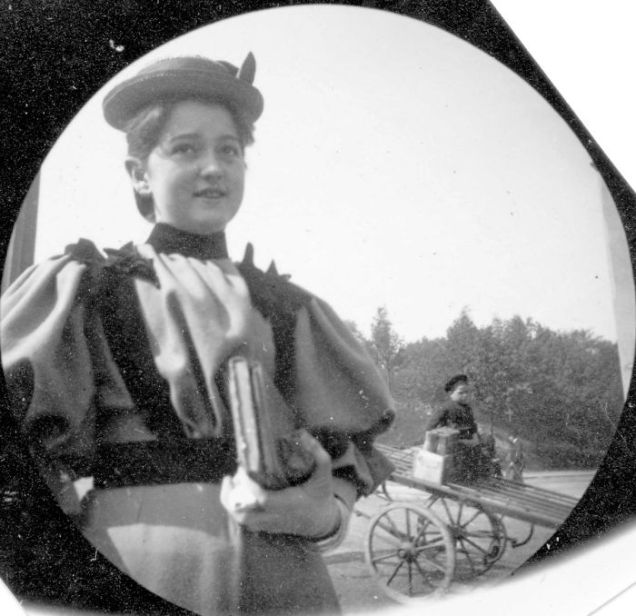
From a set of unscripted photos taken in the streets of 1890s Norway by Carl Størmer, a young woman with books:

Imgur Carl Stromer Young Woman w Books 1890s
Young woman with books, photograph by Carl Størmer via Imgur (Oslo, Norway, 1890s)

All of the subjects in this set are remarkably relaxed. Love the contrast to the stiff studio portraits of the era!

(I’ve had trouble finding a more detailed source, unfortunately. Possibly Størmer’s photos are gleaned from the 2008 book 80 millioner bilder: Norsk kulturhistorisk fotografi 1855-2005 [’80 Million Pictures: Norwegian Culture-Historical Photography 1855-2005′], edited by Jonas Ekeberg and Harald Østgaard Lund.)

Finnish ladies and gentlemen on a ski trip in the 1890s:

Helsinki City Museum N252030 Hiihtoretkelaiset
Hiihtoretkeläiset ryhmäkuvassa (‘ski trip participants in a portrait’), photograph via Helsinki City Museum (Helsinki, Finland, 1890s, image number N252030, CC BY 4.0)

Judging by their attire, they are indeed ladies and gentlemen. What struck me is that, apparently, it wasn’t at all odd for the upper class to go skiing in their regular daywear.

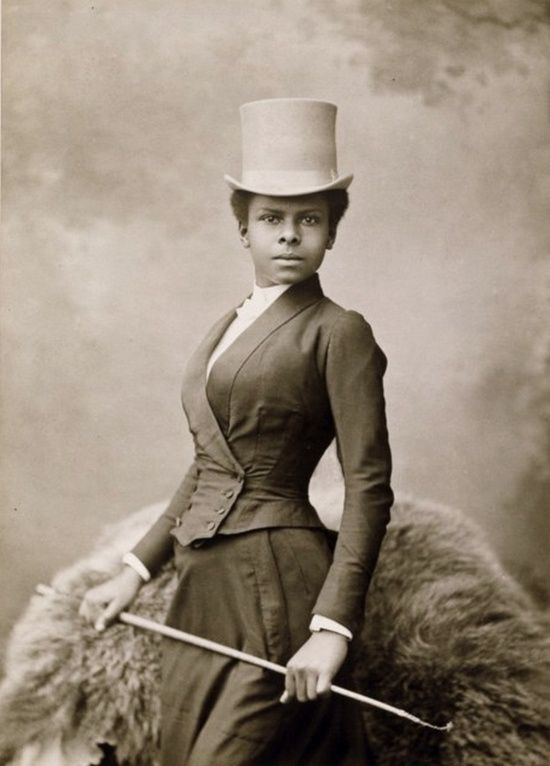
Speaking of sports and Victorians, from 1891, here is high school dressage equestrian Selika Lazevski by Félix Nadar:

Black Female Equestrians Felix Nadar Selika Lazevski
Selika Lazevski, photograph by Félix Nadar courtesy of Ministère de la Culture, France, via Black Female Equestrians (Paris, France, 1891)

What an arresting portait!

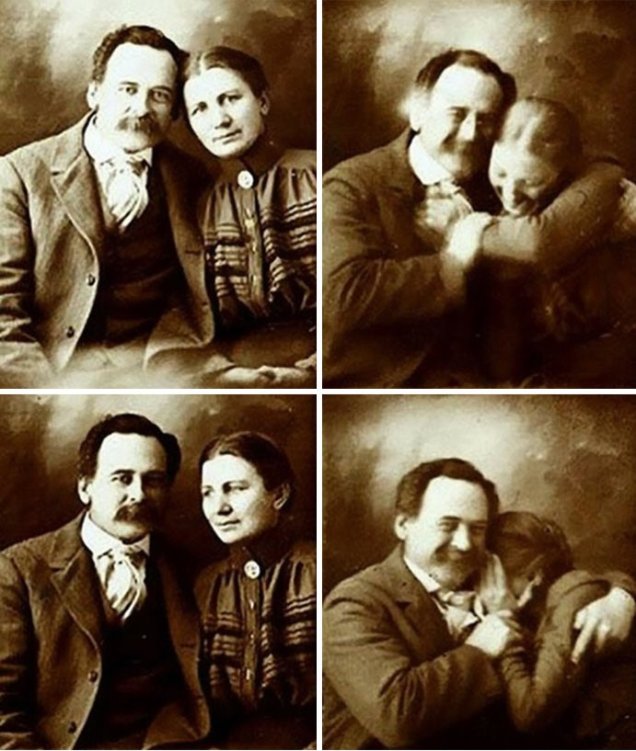
A Victorian couple from Leeds trying not to laugh while getting their portraits done in the 1890s:

Twitter Leeds Centre for Victorian Studies Couple Trying Not to Laugh
Victorian couple trying not to laugh while getting their portraits done, photograph via Leeds Centre for Victorian Studies on Twitter (Leeds, England, 1890s)

It’s like a photo version of a blooper reel! 🙂

Two Victorian ladies making a life-sized snow lady, also from Leeds in the 1890s:

Twitter Leeds Centre for Victorian Studies Making Snow Lady
Two Victorian ladies making a snow lady, photograph via Leeds Centre for Victorian Studies on Twitter (Leeds, England, c. 1890s)

With the correct corseted posture, dress ruffles, and hairdo. Wow, ladies, what a great job!

Nellie Franklin photographed holding a parasol in Tallahassee, Florida, between 1885 and 1910:

Florida Memory Nellie Franklin with Parasol HA00227
Nellie Franklin with parasol, photograph by Alvan S. Harper via Florida Memory (State Library & Archives of Florida) (Tallahassee, Florida, between 1885 and 1910, image number HA00227, public domain)

This photo clearly references painted portraits as ancestors of photographic ones.

A young man in a wheelchair:

Yale Robert Bogdan Disability Collection Wheelchair
Young man in a wheelchair, photograph via the Robert Bogdan Disability Collection at Yale University’s Medical Historical Library

Victorians certainly loved their wheels! I wonder exactly how one would’ve operated this chair—there’s clearly a handle bar connected to the front wheel, but if grabbing it with both hands, where does the propelling force come from?

A Sami woman from Finland photographed at Ellis Island in the U.S., so presumably immigrating, around 1905-1914:

NYPL Digital Augustus Sherman Sami Woman 418041
Laplander / Sami woman from Finland, photograph by Augustus F. Sherman via New York Public Library digital collections (Ellis Island, New York, NY, c. 1905-1914, image ID 418041, public domain)

I wish the portrait hadn’t cut off at the waist; I would’ve liked to see the rest of the details of her dress (the belt looks especially interesting). I know that nowadays Sami outfits (gákti) are unique. Each is made for its wearer to reflect the personal / family history and area (and possibly the people as a whole?). I don’t know, however, how far back in time that practice goes.

Anyway. These old photos give fascinating glimpses of western life only about 100 years ago. So similar and yet so, so different.

Out There is an occasional feature highlighting intriguing art, spaces, places, phenomena, flora, and fauna.


Race in Antiquity: Skin Color in Art

“What race were the ancient Greeks and Romans?”

It sounds like a simple question that ought to have a straightforward answer, but both the question and its answer are far more complicated than they appear. In these posts, I dig into the topic to explore what we know, what we don’t know, and what we mean by race in the ancient Mediterranean world.

Part 4: Skin Color in Art

In the previous post, we looked at how Greeks and Romans wrote about skin color. Today we look at how they represented it in art.

In looking at how ancient artists handled skin color, we have to begin by recognizing that not all ancient artworks have come down to us intact or preserving their original colors. We must especially shake off the association of ancient art with gleaming white marble. Marble was favored for sculpture in the ancient Mediterranean because the stone is slightly translucent and it reacts to light in a way similar to human skin, but marble statues were not usually left white. They were painted, often in bright colors which have faded or disappeared entirely after thousands of years of exposure. To get a more accurate sense of how ancient artists represented skin color, we have to choose our sources carefully and look for types of artwork that hold color better over time or that have been protected from exposure.

Although people of the ancient Mediterranean were aware that human skin tones could vary widely, they did not attach the same meaning to this variation that we tend to today. Since skin color was not a primary way of marking ethnic identity, artists could use it to convey other meanings, or simply for decorative effect.

It was a widespread custom in the ancient Mediterranean to use skin color as an indicator of gender. Men were often portrayed with dark reddish-brown skin, women with pale yellow-white skin. This artistic convention reflects a conventional ideology in which the socially acceptable activities for men were agriculture and war, outdoor occupations which exposed them to the sun. Women were similarly expected to stay indoors, working in the home and preserving their pale skin. For a man to be pale suggested that he worked indoors at trades that, though necessary for society, were less prestigious. Similarly, for a woman to appear dark-skinned suggested that she had to work outside the home, implying that her household was not rich enough to be self-sustaining. When patrons directed artists to depict them with conventional skin colors, they were responding to the social pressure to look their best. We cannot assume that artworks like these represent the actual appearance of their subjects.

Funerary statues of Rahotep and Nofret via Wikimedia (Egyptian Museum, Cairo; c. 2500 BCE; painted limestone)
Portrait of a couple from Pompeii via Wikimedia (Pompeii, currently Museo Archeologico Nazionale di Napoli; 1st c. CE; fresco)

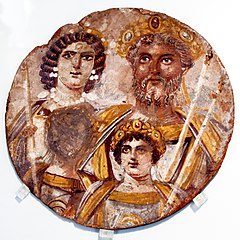
Skin color could also be used to indicate other features of identity. Darker skin, for instance, was associated with age, lighter skin with youth. Children were often depicted with light-colored skin, regardless of gender. In this portrait of the family of the Roman Emperor Septimius Severus, Septimius’ skin is distinctly darker than his wife Julia Domna’s, but their son Caracalla’s skin is even a little paler than his mother’s. (Their other son Geta’s face was obliterated in antiquity after Caracalla became emperor and assassinated his brother).

Portrait of Septimius Severus and family, photograph by José Luiz Bernardes Ribeiro via Wikimedia (currently Altes Museum, Berlin; c. 200 CE; painted panel)

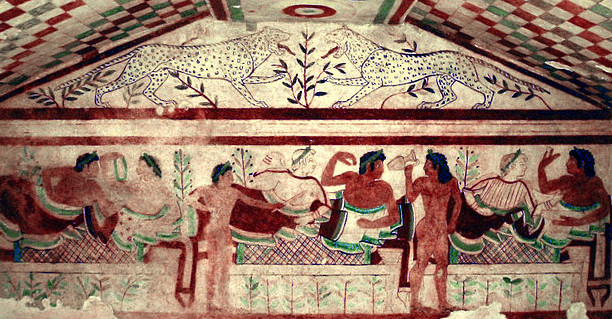
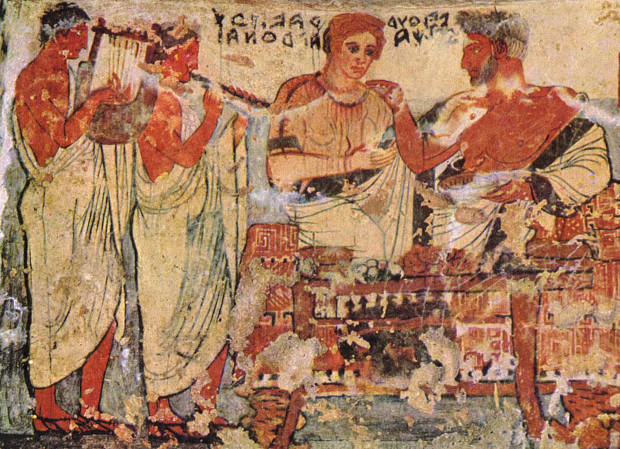
The degree to which skin color was emphasized as a feature in art also varied between cultures and across time. These two examples of Etruscan tomb art from Tarquinia show how much variation there could be even within the same community. While both follow the dark men / light women pattern (gender is also marked by differences in clothing, hair style, and activity) one makes the distinction very stark and schematic while the other is much more subtle.

Banquet scene from the Tomb of the Leopards, photograph by AlMare via Wikimedia (Tarquinia; 480-450 BCE; fresco)
Banquet scene from the Tomb of the Shields via classconnection (Tarquinia; c. 340 BCE; fresco)

In many cases, the skin color of human figures in ancient art is dictated by the choice of medium more than by a desire to convey any message. The two sides of this vase, for instance, present similar scenes, the hero Heracles at a feast, in opposite color schemes.

“Bilingual” vase, composite of photographs via Wikimedia (Vulci, currently Staatliche Antikensammlung, Berlin; 520-510 BCE; pottery; believed to be by Andokides Painter)

This statue of the Tetrarchs, four emperors who governed the Roman Empire in a short-lived experiment in joint rule, is carved out of porphyry, a very hard stone with a dark purple hue. This stone was chosen for several reasons, partly because of the traditional association of purple with imperial power and partly because the dense, hard stone suggested the strength of the institution the joint rulers were trying to create. A realistic depiction of skin tone was not a priority.

Tetrarchs statue, photograph by Nino Barbieri via Wikimedia (currently St. Mark’s Square, Venice; early 4th c. CE; porphyry)

When depicting beings beyond the human realm, skin color could carry many other meanings. The Egyptian god of the dead, Osiris, was traditionally depicted with green skin, symbolic of regrowth and new life. In these wall paintings, the green-skinned Osiris appears in two different scenes in the company of other gods.

Wall paintings from the tomb of Horemheb, photograph be Jean-Pierre Dalbéra via Wikimedia (Valley of the Kings; c. 1292 BCE; fresco)

Similarly, the Etruscan god Charu, who was responsible for guiding the souls of the dead into the afterlife, was typically shown with blue skin, representing decaying flesh.

Charu from the François Tomb, detail of photograph via Wikimedia (Vulci; c. 330 BCE; fresco)

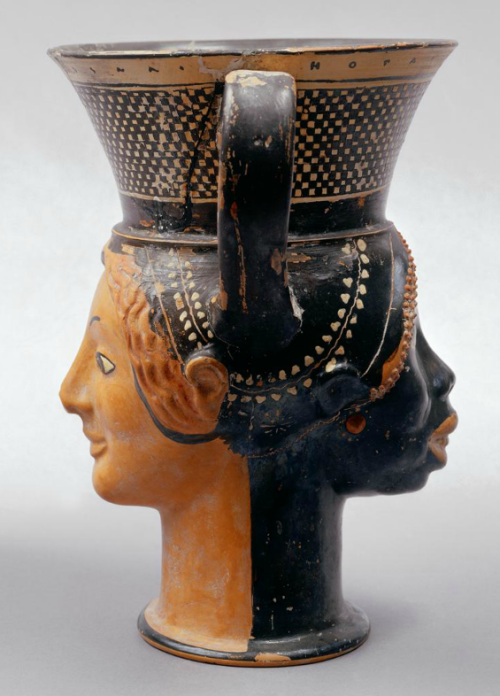
Sometimes ancient artists used skin color to indicate ethnicity in ways that are easy for us to recognize, such as this vase representing two women’s faces. The light-skinned woman’s features, such as her pointed nose, thin lips, and wavy hair, suggest that she is meant to be of European descent while the black-skinned woman has features characteristic of a sub-Saharan African origin, such as a flat nose, fuller lips, and tightly coiled hair.

Janiform aryballos, photograph by Jastrow via Wikimedia (from Greece, currently Louvre; 520-510 BCE; pottery)

In other cases, we cannot be entirely sure what the skin color in ancient art is meant to convey. This fresco from Minoan Knossos depicts bull leapers in distinctly different skin tones, but it is difficult to be sure what significance, if any, that difference has. It may be meant to show differences in gender, although the figures’ similar proportions, clothing, and hair do not confirm it. It might be intended to indicate people of different ethnic origins. Alternatively, it could be simply for aesthetic variation. We do not know enough about Minoan culture and its conventions for representing ethnicity, gender, and other identities in art to be certain.

Bull leaping fresco (restored), photograph by Nikater via Wikimedia (Knossos; 1550-1450 BCE; fresco)

As with literary descriptions of skin color, we have to approach ancient artistic representations with a cautious awareness of how far removed we are from the cultures that created them. The artists who made these images and the patrons who commissioned them did not share many of our basic assumptions about what skin color means and how it should be represented. Their cultural context was unlike ours and they created their works to communicate with other people of their place and time, not to send time capsules to us millennia later. It is not enough for us to stroll through museums or flip through the pages of art books looking for faces that look the way we think people of different ethnic origins ought to look.

Ancient art is not a representative snapshot of ancient demographics. Art represents what people consider important, not necessarily the reality of the world they live in. In a world in which privilege, power, and identity were not wrapped up with race in the same way they are today, the representation of race in art was much less of a priority. Just because ancient artists, like ancient writers, often chose not to depict skin color as a defining mark of ethnic identity does not mean that they did not live surrounded by people of all different hues with ancestries spanning the globe. As with how we read literature, we have to learn to read ancient art in new ways if we are to make sense of it as evidence for the diversity of ancient Mediterranean societies.

Other posts on Race in Antiquity:

History for Writers is a weekly feature which looks at how history can be a fiction writer’s most useful tool. From worldbuilding to dialogue, history helps you write. Check out the introduction to History for Writers here.
Imagining a Minoan Home

Imagining the mundane details of daily life in past cultures can be difficult. Everyday things like houses, clothing, and daily routines tend not to be well-represented in textual or archaeological sources because they were so ordinary that no one thought to write about them or take care to preserve them. Yet these are exactly the sorts of everyday details that can be most useful when looking to the past for inspiration for worldbuilding. To try to understand what daily life looked like in the past, we often rely on chance finds and careful reading of sources that weren’t intended as guides to the mundane.

For example, we have only a limited idea of what an ancient Minoan house may have looked like. The Minoan civilization flourished on Crete and some of the southern islands of the Aegean Sea in the first half of the second millennium BCE, at its height between roughly 2100 and 1400 BCE. Minoan palaces have been thoroughly excavated at sites such as Knossos and Phaistos, but what about the homes of ordinary people?

We have a few valuable sources of evidence. One is this pottery house model found at Archanes, on Crete. This model shows many features that must have been part of everyday Minoan architecture: solid lower-story walls and a breezy columned upper story, windows barred with slats, a projecting balcony, and perhaps a small walled garden. (The entry door is on the other side of the model; the upper story is modern reconstruction.)

House model, photograph by Zde via Wikimedia (Archanes, currently Archaeological Museum, Heraklion; c. 1700 BCE; pottery)

To get a sense of how houses like this fit together to make up a village, we can look to the site of Akrotiri, a Minoan settlement on the island of Thera (now called Santorini) that was buried in a volcanic eruption sometime around the late 1600s BCE. Despite the destructive effects of the eruption, excavation at the site has found a tightly-built settlement of multi-story houses connected by streets and drainage channels.

Photograph of Akrotiri excavation by F. Eveleens via Wikimedia


More evidence comes from a fresco that was preserved on the wall of a house at Akrotiri, depicting a panoramic view of the island. This segment shows the town. While the image is a little hard to interpret, we can clearly see a densely-built settlement with houses made of regularly cut stone sitting on many levels. These houses display many of the same features as the Archanes house: low doorways, porticoed porches, windows covered by slats, and people looking out from balconies or rooftops.

Akrotiri fresco, photograph by Dirk Herdemerten via Wikimedia (Akrotiri; c. 1700 BCE; fresco)

Akrotiri fresco, photograph by Dirk Herdemerten via Wikimedia (Akrotiri; c. 1700 BCE; fresco)

When we put all these different sources together, we can begin to imagine everyday life in a Minoan house: the shady lower floor and the breezy upper floor, the slivers of sunlight coming in through the window grilles, the gurgle of water running by in the drain channel right outside, and the endless chatter of the neighbors on their overhanging balcony. For creating any sort of pre-modern culture in a warm, dry setting like the Mediterranean, it’s not a bad start.

History for Writers is a weekly feature which looks at how history can be a fiction writer’s most useful tool. From worldbuilding to dialogue, history helps you write. Check out the introduction to History for Writers here.
Race in Antiquity: Skin Color

“What race were the ancient Greeks and Romans?”

It sounds like a simple question that ought to have a straightforward answer, but both the question and its answer are far more complicated than they appear. In these posts, I dig into the topic to explore what we know, what we don’t know, and what we mean by race in the ancient Mediterranean world.

Part 3: Skin Color

Race, as we use the concept today, applies arbitrary divisions on the wide diversity of human physiology. The fact that these divisions are arbitrary does not make them irrelevant or innocuous. As with many other ways of dividing up humanity, race has often been used to justify inequalities. The ancient Mediterranean world was not free of inequality or arbitrary divisions between people, but that does not mean that those divisions worked the same way as the modern idea of race.

Skin color is a useful place to start. Although many different aspects of human physiology have been used to mark out racial divisions—face shape, hair texture, skeletal proportions—none is more thoroughly interwoven into racial ideology as skin color. The terms black and white are conventional ways of identifying race. Others, such as red, yellow, and brown, though not as widely used as they once were, still appear today, sometimes with more complex meanings than they once had. Even the currently preferred circumlocution people of color still supposes that skin color is a prime marker of identity. In both life and art, we tend to look at skin color as the signal marker of racial identity, and to identify both ourselves and others in those terms.

What did skin color mean to the people of ancient Greece and Rome? It was not irrelevant. Greek and Roman authors and artists were aware that different people had different skin tones and they sometimes connected these distinctions with identity in significant ways, but that is not the same as recognizing race. We cannot read ancient literature or look at ancient art and evaluate it the same way we would treat at a modern movie or news story.

Consider this cheeky couplet from the Roman poet Catullus, addressed to Julius Caesar:

I don’t try too hard to please you, Caesar.

I don’t even know whether you are a black person or a white person.

– Catullus, Songs 93

(All translations my own)

To a modern Western audience, this sounds at once like a reference to race. To call someone a “black person” or a “white person” today is transparently and unambiguously a racial identification. Yet Catullus meant nothing of the kind. He certainly was not ignorant of the ancestry and identity of one of the most powerful people in the Roman world in his day. In Classical Latin, “I don’t know whether it’s black or white” is a common saying meaning “I don’t care in the slightest.” Catullus wasn’t talking about Caesar’s skin color at all.

There are examples in classical literature when people’s skin color is explicitly described, but even those cases do not follow the same patterns as modern racial categories. For example, in the Odyssey, the hero Odysseus is disguised by the goddess Athena when he first arrives home to Ithaca. When he first meets his son Telemachus, however, the disguise is briefly lifted, and part of what marks the transformation is a change in skin color:

Athena pointed with her golden wand.

First she wrapped him well in a cloak

and spread a tunic around his breast, filled out to its prime.

He became black-skinned again, his jaws stretched out,

and a dark blue beard covered his chin.

– Homer, Odyssey 16.172-6

The word used to describe Odysseus’ color, melanchroiēs, can be literally translated as ‘black-skinned,’ but really means ‘deeply suntanned.’ The darkness of Odysseus’ skin is important because it marks his age and experience. It was not part of an ethnic identity he was born with but something he acquired through experience.

Ancient authors similarly associated pale skin with youth and naivete. The comic playwright Aristophanes used whiteness as a marker of foolish inexperience to describe a character who had what his Athenian audience would have regarded as a ludicrously bad idea:

After this, some handsome young fellow,
as white as Nikias, jumped up,
put up his hand to speak,
and said we should hand the city over to the women.

– Aristophanes, The Assemblywomen 427-30

Nikias was a prominent politician of the age who championed the cause of peace between Athens and Sparta. Just like Odysseus’ “black skin” was a marker of his long career as a warrior, Nikias’ “whiteness” distinguished him as a military dilettante. In neither case was the color of their skin meant to convey a racial identity.

It seems that even at a basic level, ancient Greeks and Romans described colors differently than we do today. Latin has two words for both white and black. Albus means pale, lusterless white, while candidus means bright, gleaming white. Ater is flat, matte black while niger is glossy black. In Greek literature, many objects are described with colors we would not associate with them today: wine is black; grass is white; honey is green; iron is blue. (Note also Odysseus’ “dark blue” beard.) When ancient authors describe people in terms of color, we must be particularly cautious in how we interpret them.

In some cases, ancient authors did use skin color as a way of describing ethnic identity, but it was not the only physical feature, or even the most common one, that they paid attention to. Hair color, eye color, facial features, and physical proportions were equally relevant as ethnic traits, as shown in a couple of examples from the Greek philosopher Xenophanes and the Roman historian Tacitus:

Ethiopians say the gods are dark and snub-nosed; the Thracians give them red hair and blue eyes.

– Xenophanes, fragment 16

The physical variety [of the Britons] is suggestive. The golden-red hair and burly limbs of the Caledonians shows them to be of Germanic origin. The colorful faces and curly hair of the Silures, plus their position opposite Spain, suggests their ancestors were Spaniards who came across the ocean.

– Tacitus, Agricola 11

These observations should both caution and stimulate us.

On one hand, we cannot simply read ancient sources—or their modern translations—the same way we would read modern texts. Ancient Greek and Roman authors did not think in the same racial terms we use today, and we risk misunderstanding them if we simply apply modern concepts to ancient texts. When we read that the Greek historian Herodotus described the people of Egypt as “black” (Histories 2.22), the question we have to ask is not “What does ‘black’ mean?” but “What did ‘black’ mean to Herodotus?” Like Homer describing Odysseus, he probably meant that they were deeply tanned. He could not have meant that they belonged to the racial category of people we today classify as black because Greeks of his day did not use the word black with that meaning. Quite simply, Herodotus tells us nothing of much use in assigning modern racial categories to the ancient Egyptians.

On the other hand, the fact that ancient authors did not generally use skin color as a way of distinguishing racial groups in the same way we do does not mean that the ancient Mediterranean was ethnically homogeneous. Greek and Roman authors described the world in the terms that mattered to them. They had no idea that we would be coming along a couple of millennia later asking different questions with different ways of describing ourselves. Absence of evidence is not evidence of absence: the fact that ancient authors tended not to describe people’s ethnicities in terms of skin color does not mean that people of many different ethnic origins and skin tones did not live among them.

Race is a clumsy and historically fraught way of dividing up the rich complexity of human diversity. Just because ancient Greeks and Romans didn’t divide people up in the same way we do doesn’t mean that the world they lived in was any less complex than our own. If we want to find evidence for that diversity, we have to be prepared to look for it in ways that don’t depend on modern conventions.

Other posts on Race in Antiquity:

Image: Portrait of Septimius Severus and family, photograph by José Luiz Bernardes Ribeiro via Wikimedia (currently Altes Museum, Berlin; c. 200 CE; painted panel)

History for Writers is a weekly feature which looks at how history can be a fiction writer’s most useful tool. From worldbuilding to dialogue, history helps you write. Check out the introduction to History for Writers here.

Eating

Whether it’s lembas bread and stewed rabbit or a nice fresh pan-galactic gargle blaster, the things that characters eat and drink can be a useful way of establishing the feel of an unfamiliar world. But how your characters eat and how their food is prepared and served can contribute just as much to your worldbuilding as what they eat. Here are a few things to think about when creating food systems for fantasy worlds.

Wet carbs or dry carbs?

Traditional cuisines in most of the world are based on carbohydrates, but those carbs can come in many different forms. If they’re dry—flatbread, raised breads, tortillas, biscuits, etc.—then people are likely to eat them by hand and may well use them to pick up and hold other dishes like stews and sauces. If they’re wet—porridge, cooked rice, pasta, etc.—people are more likely to use implements like spoons and chopsticks to hold them.

Eating by hand or eating with implements?

While this can be to some extent determined by the nature of the food, many foods can be eaten either by hand or with implements. Implement-eating cultures tend to develop specialized implements for particular foods or kinds of eating; whether or not people have access to or know how to use the correct implements for the right food can be a marker of social status. On the other hand, hand-eating cultures can have just as complicated rules about how to eat. Forget the renfaire stereotypes about grabbing a turkey leg and tearing into it; societies that eat by hand tend to have strict rules governing when and how often you wash your hands, which hand you use to eat with, even which fingers and which individual finger joints should be used for which foods.

Large pieces or small pieces?

Some cuisines, such as most traditional European cookery, tend to cook meats and vegetables in large pieces which individual diners cut up for themselves. Others, such as traditional cuisines across much of south and east Asia, tend to cut meats and vegetable into smaller pieces in the kitchen which are served up to be consumed as they are.

Communal dishes or individual servings?

Sometimes food is served in communal dishes from which everyone takes what they like; other times, everyone gets their own individual serving. Both ways of serving are wrapped up with social etiquette. With communal dishes, there are usually rules about how people serve themselves, in what order, and how much at a time. With individual dishes, there may be rules about whether everyone gets the same things or the same amount.

In any culture, you are also likely to find variations on these possibilities. People of different social classes or ethnic backgrounds within the same society may well follow different eating customs. The same people may also eat differently under different circumstances: a quiet family dinner at home probably has different social rules than a public banquet for a festival day. Drawing out these complexities is also a part of worldbuilding.

Food is important. People often get emotionally invested not just in what they eat but in how they eat it. Many of the customs and norms that societies develop for how food is eaten and served have their roots in protecting hygiene and managing social hierarchies, two very important issues for personal well-being. Even today, when modern food safety practices and the weakening of traditional social hierarchies has made these issues less urgent, people can still have deep emotional reactions to perceived transgressions as trivial as folding a slice of pizza or eating a hamburger with fork and knife.

Imagine how important customs of cooking, serving, and eating food could be in a world in which your character’s standing in society may depend on knowing which finger to use to dip into the shared sauce bowl.

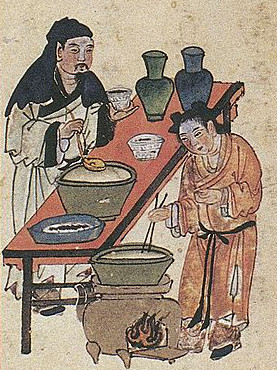
Image: Preparing butter, image from Shiwunbencao (ink on paper, Ming period)

History for Writers is a weekly feature which looks at how history can be a fiction writer’s most useful tool. From worldbuilding to dialogue, history helps you write. Check out the introduction to History for Writers here.

History for Writers Compendium: 2017

History for Writers explores world history to offer ideas and observations of interest to those of us who are in the business of inventing new worlds, cultures, and histories of our own. Here’s where we’ve been in 2017:

Practicalities

Connections between cultures

Ancient wisdom for troubled times

Telling stories

Thinking historically

Past cultures

Race in Antiquity

Join us in 2018 for more history from a SFF writer’s perspective.

History for Writers is a weekly feature which looks at how history can be a fiction writer’s most useful tool. From worldbuilding to dialogue, history helps you write. Check out the introduction to History for Writers here.

Race in Antiquity: Identities

“What race were the ancient Greeks and Romans?”

It sounds like a simple question that ought to have a straightforward answer, but both the question and its answer are far more complicated than they appear. In this and some other posts, I dig into the topic to explore what we know, what we don’t know, and what we mean by race in the ancient Mediterranean world.

Part 2: Identities

Race as we know it today is an invention of European imperialism in the last five hundred years. Because most of the world was touched by European imperialism, whether directly or indirectly, race has become a vital category of identity for people in many parts of the modern world. Race creates distinctions that benefit some and disadvantage others, and—whether we agree with its effects or not—we cannot ignore or escape them. Most of us can readily identify ourselves and the people around us in racial terms, and we often have cause to do so.

There are many other categories through which we define our identities, such as gender, sexuality, religion, nationality, language, occupation, and so on. Being a white straight male Buddhist French-speaking Canadian cheese-seller is different from being a black straight male Buddhist French-speaking Canadian cheese-seller, but so is being a black straight female Buddhist French-speaking Canadian cheese-seller, or an Asian asexual trans male atheist Spanish-speaking Peruvian piano tuner, etc.

The rules that govern racial identity are perceived to be less flexible than the rules that govern other categories of identity. In most (though, notably, not all) of the modern West, these rules are defined by an ideology that is problematic and not always compatible with lived experiences or scientific thinking, but whose components are grounded in three fundamental assumptions. According to these assumptions, race is:

Biological. We recognize race primarily in terms of physical features like skin color and facial geometry. Science defines certain genetic and physical features as characteristically “Caucasoid,” “Negroid,” “Mongoloid,” or other categories.

Hereditary. Our race is defined by the race of our parents. A person with two black parents is automatically and necessarily black. Even people of mixed racial heritage can parse out their racial identity into specific proportions.

Immutable. We cannot choose or change our racial identity; a person born white can never be any race other than white, and the same is true of other races.

The ancient Greeks and Romans, and other peoples of the ancient Mediterranean, also recognized that identities are complex, made up of different categories, and that some identities have advantages over others. An ancient Greek sage (the quote is attributed to both Thales and Socrates) said:

I thank fortune for three things: first, that I was born a human, not an animal; second, that I was born a man, not a woman; third, that I was born a Greek, not a barbarian.

– Hermippus of Smyrna, frag. 13

(All translations my own.)

In addition to these categories—humanity, gender, and culture—other categories were important for ancient identity, such as legal status (freeborn, freed, or slave), language, occupation, citizenship, and family affiliation, but race, as we recognize it today, was not among them. No category matching the modern racial assumptions of biology, heredity, and immutability existed in Greek or Roman culture.

There is no word in Greek or Latin that corresponds to “race.” The nearest equivalent is “gens” in Latin or “genos” in Greek, both of which imply a group of people with a coherent cultural identity and a common ancestry. It is better translated as “tribe” or “extended family.” The idea of dividing people up on the basis of skin color would have made no sense to a Greek or Roman, nor would the idea of a category of humanity that did not differentiate between people from Greece, Spain, Ireland, and Ukraine.

Greek and Roman authors were aware of variations in physical features. The Greek philosopher Xenophanes, for instance, noted that different peoples imagine the gods as resembling themselves:

Ethiopians say the gods are dark and snub-nosed; the Thracians give them red hair and blue eyes.
– Xenophanes of Colophon, frag. 16

The Roman historian Tacitus similarly made suggestions about the origins of the Britons based on their physical characteristics:

The physical variety [of the Britons] is suggestive. The golden-red hair and burly limbs of the Caledonians shows them to be of Germanic origin. The colorful faces and curly hair of the Silures, plus their position opposite Spain, suggests their ancestors were Spaniards who came across the ocean.
– Tacitus, Agricola 11

Nevertheless, physical features were not regarded as sufficient to divide people into categories. Languages, customs, and ways of life carried far more weight. When the Greek historian Herodotus argued that the Colchians of the Black Sea region were related to the Egyptians, he dismissed the similarities of their appearances as unreliable and based his argument instead on similarities in their cultures:

It is evident that the Colchians are Egyptians… I guessed this myself since they are both dark-skinned and thick-haired, but that amounts to nothing since others are as well. A better proof is that the Colchians, Egyptians, and Ethiopians are the only peoples who have always practiced circumcision… [The Colchians] and the Egyptians produce linen in the same way; plus their ways of life and their languages resemble one another.
– Herodotus, Histories 2.104-5

Heredity mattered for defining identities, but not in the same way as in modern racial thinking. When Greeks and Romans looked to their ancestry for claims of identity, they discussed it in terms of descent from a specific (historical or mythical) individual, not collective ancestry. King Alexander I of Macedon (the great-great-great-grandfather of Alexander the Great) argued that he ought to be allowed to participate in the Olympic Games, which were open only to Greeks, on the grounds that he was a descendant of the Greek hero Heracles. (Herodotus, Histories 5.22) This kind of ancestral argument could even bridge cultural divides. When the Persian king Xerxes was preparing to invade Greece in 479 BCE, he sent emissaries to the Greek city Argos to persuade them to remain neutral and not join the other Greeks resisting his campaign. He based his argument on the claim that the Persians were descended from the Greek hero Perseus, who came from Argos, and so Persians and Argives, as distant relatives, should not fight one another. (Herodotus, Histories 7.150)

For many ancient authors, culture was far more important than heredity in assessing people’s identities. The Greek historian Dionysius of Halicarnassus declared:

For, in my opinion, Greeks are not distinguished from barbarians by name or language, but by intelligence and the inclination to proper behavior, and more than this by the fact that they do not behave inhumanly to one another. Those whose natures are of this kind, I think, ought to be called Greeks; those who are the opposite, barbarians.
– Dionysius of Halicarnassus, Roman Antiquities 14.6

Furthermore, identity was not always assumed to remain stable across generations. The last king of Rome, Tarquinius Superbus, was identified as a Roman, but his father, Tarquinius Priscus, was an Etruscan, whose own father, Demaratus of Corinth, was a Greek. (Livy, History of Rome 1.34; Dionysius of Halicarnassus, Roman Antiquities 3.46) This same instability applied on a collective basis. Many people in the ancient Mediterranean claimed descent from other peoples. Most famously, the Romans claimed to be descended from the Trojans, but some also claimed the Romans were descended from Greeks. Gauls likewise claimed descent from Troy. Jews asserted that the Spartans of Greece were their long-lost kin, while Tacitus declared that the Jews were descended from Ethiopian exiles. (Vergil, Aeneid; Livy, History of Rome 1.1; Dionysius of Halicarnasus, Roman Antiquities 1.31, 41-44, 60, 72, 89; Lucan, Pharsalia 1.427-8; 1 Maccabees 12.5-23; Josephus, Jewish Antiquities 12.225-7; Tacitus, Histories 5.2)

Even individuals might change their identities over time. The Greek physician Galen described his Roman clientele as:

… those who are born barbarians but cultivate the ways of Greeks.
– Galen, On the Preservation of Health 1.10

Ancient Greeks and Romans thought about their identities in many different ways, but none of these ways corresponds to race as we define it today. These differences in how ancient peoples thought about identify shaped how they wrote about themselves and others. The things that mattered to them in defining identities were not always the same things that matter to us.

When we ask what race the ancient Greeks and Romans were, we are applying concepts that the people we are investigating would not themselves have understood. Acknowledging this fact is essential when we look to the primary sources to try to answer our questions. We cannot simply read ancient sources as if we were reading a modern newspaper or Twitter feed and assume that we can identify the people they describe as surely as if we met them on the street today. Looking for evidence of race in antiquity requires understanding what the ancient sources don’t say as much as what they do.

Other posts on Race in Antiquity:

Image: Bull leaping fresco (restored), photograph by Nikater, via Wikimedia (Knossos; 1550-1450 BCE; fresco).

History for Writers is a weekly feature which looks at how history can be a fiction writer’s most useful tool. From worldbuilding to dialogue, history helps you write. Check out the introduction to History for Writers here.

Magic Words

From Gandalf’s “Naur an edraith ammen” to Harry Potter’s “Expelliarmus,” words carry the power to work magic in many stories. The idea is not a new one. Here, for example, is some medical advice from the early Roman writer Cato the Elder’s treatise on agriculture:

A dislocation can be made whole with this incantation. Take a green reed four or five feet long, split it in half, and have two people hold it at your hips. Begin to chant: “Motas uaetas daries dardares astataries dissunapiter” and continue until the halves touch. Flourish an iron blade over them. Where they touch one another, take them in your hand and cut left and right. Bind the pieces to the dislocation or fracture and it will be healed. Keep chanting every day like this: “Haut haut haut istasis tarsis ardannabou dannaustra.”

– Cato the Elder, On Agriculture 160

(My own translation.)

Cato was a Roman traditionalist who preferred folk remedies like this one to the more scientific Greek medicine that was becoming popular in Rome in his day, but Greeks had magic words of their own. A set of six words, known as the “Ephesian letters,” were believed to be particularly powerful: askion, kataskion, lix, tetrax, damnameneus, and aision. These words may have been used for spoken incantations like Cato’s charms, but they were particularly used in writing. Reportedly, they originally came from an inscription on the statue of Artemis at Ephesus. It later became a common practice to write the words on scraps of papyrus which were then tied up in small pouches and carried or tied to various parts of the body for magical protection. Boxers were especially known to use these sorts of amulets for strength and defense in competition.

Magic words often seem to sit somewhere on the line between meaning and nonsense. These magic words—both Cato’s spells and the Ephesian letters—are not meaningful in themselves, but they suggest meanings to those who know Latin and Greek. Cato’s incantation implies the movement of something broken. The Ephesian letters suggest words relating to power—damnameneus, for instance, seems to derive from the verb damazo, meaning to tame an animal.

Other examples of magic words from Greece and Rome are derived from real words in other languages the Greeks and Romans had contact with, such as Egyptian, Hebrew, and Persian. Osoronnophris, for example, another magic word used in various Greek and Roman spells, comes from an Egyptian phrase meaning “Osiris (god of the dead) is beautiful.” In much the same way, although J. K. Rowling’s “expelliarmus” may not be a real word, it sounds a lot like Latin and it is not hard to guess that it is intended to disarm an opponent.

Another way of invoking the magic of nonsense is to use words in ways that disrupt normal understanding. Repetition, for example, like Cato’s “haut haut haut” makes real words into magical nonsense. In written spells, words were sometimes written backwards or with letters reversed.

There’s magic in words, spoken or written.

Image: “Expelliarmus” from Doctor Who, “The Shakespeare Code” via Giphy

History for Writers is a weekly feature which looks at how history can be a fiction writer’s most useful tool. From worldbuilding to dialogue, history helps you write. Check out the introduction to History for Writers here.

Race in Antiquity: The Question

“What race were the ancient Greeks and Romans?”

It sounds like a simple question that ought to have a straightforward answer, but both the question and its answer are far more complicated than they appear. In this and some upcoming posts, I’ll dig into the topic to explore what we know, what we don’t know, and what we mean by race in the ancient Mediterranean world.

Part 1: The Question

“What race were the ancient Greeks and Romans?”

As simple as it may sound, almost every word in this question hides layers of assumptions. It assumes that race is a valid category for describing human beings, and is equally applicable to ancient societies as to modern ones. It assumes that we can reconstruct ancient demographic information in some comprehensive way. It assumes that “Ancient Greeks and Romans” are definable groups of people, and that we know who we mean by that designation.

These are not trivial issues, and I’ll take them up in future posts, but today I want to address an even more fundamental and persistent assumption: that the racial identity of the ancient Greeks and Romans matters.

Now, I am an ancient historian and a geek. I’ve spent my entire life, both at work and at leisure, being told by people that the things I care about don’t matter. (The title of my field, “ancient history,” is even used as a synonym for “irrelevant.”) That’s never stopped me from trying to figure things out and it shouldn’t stop us from thinking about race in antiquity, but it should make us step back and ask: Why do we want to know?

When we ask questions about the race of ancient peoples, we are not posing these questions in a vacuum. There is, in fact, a long history of people arguing about the answer, and if we don’t understand their reasoning and motivations we may fall into the same traps and make the same mistakes that they did.

We can start around 1500 CE when the Western concept of race was taking on its modern contours. Variations in physical and genetic features—from skin color to blood type—are part of the reality of human biology, but the belief that these features can be used to divide humanity into distinct and meaningful categories, along more or less the terms we recognize today, was a product of European imperialism and colonialism. The European powers that were busy conquering and colonizing the rest of the world had to define themselves as superior to the people they were displacing, exploiting, or massacring. The idea of a “white” race—a superior “white” race, no less—began with the need to justify European activities abroad.

Once Europeans had defined themselves as both white and superior, history had to fall in line. On one hand, the roots of white superiority had to be found in the depths of history; on the other hand, any great accomplishments in history had to become the property of white people. Any evidence that could be interpreted as suggesting that white people had made significant achievements before anyone else were celebrated, such as Piltdown Man, a hoax that got out of hand because it conformed so perfectly to what archaeologists expected: the crucial first steps towards modern humans happened in northwestern Europe. The achievements of non-European peoples were denied or claimed for Europeans wherever possible, like the “dynastic race theory” in Egypt or the assertion that major centers of African civilization like Great Zimbabwe must have been built by white (or white-ish) settlers. Civilizations that could be neither denied nor claimed for whiteness, like those of ancient India, China, and Mesoamerica, were denigrated or dismissed.

European Christian culture had long idolized the civilization of ancient Greece, a habit that went back as far as the Roman Republic. The Romans had had an uneasy relationship with their Greek neighbors and subjects, as they tended to elevate the great literary, artistic, and philosophical works of the classical Greek past while sneering at contemporary Greeks as unworthy of their ancestors. After the fall of the western Roman Empire, as Greek and Latin became learned rather than vernacular languages, Greek and Latin literature collectively acquired an aura of cultural authority. This aura of authority was further supported by the association of Greek and Latin learning with religious authority in the Christian church.

By the imperial age, when European nations were asserting their racial superiority over their colonial subjects and slaves, ancient Greek and Roman civilizations had come to be perceived as the peaks of intellectual, philosophical, and artistic culture. A defense of European superiority therefore required the assertion of a direct link to Greece and Rome. Since race was the accepted currency of identity, that link had to be defined in racial terms. It therefore became essential that the ancient Greeks and Romans should be white.

Various strategies existed for making the argument that the ancient Greeks and Romans were white, but one of the most influential was the Aryan invasion model. According to this model, the Aryans were a primordial superior white race whose origins lay somewhere in northern or northeastern Europe. At various times in history, individual branches of this race would explode outwards, traversing great distances and conquering all the “inferior” peoples in their path, eventually colonizing a swath of Eurasia stretching from England to northern India. These Aryan invaders could be credited with cultural achievements anywhere they went, but most importantly they were hailed as the ancestors of the classical Greeks. Western and northern Europeans who claimed descent from other branches of Aryan settlers could therefore claim an ancestral connection to the glories of Greece and its Roman successors.

It was not enough for the ancient Greeks and Romans to be white. Since Europeans looked back to Greco-Roman culture as a source of authority, those who wanted to validate imperial projects required that the opinions of the great ancient authors should support their sense of racial superiority. Scholars searched ancient texts for passages congenial to the imperialist drive and elevated these as the true beliefs of the Great Thinkers of antiquity. Any passages which expressed a different perspective were dismissed or reinterpreted. Through the centuries of this scholarly activity, the ancient Greeks and Romans became not only “white” but the very founders of white supremacy.

Modern scholarship recognizes that the “Aryan race” was a figment of the imagination (the term “Aryan” is now reserved for certain historical peoples of northern India). Both the ethnic identity of the ancient Greeks and Romans and their opinions about that identity are now seen to be far more complicated issues with no easy answers, but the insights of the past several decades of scholarship are only slowly coming into wider public consciousness. The relics of the racially-determined Aryan invasion model are still all around us, some of them stripped of the most obvious racism of the older scholarship but still grounded in the urge to assert the fundamental whiteness of the ancient Mediterranean.

When we ask questions about the race of the ancient Greeks and Romans, this is the context we must be conscious of. Much older scholarship is suffused with its ideas, and even more recent popular discussions of the subject tend to be unknowingly aligned with the Aryan model.

The mistakes of the Aryan model and other arguments that asserted the whiteness of the ancient Greeks and Romans arose from the desire to make the past reflect the concerns of the present. The past does not exist to make us feel better about ourselves or validate our contemporary politics. This is the assumption we must guard against most carefully in any historical research. If we assume that the Greeks and Romans are a measure of civilization and that any similarities we can find between ourselves and them prove our own worth, our arguments will go hopelessly askew.

Instead, if there is any use in examining Greek and Roman ethnic identity, it is as part of the larger work of history: to help us understand our own society better by giving us useful examples for comparison. We will not prove our own value by showing that the Greeks and Romans were like us, but we may better grasp the complex forces at work in forming our own identities by understanding how they were different from us.

Other posts:

Image: Janifrom kantharos, via People of Color in European Art History (Etruria, currently Villa Giulia; 6th c. BCE; ceramic)

History for Writers is a weekly feature which looks at how history can be a fiction writer’s most useful tool. From worldbuilding to dialogue, history helps you write. Check out the introduction to History for Writers here.