Custom Bookcases with Carvings for a LotR Collection

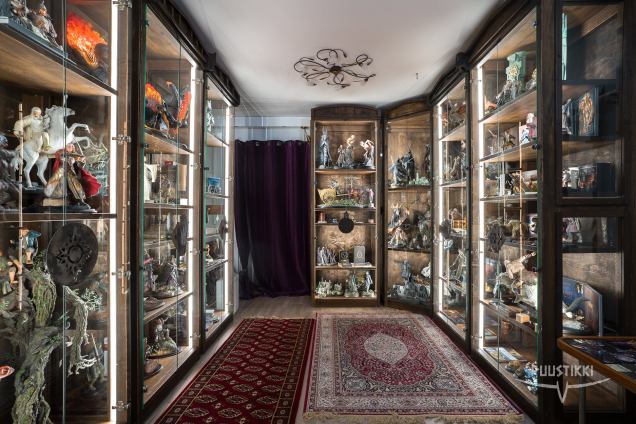
Now this is a treasure, preciouss! A Finland-based company built these amazing custom bookcases for a collection of figurines and other materials from the Lord of the Rings and The Hobbit.

FB Puustikki LotR Bookcases

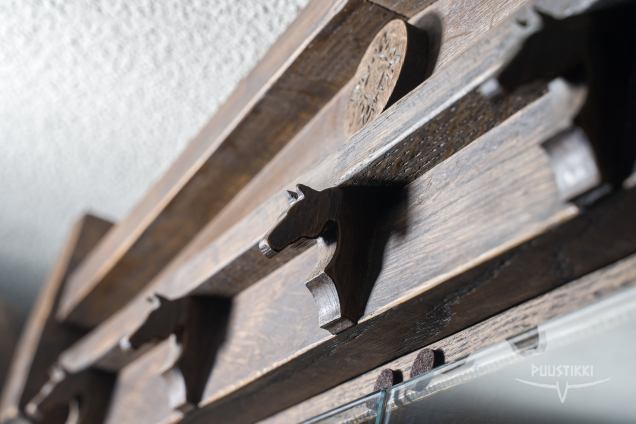
Many (if not all?) of the bookcases also have carved crowns. Here’s the Rohan one:

FB Puustikki LotR Bookcases Rohan

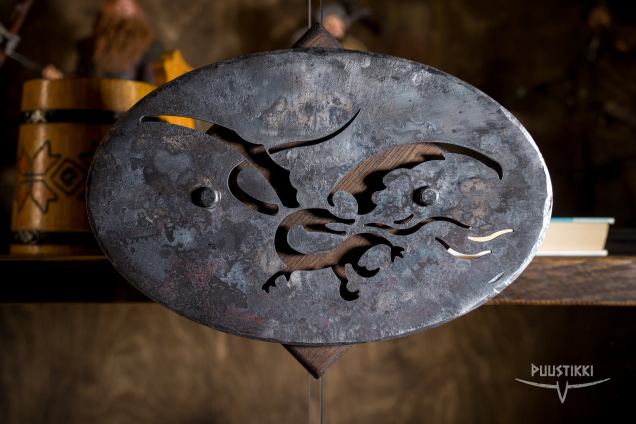
There are also metal shields that function as handles:

FB Puustikki LotR Bookcases Dragon

Puustikki talk about their project a bit on Facebook:

“Finally we’re able to publish photos of these custom made, epic showcases for LOTR and Hobbit figurine collection. Probably the biggest collection in Finland and now it’s also displayed in showcases it deserves! This whole thing is 100% handmade out of solid oak and we wanted to use glass doors to maximize visibility into the cases. Each one of the showcases has distinct features to corresponding races/nations; carvings on the top and a custom made steel handle.

“Height of these wooden marvels is 250cm, so they barely fit into a regular house! [sic]”


Puustikki is run by carpenter Jarkko Pilvinen and jeweler Juho Manninen. The makers pull their inspiration from history and historical fantasy. At this writing, their online store includes drinking horns, a picnic table and benches, beds, dragon pegboards, runed coasters, and jewelry, among others.

My goodness! Astounding, aren’t they? Stylistically, a lot of their other wares are not our style at all, but as a maker myself, I really admire and appreciate the consideration and effort that went into all of their designs.

Check out the Puustikki website or Instagram for more.

Images by Jukka Alasaari Photography via Puustikki on Facebook

In Making Stuff occasional feature, we share fun arts and crafts done by us and our fellow geeks and nerds.

Accessibility Ramps at Ancient Greek Sanctuaries

A recent article in the journal Antiquity by archaeologist Debby Sneed argues that some ancient Greek temples were built with ramps to make them more accessible to people with limited mobility.

The argument begins from the observation, already familiar to archaeologists, that some temples had stone ramps leading from ground level up to the sanctuary. While in some places these ramps clearly seem designed to facilitate the movement of carts or chariots as part of religious rituals or the delivery of supplies and offerings, many are too narrow to be explained this way. Nor can these ramps be explained as part of the building process, since they are permanent and built in stone—far more difficult and expensive to construct than the packed earth ramps that would have been used in building—and they reach only to the level where people would have entered the temple, not all the way to the roof where building materials had to reach.

The interesting observation that Sneed adds to the discussion is that the distribution of these ramps is neither universal nor random, but they are particularly associated with temples connected with healing, and especially with temples where the evidence of inscriptions and votive offerings show a special focus on healing afflictions of the legs and other impairments to mobility. This pattern of distribution, while not definitive, does suggest that the ramps were purposely built at these particular sites to make it easier for people who might have difficulty climbing steps to gain access to the temple structures where they could participate in prayers or healing rituals.

Once built, of course, these ramps could well have served other purposes as well, such as making it easier to bring in offerings or supplies such as wood or wine needed for the routine operations of the temple, but this is also true of mobility accommodations today: once there’s a ramp in place, lots of people can use it for lots of different purposes. The planners of these sanctuaries may well have had this kind of multiplicity of functions in mind when building the ramps. Nevertheless, the fact that these ramps tend to appear at healing sanctuaries and not at others does indicate that the particular needs of those temples and their patrons were an important factor in the design.

The study of disability and its accommodation in history is a growing field. Studies like this one show how revisiting familiar evidence with new questions in mind can yield fertile new observations and interpretations.

Sneed’s full article can be read at cambridge.org.

Image: Artist’s reconstruction of the Temple of Asclepius at Epidaurus, Sneed, Debby, “The Architecture of Access: Ramps at Ancient Greek Healing Sanctuaries,” Antiquity (2020): 1-15, 9.

History for Writers looks at how history can be a fiction writer’s most useful tool. From worldbuilding to dialogue, history helps you write.
Visualizing the Roman Emperors

Sometimes, putting information into a visual form helps you make sense of it. I’ve been studying, writing about, and teaching the history of the Roman Empire and its emperors for more than two decades now, but taking my knowledge and making it visual helped me grasp the significance of some of the long-term patterns I’ve know about for so long. In this chart, you can see the stumbling uncertainty of the early empire, the stability of the second century, the chaos of the third century, and the complexity of the late 200s to early 300s.

(It’s a big image; you have been warned!)

Continue reading

Bardcore: Now in Classical Latin

Most of the bardcore versions I’ve seen are in plain modern English, some in ye olde faux medievale Englisshe, and some even in Old French. But so far there seems to be only one in Classical Latin: “Smells Like Teen Spirit”.

Smells Like Teen Spirit Cover In Classical Latin (75 BC to 3rd Century AD) Bardcore by the_miracle_aligner on YouTube

Oh, yeah! LOL!

An occasional feature on music and sound-related notions.

The Curious Case of Wikipedia, My Book, and Odoacer’s Mother

I recently had the odd experience of discovering that my book Barbarians in the Greek and Roman World is cited as a source on Wikipedia, and then realizing that it is cited as a source for something the book does not actually say.

The reference is on the page about Odoacer, a “barbarian” king who ruled portions of the Western Roman Empire in the late fifth century CE. Here’s the sentence in which I am cited, at least as it appeared in early September, 2020:

Historian Erik Jensen, avows that Odoacer was born to a Gothic mother and that his father, Edeco, was a Hun.


This sentence cites page 16 of Barbarians in the Greek and Roman World, but here is what page 16 actually says:

Classical ideas about identity […] allowed for fluidity and ambiguity, on both the individual and societal level. The last Roman king, Tarquinius Superbus, is an individual example. Though Superbus was identified as Roman, his father Tarquinius Priscus was an Etruscan, whose own father, Demaratus, was a Greek: in three generations of the same family we find three different ethnic identities. At the other end of Roman history we find Orestes, a provincial Roman who joined Attila’s Huns and later made himself de facto western Roman emperor. He was succeeded by his son Romulus Augustus, the famed “last Roman emperor,” who was soon dethroned by Odoacer, a Goth whose father Edeco had been a Hun.


Do you notice what’s missing? I said nothing at all about Odoacer’s mother.

We know virtually nothing about Odoacer’s mother. Some ancient sources describe her as coming from the Sciri, one of the numerous Germanic-speaking groups who emerged on the eastern Roman frontier in the third and fourth centuries, but, like all too many women in history, she is almost entirely unrecorded in the sources.

Whoever added this sentence to the Wikipedia article made an assumption not supported by my text. It’s an understandable assumption, of course, in a modern context. Modern definitions of ethnicity tend to rely heavily on ancestry and descent. If we know that someone today identifies as, say, Irish, and their father is Lebanese, it’s a fair bet that their mother is Irish, because their Irishness has to come from somewhere. Similarly, if Odoacer was a Goth and his father was a Hun, it may seem natural to assume that he must have gotten his Gothicness from his mother.

But these kinds of assumptions don’t work in the ancient world. While ancestry was an element of ethnic identity in the ancient Mediterranean, it had much less weight than we give it today. And that, in fact, is the entire point of passage cited: we simply cannot assume that one ancient person’s ethnic identity necessarily tells us anything about how their ancestors or their descendants identified themselves.

Now, to be fair, in talking about Odoacer as a Goth and Edeco as a Hun, I was simplifying a far more complicated and tenuous set of scholarly arguments. This is how these figures are identified in some ancient sources, but there are arguments not just about how we should describe Odoacer and Edeco but even about whether we have correctly identified these individuals and their relationship to one another. These questions are particularly vexed both because the surviving primary sources for late Roman history in the West are so fragmentary and because the various groups that emerged on the late Roman frontiers were often loosely defined alliances rather than rigidly established ethnic tribes. Goth and Hun, in particular, were names that were readily adopted by people of many different backgrounds and cannot be assumed to tell us anything about the ancestry of any given individual.

So I’ll accept the blame for simplifying an issue that should not have been simplified and writing a sentence that suggested more certainty than the sources will really sustain. I will try to take this as a lesson for the future to be more careful about the dangers of choosing brevity over clarity. I hope this can also be a cautionary tale for us all: check that your sources actually say what you think they say.

History for Writers looks at how history can be a fiction writer’s most useful tool. From worldbuilding to dialogue, history helps you write.
Virtual 3D Tour of the Tomb of Pharaoh Ramesses VI

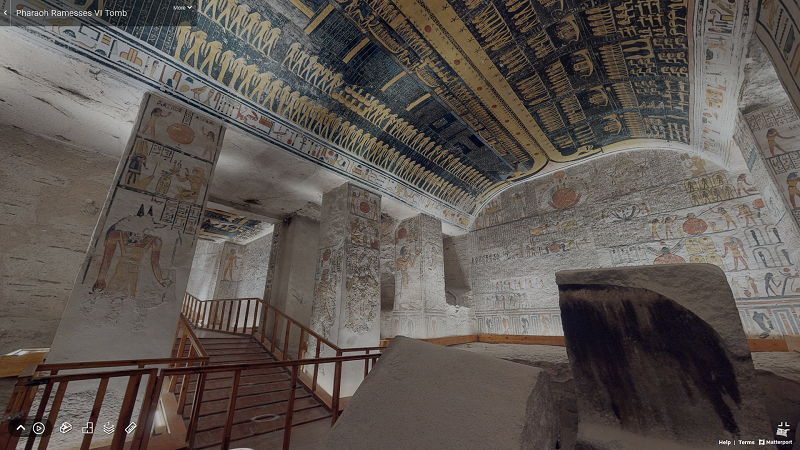
The Egyptian Tourism Authority has released an amazing virtual 3D tour of the tomb of Pharaoh Ramesses VI. Known as Tomb KV9 or Tomb of Memnon, it’s located in the east Valley of the Kings. Ramesses VI ruled during the 20th dynasty (mid to late 12th century BCE).

Matterport Ramesses VI Tomb KV9 Corridor

There are a couple of different views to play with, plus a highlights tour.

Matterport Ramesses VI Tomb KV9 Dollhouse View

Some modern amenities like wooden walkboards, handrails, and electric lights are visible, but the additions are reasonably unintrusive. You start on floor 3 and make your way down the long ramp to floor 1.

Matterport Ramesses VI Tomb KV9 Burial Chamber

It really is quite breathtaking! The screencaps above can’t really adequately capture the ambience.

Visit the tour for the full experience!

Found via Colossal.

Images: screencaps of the virtual 3D tour via Matterport

Out There is an occasional feature highlighting intriguing art, spaces, places, phenomena, flora, and fauna.

The First Villeneuve Dune Trailer Is Out

The first trailer for director Denis Villeneuve’s Dune is making its rounds, and it sure looks shiny:

Dune Official Trailer by Warner Bros. Pictures on YouTube

We don’t see many women doing much of anything, just standing, staring, emoting, and kissing, which is complete, utter, and total hooey compared to the book; I hope it’s just a case of trailers always lie.

At least Mother Gaius Helen Mohiam is prominently monologuing, but we hear nothing of Lady Jessica or Chani. As Charlotte Rampling is playing the Mother, Rebecca Ferguson Jessica, and Zendaya Chani, I have no doubt we’ll see stellar performances for the main female roles.

Timothée Chalamet plays Paul. I’ve only seen him as Laurie in the newest Little Women (2019, directed by Greta Gerwig) and apparently in Interstellar; I didn’t like his version of the former and remember nothing of the latter, so he’s a big unknown as far as I’m concerned. I saw someone critique him as being an okay choice for young Paul at the beginning but not having enough gravitas (to paraphrase) for the older Paul Muad’Dib. Plausible, I agree; I guess we’ll have to wait and see.

Oscar Isaac I’m looking very much forward to, if for nothing else then to see whether he has the range to play Duke Leto. Stellan Skarsgård, Javier Bardem, and David Dastmalchian I would also expect to do just fine if not directed to be too hammy. But the rest… Well. I get that Jason Momoa, Josh Brolin, and Dave Bautista are big names, but I find them uninspiring choices. Again, I guess we’ll have to wait and see.

I’ve also seen the two previous big screen adaptations (the 1984 movie directed by David Lynch and the 2000 miniseries directed by John Harrison). Both had some flaws that to me weighed the adaptations down more than the positives could buoy them, so I’m looking forward to Villeneuve’s version. It certainly looks gorgeous.

At the same time, I agree with an online contact who elsewhere said that they’d like something that’s more relevant to 2020s than to the time the story was written (1965).

At this writing, Dune is set to be released on December 18, 2020.

I doubt we two will see it in the theater unless there’s significant improvement in the local covid-19 numbers, so I’m hoping for an early release to either streaming services or disc.

Hey, look! We found a thing on the internet! We thought it was cool, and wanted to share it with you.

Artemisia: Between Greece and Persia

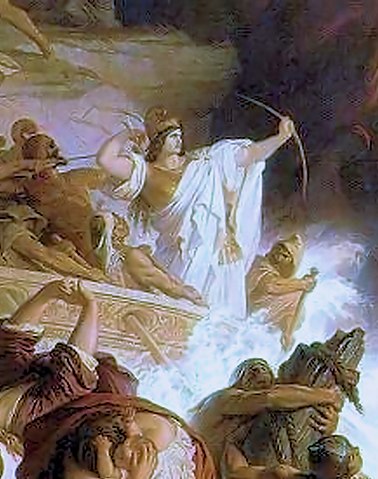
We know little about the life of Artemisia I (early 5th c. BCE – ca. 460 BCE) apart from one event, but that event and her participation in it give us a valuable insight into how Greeks lived at the frontiers of the Persian Empire.

Artemisia was the daughter of Lygdamis I, the first satrap of the city of Halicarnassus under Persian rule. Halicarnassus was a city on the coast of Anatolia, modern-day Turkey, one of many culturally Greek cities on the eastern shore of the Aegean Sea in the region more broadly known as Ionia. Like other such cities, Halicarnassus’ population was a mixture of local peoples—mainly Carians from the surrounding mountains, in the case of Halicarnassus—and the descendants of Greek settlers and merchants who had migrated to the Anatolian coast over several centuries. Artemisia’s family was a product of such interactions, as her father, Lygdamis, was of mixed Greek and Carian ancestry, and her mother was from Crete.

Lygdamis passed his power down to Artemisia’s husband, of whom we know nothing else except that he died soon thereafter, and Artemisia herself came to power in his place, probably acting as regent for their young son Pisindelis. Artemisia ruled Halicarnassus as a satrap, or local governor, on behalf of the Persian kings. Her most famous deeds came in this role.

When the Persian king Xerxes mounted his invasion of Greece in 480 BCE, he called upon the Ionian Greek cities to furnish warships for the campaign. Despite Athenian efforts to persuade the Ionians to defect or hold back in the fighting, Ionian Greek ships and their crews participated eagerly in the Persian invasion.

As satrap of Halicarnassus, Artemisia had the responsibility to furnish her share of ships for the fleet, but she went even further, personally commanding her own contingent and serving Xerxes as an adviser during the campaign. The historian Herodotus describes her this way:

She led the forces of Halicarnassus, Cos, Nisyurs, and Calyndus, crewing five ships. Of all the ships in the fleet, besides the Sidonians, hers were considered to be the best, and of all the allies she gave the king the best advice.

– Herodotus, Histories 7.99

(All translations my own)

Herodotus credits Artemisia with an exceptional display of skill and cunning in the midst of the Persian naval defeat at the battle of Salamis:

I cannot say exactly how any other ship, whether Greek or barbarian, did in that battle, but this is what happened to Artemisia and won her even greater respect in the eyes of the king. The Persian fleet was in chaos and an Athenian ship was bearing down on Artemisia’s. There was nowhere for her to flee to since her ship was hemmed in by friendly ships and close to the enemy lines, so she made a decision which turned out very well for her. Pursued by the Athenian, she rammed a friendly ship at full speed. This ship was crewed by the Calyndians and carried not only many Calyndian men but also their king, Damasythimus. I cannot say whether there had been some quarrel between Artemisia and Damasythimus when they were stationed at the Hellespont, or if she had planned to attack him, or if it was just by chance that the Calyndian ship was nearby. In any case, when Artemisia rammed and sank that ship it turned out well for her in two ways. In the first place, when the Athenian captain saw her ship sink one of the barbarians, he thought she was either on the Greek side or was coming over to their side, so he broke off and turned his attention elsewhere, and so she got away. In the second place, even though she was doing harm to his own fleet, she won high praise from Xerxes.

They say that as the king was watching the battle and saw her ship ram the other one, someone by his side said: “My lord, do you see what a good fight Artemisia is putting up and how she has sunk one of the enemy’s ships?”

The king asked it if was really Artemisia and the bystander confirmed it, since he knew the markings of her ship well and assumed that the ship she destroyed must be an enemy. As I said, all this turned out to her benefit, since no one from the Calyndian ship survived to accuse her.

In response to this observation, it is reported that Xerxes remarked: “My men have become women, and my women have become men!”

– Herodotus, Histories 8.87-89

Artemisia displayed similar shrewdness when, after the defeat of his fleet, Xerxes consulted his advisers on how to continue the war in Greece. When the general Mardonius offered to remain in Greece and keep fighting while Xerxes himself returned to Persia, Artemisia offered this advice:

When consulted on the question of what to do, Artemisia said: “Sire, it is hard to give good advice in such a case, but what seems best to me is for you to march home and leave Mardonius and whatever troops wish to remain with him here, if he is willing to undertake this task. If Mardonius is successful and accomplishes what he says he can, the credit for it will belong to you, since he is your servant. If he is wrong and things go against him, it will be no great disaster for you and your house. As long as you and your line endure, the Greeks will often face great struggles, and no one will much care if anything happens to Mardonius, nor will defeating your servant count as a great victory for the Greeks. You, however, will depart having accomplished what you set out to do, which was to burn Athens.”

Xerxes was delighted with this advice, since he had been thinking exactly the same thing. He was gripped with such fear that he would not have stayed in Greece even if all the men and women in the world had recommended it. He thanked Artemisia for her advice and entrusted her with taking his children to Ephesus, since he had some of his illegitimate children with him.

– Herodotus, Histories 8.102-103

Now, Herodotus—a fellow Halicarnassian—may be accused of partiality and playing up Artemisia’s involvement in the war effort, but the kinds of deeds he attributes to her are telling. Artemisia was actively engaged in Xerxes’ war, but she was also politically canny and willing to seize her own advantage when it came. Given the opportunity to demonstrate her utility to the king, she took it and personally led her forces as part of the Persian fleet. Finding herself in a difficult position in battle, she saved herself at the cost of a friendly ship. When consulted for her advice, she told the king what he wanted to hear and was rewarded with an important commission.

Many Greeks were in positions like Artemisia’s when it came to the Persian Empire. Persia was large, powerful, rich, and right at the Greeks’ doorstep. Persia was a huge market both for Greek exports and for the services of Greek artists, crafters, and mercenaries. For all that historians have tended to celebrate the Athenians and Spartans for resisting Persian invasions in 490 and 480-479, far more Greeks worked for the Persian kings than ever fought against them.

The boundary between Greece and Persia was porous. Many people went back and forth across it as their own interests dictated. While modern narratives have tended to paint the division between Greece and Persia in stark terms, the reality was much more gray than black and white. Not everyone who negotiated the space between Greece and Persia did it with the skill and panache that of Artemisia, but she was far from alone.

Image: A modern artist’s impression of Artemisia, detail from “Die Seeschlacht bei Salamis” via Wikimdeia (Maximillianum, Munich; 1868; oil on canvas; by Wilhelm von Kaulbach)

History for Writers looks at how history can be a fiction writer’s most useful tool. From worldbuilding to dialogue, history helps you write.

Rating: Castle, Season 8

The eighth and final season of Castle, sadly, is a bit of a flop. Here’s our rating for this season’s episodes:

  1. “XY” – 1.5
  2. “XX” – 0
  3. “PhDead” – 4
  4. “What Lies Beneath” – 5
  5. “The Nose” – 5
  6. “Cool Boys” – 3
  7. “The Last Seduction” – 6.5
  8. “Mr. and Mrs. Castle” – 3
  9. “Tone Death” – 8
  10. “Witness for the Prosecution” – 6.5
  11. “Dead Red” – 7.5
  12. “The Blame Game” – 4.5
  13. “And Justice for All” – 6
  14. “The G. D. S.” – 3
  15. “Fidelis ad Mortem” – 4
  16. “Heartbreaker” – 4
  17. “Death Wish” – 4.5
  18. “Backstabber” – 3.5
  19. “Dead Again” – 8
  20. “Much Ado About Murder” – 5
  21. “Hell to Pay” – 5
  22. “Crossfire” – 1.5

This season’s average is 4.5, the lowest of any season of Castle, and the problems are not hard to spot. Squeezed between the attempt to wring just a bit more drama and action out of some old and used-up plotlines (the conspiracy around Beckett’s mother’s murder gasps its last; intrigue shenanigans throw Castle and Beckett’s relationship back into will-they-or-won’t they spasms) and the introduction of new characters and story ideas that don’t get room to develop (Hayley Shipton, a British ex-spy who gets caught in the orbit of Castle’s expanding private investigator business), there just isn’t much room for this season to stretch its legs.

Shake-ups in the production also mean we lose Captain Gates and don’t see much of Dr. Parish, two of our favorite side characters. There were even rumors going into this season that Beckett might not return, which would have been disastrous. Fortunately, that didn’t come to pass, but Beckett spends so much time this season angsting about the conspiracy-that-will-not-die and her relationship with Castle, we lose a lot of the spark she used to bring to the series.

The bottom of the barrel this season comes with the opening two-parter, “XY” (1.5) and “XX” (0), in which we separately follow Beckett on the run from the endless conspiracy and Castle trying to find her. The conspiracy episodes of Castle never work well for us, and this one feels particularly like a desperate attempt by the writers’ room to concoct another arc story, having done several to death already. There was a time when continuity between episodes was a rarity on tv and arc stories were new and exciting. Now every series has an arc, and we’re more excited to see standalone episodes that have a satisfying beginning, middle, and end.

Fortunately, this season hasn’t entirely lost the Castle magic, and we do get a few good old quirky murder-of-the-week episodes. The two best of this season, both at 8, are of this kind; “Tone Death” takes the team into the seamy underbelly of competitive a capella singing, and “Dead Again,” about a safety inspector who keeps surviving what should be fatal attacks, prompting Castle to wonder whether they’ve stepped into a superhero’s origin story. These episodes have the fun mystery caper action we expect from the series.

It’s not the best way to close out the series, but it seems like the production had some troubles behind the scenes at the end. We can be glad for the good episodes we did get this season, even if it’s one we’ll only be rewatching selectively.

Image: Beckett and the boys, from “Tone Death” via IMDb

In the Seen on Screen occasional feature, we discuss movies and television shows of interest.

A Helsinki Location in The Last of Us Part II Cover Version

Game Music Collective is a Finland-based orchestra, band, and studio production company lead by cellist Lukas Stasevskij. As the name implies, they produce and perform game and other soundtracks.

Their latest project is a cover version of Ellie’s song “Through the Valley” from the PlayStation4 game The Last of Us Part II. The music video for the cover was filmed in Helsinki, Finland.

THE LAST OF US 2 OST – Through the Valley REAL LIFE ELLIE’S SONG [4K] Shawn James Guitar Cover(2020) by Game Music Collective on YouTube

The original song was written by Shawn James; the Game Music Collective version features Mokka Laitinen (vocals and guitar), Sujari Britt (cello), Leonardo Carrillo (oboe), and Eeti Nieminen (drums).

Pretty neat, isn’t it? (Although strictly speaking I would’ve been happier to see outdoor locations, too.) #FinlandNerd 🙂

Found via Helsingin uutiset (NB. Finnish only).

An occasional feature on music and sound-related notions.