Hugo Voting, “Good” Stories, and Politics

I just submitted my Hugo ballot for 2015. We’ll know soon enough who won what. We’ve had months of online arguing about who should win and why, and I’m sure we’ll soon have months of arguing about who won and why, and if you’re at all like me, you’re sick to death of the whole business. So, I’m not going to talk about who I voted for or why I think they should win. Instead, I want to talk about two ideas that have arisen from the conversations that have unfolded around the Hugos this year. Both have to do with how we evaluate stories and both, I think, are founded in misguided ideas about what a story is.

The ideas I’m talking about are:

1. “We should vote for stories that are good, not just the ones we like”

Most of the time, I like things because I think they are good and I think things are good because I like them.

There’s some slippage around the edges. There are some things that I can see are technically well executed, but that I don’t enjoy (The Hunger Games, the rebooted Battlestar Galactica), and there are some things I enjoy despite their technical failings (early-season Star Trek: The Next Generation, The Princess Bride). For the most part, though, the overlap between “stuff I like” and “stuff I think is good” comes pretty close to 100%.

There is no objective standard of what makes a story “good.” You can’t measure and quantify it. There are things that a lot of people agree on about what makes for a good story, but subjectivity in large amounts is not the same as objectivity. Lots of people think that Ender’s Game is a great work of science fiction, but in the end all that means is that lots of people like it.

Calling on people to vote for stories that are “good” is meaningless. If nothing else, the controversy around this year’s Hugo nominees has been an excellent demonstration of the fact that we all have different definitions of what good means. We vote for the stories we like because those are the stories we think are good. The winners will be the stories that the greatest number of people liked, and that’s all there is to it.

2. “We shouldn’t judge a story on whether we agree with its politics or not”

As one of my college writing teachers told us: “A story is an experiment in moral physics.” At the core of a story, any story, is an idea about how the world does, could, or should work. You can call that politics or a message, but all it is in the end is an idea, and an idea that shapes how the world of a story works and how its characters interact with one another is just as integral to that story as any other element.

It is just as legitimate to judge a story on its ideas as on its plot, characters, dialogue, or any other element. A vital part of what make so many of us love, say, The Lord of the Rings is the idea that doing the right thing matters, even when it seems like no one will ever notice or care. Without that guiding idea, the story would not be at all the same. When we are deciding whether we like a story or not, we cannot take the ideas of that story out of the picture and it would be a mistake to try.

And that is all I have to say about the 2015 Hugos. You pay your money and you cast your vote. We’ll see the results soon enough.

Story Time is an occasional feature all about stories and story-telling. Whether it’s on the page or on the screen, this is about how stories work and what makes us love the ones we love.
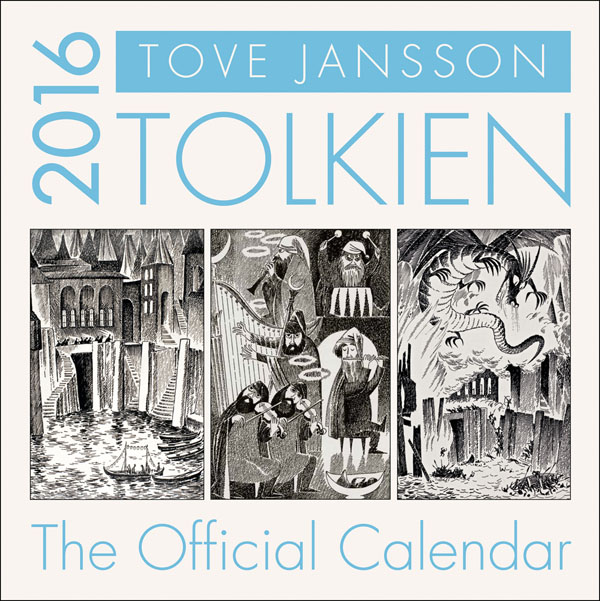
2016 Tolkien Calendar Illustrated by Tove Jansson

According to The Tolkien Society, the Official Tolkien Calendar for 2016 will be released tomorrow, July 30, 2015. The calendar is illustrated by Tove Jansson, a Finnish visual artist and author.

Tolkien Calendar 2016. HarperCollins.

Jansson (1914-2001) is best known as the creator of Moomins. However, she also illustrated Swedish translations of The Hobbit and Lewis Carroll’s The Hunting of the Snark and Alice’s Adventures in Wonderland. Some of these illustrations were later used in Finnish translations.

Jansson's illustrations for early Swedish and Finnish translations of The Hobbit. The estate of Tove Jansson, via Tolkien Library.
Jansson’s illustrations for early Swedish and Finnish translations of The Hobbit. The estate of Tove Jansson, via Tolkien Library.

The publisher’s description of the calendar reads:

“Jansson illustrated The Hobbit in 1961 for the Swedish and Finnish editions, creating a dozen enchanting full page drawings plus many smaller vignette pieces. Never before published in an English-language edition, the 2016 calendar contains all twelve of these illustrations, many of the vignettes, and a full-colour centrefold featuring her dramatic cover painting of Smaug attacking the Dwarves. The calendar is introduced by Tolkien expert and author Brian Sibley, who corresponded with the artist and provides insightful commentary regarding the genesis of the illustrations and Jansson’s tireless work continuing to build the world of The Moomins. The Official Tolkien Calendar has been an established publishing event for Tolkien fans and Hobbit collectors for the last four decades, and the 2016 edition will continue to delight and surprise.”


Recommended Reading: Herodotus, “The Tale of the Clever Thief”

150727ringWe learn to write by reading, and so I’d like to share with you some of the works of classical literature that have inspired me as a writer. There’s no better place to start than with the Greek historian Herodotus. Herodotus’ Histories is my favorite book of all time. I re-read Herodotus like some people re-read Tolkien. “The Tale of the Clever Thief” (that’s my own name for it; Herodotus didn’t give that particular story a name of its own) is one of the most delightful parts of the work.

Herodotus is popularly known as the Father of History. He is also known as the Father of Lies. Both titles are appropriate. Herodotus was the first (surviving) author in the western tradition to write about the past in terms of human actions and motivations, not the deeds of gods and heroes. He was also a storyteller who enjoyed spinning a good tale, even if he didn’t think it was true (and some of the things he did think were true are pretty outrageous).

Continue reading

Parody Movie Trailer: The Greenlighter

This trailer for the imaginary superhero movie The Greenlighter by Above Average is definitely onto something:

Marvel’s First Female Superhero Movie: The Greenlighter by Above Average

Agreed – it shouldn’t be hard at all to write a superhero movie starring a woman. Except, you know, while you’re at it, have more than one. Mad Max: Fury Road did it just fine.

Hey, look! We found a thing on the internet! We thought it was cool, and wanted to share it with you.

Q&A: Which Starship Would You Command

Quiz time! We took the Which Starship Would You Command quiz. Here are the results:

1) What do you think is the most important quality or feature for a starship?

Erik: Ability to withstand powerful forces [‘Cause, you know, I bet there’s a lot of those in space.]

Eppu: A good collection of scientific instruments, weapons, and engineering tools. [Be prepared! Things are going to break, and in space you want to be very, very prepared when something breaks.]

2) What kind of crew would you want to have on your starship?

Eppu: I’d like a well-balanced crew on my ship; diplomats, security experts, scientists, doctors, etc. [Again, be prepared!]

Erik: A family of versatile and multi-talented members with a strong purpose. [I figure being versatile with a strong sense of purpose is important if you’re in danger of being stranded millions of light years out in space.]

3) Pick a vehicle.

Green compact carErik: Green compact car. [It’s cute!]

Eppu: Same [A good-enough compromise between looks and utility; also, I don’t need that question answered.]


4) You’re out exploring space, when you come across a ship belonging to a new alien species you’ve never encountered before. What would you do?

Eppu: Stealthily observe them from afar to determine if they’re hostile before opening communications. [I guess one of these days I’ll find myself in a “bath” that’s getting hotter in minute increments… 😉 ]

Erik: Same [I don’t like talking to people to begin with. Even more so if they’re hostile.]

5) You’re out patrolling the stars when you get a distress call from a civilian freighter that has been damaged somehow and drifted into the territory of a hostile, angry alien race. They’re asking for help. What do you do?

Erik: Approach the border cautiously, broadcasting to the hostile alien empire that we come on a mission of mercy. [But if I have to deal with hostile folks I’m going to let them know that I’m not here to cause trouble.]

Eppu: See if there’s any way I can quietly and sneakily cross the border to try and reach the freighter. [Quick, before the hyena come!]

6) Pick which uniform you’d like your crew to wear.

Han Solo's outfitEppu: Han Solo’s outfit [‘Cause pockets! This is a pet peeve of mine. We’ll need pockets in the future, too. So many sci-fi outfits are ridiculously lacking in practical details.]


Battlestar Galactica uniformErik: Battlestar Galactica uniform. [Eh. What can I say? I’m a sucker for a nice sash.]


7) What kind of captain would you like to be?

Erik: Wait, lead? I’m in charge? Whose idea was that? [I’m like the guy who sits three chairs down from the navigator in the staff meeting and has one line explaining why the people on this planet are offended by the color orange. Don’t put me in charge of nothin’.]

Eppu: Same [Uhh…]

8) Pick a color scheme for your ship’s hull.

Grey, subtly pixelatedEppu: Grey, subtly pixelated [In space, no-one can hear you complain about hull color.]


Grey with bright stripeErik: Grey with bright stripe [Ooh, it’s so shiny and spacey!]


9) Pick a bridge.

Traditional Far-Eastern bridgeErik: Traditional Chinese bridge. [It’s elegant and tranquil. I go for that.]


Gracefully curved bridgeEppu: Graceful curves and loop at one end [Loop-de-doo!]


10) You receive a communication from an off-world colony, which says they’ve encountered a new life form and would like you to assist. What would you do?

Eppu: I’d bring a science team to investigate the new life form. [No word on danger, so study it is!]

Erik: Same. [Because that’s what I do: I investigate the heck out of things.]

So, apparently we both would command…

USS Enterprise D

USS Enterprise D. “Let’s see what’s out there.”

Q&A is an occasional feature in which we share our responses to quizzes, questions, and quirky ideas for your entertainment.

Solid Centers and Fuzzy Edges

150730SapphoThis is not the post I had intended for today. When I started working on this one, it was about some of the different ways of organizing basic labor that have existed in history, from slave gangs to independent peasant farmers. As I kept working on it, I found that I had more to say about slavery, especially in light of the public dialogue that has been happening in the United States lately surrounding symbols of the Confederacy. So I started working on a post specifically about slavery in historical context, but as I tried to write that post, it became clear to me that there is an even more fundamental issue in historical interpretation I needed to talk about, something that applies not just to slavery but to almost every historical phenomenon. It is so universal that we don’t really have a standard vocabulary for talking about it. You could call it variability, or you could call it norms and exceptions, but I prefer to think of it as solid centers and fuzzy edges.

Continue reading

Do-It-Yourself Fantasy Place Name Generator

Writing a fantasy story or role-playing scenario? Need to come up with names for towns, rivers, mountain ranges and so on, but tired of thinking up new names all the time? Here’s a handy technique I use. It takes a little work up front, but then it makes coming up with new names really easy.

The thing about place names is: when you dig down deep into their meaning, they’re usually really obvious and descriptive. It’s only time and language change that obscures their meaning.

Look at a map of Europe and you’ll find Copenhagen (“merchant harbor”) and Dublin (“black pool”). In Asia there’s Shanghai (“above the sea”) and Samarkand (“stone fortress”). The same applies to the native names anywhere else in the world. In places that have experienced substantial colonization, the conquerors often imported old names that didn’t relate to the landscape (New York, Wellington), but in other cases the new names given by colonizers were just as descriptive (Cape Town, Salt Lake City).

The reasons for this naming pattern are fairly straightforward. If you live in a landscape where there are several rivers, but only one of them is muddy, or plenty of mountains, but there’s a big one with no trees on top, when you need to refer to that river or that mountain, you’re likely to say: “the black river” or “the bald mountain.” From there it’s only a short step to calling them “Black River” and “Bald Mountain”. As time goes on and language changes, place names tend to become fossilized and preserve older variants and meanings that the rest of the language has left behind.

So, put these facts to work for you. When you’re setting up your map, generate a list of place name elements and then you can quickly combine them to make new names for whatever you need.

Here’s how it works:

Continue reading

Fan-Made Boba Fett Short

Can’t wait for Star Wars: The Force Awakens to come out? Apart from the material shared at San Diego Comic Con, the short fan film Boba Fett – The Twelve Parsec Stare should help.

The story, produced and filmed entirely in Helsinki, Finland, has Boba Fett tracking down a specific bounty on Tatooine. There is no (human) dialogue, but oodles of Italo-Western action shots and scruffy Mos-Eisley crud. Director Eric Raunio surely knows his stuff. Also composer Juho Pakkasvirta does a fantastic job, not forgetting to spoof the “Imperial March” or “The Good, the Bad and the Ugly” theme. 🙂

Raunio tells Nyt1 [NB. Finnish only] that the two-day shoot at Kaapelitehdas in February 2015 followed a few months’ intense pre-production. Sets, costumes, and props were built from everyday items and thrifted / upcycled finds under the direction of producer Teemu Vainio. Boba Fett fans may also be interested in the two behind-the-scenes production diaries (1, 2).

The indie company behind the short, Ruined Films, is headed by Raunio, and produces not only their own films but also promotional videos and provides post-production for outside projects.

1 Nyt is the weekly supplement of Helsingin Sanomat newspaper, the largest daily newspaper in Finland.

Hey, look! We found a thing on the internet! We thought it was cool, and wanted to share it with you.