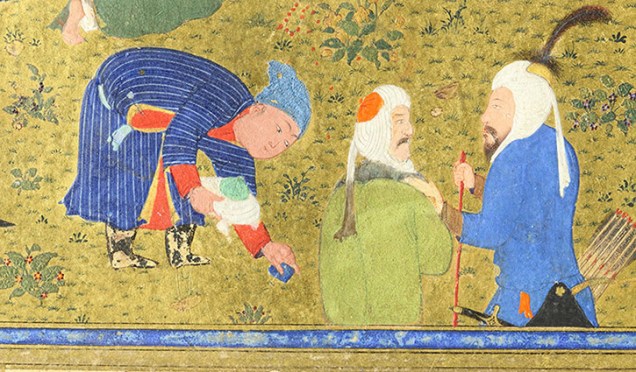
Two Black Amazons from 1400s

Oh, goodness! An illumination from a 15th-century French manuscript shows two black Amazons. Have a look:

Le secret de l'histoire naturelle fol 2r Cropped
Le secret de l’histoire naturelle, France, ca. 1480-1485, BnF, Français 22971, fol. 2r; via discarding images on Tumblr.

This image has clearly been cropped and edited. My source, discarding images on Tumblr, says the two women are Amazons but gives no more details.

Being an early history nerd, I did some additional digging. Below is the whole page via Gallica, the digital library for the national library of France (Bibliothèque nationale de France, or BnF).

Le secret de l'histoire naturelle fol 2r Full Page
Le secret de l’histoire naturelle, France, ca. 1480-1485, BnF, Français 22971, fol. 2r.

The full title of the manuscript is Le secret de l’histoire naturelle contenant les merveilles et choses mémorables du monde. It was created between 1401-1500, and is currently stored at BnF. The illumination comes from the first part of the book, which presents the great countries and the great provinces of the old world.

Unfortunately, my French isn’t good enough anymore to be confident in my reading; I can understand a word here and there, but not the whole. However, it does look like the first word below the illumination is Amazon.

I’ve cropped into a separate image the bottom left corner of the illumination with the text following immediately after it:

Le secret de l'histoire naturelle fol 2r Amazons
Le secret de l’histoire naturelle, France, ca. 1480-1485, BnF, Français 22971, fol. 2r; cropped.

I just cannot make out the full spelling of the first word due to the ligatures that squish up the last two or three letters. It definitely looks like it’s inflected, though. The sequence ma definitely follows the capital A, with most likely a z and o further along.

It also looks there’s a sigil marking an abbreviation on top of the o, which was very common in handwritten Medieval documents to mark inflectional endings, among others. (Unless it’s a diacritic like in modern French – were they even used in Medieval French? If so, maybe Amazonye? Amazònye? Amazónye?? Amazônye???)

Anyway, it seems that Amazons are indeed talked about on the same page. The larger block of text above the illumination mentions the word affricà, too. (Again, not sure whether that’s a sigil or diacritic on the final a.)

In any case, if the two women aren’t Amazons, at the very least they are heralds of some sort leading a column of warriors. The image details, like the mi-parti dresses, are really neat, too.

Found via MedievalPOC on Tumblr.

And speaking of MedievalPOC, I’ve found it a truly valuable source for types of art imagery that’s not usually included in the canon from the Middle Ages onwards. The site is sometimes a little too interesting: on several occasions, I’ve spent much longer than intended there, happily chasing intriguing details down the rabbit hole. If you’ve got the time to spare, I wholeheartedly recommend it. 🙂

P.S. You can also follow MedievalPOC on Twitter. Happy browsing!

This post has been edited.

Hey, look! We found a thing on the internet! We thought it was cool, and wanted to share it with you.


Cheddar Man: A European Mesolithic Male with Blue Eyes and Brown Skin

I saw these headers go by earlier this spring, but didn’t really have time to really dive into it until now. Well, better late than never, as they wisely say. 🙂

Despite the name, the Cheddar Man isn’t some silly cheese ad bloke. Instead, he has opened doors to very intriguing discoveries about European population during the later Stone Age.

The remains of an anatomically modern human male from about 10,000 years ago were found near Bristol in Gough’s Cave in Cheddar Gorge, Somerset, England in 1903. Recent DNA analysis of the skeleton—Britain’s oldest (almost) complete one—suggests that he had blue eyes, dark curly or wavy hair, and dark brown to black skin.

Natural History Museum Tom Barnes Cheddar Man Bust Closeup

They also found that the Cheddar Man belonged to the same population as Mesolithic individuals whose bones were recovered from Spain, Luxembourg, and Hungary, usually referred to as western European Mesolithic hunter-gatherers or European early modern humans.

Hannah Devlin at The Guardian writes most aptly:

“The discovery shows that the genes for lighter skin became widespread in European populations far later than originally thought – and that skin colour was not always a proxy for geographic origin in the way it is often seen to be today.

“Tom Booth, an archaeologist at the Natural History Museum who worked on the project, said: ‘It really shows up that these imaginary racial categories that we have are really very modern constructions, or very recent constructions, that really are not applicable to the past at all.’”

A new bust model of Cheddar Man was made by Kennis & Kennis Reconstructions. (See a photo of the previous model made by a team at the University of Manchester here.) They took measurements of the skeleton, scanned the skull, and 3D printed a base for their model. Then they applied certain conventions to shape the face.

I fully confess I’m having a hard time keeping track of the exact timespans and geographical limits of the various Stone Age eras in Eurasia and Africa—what’s paleolithic, mesolithic, or neolithic and where and at what time. But it is so fascinating (and delightful!) that we continue to develop new methods of finding more about our past, and that so many different disciplines seek to understand where we came from and what makes us tick.

Image: closeup of the model of Cheddar Man by Tom Barnes / Channel 4 via Natural History Museum, London

Christopher Robin Trailers with Thoughts on Gender

The movie Christopher Robin opens in a week, on August 03, 2018.

Here’s a trailer from the end of May:

Christopher Robin Official Trailer by Disney Movie Trailers

And a sneak peek from July:

Christopher Robin “Adventure” – Sneak Peek by Disney Movie Trailers

I remember liking Nalle Puh stories (as they were translated into my native language) quite a bit, so I wonder what my reaction to the voice acting will be, since I didn’t grow up thinking of the characters in terms of gender.

You see, Finnish does not have grammatical gender at all; we only have gender-neutral third-person pronouns (singular hän or plural he). This means that for me the only explicitly female character in the gang was Kengu because she was a mother, and the only explicitly male character was Risto Reipas because he was a human boy. The others were their own individual, quirky, stuffed-animal selves.

I guess the closest I can come is associating the stuffed animal characters with the non-binary gender identity. They didn’t need categorization into male or female, because that’s not how I saw their world working. I still don’t, even though talking about them in English forced me to learn which pronouns English associates with each.

It’s fascinating to notice myself using gendered English-language pronouns and yet at the same time still thinking of the stuffed animal characters as not fitting into those divisions. Eating too much honey and getting stuck in someone’s doorway, or figuring out that a popped balloon and an empty jar of honey go splendidly together do not require the gendering of anybody in the story.

I really do wonder how my perception changes after hearing voice actors and their intonational choices—or whether it will change at all.

Hey, look! We found a thing on the internet! We thought it was cool, and wanted to share it with you.
Quotes: Violence Is a Tool That … Begs You to Use It Again and Again

“Violence is a part of our trade, yes. It is one tool of many. But violence is a tool that, if you use it but once, it begs you to use it again and again. And soon you will find yourself using it against someone undeserving of it.”

– Ashara Komayd, former operative for and prime minister of Saypur in City of Miracles by Robert Jackson Bennett

Yup. I’ve been thinking along similar lines with regard to the racism in the U.S. and the ridiculous, racist non-reasons some racist-ass whites justify their calling of police on people of color, especially blacks. It’s racist, wasteful, racist, reprehensible, racist, entitled, racist, cruel, racist, wrong, and racist. It has to stop.

Bennett, Robert Jackson. City of Miracles. New York: Broadway Books, 2017, p. 177.

Serving exactly what it sounds like, the Quotes feature excerpts other people’s thoughts.

Faves from a List of Upcoming Female-Lead Action Movies

Jordan Crucchiola at Vulture listed and tracked every upcoming female-lead Hollywood action movie. It’s divided into sections so that it’s easy to see what’s in development, in production, and postproduction (or coming soon).

IMDB Widows Photo

It’s an impressive list. (I wish its scope were wider, though—gimme other genre subtypes, too, and productions from around the world, please?)

Below are a few of the ones that most tickle my fancy, with first a short description by Crucchiola and then my impressions.


The Aeronauts (preproduction)

  • “Eddie Redmayne and Felicity Jones star as a researcher and pilot team that goes on a science mission in a hot-air balloon. They ascend higher than anyone ever has, and have to fight for survival in the thinning atmosphere.”
  • Apparently set in the mid-1800s, this sounds like a non-mystery precursor to Murdoch Mysteries. I like Felicity Jones a lot, but am dubious of Amazon productions (mostly since I haven’t seen any so far, so take this with a bucket of salt).

A Black Widow stand-alone movie (screenwriter attached)

  • “It was announced earlier this year [2018] that Kevin Feige and Marvel had hired a writer for a Black Widow stand-alone screenplay.”
  • High time!

Captain Marvel (postproduction; U.S. release March 08, 2019)

  • “Marvel’s first female-lead superhero movie stars Brie Larson as Carol Danvers, a.k.a. Captain Marvel, an extremely powerful figure in the comics canon. We don’t know much—except that it’s set in the 1990s […].”
  • Again, high time! (According to Wikipedia, Captain Marvel has been in development since 2013.) I know extremely little of the character, but liked Brie Larson in Kong: Skull Island and Community.

Cleopatra Jones (in development)

  • “Details about the new film are not yet known, but in the 1973 original, Cleopatra Jones was a James Bond-type who worked as a special agent for the U.S. government and dealt with drug-related crimes.”
  • A reboot, although nothing I’ve heard of before. Hm. Maybe?

Enola Holmes (just announced at the start of the year)

  • “[A]daptation of Nancy Springer’s Enola Holmes Mysteries novel series. Enola is the baby sister of Sherlock and Mycroft Holmes, and wouldn’t you know it, a crack sleuth in her own right.”
  • Yes, please! Even more so, since Millie Bobby Brown (who outshone everyone else in Stranger Things) is set to star in and produce.

The Killer (in development)

  • “An assassin with a strict moral code can no longer abide the amoral ways of her employer, and so seeks to get out of the game.”
  • This might be amazing: John Woo is set to direct a reboot with Lupita Nyong’o in the head role.

Star Wars Episode IX (preproduction but definitely happening; U.S. release December 20, 2019)

  • “Star Wars remains an ensemble-powered saga, but this trilogy has always been about Rey’s journey.”
  • Yay! I’m just so sad we can’t have Carrie Fisher in it!

Widows (postproduction; U.S. release November 16, 2018)

  • “Brace yourself for this screen adaptation of a British mini-series from 1983, in which four widowed women plan to finish a heist job their dead husbands failed to complete.”
  • Ocean’s 8 was a great heist movie with a fantastic spread of women of all sorts (except the law-abiding type, heh heh) so this might be good, too.
  • Of the female cast, I recognize only Viola Davis (who’s awesome!); of the male, Collin Farrell (a meh performance in the 2012 Total Recall reboot and a suitably psycho Bullseye in the 2003 Daredevil), Daniel Kaluuya (W’Kabi in Black Panther), and Liam Neeson (who’s a turnoff for me, but perhaps he’s only got a small supporting role).

Wonder Woman 2 (in development)

  • “The timeline will reportedly move into the ’80s for the Wonder sequel, with the Cold War and USSR factoring in. Jenkins has also teased another love story.”
  • Am I the only one who’s noticed an uptick in movies where Russia (in one of its embodiments) is a bad guy? But: puh-leeeease stop writing forced love interests in movies! Love is great, but we don’t have to have an example of romantic love in every. single. story. Some stories work better without it, or with other types of love than the romantic variety.


Image: photo from the movie Widows from Twentieth Century Fox Film Corporation via IMBD

In the Seen on Screen occasional feature, we discuss movies and television shows of interest.

Quotes: Finland Is Weird. Finland Is Different

I first became aware of Adrian Tchaikovsky when he won the Arthur C. Clarke Award in 2016. I’ve been meaning to check out his writing since then. Ironclads, a limited-edition hardcover novella, finally made it to the top of my TBR pile last month.

The novella was great in several respects, but I was especially tickled by the American POV character’s descriptions of Finland and Finns. For example:

“All the middle of Nordland is the bit we’ve got problems with, basically: Sweden and Finland, say the maps. Sweden is where the fighting is, and the other place… Finland is weird. Finland is different.“

– Adrian Tchaikovsky: Ironclads

The version of U.S. in the story is fighting in Scandinavia, and, due to having laxer laws on genetic modification, Finland apparently has become home to very interesting types of special forces.

But the best, the absolutely best detail is mentioned in this section:

Quotes Tchaikovsky Ironclads

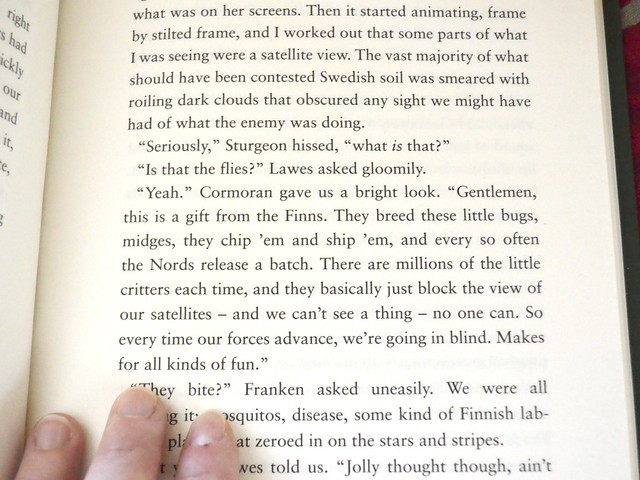
“[F]or a long time I couldn’t even work out what was on her screens. Then it started animating, frame by stilted frame, and I worked out that some parts of what I was seeing were a satellite view. The vast majority of what should have been contested Swedish soil was smeared with roiling dark clouds that obscured any sight we might have had of what the enemy was doing.

“’Seriously,’ Sturgeon hissed, ‘what is that?’

“’Is that the flies?’ Lawes asked gloomily.

“’Yeah.’ Cormoran gave us a bright look. “Gentlemen, this is a gift from the Finns. They breed these little bugs, midges, they chip ’em and ship ’em, and every so often the Nords release a batch. There are millions of the little critters each time, and they basically just block the view of our satellites – and we can’t see a thing – no one can. So every time our forces advance, we’re going in blind. Makes for all kinds of fun.’

“’They bite?’ Franken asked uneasily. We were all thinking it: mosquitoes, disease, some kind of Finnish labgrown plague that zeroed in on the stars and stripes.

“’Not yet,’ Lawes told us. ‘Jolly thought though, ain’t it?’”

– Adrian Tchaikovsky: Ironclads [original emphasis]

The militarization of mosquitoes! We already joke—as a way of dealing with an irritant that’s just a part and parcel of life—that mosquitoes are the Finnish air force. Finally, someone did it! 😀

It makes perfect sense in a world with aggressive biological research to turn a ubiquitous pest into an asset. Come to think of it, it sounds very much like the strategies that Finns used in the Winter War of 1939-1940 against Soviet forces—making native conditions work for you and against the enemy.

Of course, no one person can disapprove or approve of any characterization on behalf of their whole group. However, in My Official Opininon As a Finn, Tchaikovsky managed to balance well the view of Finland as part of Scandinavia with Finns being distinctly different from their Swedish, Norwegian, and Danish cousins. Also, he got so many little details right, like the way the Finnish language sounds, or our deep appreciation of nature.

I practically tore through the book. Kudos!

Tchaikovsky, Adrian. Ironclads. Oxford: Solaris, 2017, p. 22 and p. 29.

This post has been edited to correct a typo.

Serving exactly what it sounds like, the Quotes feature excerpts other people’s thoughts.

National Museums Scotland Online

National Museums Scotland have made their collections available online.

First, you can tour the National Museum of Scotland in Edinburgh through Google street view. Around 20,000 objects on display at the permanent galleries can be seen this way.

Google Arts National Museums Scotland Screencap

In addition, over 1,000 objects from the National Museums have been added to the Google Arts & Culture online collection. They are arranged in groups that work much like online photo albums. Clicking on an image opens a detailed view of that item with additional information.

Four separate museums form the National Museums Scotland: in Edinburgh, the National Museum of Scotland and the National War Museum, plus the National Museum of Flight in East Lothian and the National Museum of Rural Life in East Kilbride.

This is so great! I’ve been lucky enough to be able to visit the National Museum of Scotland in person, but that was years ago and I couldn’t get to everything I wanted to see. Now I can patch those holes in my not-quite-a-bucket-list. 🙂

Image: screencap from National Museums Scotland Google Arts & Culture webpage

Built-in Brick Space Invaders

When you really love a game: Klopper & Davis Architects in Perth, West Australia, built Space Invaders critters into the walls of this house. The critters are made with depressed brick, and appear both indoors and outdoors. Take a look:

Desire to Inspire florence_141

Desire to Inspire florence_231

Desire to Inspire florence_363

Not an easily DIY-able project, but very neat.

Found via Desire to Inspire. (Visit the DtI blog post for additional Space Invaders views!)

Images: Klopper & Davis Architects, via Desire to Inspire

In Here is an occasional feature highlighting geeky spaces created by our fellow geeks all over the world.

Gleaned from Bodleian Libraries Workshop on Ultramarine Blue

Did you know that the Bodleian Libraries at the University of Oxford have a Tumblr micro blog? I didn’t until just recently. And oh my, it’s a treasure trove!

Bodleian Libraries Ultramarine Young Man Blue Rock Bodl MS Elliott 287 fol34a

A short post gives a few tantalising details on lapis lazuli, the mineral that was ground down to get bright blue pigment for example for illuminating Medieval manuscripts:

“In his travels Marco Polo vividly described the cold province of Badakhshan, a prosperous land where horses that descended from Alexander’s horse Bucephalus were once bred and where priceless rubies and the finest lapis lazuli were found.

“Since ancient times lapis lazuli has been sourced in this remote region, north-east of modern Afghanistan, and exported over vast distances. Its mines on the steep Hindu Kush Mountains, above the Valley of the Kokcha River, can only be reached through a tortuous and dangerous route.

“Lapis lazuli consists of a large number of minerals, including the blue mineral lazurite, the white mineral calcite and golden specks of iron pyrites.

“A laborious process transforms this composite mineral into the pigment ultramarine; various grades of ultramarine can be obtained, from the purest extremely expensive deep blue, composed mostly of lazurite particles to the pale grey so-called ultramarine ash.”


Tumblr Bodleian Libraries Ultramarine Workshop Screencap

The conservators at Bodleian (Anita Chowdry, David Margulies and Marinita Stiglitz) learned how to make pigment from scratch in a two-day workshop, and shared their notes in a longer post.

Bodleian Libraries Ultramarine Detail Bodl MS Arab d98 fol1b

Both the historical process and conservators’ efforts are fascinating! Did you know, for instance, that before explosives were developed, lapis lazuli was mined with the help of large fires and cold water?

Visit the Tumblr post for more photos, and read more in the Bodleian blog post “Exploring Ultramarine”.

Found via MedievalPOC on Tumblr.

Images via Bodleian Libraries: Young man picks a blue rock, Bodleian Library, MS. Elliott 287, fol. 34a. Workshop image collage screencapped from Tumblr. Detail of Bodleian Library, MS. Arab. d. 98, fol. 1B.

How It Happens is an occasional feature looking at the inner workings of various creative efforts.

An Extant Map as Evidence of Native American Cartography

In the U.S., and indeed more widely in the Anglo-American world, Meriwether Lewis and William Clarke are known for their two-year expedition of the Louisiana territory (purchased from France in 1803) and the land beyond the “great rock mountains” in the west.

Less commonly remembered in cursory mentions is the extent of Lewis and Clarke’s interactions with local Native Americans. (Apart from Sacagawea, who is known at least in the U.S.) The whites didn’t just exchange gifts or talk about trade or clash with the local population; they received invaluable help and information (like when the expedition wintered with the Mandan people in present-day North Dakota).

Now it seems that western historians need to re-evaluate that extent.

According to The Jefferson Watch, cartographers have identified at least ten places in the journals of Lewis and Clarke where the captains talk about the maps by Native American hosts to help them figure out the lay of the land.

Christopher Steinke, at the time a graduate student at the University of New Mexico, found one of those maps at the archives of the Bibliothèque nationale de France (BnF) in Paris. It was drawn by Inquidanécharo, a chief of the Arikara (in French, Ricara), who was apparently also known as Too Né.

LudditeLabs on Twitter did some of the heavy lifting and linked to the BnF digital copy of the map:

BnF Gallica Inquidanecharo Map Missouri Valley

An article by Steinke is available at JSTOR, where this abstract comes from:

“The Bibliothèque nationale de France contains a hitherto unnoticed map attributed to Inquidanécharo, a Ricara chief. Lewis and Clark knew him as Too Né, an Arikara village leader who accompanied them upriver to the Mandan and Hidatsa villages in 1804. The map, which Too Né showed to playwright and artist William Dunlap when he visited Washington in 1806, is the most detailed surviving Indian representation of the Great Plains from this period. It invites scholars to reorient early American exploration and cartography from indigenous perspectives. Too Né interpreted his map as a work of history and cartography and situated the American explorers in the historical and religious landscape of the Arikara people.”

In “Here is My Country”, Steinke outlines some of the main features of Inquidanécharo’s map, and recounts some history surrounding it. He also lists a few other Native American maps from the eighteenth and early nineteenth centuries.

What most struck me, though, is that Native American maps seem to have contained more information than just geographical details—they also depicted cultural connections and ethnographical information.

I knew Native Americans used symbols and pictograms, and had to have—like people everywhere—a way of talking about and remembering locations outside their immediate surroundings. I had no idea, however, that Native American cartography was as polished or wide-reaching as it was (a hint for the Finnish school system), let alone that their maps might still be extant. Fascinating!

Found via bluecorncomics on Twitter.

This post has been edited to correct a typo.

In Live and Active Cultures we talk about cultures and cultural differences.