Quotes: Any Man Who Judges by the Group is a Pea-wit

We’ve been watching some Lincoln documentaries and movies plus various Lincoln-adjacent media recently. This LOL-worthy moment comes from the movie Gettysburg:
Gettysburg Pea-Wit

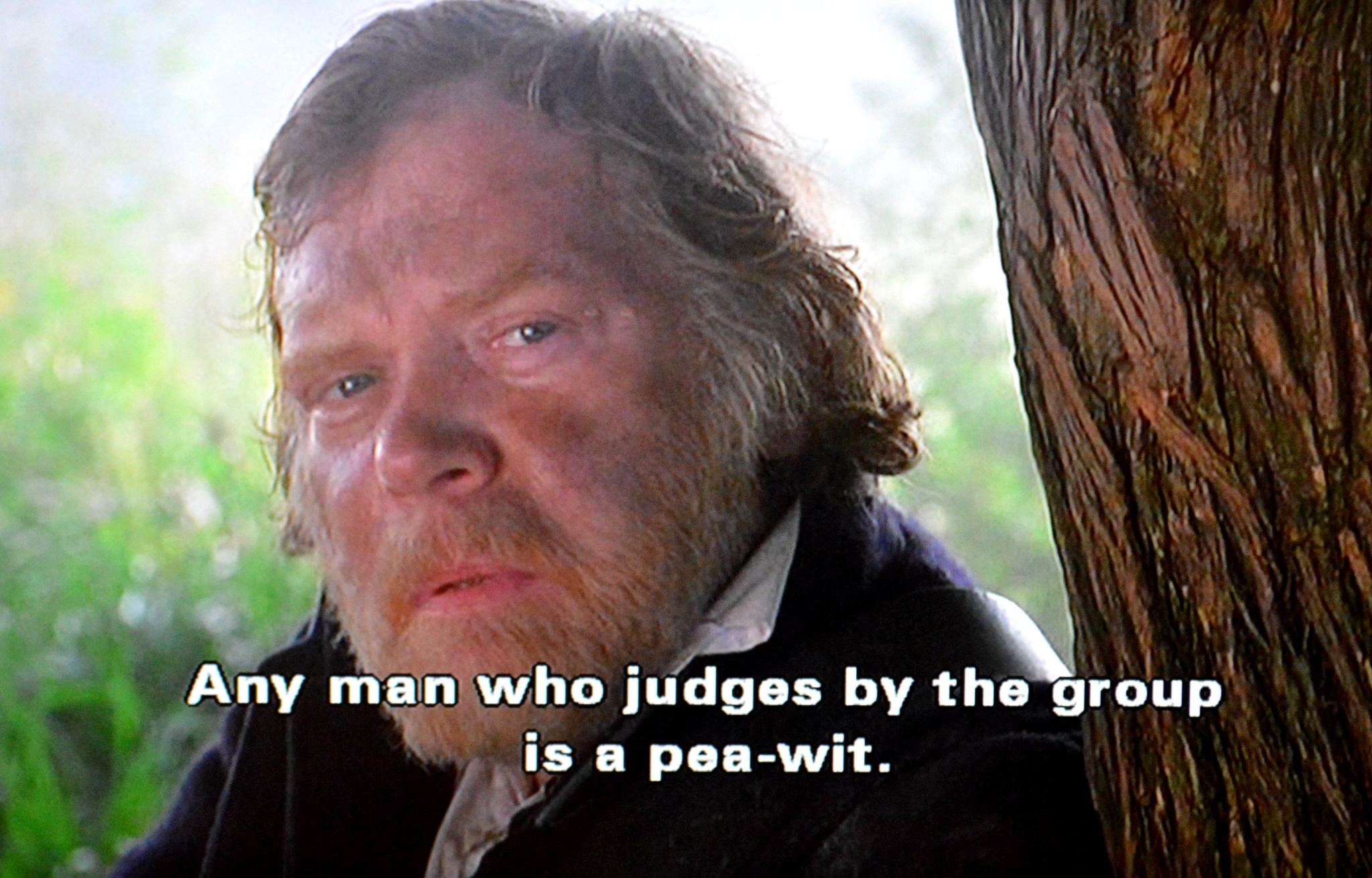
“Any man who judges by the group is a pea-wit.”

– Sergeant Buster Kilrain in Gettysburg by Ron Maxwell

Context: union soldiers Sergeant Buster Kilrain (pictured) and Colonel Chamberlain were having a discussion on the racism that Black people experience. (Apparently this Kilrain is an invented character.)

Well, he put it concisely and politely!

I can’t say I knew much at all about the U.S. Civil War, but during this Lincoln spell of ours I have learned much, including about Colonel Joshua Chamberlain and the 20th Maine, and feel very co-proud—their resilience at Little Round Top really reminds me of the Finnish Winter War. Go, small northern states with obstinate, resourceful populations!

Image: screencap from Gettysburg (1993; directed by Ron Maxwell, based on the book by Michael Shaara, screenplay by Ron Maxwell)

P.S. In case anyone’s interested, Abraham Lincoln: Vampire Hunter is a surprisingly good bad movie.

Serving exactly what it sounds like, the Quotes feature excerpts other people’s thoughts.

The Functions of Law

Those of us who know the legal system primarily through procedural dramas tend to think of the law as being mostly concerned with punishing criminals (well, that and giving ace lawyers a chance to stage dramatic courtroom antics), but law has many other functions in society. While many of these are still visible in modern times, in many pre-modern cultures, law was focused on a different function or set of functions than we are used to. If you are writing a story set in the past or in an imagined world and you want to include some dramatic courtroom antics of your own, you may want to think about how law fits into the society you are creating differently from how it fits into ours. Here are some functions of law to think about as you go:

Resolving disputes

This is one we still see a lot in modern legal systems. A lot of law is civil, not criminal, that is it is about settling conflicts between private individuals or groups rather than about the state enforcing standards of acceptable behavior. One of the distinguishing features of modern states is that many conflicts between individuals that earlier legal systems treated under civil law have been brought under criminal law. In pre-modern societies, with less developed state systems, many misdeeds that we consider crimes were left to individuals to dispute through civil law, such as trespass, theft, even murder.

Reinforcing power structures

No society has yet managed to create a legal system that actually treats the rich and powerful equally with the poor and powerless, but the notion this is even an ideal worth striving for is rather modern. In pre-modern cultures, legal systems often served to explicitly reinforce social disparities. Rules about who could bring suit against whom, whose testimony was considered valid, and what punishments could be meted out for a given infraction could be dictated by the status of the individuals in question. The progress and results of a court case functioned as public reminders about who had power and who did not.

Testing community opinion

In pre-modern societies, especially ones that operate on a small scale, relationships often matter more than institutions (more on this topic here and here). As such, when people have problems to resolve, it can be important to gauge and even try to influence the wider community’s opinion. Legal proceedings can be a way of seeing how your neighbors feel about your issues and trying to get them on your side.

Venting anger

People who feel they have been wronged often feel angry about it. Without a way of publicly venting that anger, those feelings can fester and poison relationships within a community. The law can provide a venue for people to express their anger and feel heard. Even if they don’t get the substantive result they want, the psychological relief of letting those feelings out can do a lot to restore calm among neighbors and relations.

Constraining violence

People who feel wronged and have no other recourse may decide to redress the injuries they have suffered by force. This violence can spiral out of control as families, villages, and factions get wrapped up in reprisals. There are few real cases in history of violent feuds going on for generations (unlike in fiction, where they are all too common), but even short-term flare ups of violence can be hugely disruptive to smaller societies. The law offers an alternative way of settling disputes that sets limits on who can legitimately use violence, when, where, and for what purpose.

Most legal systems combine some or all of the aspects listed here, but the balance among them tells us a lot about how any given society works. If you’re including some kind of legal tradition in your worldbulding, its a useful exercise to think about which of these functions are more important in it, and how it achieves them. Because not every fantasy court case needs to play like an episode of Law & Order!

History for Writers looks at how history can be a fiction writer’s most useful tool. From worldbuilding to dialogue, history helps you write.

Dwarven Fire Mage Transmog

I mentioned in the past that my fire mage got a hidden artifact appearance as a random drop back in Legion. I also mentioned that I’d made a new mog for her, but never posted a better screencap of it. Tut tut, bad librarian!

Turns out I liked her mog so much I kept it even after we moved on from Legion artifacts. Since it’s likely I’m going to change it after World of Warcraft Shadowlands drops, here, finally, is the mog saved for posterity.

BfA Dwarven Fire Mage Transmog

The wand and legs aren’t mogged, and I’ve hidden the head, shoulder, and belt slots. Like with my surv hunter mog, I used the wrist armor to add another stripe of turquoise into the set.

If interested, you can have a look at the set in Wowhead’s Dressing Room.

Image: screenshot from World of Warcraft

Of Dice and Dragons is an occasional feature about games and gaming.

Representation Chart: Star Wars, Sequel Trilogy

We all know that the representation of people of different genders and races is imbalanced in popular media, but sometimes putting it into visual form can help make the imbalance clear. Here’s a chart of the Star Wars sequel trilogy movies (Episode VII: The Force Awakens, Episode VIII: The Last Jedi, Episode IX: The Rise of Skywalker).

Characters included

(Characters are listed in the first movie in which they qualify for inclusion under the rules given below.)

  • Episode VII: The Force Awakens: Poe Dameron, Kylo Ren, Han Solo, General Hux, Snap Wexley, Rey, Captain Phasma, General Leia Organa, Finn
  • Episode VIII: The Last Jedi: Luke Skywalker, Vice Admiral Holdo, Rose Tico
  • Episode IX: The Rise of Skywalker: Emperor Palpatine, Zorii, Lando Calrissian

Rules

In the interests of clarity, here’s the rules I’m following for who to include and where to place them:

  • I only count characters portrayed by an actor who appears in person on screen in more or less recognizable form (i.e. performances that are entirely CG, prosthetic, puppet, or voice do not count). Phasma and Zorii are edge cases on this rule, but since we do at least once see enough of their faces to identify the actors as white women, I have included them.
  • The judgment of which characters are significant enough to include is unavoidably subjective, but I generally include characters who have on-screen dialogue, who appear in more than one scene, and who are named on-screen (including nicknames, code names, titles, etc.)
  • For human characters that can be reasonably clearly identified, I use the race and gender of the character.
  • For non-human characters or characters whose identity cannot be clearly determined, I use the race and gender of the actor.
  • I use four simplified categories for race and two for gender. Because human variety is much more complicated and diverse than this, there will inevitably be examples that don’t fit. I put such cases where they seem least inappropriate. “White” and “Black” are as conventionally defined in modern Western society. “Asian” means East, Central, or South Asian. “Indigenous” encompasses Native Americans, Polynesians, Indigenous Australians, and other indigenous peoples from around the world.
  • There are many ethnic and gender categories that are relevant to questions of representation that are not covered here. There are also other kinds of diversity that are equally important for representation that are not covered here. A schematic view like this can never be perfect, but it is a place to start.

Corrections and suggestions welcome.

Chart by Erik Jensen

In the Seen on Screen occasional feature, we discuss movies and television shows of interest.

The Four Styles of Lego Pop Wall Art

Lego seems to be trying to appeal to older fans as well as kids: they’re now offering some pixelated “pop art” (to quote CNN Style). These Lego art pieces depict Marilyn Monroe, The Beatles, some of the Sith from Star Wars, and Iron Man.

Lego Art Options Screencap

I don’t know about you, but this is a really cool idea. I just wish there were more of them, and more women plus BIPOC.

In related news, did you know you can buy individual Lego bricks? I may have to dust off my pixelating software skills…! 😀

Found via File 770.

Image: screencap from LEGO website.

Out There is an occasional feature highlighting intriguing art, spaces, places, phenomena, flora, and fauna.

Toss a Coin to Your Mercenary

If you’ve played a role-playing game, whether tabletop or computer, you’ve probably seen your hero complete a quest and get rewarded with a handful of coins (be they copper, silver, gold, or something more exotic). It’s a perfectly familiar experience that makes sense from a modern point of view: do a job, get money. There’s a historical connection, though, between mercenaries (which, when you come right down to it, is what a lot of RPG characters are) and coins.

Various objects have been used for trade in cultures all around the world, from cowrie shells to cacao beans, but the earliest coins as we traditionally know them—lumps of precious metal in standardized weights stamped with symbols—were produced in the kingdom of Lydia, in the mountains of western Anatolia (modern-day Turkey), in the seventh century BCE. Lydia had two good reasons for producing coins. One: they had an abundance of precious metal wealth in the form of electrum (a natural alloy of gold and silver) collected from the rivers that ran through Lydia’s mountainous land. Two: they needed soldiers.

For a period in the seventh and sixth centuries, Lydia was one of four major states that dominated the region we know today as the Middle East. The others were Egypt, Babylon, and Media. These four states competed for dominance in the region and needed to maintain strong military forces. Many of them looked to the smaller, poorer, less well organized societies on their borders as recruiting grounds for mercenary soldiers.

There are certain advantages to hiring mercenaries rather than recruiting your own people to fight your wars. Hiring mercenaries lets you put troops on the front lines quickly while keeping your own peasants in the fields producing food. The loyalty of mercenaries is not constrained by local ties or obligations. They can be tasked with dangerous or onerous tasks like digging siege tunnels or standing guard duty that might prompt unrest if you asked a levy of your own people to do them. Finally, if you send a company of mercenaries into battle and a lot of them die, you don’t have to deal with their angry families back home.

Mercenaries are not integrated into the economies in which they serve. Pre-modern societies were held together by bonds of mutual obligation established over years and generations of living and working together. Landowners had an obligation to protect the tenant farmers who worked for them, and tenant farmers in return had an obligation to work the land. Small farmers living together in a village owed one another mutual support. Crafters and other specialists such as priests, doctors, entertainers, scribes, and others who offered services for pay still did so in the context of long-standing relationships. When people like these were called upon to form an army, they fought in defense of their homes and families, but also within existing relationships of obligation and patronage. Even if there was no formal compensation for militia service, a tenant farmer or a blacksmith who went off to war could expect that some of the benefits of victory would filter down to them through these relationships.

If you want mercenaries to fight for you, though, you have to pay them. You can offer food, clothing, and other goods like that, but a person only needs so many shirts, and extra food is hard to lug around from camp to camp. You can promise them land once their service is done, but that can cause conflicts with your own people who may not want a bunch of foreigners settling nearby. Also, having a lot of experienced fighters with nothing to do hanging around your kingdom can lead to trouble—once they’ve finished fighting your wars, you generally want them to go away again. For similar reasons, you don’t want your mercenaries to feel as though they’re being cheated or paid unequally, so whatever you pay them should be something whose value is easy to measure.

So the ideal characteristics of mercenary pay are:

  • Something that doesn’t excessively burden your own people to spend.
  • Something easily portable.
  • Something whose value is not dependent on being tied into your society or economy.
  • Something whose value is easy to measure.

For the kings of Lydia, the answer was easy: lumps of precious metal in standardized weights stamped with symbols. Or, as we know them now: coins.

Lydia had plenty of electrum to spare; handing it out to mercenaries put no extra burden on the Lydian people. (Electrum, containing variable proportions of silver and gold, was hard to make coins of standard value out of, so early electrum coins were soon replaced with coins made out of pure silver or gold processed out of raw electrum.) Coins were easy to carry. Although the exact value of a given weight of metal could vary depending on local circumstances, a full year’s pay for a mercenary might amount to no more than a kilo and a half of silver or a tenth of a kilo of gold. Precious metals were in demand everywhere. Mercenaries from Greece, Thrace, or Caria could easily take their coins home and exchange them for land or goods. The symbols stamped on coins served in part to guarantee that they were minted to a standard weight, which made it easy for soldiers to confirm that they were being paid what they had been promised and that pay was distributed fairly.

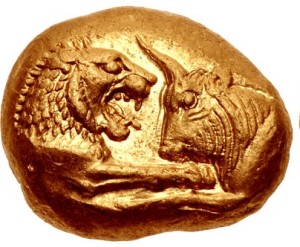
The symbols on coins had another function as well. Early Lydian coins were marked with the heads of a lion and a bull. These images suggested harmony on many levels, including cosmological (the lion representing the sun, the bull the moon), ecological (lion representing the wilderness, the bull cultivated land and civilization), and social (predator and prey together as one). It was an apt symbol for a rich and powerful state recruiting the services of its poor and underdeveloped neighbors. The coins that mercenaries carried around with them were meant to remind them of their role as the hungry lions who fought for the rich Lydian bull and were rewarded for it. Not long afterward, kings began to put their own images and personal symbols on their coins, an even more pointed reminder to the mercenaries who received them of who they owed their loyalty to.

Not long after Lydians began minting coins, many other peoples began to do the same—some directly inspired by the Lydians’ example, others independently but for much the same reasons. The usefulness of these coins for facilitating trade soon also made them appealing to merchants, crafters, wandering minstrels, and lots of other people not embedded in the agricultural economy, but paying mercenary soldiers continued to be an important reason for kings and empires to mint coins for many centuries to come.

So the next time your hero returns to town after clearing out another dungeon full of monsters and gets a handful of coins as a reward, know that you are part of a very long tradition.

Image: Lydian gold Croessid, obverse, photograph by Classical Numismatics Group via Wikimedia (minted Sardis; 564-539 BCE; gold)

History for Writers looks at how history can be a fiction writer’s most useful tool. From worldbuilding to dialogue, history helps you write.

The Rise of the First Cities through Genetic Research

Juan Siliezar at The Harvard Gazette writes about new genetic research into the movement and interactions of inhabitants of different areas of Western Asia and the Levant in the Bronze and Iron Ages. According to the evidence, people traveled and interacted with their neighbors before the rise of cities (and not the other way around as previously thought).

MHAAM Genetic Gradient 6500 BCE

Quoting Siliezar’s article:

“The evidence reveals that a high level of mobility led to the spread of ideas and material culture as well as intermingling of peoples in the period before the rise of cities, not the other way around, as previously thought. The findings add to our understanding of exactly how the shift to urbanism took place.

“The researchers, made up of an international team of scientists including Harvard Professor Christina Warinner, looked at DNA data from 110 skeletal remains in West Asia from the Neolithic to the Bronze Age, 3,000 to 7,500 years ago. The remains came from archaeological sites in the Anatolia (present-day Turkey); the Northern Levant, which includes countries on the Mediterranean coast such as Israel and Jordan; and countries in the Southern Caucasus, which include present-day Armenia and Azerbaijan.

“Based on their analysis, the scientists describe two events, one around 8,500 years ago and the other 4,000 years ago, that point to long-term genetic mixing and gradual population movements in the region.

“’Within this geographic scope, you have a number of distinct populations, distinct ideological groups that are interacting quite a lot, and it hasn’t really been clear to what degree people are actually moving or if this is simply just a high-contact area from trade,’ said Warinner, assistant professor of anthropology in the Faculty of Arts and Sciences and the Sally Starling Seaver Assistant Professor at the Radcliffe Institute for Advanced Study. ‘Rather than this period being characterized by dramatic migrations or conquest, what we see is the slow mixing of different populations, the slow mixing of ideas, and it’s percolating out of this melting pot that we see the rise of urbanism — the rise of cities.’ […]

“Historically, Western Asia, which includes today’s Middle East, is one of civilization’s most important geographical locations. Not only did it create some of humanity’s earliest cities, but its early trade routes laid the foundation for what would become the Silk Road, a route that commercially linked Asia, Africa, and Europe. […]

“The paper outlines how populations across Anatolia and the Southern Caucasus began mixing approximately 8,500 years ago. That resulted in a gradual change in genetic profile that over a millennium slowly spread across both areas and entered into what is now Northern Iraq. […]

“’What’s really interesting is that we see these populations are mixing genetically long before we see clear material culture evidence of this — so long before we see direct evidence in pottery or tools or any of these more conventional archaeological evidence artifacts,’ Warinner said. ‘That’s important because sometimes we’re limited in how we see the past. We see the past through artifacts, through the evidence people leave behind. But sometimes events are happening that don’t leave traces in conventional ways, so by using genetics, we were able to access this much earlier mixing of populations that wasn’t apparent before.’”

Interesting, especially the fact that genetic mixing predates evidence seen in artifacts. Sounds like there’s much to research in the future!

Read more at The Harvard Gazette or see the original article by Lily Agranat-Tamir et al. at Cell.

Found via File 770.

Image: The Max Planck-Harvard Research Center for the Archaeoscience of the Ancient Mediterranean (MHAAM) via Phys.org.

The Strange Poetry of an Index

One of the tricks of the trade in academia is: when you pick up a new book, look at the index first. Seeing what terms appear there and which ones have large numbers of references tells you a lot about what the book is about.

I’ve been working on the index to my latest book, a collection of primary sources on the Greco-Persian Wars. Most of the entries are proper names for people, places, and institutions, and their specificity tells you pretty clearly the topic of the book. If you take those out, though, the terms that are left have a strange kind of poetry about them. You could let your imagination wander and dream up some very different books that had these terms in their indices. For your enjoyment:

animals, archers

beer, bees, bread, brick, bridges, bulls

canals, cannibalism, carnelian, cattle, cavalry, chariots, childbirth, clothing, colonies, crown, cuneiform

democracy, diplomacy, disease, dreams

earth and water, earthquakes, esparto, exiles

forgery, fowl, frankincense, frontiers

gifts, goats, gold, grain, guest-friendship

hair, helots, heralds, heroes, hoplites, horses, hostages

incense, ivory

labor, language, lapis lazuli, laws, linen, lions

medicine, mercenaries, merchants, moon, mules, multiculturalism, mummification

oil, ointment, oligarchy, oracles

palaces, papyrus, phalanx, pomegranates, poultry, propaganda

racing, rain, religion, roads

sacrifice, satraps, satrapies, sheep, shields, ships, shipwrecks, sieges, silver, storms, stone

temples, tolerance, tombs, trade, translation, tribute, triremes, turquoise, tyrants

walls, water, wind, wine, wood

How It Happens is an occasional feature looking at the inner workings of various creative efforts.

Night Elf Survival Hunter Transmog

As I mentioned earlier, I’m going to spend a lot of time in the barbershop after World of Warcraft Shadowlands drops. I’m likely to change not just some details of my toons’ appearance but also some of their transmogs—I like to rotate some of my characters’ mogs since I don’t have an absolute favorite, and for others I’ve never found anything particularly fitting. So I thought I’d save a few mogs for posterity by posting them online.

Here is my female night elf survival hunter.

BfA F NElf Survical Hunter Transmog1

I go back and forth with a headpiece I like and a hidden head slot like here; the polearm is also unmogged. Other armor slots, however, are mogged, including the the bracers, which I usually skip; this time I found a way to add a slight chevron line just above the glove edge with the bracers.

BfA F NElf Survical Hunter Transmog2

If interested, you can have a look at the set in Wowhead’s Dressing Room.

Images: World of Warcraft screencaps

Of Dice and Dragons is an occasional feature about games and gaming.

Rating: Castle, Season 6

It’s a return to form for the sixth season of Castle. Here’s our take on this season’s episodes:

  1. “Valkyire” – 7
  2. “Dreamworld” – 2
  3. “Need to Know” – 5.5
  4. “Number One Fan” – 8
  5. “Time Will Tell” – 8
  6. “Get a Clue” – 6
  7. “Like Father, Like Daughter” – 8.5
  8. “A Murder is Forever” – 6
  9. “Disciple” – 2
  10. “The Good, the Bad, and the Baby” – 9
  11. “Under Fire” – 8
  12. “Deep Cover” – 2
  13. “Limelight” – 6
  14. “Dressed to Kill” – 5.5
  15. “Smells Like Teen Spirit” – 2.5
  16. “Room 147” – 8.5
  17. “In the Belly of the Beast” – 3
  18. “The Way of the Ninja” – 7.5
  19. “The Greater Good” – 5
  20. “That 70’s Show” – 3
  21. “Law and Boarder” – 6
  22. “Veritas” – 2.5
  23. “For Better or Worse” – 3

The average rating for this season is 5.4, not the best that Castle has done, but a decent showing and better than the last couple of seasons. This season does well when it plays to its strengths: offbeat crimes and the interactions of its characters.

The three lowest episodes this season, coming in at 2, try to break the formula: “Dreamworld,” in which Beckett gets tied up in an international conspiracy; “Disciple,” in which Castle’s pet serial killer returns with a new friend; and “Deep Cover,” in which Castle gets tied up in an international conspiracy. None of these episodes works well or delivers the crime-solving comedy we expect from this series. I’m beginning to get the sense that someone in the Castle writers’ room really wanted to write spy thrillers but couldn’t hack it. Every time Castle tries to do international intrigue, it just bombs. At least this season mercifully more or less ties up the overdrawn story of Beckett’s mother’s death.

But this season more than makes up for its occasional missteps with a lot of average-to-good episodes that are enjoyable to watch. Our top pick this season, “The Good, the Bad, and the Baby,” at a 9, finds the team working backwards to uncover what led to a dying man staggering into a church holding a baby. One of the lovely things about this episode is how eagerly Castle jumps into the role of taking care of the baby, a refreshing reversal of the usual trope that men are useless with children. As runners-up at 8.5 we have “Like Father, Like Daughter,” in which Alexis enlists her father’s help for an Innocence-Project-like case, and “Room 147,” an intricate mystery in which multiple people inexplicably confess to the same crime.

Image: Beckett and Castle investigate, from “Room 147” via IMDb

In the Seen on Screen occasional feature, we discuss movies and television shows of interest.