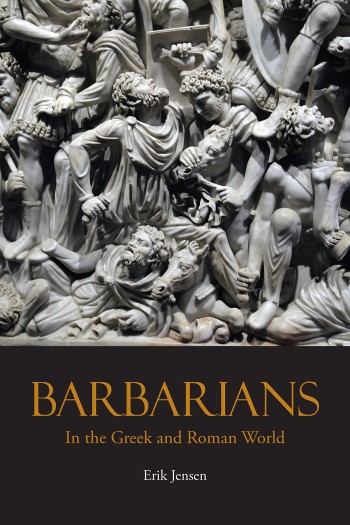
Some “Deleted Scenes” from Barbarians in the Greek and Roman World

They say good writing is good rewriting. They also say to kill your darlings. Both are good pieces of advice. The process of writing involves a lot of false starts, changes, and reworkings. Sometimes it means having to let go of something you worked hard on, that you like, but that just doesn’t serve the needs of your project.

In writing my book Barbarians in the Greek and Roman World, I had to kill a lot of darlings. A lot of text just got deleted and rewritten, but sometimes I had to cut out things I liked and was happy with, but that just didn’t belong in the book as written or that I had found better ways to express. In those cases, rather than delete the the text entirely, I cut and pasted it into a separate file to save just in case I decided to put it back in future revisions, or maybe to some day develop into its own project. That file ended up being longer than any of the actual chapters in the book.

In the spirit of DVDs with deleted scenes from movies, I present to you a few choice bits that didn’t make it into Barbarians, but that I still think are worthwhile on their own.

On the significance of the Greco-Persian Wars in later Greek culture:

The Athenian playwright Aeschylus was a giant of classical literature. He was the first author to put multiple characters on the stage at once, thus introducing conflict and inventing Greek drama as we know it. He won the Athenian dramatic competition thirteen times and was praised for his compositions by both contemporaries and later generations. But when he died his epitaph celebrated only one achievement: he fought at Marathon. Such was the importance of the wars against Persia in the later history of Greece.

On the connections between Persia and Macedonia:

Alexander trod the path that had been laid down by Cyrus the Younger generations before. He had grown up in a Macedonian court that hosted Greek intellectuals and Persian exiles. The similarities between Cyrus and Alexander’s campaigns are hardly accidental. Both were efforts from the edge of the Persian world to capture the center. Alexander may have started his campaign farther away from that center than Cyrus did, but the ties of politics, diplomacy, and personal relationships that connected Macedonia to Persia were just as strong as those to ran through Anatolia and Greece.

On the shifting definitions of Greekness:

In other words, although both ideas always had some currency, in earlier times it was more common to argue that Greeks were Greeks because they were descended from Greeks, while by the later fourth century it was more common to argue that Greeks were Greeks because they acted like Greeks.

On the political ramifications of culture in the Hellenistic world:

Behind all of these complicated relationships was a fundamental political fact: Macedonian kings now ruled most of the territory of the old Persian empire. These kings and their supporters in the ruling class had chosen to identify themselves with Greek culture. In the past, some Greeks had exercised power over non-Greek populations—particularly in major colonial cities like Syracuse and Massilia—but never on this scale. Now vast new populations had to come to terms with the linking of political power and Greek culture. Their responses ranged from resistance to collaboration to indifference. The Greeks in these kingdoms also had to come to terms with new ways of being Greek.

None of these cultural innovations could erase the boundaries of status and privilege that the Greco-Macedonian ruling class had erected between itself and the peoples over whom it ruled. As in many more recent colonial contexts, the rigid enforcement of cultural lines may itself have given impetus to the reinvention of the cultures of both the rulers and the ruled. When being “Greek” was the key to social and political advancement, it is no surprise that some people looked for novel ways of being Greek while others strove to reassert the value of not being Greek.

All of these selections got cut for good reasons, but it’s a pleasure to be able to share them with you now.

How It Happens is an occasional feature looking at the inner workings of various creative efforts.

Please Have a Bunny Thankyou

I’ve been sick for ten days and I’m out of pre-prepared posts, so please have a bunny thankyou.

Cannot Human Today I Want to Bunny

“I do not want to adult today. I don’t even want to human today. Today, I want to bunny.”

You know you’re legit sick when reading an exciting new book feels too strenuous.

Enjoy your weekend!

Image via Rabbit Rescue Inc.

When the suckage just sucks too much.

Happy Pi Day!

Happy Pi Day!

I’m the kind of geek you can (within reason) egg on to doing something by saying most people don’t act in a particular way or do whatever it is you’re describing.

Case in point: our high school math teacher told us that most people won’t ever learn the approximation for pi further than 2 or 4 decimals places. So, I had to go and memorise it to 8 decimal places. I can still remember it: 3.14159265.

Dinner3 Dessert

Don’t ask me why it was so important to me—I can’t remember anymore. I am, however, surprised that I can still produce it without any hesitation whatsoever even though I haven’t used it in decades. (It only works in Finnish, though; clearly there’s some connection with the rhythm and sounds that made it easy for me to memorize.) I wish I was as speedy with my U.S. social security number, for instance. 🙂

P.S. For a full appreciation of my dorkiness, look at the tags for this post. :p

Messing with numbers is messy.

Happy New Year 2019!

2018 was a tough one for us, but it’s almost done now—phew!

Two Candles for FIN Independence

May 2019 simply be better for you in any way you’d like to define it.

I’d like to finish with a quote from Executive Director and diversity educator Shay Stewart Bouley‏:

“Centering yourself and treating yourself with the love you give to others allows you to be in the work and have a healthy perspective. Less reactionary. I can extend grace when I’m well. I can see what’s real and what’s not.”

Stay safe.

Image by Eppu Jensen

Announcements from your hosts.

Top Five Posts for 2018

Well, that was 2018! Here are our posts from the year that have gotten the most attention:

  1. Call for Help: Where is Miss Sherlock? Eppu’s post about a new mystery series that transposes the characters of Holmes and Watson to modern-day Japan and makes them both young women for good measure. Unfortunately, we’re still not sure where or how we can watch it, but it’s nice that so many other people are also excited by the idea.
  2. Arisia: A Point of No Return for Us Our statement in support of Crystal Huff and against the repeated failure of the Boston-based Arisia convention to effectively address problems of sexual harassment and stalking not just at the con but by members of the con staff itself.
  3. Quotes: Finland is Weird. Finland is Different All together now, Finland fans! A gratifyingly bewildered quote from Adrian Tchaikovsky’s Ironclads.
  4. “At Least It Made You Feel Something” Erik’s rant against creators who justify storytelling choices that aggravate fans by patting themselves on the back for making us feel something.
  5. Barbarians in the Greek and Roman World Preview A preview of Erik’s book, published in September, about the concept of the barbarian and the realities of cross-cultural interactions in the ancient Mediterranean.

Some of our old posts remain perennial favorites, too. Here are the overall top five Co-Geeking posts that people viewed in 2018:

  1. Do-It-Yourself Fantasy Place Name Generator Erik’s name-generating technique from back in 2015 still gets a lot of attention. Apparently a lot of you out there are making up names for things!
  2. Sean Bean on the LotR Joke in The Martian Eppu’s 2015 post on Finland’s Yle News interview with the delightful Sean Bean on the Lord of the Rings joke in The Martian. Such a treat, and still well worth watching today.
  3. Hogwarts Dueling Club Tablecloth Transformed into Wall Hanging Eppu’s post about a home-made version of the moon-phase dueling cloth from Harry Potter, posted in 2016.
  4. Custom is King Erik’s translation of a favorite passage from Herodotus’ Histories, posted in 2017.
  5. Call for Help: Where is Miss Sherlock? Eppu’s post from this year

Thanks for hanging out with us this year. We hope you’ll join us again in 2019.

Messing with numbers is messy.

Happy Holiday Wishes with Northern Lights Seen from the ISS

I grew up seeing Northern Lights every winter, so for me they’re not a novelty—except when seen from space.

NASA Instagram ESA Alexander Gerst Northern Lights from Space

This amazing photo was taken by the European Space Agency astronaut Alexander Gerst at the International Space Station.

I think it’s fair to say we’re living in an age quite unlike any previous one from a scientific and research perspective. It’s amazing and incredible.

We’re vacationing for a week or so. Until then, Happy Merry!

Image: Northern Lights from space ESA/NASA-A.Gerst via NASA at Instagram.

Out There is an occasional feature highlighting intriguing art, spaces, places, phenomena, flora, and fauna.

Quotes: I’m Okay with Living in a House Where a Random “Han Solo” is a Thing That Happens

I love geeks and nerds, and being a geek / nerd. Sometimes it occurs to me, though, how terribly odd it must look like seen from the outside. Exhibit 6,430: the exchange below that Erik and I had last weekend:

Me: *mumbling to myself, trying to remember a detail from Star Wars*

Me: Han Solo

Erik: … I don’t know what that’s about, but I’m okay with living in a house where a random “Han Solo” is a thing that happens.

I’m okay with my life choices. 😀

Some things are just too silly not to share!

Barbarians in the Greek and Roman World Preview

What did the ancient Greeks and Romans think of the peoples they referred to as barbari? Did they share the modern Western conception—popularized in modern fantasy literature and role-playing games—of “barbarians” as brutish, unwashed enemies of civilization? Or our related notion of “the noble savage?” Was the category fixed or fluid? How did it contrast with the Greeks and Romans’ conception of their own cultural identity? Was it based on race?

These are the questions that my first book addresses. Barbarians in the Greek and Roman World will be published in the fall of 2018. The book explores both the realities of interaction among peoples of different cultures in the ancient Mediterranean and the ways in which Greek and Roman thinkers interpreted these interactions to create the idea of the “barbarian.”

Here’s a preview, discussing the experience of the Greeks in their colonial settlements around the Mediterranean Sea:

* * *

The history of Greek settlement in Egypt demonstrates the complexity of colonial interactions. In the late 600s BCE, Egypt was under Assyrian dominion. An Egyptian noble, Psammetichus, had been appointed as governor, but when the Assyrians were distracted by internal conflicts, Psammetichus raised a rebellion, bolstered by mercenaries from Greece and Caria, a region of southwestern Anatolia. When the fighting was done and Psammetichus had become king of a newly independent Egypt, he settled the remaining mercenaries in the Nile delta. These settlements also attracted other foreigners, such as Phoenician crafters who made imitation Egyptian artworks on the site for export.

The mercenaries remained in Egyptian service, and it appears their descendants did as well, since some were deployed to southern Egypt under Psammetichus II decades later. One such band carved graffiti on the temple of Abu Simbel to commemorate their adventures: “When King Psammetichus came to Elephantine, this was carved by the companions of Psammatichus, son of Theocles, who sailed beyond Kerkis as far as the river went.” The mercenary Psammatichus was evidently named after the pharaoh by his Greek father. Some families went beyond names and embraced Egyptian culture, as shown by the burial of Wahibre-em-akhet, whose name and hieroglyph-inscribed sarcophagus are conventionally Egyptian; the only clue to his foreign ancestry are the Greek names of his parents, Alexicles and Zenodote. Other soldiers left graffiti at Abu Simbel in Carian and Phoenician, another testament to the cultural and linguistic diversity of those traveling and trading around the Mediterranean at this time.

Sometime after 570, the pharaoh Amasis reorganized the Nile delta settlement. Land was granted for the construction of a Greek colony, which, unusually, was collectively founded by nine Greek cities from the coast of Anatolia. Representatives from these cities jointly governed the new community now called Naukratis. Greek ships were banned from landing anywhere else in Egypt for trade. The colony thus became the primary site of exchange between Greeks and Egyptians. Trade connections brought people of many different backgrounds to Naukratis and connected its people to a wider world. One visitor was Charaxos, the brother of the poet Sappho, who traded wine from his home city Mytilene to Naukratis. He met a slave courtesan there, a Thracian woman named Rhodopis who had been brought to Egypt by her Samian owner. Charaxos fell in love with Rhodopis, bought her, and freed her, after which she chose to remain in Naukratis to ply her trade. To celebrate the fortune she had amassed in her work, Rhodopis later made a rich dedication at Delphi in Greece. A hieroglyphic inscription on a stele erected by the pharaoh Nectanebo in the fourth century, dedicating revenues from Naukratis to the temple of Neith, shows that the pharaohs kept an active interest in the administration of the colony. Naukratis retained its importance and trading privileges after the Persian Empire conquered Egypt in 525. It continued to welcome not only traders but tourists and other travelers, like Herodotus, who visited Egypt and whose writings record the existence of a local industry of tour guides and interpreters. The Greeks who settled in Egypt did not exist in isolation but had productive relationships with traders, artisans, and the ruling class alike.

The interactions in and around Naukratis are a window into the complexity of the colonial world. There were Greeks trading with Egyptians, but also Phoenicians making knockoffs of Egyptian art, Greeks assimilating into Egyptian culture, Thracians and Carians negotiating the needs of Egyptian and Greek patrons, and Egyptians making a living off showing the wonders of their country to curious foreigners. Interactions like these were happening all around the Mediterranean. There is no simple way to describe Greek relations with non-Greek peoples in the archaic and classical periods because those relations were never simple.

* * *

If you’ve enjoyed some of my posts about ancient trade connections, the diversity of ancient armies, individuals crossing cultural boundaries, modern peoples’ attempts to claim ancient peoples’ identities for themselves, and the variety of different kinds of “barbarian” you may find something to enjoy in Barbarians in the Greek and Roman World.

Barbarians in the Greek and Roman World comes out in September from Hackett Publishing.

Hardcover: $48 / Paperback: $16

You can pre-order directly from Hackett or on Amazon.

Image: Barbarians paperback cover by Hackett Publishing

Announcements from your hosts.