Representation Is for Everyone

Monday is when I write, from a historian’s perspective, about some interesting or useful tidbit for writers, especially writers of genre fiction. I’m doing that again today, but from a different angle. Today I want to talk about representation, specifically the representation of people who are not straight white cis men in books, television, movies, games, and other media.

First things first: I’m a straight white cis man with no significant mental or physical challenges. I am a native-born citizen of the country in which I live and a native speaker of its majority language. I am financially secure and socially comfortable. I am not, as far as I know, heir to any titles of nobility, but other than that, if a privilege exists in the world, I’ve probably got it.

Yeah. I’m about to talk about representation. If anyone wants to get off this ride, now’s the time.

When creators and fans talk about adding representation to popular media, the refrain from people who look like me is often: “Why do we have to have X in this story? What do you mean you can’t identify with the characters? Why can’t all you Xes identify with people who aren’t exactly like yourselves?”

I understand where this response comes from. There are white guys all over the place in popular media, but I’ve never identified with a character just because he was a white guy.  There are so many of them that I couldn’t identify with them all if I wanted to. When I look at a character and think Hey! That’s me! it comes from traits other than outward identities. Here are some of the characters I’ve felt connected to over the years:
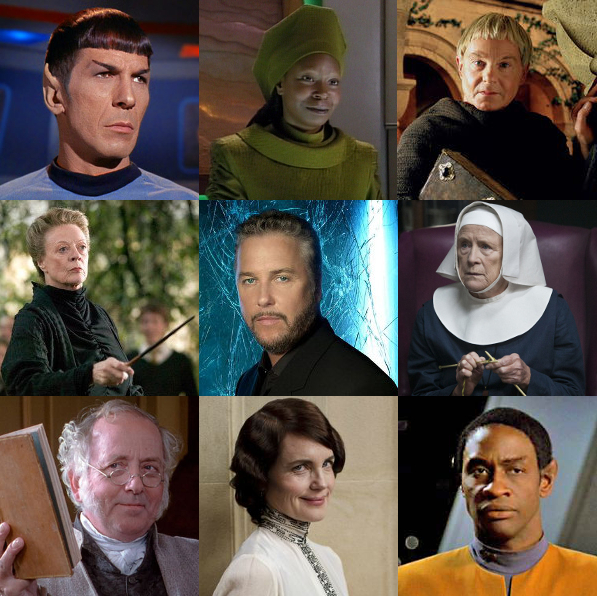
Spock (Star Trek), Guinan (Star Trek: The Next Generation), Brother Cadfael (Cadfael novels and Cadfael tv series), Minerva MacGonagall (Harry Potter novels and films), Gil Grissom (CSI), Sister Monica Joan (Call the Midwife), Mr. Bennet (Pride and Prejudice), Cora Crawley (Downton Abbey), Tuvok (Star Trek: Voyager)
Spock (Star Trek), Guinan (Star Trek: The Next Generation), Brother Cadfael (Cadfael novels and tv series), Minerva MacGonagall (Harry Potter novels and films), Gil Grissom (CSI), Sister Monica Joan (Call the Midwife), Mr. Bennet (Pride and Prejudice), Cora Crawley (Downton Abbey), Tuvok (Star Trek: Voyager)

They’re not all the same gender, race, age, or even species as I am. Two of them are members of a religious order, and I’m not religious at all. Most of them don’t even (fictionally) live in this century.

What can we learn from this collection? (Other than that I have a thing for Vulcans and a rather inflated sense of my ability to dole out wise advice to young ‘uns.) That representation is an aspect of privilege even when you’re not being represented. Having white guys all over the place frees me to look at the characters in my media and identify with them not based on the outward categories they fall into but because they’re thoughtful, introverted, curious, even-tempered, and passionate about knowledge.

On the other hand, I am a member of a very small minority who is rarely represented in media, and then usually in a dismissive, stereotyped, even offensive way: history professors. According to most books, movies, and tv shows, we are boring, joyless pedants in tweed jackets with elbow patches who obsess over minutiae and care only about names and dates.

“Easily the most boring class was History of Magic, which was the only one taught by a ghost. Professor Binns had been very old indeed when he fell asleep in front of the staff room fire and got up the next morning to teach, and left his body behind him. Binns droned on and on while they scribbled down names and dates, and got Emeric the Evil and Uric the Oddball mixed up.”

– J. K. Rowling, Harry Potter and the Philosopher’s / Sorcerer’s Stone Ch. 8

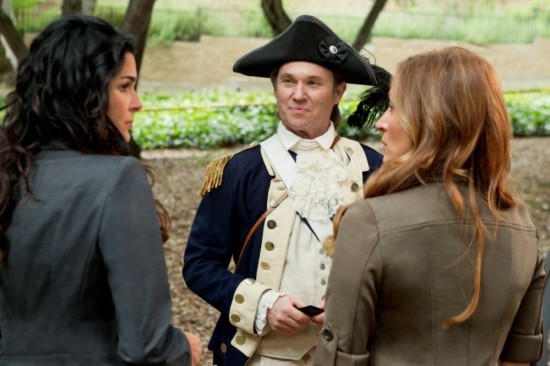
We always wear period clothes and are at best dimly aware of what century we actually live in, if not actively in denial about it.
160815RizzoliIsles
Professor Dwayne Cravitz from Rizzoli and Isles s. 2 ep. 6 “Rebel Without a Pause”

(Not to mention that we make our (black) graduate students do unpaid labor so that they can have the “authentic slave experience.”)

Oh, and if we’re medieval historians, we’re indistinguishable from renfaire performers. (I can’t find a link to it now, but the memory is seared in my mind of an NPR interview with a scholar attending the annual medieval studies conference in Kalamazoo which made it clear the interviewer thought it was basically a fantasy convention.)

Come on by my history class sometime. I won’t be wearing a costume or droning on about names and dates. I’ll be deep in conversation with my students about social structures, economic forces, multicultrual interactions, source analysis, and all the other interesting parts of history.

Now, history professors are not, by any stretch of the imagination, a historically oppressed or marginalized group. I know how aggravating it can be to be badly represented even as a comfortably privileged middle class white man, but I can’t really imagine what it must be like to be, say, a Native American woman, or a gay man who uses a wheelchair, or a Muslim teenager with Asperger’s, and have to deal with not only the weight of the social disadvantages that come with that and seeing people like myself so rarely and poorly portrayed in media.

Of course we can all identify with people who aren’t like us. That’s not the point. The point is that, no matter who we are, we all deserve to see enough people outwardly like ourselves in books, television, movies, and other media that we don’t have to identify with them just to feel like we’re there.

Images: Spock via Memory Alpha; Guinan via Memory Alpha; Cadfael via Heroes Wikia; Minerva MacGonagall via Harry Potter Wiki; Gil Grissom via CSI: Wiki; Sister Monica Joan via PBS; Mr. Bennet via Jane Austen variations; Cora Crawley via Downton Abbey Wiki; Tuvok via Wikimedia; Rizzoli and Isles “Rebel Without a Pause” via Sidereel

History for Writers is a weekly feature which looks at how history can be a fiction writer’s most useful tool. From worldbuilding to dialogue, history helps you write. Check out the introduction to History for Writers here.
Fantasy Religions: Faith and War

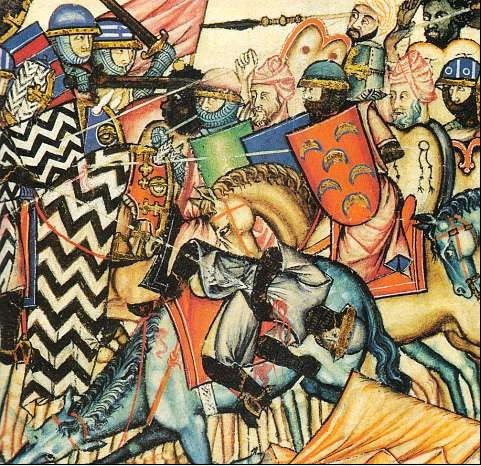
160808ReconquistaReligion often becomes involved when people are in conflict. Many religious traditions provide points of identity around which people can rally when they feel threatened or can offer reassurance and justification to those about to enter combat. Extreme circumstances, like war, have often led people to embrace their own religious traditions (or new ones) more firmly. All of this is undeniably true. Popular history, however, often makes a further claim: that religious differences cause violent conflicts. A careful look at history shows us a different picture. Religious differences have rarely, if ever, caused wars on their own, and where they have been involved in starting hostilities, they have played only a partial role alongside many other forces.

When we look at history, it is easy to find conflicts between people of different faiths, but these are unusual interruptions in a world history that is mostly about people of different faiths getting along reasonably well. Religious differences on their own don’t drive people into conflict. Protestant and Catholic Christians, for example, have been engaged in a bitter conflict in Northern Ireland for most of the past century, but during that time Northern Ireland has been pretty much the only place in the world where Protestants and Catholics have fought a sustained violent conflict. Nor is religion the only thing that separates the sides in Northern Ireland: differences in religion, language, political inclinations, popular culture, and social life are all wrapped up in the thousand-year history of English colonialism in Ireland. Catholic and Protestant denominations in Northern Ireland have provided a structure in which people can organize to pursue their causes and have been markers of identity around which people rally in difficult times, but if all the people of the territory were of the same religion, the conflict there would still have happened. Blaming religious differences for the Northern Irish Troubles is like blaming the US Civil War on a disagreement over what color Army uniforms should be.

Continue reading

Text as Art

Language can be beautiful. We all know this as readers and writers. But language can also be beautiful as a visual, even physical work of art. In pre-modern societies where literacy rates were low, most people who looked at written text experienced it as a work of art, not as a work of language.

Here, for example, is the beginning of the Gospel of John in the Book of Kells.

Book of Kells, folio 292r via Wikimedia (Ireland; c. 800; ink on vellum)

It may be hard at first to tell that there is even a text in the midst of this work of art, but if you know where to look you can find the Latin text: IN PRINCIPIO ERAT VERBUM (In the beginning was the word).

Book of Kells via Wikimedia, text highlighted by Erik Jensen

Continue reading

Quotes: Our Ability to Come Together

“Because it’s those things we celebrate as ‘other’ that make us truly human. It’s what we label ‘soft’ or ‘feminine’ that makes civilization possible. It’s our empathy, our ability to care and nurture and connect. It’s our ability to come together. To build. To remake. Asking men to cut away their ‘feminine’ traits asks them to cut away half their humanity, just as asking women to suppress their ‘masculine’ traits asks them to deny their full autonomy.

“What makes us human is not one or the other–the fist or the open palm–it’s our ability to embrace both, and choose the appropriate action for the suitable situation we’re in. Because to deny one half […] is to deny our humanity and become something less than human.”

– Kameron Hurley: The Geek Feminist Revolution

Because people are not stereotypes. Stereotypes aren’t just lazy, they’re outright dangerous if carelessly applied.

Hurley, Kameron. The Geek Feminist Revolution. New York, NY: Tor, 2016. Chapter “Women and Gentlemen: On Unmasking the Sobering Reality of Hyper-Masculine Characters.”

Serving exactly what it sounds like, the Quotes feature excerpts other people’s thoughts.

Ancient Models for Writing About Language Barriers

160718graffitoThe ancient Mediterranean was a multilingual place. Although a few languages were in common usage—Phoenician, Greek, Aramaic, Punic, and Latin, in different times and places—many other languages were spoken, including Iberian, Gaulish, Etruscan, Oscan, Hittite, Hebrew, Egyptian, and Numidian. Many people, especially in the great port cities like Carthage, Rhodes, and Alexandria, would have encountered numerous different languages in their daily lives. It is no surprise that this experience of a polyglot world was reflected in classical literature. The ways in which ancient writers represented multilingualism and language barriers offer some useful models for us as speculative fiction writers today.

Continue reading

Legal Brief Partly in Klingon to Counter a Big Movie Studio

The copyright infringement case filed by Paramount Pictures Corporation against the Star Trek fan production Axanar has been in the news a bit this spring. I have a mild interest in it, but I don’t spend much time following the reports—with one marvellous, excellent, and hilarious exception.

Attorney Marc Randazza wrote an amicus curiae brief for Language Creation Society (i.e., for the defendant’s benefit) to counter a copyright claim by Paramount “over the entire Klingon language, not any particular words or portions of dialogue from any episodes of Star Trek, but in the entire vocabulary, graphemes, and grammar rules of Klingon.”

His friend and co-blogger Ken White at Popehat shared the story and the brief itself (as a .pdf file). (The full docket for the case is also available via the U.S. Courts Archive.)

Mr. Randazza not only argues that one cannot copyright an entire language, invented or not; he also briefly summarizes the history and some current uses of Klingon. (Did you know, for example, that the Klingon Language Institute has overseen Klingon wordplay contests? I didn’t. Check them out; the palindromes are especially awesome.)

The best thing about the brief, however, is how Mr. Randazza uses Klingon—complete with the Klingon font, transliterations to the Latin alphabet, and translations—to illustrate his arguments.

I’ve copied three examples below without the Klingon font, using the Latin transliterations instead and adding the English translations Mr. Randazza provides. It’s worthwhile to visit the .pdf brief available online (here or here) for the full effect, though.

“Plaintiff Paramount Pictures Corporation (“Paramount”) has claimed this copyright interest for many years, but has not actually asserted it in court before now – most likely because the notion of it is [meq Hutlh / it lacks reasons].”

[p. 9 of 26]

“Just as poker jargon is unprotectable, so is Klingon. To grant such protection would be to attempt to leash that which Plaintiffs have no right to control. Plaintiffs will learn that [Suvlu’taHvIS yapbe’ HoS neH / brute strength is not the most important asset in a fight].”

[pp. 16-17 of 26]

“Plaintiffs attempt to downplay the significance of their claim of ownership over the Klingon language by arguing that ‘a language is only useful if it can be used to communication [sic] with people, and there are no Klingons with whom to communicate.’ […]

“A language is not constrained to a given ethnic or racial group. By their logic, Ancient Greek is not ‘useful’ because the Ancient Greeks are no longer with us, and the language has no native speakers, despite it being the original language of some of the seminal literary and philosophical works of the western world. Plaintiffs’ logic would seem to dictate that French is not ‘useful’ if spoken by a native German. [qoH vuvbe’ SuS / The wind does not respect a fool.]”

[pp. 23-24 of 26]

At the very least, do yourself a favor and check out how the first line of the Sesame Street theme song translates into Klingon (pp. 23-24). Ha!

Randazza Amicus Curiae Paramount v Axanar

Mr. Randazza’s straightforward and humorous writing not only counters stereotypes about legal language, but it’s also very informative. (And he did it pro bono!) Qapla’, sir!

Image: Screencap from Brief of Amicus Curiae by Marc J. Randazza for Paramount v. Axanar (case no. 2:15-cv-09938-RGK-E) filed April 26, 2016

Out There is an occasional feature highlighting intriguing art, spaces, places, phenomena, flora, and fauna.

This Is Not the Food

When characters in fantasy fiction sit down to a meal, we have a pretty god idea of what to expect. If the setting is Europe-ish, you can count on hearty bowls of stew, roasted meats dripping with savory juices, ripe wheels of cheese, and maybe a little bread to dab up the sauce with. If the setting is Asia-ish, expect sizzling pans of vegetables and fish, skewers of meat steaming with spices both hot and sweet, and maybe a little rice to dab up the sauce with. (And I’m sure some of you out there who have read books I haven’t can tell us what food to expect in Africa-ish, Americas-ish, or other-ish settings.) The trouble with this picture of food is, historically speaking, it’s backwards. The sizzling meats, steaming vegetables, and spicy sauces are not the food. The bread, rice, and other grains are the food.

160627banquet Continue reading

Fantasy Religions: Religious Experts

If you’re inventing a fantasy religion for a story or game, you’ll probably want more than just buildings and rituals. Who uses those buildings? Who performs those rituals? Not just the everyday believers but the people whose job it is to carry out the functions of the faith. For many of the stories we tell that involve imagined religions, knowing something about the people who have expertise in that religion is important.

There are many different kinds of religious experts, even within most religious traditions, and their roles and lives can vary enormously, from the highest priest of a central temple to the attendant who sweeps the dirt off a rural roadside shrine. Some cultures have complex hierarchies of religious people or divide them into many different roles, while in others all people who follow a religious life are the same. Some religious traditions have no special personnel at all.

To try to list all the possible variations of religious people would be overwhelming and unhelpful. Instead, I’d like to offer a way of thinking about different kinds of religious experts that is flexible and practical, especially for worldbuilding. To that end, consider this question: what is it about a person with a special religious role that makes them special? Here are a few possible answers, and bear in mind that more than one of these can apply to the same person.

Special powers

160620priestSome religious experts are believed by the adherents of their faith to be endowed with a special ability to invoke divine aid, at least under certain conditions. Historically, it is common to refer to religious experts with such special powers as priests, but different traditions have their own terms.

A familiar example in the modern west is the priests of Catholic Christianity who have the power to, among other things, invoke the miracle of transubstantiation. Many other religions practiced today also have priests who perform important rites, such as Hinduism, Zoroastrianism, Shinto, and Ifa. The priests of most historical religions with an organized structure also fall into this category, including those of ancient Greece, Rome, Egypt, Persia, the Aztecs and the Maya. Many traditions require specific circumstances, locations, and rituals in order for the invocation of divine aid to be effective, but others hold that every act of a holy individual is imbued with divine force.

Continue reading

Land Tenure

160613MarchLand tenure. The very words sound boring. Perhaps they conjure images of gray-haired men in tweed jackets with elbow patches picnicking beside a barley field. But stick with me for a minute here, because land tenure is an important thing to know about in understanding historical cultures and for building your own fictional worlds.

Land tenure is one of several terms historians use to describe the legal structures surrounding the control of land. (Technically, the term land tenure is only used in British common law. Other legal systems use different terms, but this is one you’ll see a lot of in English-language history texts.) The question of who controls a piece of land is always important, but it is especially vital in agrarian societies in which land, specifically farmland, is the basis of wealth. Land tenure is about figuring out who gets to use a piece of land and under what conditions.

In some cultures this isn’t an issue. Some legal systems allow only an either-or choice, you either own a piece of land or you don’t. Under other traditions, no one owns land at all. But in certain kinds of societies, the question of who controls a plot of land and under what conditions they hold it is at the heart of many conflicts.

It’s the same basic principle that applies today when you rent an apartment. As a tenant, you have certain rights in the use and enjoyment of the apartment, but the landlord also has rights they can enforce such as demanding rent and keeping the apartment in a usable condition. Landlords have good reason to want to keep as much control over their property as they can. They don’t want tenants messing things up and making it harder to rent the apartment profitably in the future, plus they want to be able to easily get rid of tenants who make trouble or don’t pay their rent. At the same time, renters also have good reason to want as much control as possible over their apartments. They want the security of knowing they won’t suddenly be thrown out and have to look for a new place and they want to know that no one’s going to be coming in and messing with their stuff. There is a tug-of-war between different interests and the balance of legal rights between landlords and tenants reflects the balance of power in larger society.

Continue reading

Life Cycle of a Book Infographic

This may be of interest to prospective writers (or anyone wishing to better understand the steps involved with traditional publishing): an infographic by Rachel Doll, University Press of Florida, shows a book’s journey from conception to publication.

UPF Life Cycle of a Book
Life Cycle of a Book, screencap of pdf by Rachel Doll, University Press of Florida

It lays out explicitly at what point in the process the page proofs or the book itself, for example, will be available, and some of the times that each step requires. The graphic is available for download as .pdf from University Press of Florida.

How It Happens is an occasional feature looking at the inner workings of various creative efforts.