[Signalboosting] Wanted: Speculative Stories by Women, Esp. of Color, LGBTQ, and Immigrants

Last week, editor and writer Jaym Gates posted a call for stories for a potential anthology:

“Okay, so should I do an anthology of NEVERTHELESS, SHE PERSISTED, what female authors would be interested in contributing? What awesome female authors (especially POC and LGBTQ, ESPECIALLY immigrant and trans authors) should I be reaching out to?

“And why only female authors?

“Because this is a project about the struggles that women face from the moment their gender is announced, and the courage and tenacity that helps them rise above that deep and unending opposition.

“It is a book about the experience of women, told in their voices. It is not a book about how others imagine it to be, but one deeply and personally influenced by their own fights and victories.

“And sure, I’ll do an anthology as a stretch goal, titled I’M WITH HER. Men are welcome to submit to that one. But men are over-represented in the SF and political world as it is, and I want more women to be heard.

“Yes, it’s fucking political. This project will be incredibly political. Intentionally. It will have middle fingers everywhere, between the lines and sometimes in them. I’m not going to be shy about this being a female-oriented project. I am also going to ensure that it is not cis-centered, that anyone who identifies as female is welcome. At least 2/3 of the authors will need to be women of color, immigrants, or queer. That’s going to be really tricky.

“But nevertheless, we persist in making more women’s voices heard.”

Visit the Facebook post for how to contact.

Makes me wish I were a fiction writer. Alas, more room for others. 🙂

Tips Needed: Years-Long Story Arcs on Screen?

Recently I’ve been thinking of Babylon 5 quite a bit from the storytelling point of view. When it first aired (1994-1998 in the U.S.), it was unique in my experience (which was, at the time, still quite limited) for a few things.

The Catholic Geeks babylon52

Firstly, I loved B5 for its complex, detailed, and consistent world. I hadn’t seen that level of commitment to worldbuilding on tv before. Also, the plot moved on several levels, from individual concerns to multi-species war, and involved political struggles, religious prophesies, racial tensions, social pressures, and personal rivalries of many kinds. At times it was heavy-handed, for instance in its discussion of authoritarianism vs. free will (“Who are you?” “What do you want?”), but not consistently across every plotline, if memory serves. (Note to self: It’s clearly time for a rewatch!)

What really sets B5 apart from other attempts, however, is that it’s carrying essentially one huge story arc over years of tv programming, not just one season’s worth. The creator, J. Michael Straczynski, conceived of the whole plotline before the series was written for tv. Apparently, it was specifically supposed to be a “novel for television,” with the core plot points figured out beforehand. (That’s my biggest beef with the current Doctor Who, for example: the writers are struggling to fold in new storylines into the existing canon—even very recently created canon—and it shows.)

Game of Thrones and The Expanse feel very similar to B5, being tv adaptations of stories already in existence, and I’ve really enjoyed those aspects of both. Before them, though, I can’t really remember seeing that many quality series that incorporate truly extended story arcs. Star Trek: Deep Space Nine, Buffy the Vampire Slayer, and the Battlestar Galactica reboot all tried, even though none of them really implement as overarching a story as B5 does.

I’ve been wanting to see (and not just read) long plots lately, so I’d really appreciate your input. I still haven’t looked into Straczynski’s new series sense8—does anyone know whether it has a similar structure? Or can you recommend any other genre shows with long-term payoff?

Image via The Catholic Geeks

In the Seen on Screen occasional feature, we discuss movies and television shows of interest.


Quotes: [People Are] Not Isolated or Sensationalized Exceptions

“[…] I wanted to write about people who were seen as freaks, who had been broken out of the Acceptable Mainstream Mold, because […] those are the more interesting characters to show. But I didn’t want to punish them for it.

“And I didn’t want that punishment to be seen as what was valuable about them. […]

“But it wasn’t until the Devil’s West books that I faced head-on what had been simmering […]. I wanted to show those characters as part of the society that created them, not isolated or sensationalized exceptions. More, I wanted to show them as active parts of that society.”

– Author Laura Anne Gilman

Author Laura Anne Gilman talking about how anger (at sensationalizing attitudes and at one novel in particular) has directed her creative work; specifically, to show charcters outside the accepted American norm not as outsiders but insiders.

Gilman, Laura Anne. “The One Book That Piqued My Creative Fury”. Tor.com.

Serving exactly what it sounds like, the Quotes feature excerpts other people’s thoughts.

Being a Spartan

170123spartiateSpartans are renowned as some of the greatest warriors of the ancient Mediterranean world, and with good reason. Sparta had a 3-century streak undefeated on the battlefield (minus the battle of Thermopylae, where they lost only to encirclement by Persia’s overwhelming numbers). They won many of their wars without even a fight because when their opponents saw a wall of Spartan shields coming towards them, they just gave up and ran.

How did they do it? What’s so special about the Spartans?

The exceptional experience of being a Spartan began at birth when a state official judged the newborn baby’s physical health. Only healthy babies were allowed to be raised. Those that were sickly, weak, or had visible birth defects were exposed in the wilderness to die. (Only the children of the kings were exempt from this rule.) At the age of seven, all male Spartans were taken from their parents and put into a state-run education called the agōgē. The agōgē experience was brutal. The boys were trained in hoplite combat while living on meager rations. They slept outside, all year long, with only one cloak. Violence between boys of different age groups was encouraged as a way of toughening them up.

Continue reading

Cold

Keira Knightley performing “how not to dress in the snow,” from King Arthur via IMDb
Keira Knightley as “how not to dress in the snow,” from King Arthur via IMDb

It’s cold outside, at least hereabouts where we are, which always sends my thoughts to the depiction of cold weather and the people who have to cope with it in the media I enjoy. The experience of serious cold weather is one that’s hard to convey to someone who hasn’t lived with it, so perhaps it’s no surprise that while some books, movies, and tv shows get it right, others really don’t.

If you want to get it right in your stories, here are a few things to know about the effects of cold and how to deal with them in pre-modern settings:

Exposed skin is bad. Very bad. Especially skin with lots of blood vessels close to the surface like heads, necks, ears, noses, cheeks, hands, and feet. That’s how you lose heat, and if you lose too much heat, you can start losing body parts, too. If you find yourself out in the cold unexpectedly, the first thing you should do is cover up as much skin as you can.

John Snow realizing he knows nothing about dressing for the cold, from Game of Thrones via IMDb

Layers are good. Layering clothing creates air pockets, which is what keeps heat in. Metal provides poor insulation. Leather and cloth are better. Any cloth will do, but wool is particularly good. Fur is excellent, but if you’re wearing fur for warmth (rather than as a fashion statement), you want the fur on the inside where it can trap air more effectively, not the outside catching snow. For body parts that you can’t cover with clothing, such as your face, a layer of hair or grease will help, but not nearly as much as proper clothing.

Frostbite is VERY bad. Frostbite is not “Ah, it’s a little chilly, I think I’ll stick my hands in my pockets to warm them up.” Frostbite is when ice crystals form inside your body and kill your cells. It is treatable if caught in time, but it’s serious. This is how people lose fingers, toes, even limbs to the cold. Less serious than frostbite is frostnip, when the body pulls blood away from exposed skin. Frostnip is treatable just by warming up, but do not rub! Rubbing frostnipped or frostbitten skin can cause damage to tissues made fragile by the cold.

Dangerous cold doesn’t always feel cold. The experience of frostbite and frostnip doesn’t necessarily feel cold. The affected area may actually feel hot or just numb. This is the result of nerve cells shutting down or dying. In extreme cases, some people suffering hypothermia will start taking off their clothes because they feel overheated, even though they are literally dying of cold. Alcohol increases blood flow to the skin and extremities which makes you feel warmer (and can be useful when you’ve come in out of the cold into warmer surroundings), but can be dangerous when you’re still exposed to cold temperatures.

People are mammals. That means, in addition to some other fun features, we make our own heat. That heat comes from the same place the rest of our energy comes from: food. Cold makes you hungry. Eating keeps you warm.

Cold makes you go. Your body responds to cold by pulling blood away from the extremities into the core. Your kidneys respond to all that blood rushing around by going into overdrive trying to purge excess fluid from your system, leading to a full bladder.

These are all things to remember as you write about characters braving the harsh winter weather. I’ll leave the last word, though, to Magnar of Finn:

Post edited for clarity.

History for Writers is a weekly feature which looks at how history can be a fiction writer’s most useful tool. From worldbuilding to dialogue, history helps you write. Check out the introduction to History for Writers here.

Top Five Posts for 2016

Go-Geeking is a year and a half old! Like last year, we looked at the posts that got the most eyeballs. For 2016 they are as follows:

  1. Race and Culture in Hannibal’s Army Erik responds with an ancient historian’s perspective to a Tor.com post about Hannibal’s army from the point of view of historical wargaming
  2. Hogwarts Dueling Club Tablecloth Transformed into Wall Hanging Eppu shares an eye-catching Harry Potter craft project found online
  3. Putting Trigger Warnings on my Syllabi Erik lays out An Opinion
  4. Arrival Recap Eppu’s first thoughts on the movie Arrival
  5. Fantasy Religions: Sacrilege, Blasphemy, and Heresy In a History for Writers piece, Erik discusses religion from the point of view of early history and what to consider while worldbuilding

Overall—taking the whole year-and-a-half block—we get a slightly different list:

  1. Do-It-Yourself Fantasy Place Name Generator Erik’s basic system for creating fictitious place names wins the top slot by a wide margin
  2. Race and Culture in Hannibal’s Army Erik responds with an ancient historian’s perspective to a Tor.com post about Hannibal’s army from the point of view of historical wargaming
  3. Sean Bean on the LotR Joke in The Martian Eppu shares a short transcript from an interview with Sean Bean by Yle, the Finnish national broadcast company
  4. Hogwarts Dueling Club Tablecloth Transformed into Wall Hanging Eppu shares an eye-catching Harry Potter craft project found online
  5. Putting Trigger Warnings on my Syllabi Erik lays out An Opinion

It’s fascinating to compare our favorite posts with what other people find interesting. Cool cool cool. 🙂

Messing with numbers is messy.

History for Writers Compendium: 2016

History for Writers explores world history to offer ideas and observations of interest to those of us who are in the business of inventing new worlds, cultures, and histories of our own. Here’s where we’ve been in 2016:

Living historically

Thinking historically

Race and identity

Language

Special Series:

Recommended Reading

Fantasy religions

Connections

Travel

Architecture

Join us in 2017 for more history from a SFF writer’s perspective.

History for Writers is a weekly feature which looks at how history can be a fiction writer’s most useful tool. From worldbuilding to dialogue, history helps you write. Check out the introduction to History for Writers here.

In Which Our Heroes Go Clothes Shopping

161212dyingOur Heroes wake up naked and cold with the chickens in the alley out back of the inn after being on the losing side of a tavern brawl. Clearly this is part of the Call to Adventure that must not be denied, but first things first: they need clothes. What do they do?

We today live in an industrialized world in which consumer goods like clothes are readily available. If you need something to wear, it’s easy enough to go into a store and buy something. Unless you’re shopping for high fashion, it probably won’t cost you too much, either. All of this is possible because of factories, global transportation networks, and a modern economy, but none of these things existed before the last couple of centuries. Any time before then, buying clothes was a very different experience.

To begin with, a lot of clothing wasn’t bought at all. In many pre-industrial societies around the world, producing and maintaining the family’s clothing and other textile goods was one of the main occupations of the household. Although textile production was in many cultures traditionally counted as women’s work, men were involved in it, too, at every stage from shearing sheep or gathering flax to delicate finish stitching.

Only specialty items requiring expert work, like gloves, boots, hats, etc., were routinely made by professionals. As market economies developed, specialty processes, like dying and fulling, were also increasingly outsourced to professionals, but everyday wear was still largely made at home. (As a useful point of reference for the development of specialty production, notice how family names like “Glover” or “Dyer” are much more common than, say, “Shirter” or “Socker.”)

Of course, there were always people who didn’t have a household around them to help make clothes. Soldiers and travelers far from home might need to replace damaged clothing or buy new gear suitable to the local climate. In any reasonably well-developed settlement, those who needed to purchase clothes probably could. They might get lucky and find someone willing to sell off an older set of clothes, or, for the right price, they might be able to get someone to sew them up a new set to order, but the chances of finding a clothing shop with new garments ready to wear were very slim.

So, supposing Our Heroes do find someone with clothes to sell, what are they going to cost? It’s hard to estimate prices in pre-modern economies, but here are a few points for reference:

The Roman emperor Diocletian, during a period of economic crisis, tried to stabilize the Roman economy by issuing an edict dictating wages for many different kinds of workers and prices for a variety of commodities and services. Diocletian’s edict wasn’t very effective in practice, but it’s a useful snapshot of what someone in antiquity thought were reasonable wages and prices. So, for example, the edict prescribes a price of 2,000 denarii for a common shirt. Compare that with the daily wages of 25 denarii for a farm laborer, 50 for a carpenter, or 75 for a skilled terra cotta artist. Even a well-paid artisan would have to spend most of their wages for a month just to buy a shirt. Depending on how rich Our Heroes are, new clothes could set them back a lot of money.

Now, Diocletian’s edict was only one politician’s idea of what things should cost, not a record of what they actually did cost. For a glimpse of actual prices we can look to some of the letters from Vindolanda, a Roman fort in northern Britain, where some everyday letters and paperwork from the fort were preserved by chance in the local soil. Some of these documents mention tunics priced at 3 denarii, boots for 3.5 denarii, and cloaks for 11.5. These goods sound a lot cheaper, but, in this period before the economic crisis that Diocletian was trying to deal with, wages were a lot lower, too. Soldiers at the time were paid 300 denarii a year, less than a denarius a day, a portion of which was held back to cover expenses. At those levels, a soldier would still have to spend most of his pay for a week to buy a tunic, or half a month to buy a cloak.

What was true in Rome was true in most other parts of the pre-modern world. There was no just nipping into a shop to buy a new set of clothes. Even where you could find clothes for sale, they were not a small expense. Outfitting one of Our Heroes in a full new set of clothes could well cost them most of their income for a year.

Image: Linen working via Wikimedia (14th c.; paint on parchment)

History for Writers is a weekly feature which looks at how history can be a fiction writer’s most useful tool. From worldbuilding to dialogue, history helps you write. Check out the introduction to History for Writers here.

Celebrating Hidden Youth With Rhodopis

161121bendisHidden Youth comes out today! Among the many short stories in this collection about young people from marginalized groups in history is my story, “How I Saved Athens from the Stone Monsters,” about the adventures of two flute girls, one Egyptian and one Thracian, on one strange and terrifying night in ancient Athens. I hope you’ll consider picking up the collection, not just for my story but for all the other amazing work in it.

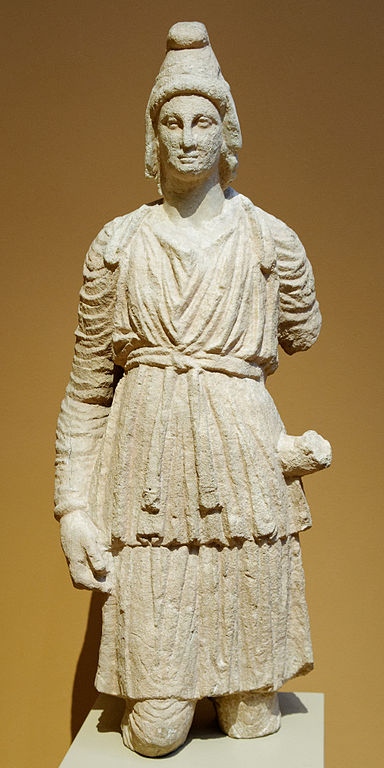
My story was inspired in part by the Egyptian and Thracian immigrant communities we know existed in Classical Athens. There were temples in the city to both the Egyptian goddess Isis and the Thracian goddess Bendis. But Athens wasn’t the only place Egyptians and Thracians crossed paths.

A famous Thracian courtesan named Rhodopis worked in Naucratis, the Greek trading city in Egypt in the 6th century BCE. She seems to have been a larger-than-life character whom people liked to tell stories about. It was apparently widely believed in antiquity that one of the three great pyramids at Giza was built for her by her lovers. Another fanciful story about her is the closest ancient equivalent to the story of Cinderella:

They say that one day, when Rhodopis was bathing, an eagle snatched her sandal from her serving maid and carried it away to Memphis. There the king was administering justice in the open air and the eagle, flying over his head, dropped the sandal in his lap. The king, moved by the beauty of the sandal and the extraordinary nature of the event, sent all through the country to find out whose it was. She was found in Naucratis and conducted to the king, who made her his wife.

– Strabo, Geography 17.1.33

(My own translation)

While this is obviously just a bit of a fairy tale, Rhodopis was a real person. One of her lovers was Charaxus, the brother of the lyric poet Sappho. Sappho evidently didn’t think much of the relationship. A fragment of one of Sappho’s poems throws a little shade the courtesan’s way (referring to Rhodopis as Doricha—it was not unusual for courtesans to use several different names):

O, Aphrodite, may she find you too bitter for her taste,

and don’t let her go boasting:

“What a sweet thing Doricha has got herself into

this time around!”

– Sappho, fragment from Oxyrhynchus papyrus 1231.1.1.(a)

(My own translation)

Herodotus reports that the rich offering Rhodopis made at Delphi at the end of her life to celebrate her good fortune—an enormous pile of iron roasting spits—was still to be seen there in his day. (Herodotus, Histories 2.135)

Rhodopis sounds like she would have been an interesting person to hang around with, and Hidden Youth is one more reminder that interesting people were everywhere in history, not just in the places we expect.

Image: Greek statue of Bendis, photograph by Marie-Lan Nguyen via Wikimedia (Cyprus, currently Metropolitan Museum of Art, New York; 3rd c. BCE; limestone)

Announcements from your hosts.

The Attack on the Hermas

161114hermaA strange thing happened one night in ancient Athens. This incident, the attack on the hermas, provides the background for my short story “How I Saved Athens from the Stone Monsters,” in the collection Hidden Youth. While there are no stone monsters in the actual history, it’s a fascinating story in its own right.

It was the spring of 415 BCE. All around the city—at crossroads, in marketplaces, in front of houses and temples—stood square stone posts carved with human heads on top and crude penises in front. These were the hermas, stones sacred to the god Hermes that the Athenians believed protected their homes and city against bad fortune. The people of the city woke up one morning to discover that the hermas had been smashed up in the night.

Now, in any city, you would expect people to be upset to wake up to widespread vandalism, but Athens was no ordinary city and these were no ordinary times. Athens had been at war with Sparta for more than a decade. A war that both sides had expected to be quick and decisive had turned into a long, unwinnable slog. The Spartans had repeatedly ravaged the Athenian countryside. Farms had been burned and vineyards wrecked. Behind the walls of Athens, plague had slaughtered the refugees who sought shelter from the Spartans. Athens had not seen such suffering since the Persian army of Xerxes captured and burned the city more than half a century before.

In the midst of the destruction, democracy and social cohesion suffered. The poor farmers from the countryside whose homes and fields got burned lost everything while the rich merchants and landowners in the city were mostly unaffected. The leading general Pericles’ strategy of pulling back behind the walls and sending out the fleet to raid the Spartan coast felt slow and cowardly to people used to the swift clash of the hoplite phalanx. Indeed, it was the solidarity of standing shoulder-to-shoulder, row upon row in the phalanx, regardless of family or property, that grounded the Athenian democracy, but those who served as hoplites were now helpless behind the walls. When the plague struck, already weakened social bonds were snapped as everyone looked out for themselves and people who felt sure they were going to die anyway indulged in every impulse and vice.

In times like this, when social solidarity was strained by factional and regional conflicts, many Greek cities had turned to tyrants: aristocrats who held themselves out as champions of the people and leveraged popular anger as a way to propel themselves into power. Athens itself had had tyrants, in the decades before the wars with Persia. Wherever tyrants had risen, they crushed their rivals and abused their power until finally they were driven out and replaced with new, more balanced forms of democracy. The same had happened in Athens, but the time seemed ripe for a new tyrant to rise and sweep away the democratic system with the anger of a frustrated and fed-up populace.

A new leader had already arisen to promise the people of Athens a better future. Alcibiades, a rich and flamboyant aristocrat with time on his hands, had pushed for a major expedition to sail to Sicily and attack Syracuse. Syracuse had largely stayed out of the war between Athens and Sparta, but they had cultural ties to Sparta and were a major exporter of grain, so there was a fear that Syracuse might decide to step in and shore up Sparta against Athenian raids. The people of Athens were enthusiastic about the prospect of getting out of the city for a fight they could win. They looked forward to looting the treasuries of Syracuse and coming home victorious and rich.

Then the hermas got smashed.

Suspicion fell immediately on Alcibiades. It seemed like the sort of thing he would do. He was well known for holding raucous drinking parties with other rich young men and had a reputation for flippancy and arrogance. He was a student of Socrates, that annoying old man who refused to participate in the democratic assembly but liked to ask people tricky questions and make them look stupid. If anyone in Athens wouldn’t respect the hermas and would think that running around town at night doing some property damage would be a good joke, it would be Alcibiades.

There was some legal wrangling about whether to bring charges against Alcibiades at once or let the expedition go ahead as planned, but the upshot was that the expedition went out and Alcibiades fled Athens to find refuge among his friends in Sparta.

This all may seem like an overreaction to what amounts to little more than the ancient Athenian equivalent of some frat boys going on a bender and playing a little mailbox baseball, but context is everything. It wasn’t just that the people of Athens valued their good luck statues. This sort of flippant disregard for tradition was exactly what one expected from a tyrant. The hermas may have been old-fashioned relics of simpler times, but so, in its way, was the democracy. In the Athenian assembly, the will of the people was the law, and if it was the will of the people to have crude statues in front of their houses, to disrespect that choice was to disrespect democracy itself.

Alcibiades was exactly the sort of person who aimed at tyranny: rich, idle, and dismissive of tradition. The smashing of the hermas made those qualities obvious in a way that no one could ignore.

Thoughts for writers

It’s easy to look at the past and be perplexed by the weight people attached to symbols and minor events, but it is context that gives importance to those things that seem trivial to us. In other times, the attack on the hermas would have been a case of petty vandalism, a scandal to be argued over in the marketplace for a few days and in time forgotten. Because of the times in which it happened, it became the tangible symbol of something far more perilous: a threat to Athenian democracy itself.

This is one of the challenges of worldbuilding. Making a world that works differently from our own means creating contexts in which things that seem trivial to us carry profound weight. The power of such small things depends on the context in which they occur. The smashing up of the hermas might not seem important to us, just like no one from a hundred years ago would grasp the significance of yellow stars and shattered shop windows, or a woman refusing to give up her seat on a bus. Creating such moments—and giving our readers the context to understand them—is part of how we make our worlds feel real.

Image: herma, photograph by André Frantz via Wikimedia (Siphnos; c 520 BCE; marble)

History for Writers looks at how history can be a fiction writer’s most useful tool. From worldbuilding to dialogue, history helps you write. Check out the introduction to History for Writers here.