Visual Inspiration: Living Root Bridges

Living root bridges are an ingenious type of suspension bridge shaped from plant roots. They are common in the southern part of the Indian state of Meghalaya (in the northeast of the country), home for some of the wettest locations on Earth.

Flickr Roman Korzh Double Decker

The Khasi and Jaintia communities who inhabit the region needed a low-cost way to cross the valleys and gorges in the rainforest during monsoon season. Living root bridges are sturdy and easy to build—albeit time-consuming—and apparently they withstand flash flooding and storm surges quite well.

Flickr Ashwin Kumar Double Decker Living Root Bridge

The building process is described by Zinara Rathnayake for BBC Future as follows:

“Building these bridges takes decades of work. It begins with planting a sapling of Ficus elastica – a tree that grows abundantly in the subtropical terrain of Meghalaya – in a good crossing place along the riverbank. First the trees develop large buttressing roots and then, after about a decade, the maturing trees sprout secondary aerial roots from further up. These aerial roots have a degree of elasticity, and tend to join and grow together to form stable structures.

“In a method perfected over centuries, the Khasi bridge builders weave aerial roots onto a bamboo or another wooden scaffolding, wheedle them across the river and finally implant them on the opposite bank. Over time, the roots shorten, thicken and produce offshoots called daughter roots, which are also trained over the river. The builders intertwine these roots with one another or with branches and trunks of the same or another fig tree. They merge by a process called anastomosis – where branching systems like leaf vessels, tendrils and aerial roots naturally fuse together – and weave into a dense frame-like structure. Sometimes, the Khasi builders use stones to cover the gaps in root structures. This network of roots matures over time to bear loads; some bridges can hold up to 50 people at once.”

Flickr Roman Korzh Living Root Bridge

Despite not having the capacity of bridges built entirely from man-made materials, the capabilities of living root bridges are nothing to sneeze at in the kinds of difficult terrains they’re used for. For example, the longest living root bridge is the Rangthylliang bridge at 50+ meters long. That kind of length makes for plenty of potential for similar live-plant-based bridges in speculative gaming campaigns or stories, from ad hoc methods of river crossing for an army or a group of refugees (with the help of plant-growth spells) to permanent structures for local communities.

Living bridges can also last for many hundreds of years in ideal conditions. Even if the oldest currently existing bridges were “merely” from the 1800s, it’s clear that that kind of longevity wouldn’t be possible without community building and traditions passed on and cherished. I.e., the structures solve a concrete problem in a way that both suits and takes advantage of local conditions. We humans tend to be smart like that. 🙂

Images: Double decker by roman korzh via Flickr (CC BY-NC-ND 2.0). Second double decker by Ashwin Kumar via Flickr (CC BY-SA 2.0). Closeup of stone walkway by roman korzh via Flickr (CC BY-NC-ND 2.0).

Barbarian Migrations: The Imaginary and the Real

Previously we considered how large the groups of people who moved around the ancient world actually were and what challenges such large groups faced in migrating from one place to another.

The idea of large, cohesive groups traveling across the map to resettle elsewhere is largely a product of two things: ancient literary conventions and modern historiography. Ancient Mediterranean writers had their own literary habits. Among them was positing large groups of people picking up and resettling elsewhere as a way of explaining cultural relationships (such as, for instance, the legend that the Romans were the descendants of Trojans, or that the Spartans were long-lost kin of the Jews). These stories were not based in any reality but served the literary and political needs of those who told them.

Modern historians of the nineteenth and early twentieth centuries approached ancient history with the assumption that ethnic groups were coherent units with definable traits whose history could be traced across time and space. There was, they believed, a distinct “Gothic” or “Celtic” character that could be identified in literature and art and that marked the movement of whole peoples to replace or subjugate others. These assumptions were grounded in the systems of modern imperialism and the ideals of Romantic nationalist movements, not the realities of ancient history, but they shaped how scholars read ancient literary sources. The idea that there were mass migrations across Europe at any point in antiquity is largely a figment of the modern imagination.

When we revisit the ancient sources and the archaeological evidence, we can identify several different kinds of movement, each of which faced different versions of the problems outlined above and had different ways of dealing with them.

Long-term movement: Many of the “migrations” identified by nineteenth-century scholars are better understood as the result of small groups of people such as families, extended kin groups, or raiding parties taking similar routes over time. Each individual group was small enough to travel without overstraining the resources of the lands they moved through, but many such groups taking the same journey over an extended time period could eventually lead to significant shifts in population and local culture. This kind of movement can be seen for example in the migration of Gaulish warbands into northern Italy in the fifth and fourth centuries BCE and the large-scale shift of populations from northern and western Europe into the southern and eastern Mediterranean in the later centuries of the Roman Empire.

Armies: Other movements did involve large groups of people moving within a short time frame, and are best understood as armies on the march, attended by followers and hangers-on. The frontier peoples of the late Roman period were deeply interconnected with the Roman world. Under their own leaders, they competed for power and wealth in much the same way that Roman armies competed to put their leaders into power. Many of these groups included veterans of the Roman army and had diplomatic relations with the Roman elite. Their movements were directed at political ends, and they drew on the same resources that Roman armies did to manage the logistics of travel. The late Roman Franks and Vandals, for example, functioned essentially as armies with large civilian followings.

Refugees: Other groups of people moved en masse not by choice but because the alternative was worse. Economic and political changes could uproot some people and force them to relocate, whether they were prepared for a journey or not. Those forced to relocate could face extreme hardship, just as modern refugees too often do. We can get an idea of how desperate ancient refugees could be from accounts of peoples crossing into eastern Roman territory in the late fourth century selling their fellow refugees to the Romans as slaves at bargain prices just to feed themselves. Refugees faced the same challenges that traveling armies did, but with none of the same support; these groups probably lost many members along the way to illness, hunger, combat, or enslavement. Refugee groups include the Cimbri and Teutones in the late second century BCE and the Visigoths in the fourth century CE.

Migrating groups in antiquity were mostly small. The idea of barbarian hordes hundred of thousands strong is more fiction than history. Those who did travel in large groups mostly did so either as organized armies drawing on the same logistical resources that other ancient armies did or as refugees driven by desperation who managed the best they could under terrible circumstances.

The idea of massive hordes of barbarians migrating at once across the ancient landscape is a figment of the imagination, but that doesn’t mean that they ancient world was static. People moved, and sometimes they moved in large groups, but any such group faced enormous practical challenges. Some groups were in a position to overcome these challenges; many were not. “Barbarian” peoples did not have any special way of overcoming the practical problems of migration. They solved those problems the same way that other peoples did, in small groups, as armies, or as refugees.

Image: “Battle of Guadalete,” photograph by Christie’s via Wikimedia (1882; oil on panel; by Mariano Barbasán Lagueruela)

Barbarian Migrations: Logistics

In a previous post, we considered the sizes of migrating groups in antiquity. We can probably dismiss any idea of hundreds of thousands of people pouring across the Roman Empire, but the challenges of moving even 10,000 people long distances in ancient conditions are significant.

People need things: clothing, bedding, medicine, tools, weapons, and most of all food and water. People on the road have to make do with less, but some things are still essential for survival and must be either carried with the group or found along the way. The more stuff people carry with them, the slower they move and the longer it takes for them to get to a place where they can settle down and start rebuilding; the faster people move, the less they can carry with them and the more they have to either rely on finding what they need along the way or suffer without. The logistics for moving a large group of people are always a compromise between stuff and speed.

The amount of stuff people can carry is limited. A healthy adult can typically carry around 20-25 kilos and still manage to walk long distances. Trained individuals can carry more, but people who can manage this feat are few, and in a large group will be outweighed by the young, elderly, sick, and disabled who can carry less. Animals can add to carrying capacity, but they also create greater demands for food, water, and medical care; carts or sledges can add capacity, but they are slower and limit what terrain a group can cover. The best way to carry large amounts of stuff long distances is over water, but this also limits what routes a group can take.

Healthy adults traveling by foot in good conditions can typically maintain a walking pace of about 4-5 kilometers an hour, and keep up that pace for hours at a time, covering between 20 and 40 km a day, but large migrating groups were not all made up of healthy adults and did not always have the luxury of traveling in fair conditions. A large group traveling across country would have been slow, and the larger the group, the slower it would have traveled.

The most important supplies for a traveling group are food and water. In extreme circumstances people can do without bedding, tools, weapons, even clothes, but if they run out of food and water they are done for. The average adult needs about 1.5 kilos of food and 1.5 liters of drinking water every day to sustain the exertion of long-distance travel by foot. Fresh water is available from wild sources across many parts of the temperate world, but large groups can exhaust local supplies. Some amount of food can be foraged or hunted in the wild, but there are very few landscapes anywhere rich enough in wild food sources to sustain a group of 10,000 while still allowing them time to make significant progress on their journey. A large group of people traveling across an ancient landscape had only two practical choices: carry food with them, or acquire it from the farms and fields of the regions they passed through.

Carrying your own food for a journey is helpful, but it has limits. Considering that typical adult carrying capacity is 20-25 kilos, and an adult needs 1.5 kilos of food a day, even a person carrying nothing but food can only carry about two weeks’ worth of rations. Carrying that much food means sacrificing any other gear, even the tools to prepare and cook the food with. In a large group including young, old, sick, and disabled, some people have to carry food for others. Even in the best conditions, a large group traveling overland could carry its own food for only about 10 days. Adding pack animals does not help the situation, because the proportion between what a horse, donkey, or camel eats and how much food it needs to sustain itself is the same as for a human being: even a pack animal loaded with nothing but food will eat up its entire cargo in less than two weeks. Allowing animals to graze extends the number of days they can go, but also slows them down. A large group traveling for 10 days might just be able to carry all their essential supplies with them. 10 days of travel would allow them to cover a distance of at best around 200 km, but in practice most migrating groups could not maintain such a speed. Realistically, any large group undertaking a long journey would have to acquire food (and other supplies) from the regions they traveled through.

Acquiring supplies locally is its own challenge. Ancient agriculture was of limited productivity. Most ancient farming towns did not produce a large surplus. Large migrating groups were unlikely to be carrying with them either trade goods or cash sufficient to buy or barter for all the food they needed (unless they were willing to sell off some of their own number as slaves). Any large migrating group probably reached a point, willingly or not, where they had no option but to take by force the food they needed to keep going. Such raiding surely provoked the local population to either fight back or hide their food supplies, either of which was another problem for the migrating group that slowed down their travel and stretched their resources.

Now, all of these problems did have solutions in ancient conditions. They are essentially the same problems that an army on the march faced, and there were plenty of armies in the ancient world, some of which may even have numbered in the hundreds of thousands. Armies, though, had two advantages that migrating groups did not: 1) they were mostly made up of healthy adults, and 2) they had the financial and logistical support of a state behind them. Groups of people that did not have these two advantages faced serious challenges if they wanted to move long distances en masse.

Next time, we’ll put together what we know about the realities of numbers and logistics to see what we can say about what a “barbarian migration” might have actually looked like.

Image: Huns via Wikimedia (1910; painting; by Georges-Antoine Rochegrosse)

Barbarian Migrations: Numbers

Barbarian migrations are a staple of popular histories of the ancient world. From early wandering groups like the Cimbri and Teutones in the late second century BCE to massive hordes of Goths, Vandals, Juthungi, and the like streaming across the map of the late Roman Empire, it seems that gathering up in huge masses and tromping around the world is just what barbarians do.

But is it? The popular image of migrating barbarian hordes comes from older scholarship, many of whose assumptions and conclusions have been challenged in recent generations. No one today doubts that people in antiquity moved, sometimes in groups, and sometimes long distances, but the idea of massive hordes pouring across the landscape is becoming less and less tenable.

To get an idea of why massive barbarian migrations are questionable, we’ll consider two interrelated issues: numbers and logistics. How large were the groups that moved long distances in antiquity? And how did those groups manage the practical problems that come with moving long distances? This post addresses numbers. In the next post, we’ll talk about logistics. Finally, we’ll see what conclusions we can draw about how and why large groups of people moved around the ancient world.

Ancient sources are notoriously unreliable when it comes to estimating the numbers of people in large groups. Greek and Roman writers trying to describe the movements of large groups of potentially hostile outsiders are especially unreliable. Even today it is difficult to estimate the size of crowds, and we have much better tools at our disposal than ancient authors did. Most writers who report figures for the movement of large groups were not eyewitnesses, and were certainly not in a position to get an accurate count.

Greek and Roman authors had reasons to exaggerate the scale of forces they perceived as hostile intruders. A large movement was more dramatic to write about, and the defeat of a large hostile force reflected more glory on the Greek and Roman armies and leaders who fought them. The literary mood of late antiquity was particularly pessimistic, influenced both by the competition for power among rival generals who needed to claim that they had triumphed over unbeatable odds and the Christian hope for an apocalyptic end of the world. The image of massive hordes of invading barbarians suited the needs of contemporary writers, but that does not mean that barbarians were actually invading in massive hordes. The same dire language was used to describe urban unrest, rural banditry, undisciplined soldiers, even overzealous monks.

Still, there was nothing new about Greek and Roman authors wildly overestimating the size of outside groups on the move. The Greek historian Herodotus in the fifth century BCE famously estimated the size of the Persian king Xerxes’ expeditionary force in Greece (army and navy combined) at a ludicrously high figure of 5,283,220; modern estimates vary, but generally put the total at less than 100,000.

Given these facts, we should be skeptical of ancient sources that breezily conjure up 80,000 Vandals, 150,000 Goths, or 400,000 followers of Radagaisus. While any of these figures could theoretically be correct, and we cannot categorically reject them, none of them is any better than an estimate by an outside observer passed through several hands and recounted by a writer with literary and political axes to grind.

So, how large were the actual groups of people moving around the ancient world? It is impossible to say with any certainty, but we can make a few suggestions. To begin with, the lower literary estimates are a workable upper bound. 80,000 is repeated by enough sources in enough different contexts that it probably represents a literary convention for “a very big number of people.” If we suppose that this literary convention is derived from actual experience of the practicalities of moving large groups of people, then it makes sense to suggest that few if any moving groups in antiquity numbered more than 80,000, and most were much smaller.

Accounts of some late antique battles give figures of approximately 10,000 fighters in the “barbarian” armies. These figures are questionable for all the same reasons described above, but they are not out of proportion to the sizes of known ancient armies. Fighting forces represent only a fraction of an entire population, conventionally estimated at an eighth, or perhaps as much as a quarter in extreme circumstances. A fighting force of 10,000 would then represent a total population of 40,000-80,000. Since the “barbarian” armies in these battles were often temporary alliances of disparate groups, the constituent groups themselves must have been smaller.

Our numbers can only be speculative, but drawing together these inferences, we are probably not terribly far wrong if we imagine most migrating groups in antiquity on the scale of 10,000-20,000 people, with some temporary alliances adding up to 80,000 or so.

In the next post, we’ll think about what it would actually take for even a group of 10,000 or so people in ancient conditions to migrate from one place to another.

Image: Ludovisi sarcophagus, photograph by Jastrow via Wikimedia (currently Museo Nazionale Romano di Palazzo Altemps, Rome; c. 251 CE; marble)

A Roman Boat Trip to Nowhere

Most of us aren’t doing a lot of traveling these days, what with the pandemic restrictions. Some people are missing the travel experience so much they’re paying for flights to nowhere, but it’s good to be reminded that travel can also be a real pain—uncomfortable accommodations, bad food, rude fellow passengers, awkward schedules, and the like.

Travel could be just as difficult in the past, too. Here’s the Roman poet Horace’s description of an unintentional canal boat trip to nowhere to remind you of what you’re (not) missing.

[…] An hour went by in taking fares
and hitching up the mule. The vile marsh midges and frogs
kept sleep at bay; all the while a boatman, sloshed on cheap wine,
competed with a passenger in crooning to absent
girlfriends. At last, worn out, the passenger went to sleep
and the lazy boatman hitched the mule to a rock
to graze, then flopped down and snored.
When morning dawned we realized the old tub
wasn’t moving, not until some hothead jumped up and gave
the mule and boatman both a good thrashing about the head and hindquarters
with a willow switch. […]

– Horace, Satires 1.5.13-23

(My own translation)

Enjoy the pleasures of just staying home!

Serving exactly what it sounds like, the Quotes feature excerpts other people’s thoughts.

Aiming for Alpha Centauri with Light-driven Nanocraft

Some people say we’re living through a golden age of science fiction and fantasy, and I for one agree. I’d also argue that we’re living through a golden age of science and exploration, especially of space.

Breakthrough Starshot is a new-to-me initiative whose aim is to “demonstrate proof of concept for ultra-fast light-driven nanocrafts, and lay the foundations for a first launch to Alpha Centauri within the next generation.”

Breakthrough Starshot Light-driven Art image3

Alpha Centauri would be reachable within a reasonable timeframe if unmanned space flight could reach 20 % of the speed of light. Ultra-light craft with solar sails could, they calculate, reach and fly by the system in just over 20 years.

The Breakthrough Initiatives were founded in 2015 by Yuri and Julia Milner to “explore the Universe, seek scientific evidence of life beyond Earth, and encourage public debate from a planetary perspective.”

Judging by their News section, however, Breakthrough Listen—which is “a $100 million program of astronomical observations in search of evidence of intelligent life beyond Earth” directed from UC Berkeley—is currently producing the most interesting results.

The board of Breakthrough Initiatives consists of three people as of this writing: Stephen Hawking, Mark Zuckerberg (yes, of the Facebook reputation), and Yuri Milner (an Israeli-Russian physicist, entrepreneur, and capitalist).

I must say that the initiative sounded more exciting to me prior to checking who the board are. Then again, who knows—after all, SpaceX has had its share of successes despite having essentially started as a millionnaire pet project. At least the Breakthrough Listen data is supposed to be open to the public.

Found via Helsingin Sanomat (NB. Finnish only).

This post has been edited for clarity.

Out There is an occasional feature highlighting intriguing art, spaces, places, phenomena, flora, and fauna.

What a Long Walk Does to Your Body

A lot of speculative stories involve characters going for very long walks, whether it’s carrying the One Ring to Mordor or keeping away from other tributes in the Hunger Games. If you’re feeling cooped up inside right now, you may well be imagining a new story in which your characters travel a long way through the wilderness on foot.

I’ve written before about some of the practical details of walking long distances (here), but you may also want to think about the effect a long walk has on the human body. Here is a very interesting article by Robert Moor from a few years back about how walking the Appalachian trail affected him.

The whole article is fascinating reading, but here are few noteworthy observations from Moor about the effects of strenuous walking.

  • Your body learns to recognize good and bad foods: “you begin to acutely feel the quality of the nutrition you are putting into your body.” You come to crave those that will give sustaining energy for hours of walking, while cheap highs of sugars and fats can come with a devastating crash afterward.
  • Many walkers loose weight, shedding fat and building muscle. The result is often that as walkers go on they can walk farther and farther distances.
  • The body’s adaptation to walking, though, makes it less adapted to other demanding activities. A simple swim in a lake left Moor and another hiker “blue-lipped from the water, clutching ourselves and shivering electrically.”

Enjoy your explorations. Even if you are stuck between four walls at the moment, the imagination knows no limits!

How It Happens is an occasional feature looking at the inner workings of various creative efforts.

How to Helsinki: Last Call

Worldcon is in Helsinki this year. As a Finnish-American couple, we are very excited about this! In the coming months, we’d like to offer some practical advice about visiting Finland to our fellow fans who are considering going to the event but haven’t had experience with Finland and Finns before.

Worldcon 75 is just a week away now. In case you missed any of our previous posts, you might want to check them out, too:


Here are a few last-minute tidbits, odds and ends, and random pieces of advice that might be worth knowing if you’re getting ready to head to Helsinki:

Low-alcohol beverages, like beer and cider, are available at most grocery stores. For harder liquor (22+ % alcohol), you’ll need to go to one of the state-run Alko stores; you also must be 20 years old and have valid government I.D. Anyone who looks under 30 years of age may be carded when buying alcohol.

Apteekki = pharmacy

Apua! = Help!

Ateneum Art Museum is one of the three museums forming the Finnish National Gallery and located conveniently on the south side of Rautatientori square close to Helsinki central railway station.

Flickr Alessandro Grussu Ateneum Art Museum

DO NOT FEED THE BIRDS. That creates problems for residents, outdoor sellers, and other visitors. The seagulls at Kaupptori, for example, are already quite adept at snatching food from people. (That means they will dive AT YOU and steal your food FROM YOUR HAND. I don’t know about you, but I find that intimidating and I don’t want it to happen to me! –Eppu)

Public drinking water fountains are rare in Finland, but tap water is clean and safe. Carrying a water bottle is a good idea.

Dual flush toilets are becoming very common, and they’re easy to operate: small button for small flush, big for large. Please do take part in our environmental efforts.

Electric sockets and plugs are Europlug type C or the grounded Schuko type F.

Elevator behavior humorously put: Keep your arms and legs inside the vehicle at all times, and for the sake of everything you hold dear, do not engage in small talk.

9gag Finland Elevator

More seriously: Elevator behavior shouldn’t be a problem; just be mindful that customs may be different than you’re used to and you’ll be fine.

The number for emergency services is 112. Also note that pay phones are almost non-existent in Finland because cell phones are so ubiquitous.

You may not be able to establish eye contact with strangers on the streets. This is perfectly normal in Finland; we love our personal space and want lots of it.

Gasoline is very expensive due to taxation—keep it in mind if planning to rent a car.

If you meet a Finn with whom you share a mutual acquaintance, you may be asked to take greetings to that person. It is vital that you follow through. Carrying greetings (the Finnish word is terveisiä, which covers the whole social scale from “Say hi to your buddies for me” to “Do give my sincerest regards to your honored great-grandmother”) is serious business in Finland.

Indoor spaces tend to be warm due to effective insulation. Dress in layers for the win!

With regard to the language issue, one of the most succinct answers is by author Elizabeth Bear: “[I’ve] heard some concern about the language issue. There is no language issue. If one of your languages is English […] you will have no issues at all navigating. (It’s sort of a running joke with my agent and I that while my books sell very well in the Nordic countries as imports, we can’t get a translation deal there. Because everyone speaks English […]”

Luggage storage is available e.g. at Helsinki central railway station and at the Kamppi long distance bus station.

Mosquitoes are the bane of the Finnish summer. (We actually joke about them being our air force. –Eppu) Current reports are that this has not been a bad mosquito year, but it’s still important to take precautions if you’re sensitive to bites and will be out and about in the late evening or early morning, which are the prime biting times.

The National Museum of Finland concentrates on Finnish history from the Stone Age to 19th century and has an extensive collection of objects. The building itself, of National Romantic style, may also be of interest. Free entry every Friday 4 p.m. to 6 p.m.; at other times, entry fees apply.

National Museum of Finland

Petrol is very expensive due to taxation—keep it in mind if planning to rent a car.

Pharmacy = apteekki

The word please (or the like) doesn’t exist in Finnish. Instead, the same function is embedded in the verb form of the sentence. This doesn’t mean that Finns are inherently rude; we may sound rude to native speakers of languages that use an explicit please word if we forget to use it in other languages, and we well might slip up since it’s not ingrained.

Finnish does not have gendered pronouns. The word hän means both ‘he’ and ‘she.’ It’s not unusual for Finns, even Finns who speak English very fluently and are highly aware of gender identity issues, to slip and use the wrong gendered pronoun when speaking English. (It’s a little like English speakers learning Spanish and having to remember that forks are masculine but spoons are feminine.)

Recycling is becoming very common. Your hotel room and Messukeskus might have containers for different types of trash. Please do take part in our environmental efforts.

If you bump into someone by accident, just saying “Sori” (comes from and sounds pretty much the same as English sorry) is usually sufficient. Finns don’t really do apologies for small accidents.

Towel hooks in bathrooms are only for storing the dry towels. Spread towels to dry elsewhere (rack, over the shower stall door / shower curtain bar) and hang to store.


Some additional reading & browsing

Images: Ateneum Art Museum by Alessandro Grussu on Flickr. Finland elevator behavior via 9gag. National Museum of Finland by Eppu Jensen

In Live and Active Cultures we talk about cultures and cultural differences.

Connections: Denmark and Egypt

More than 3,500 kilometers separate the tombs of the Valley of the Kings in Egypt from the village of Ølby in Denmark, but thousands of years ago they were connected by trade.

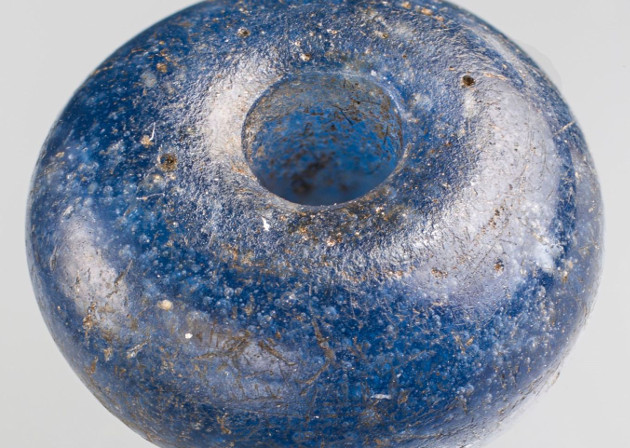
160523mapRecent archaeological work has identified a blue glass bead found in a bronze age woman’s grave in Ølby as originally Egyptian. In fact, based on the composition of the glass, researchers have suggested that the glass bead was made in the same workshop that produced the blue glass inlay on Pharaoh Tutankhamun’s gold funerary mask. Similar beads are known from several other Danish burials. In an age when glass-making as a skill known only in a few regions, colorful glass beads were as precious as gemstones.

160523glassGlass beads like these could have come to Denmark in exchange for amber from the shores of the Baltic Sea. Amber was highly prized in the ancient Mediterranean and not just as jewelry. It was sometimes fashioned into amulets for warding away evil or burned like incense. (The Roman naturalist Pliny the Elder complained about his fellow Romans’ superstitions about it; see: Pliny, Natural History 37.11.)

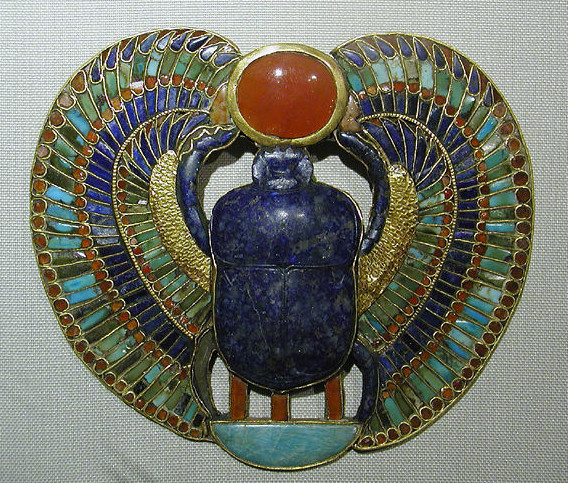
Amber has not been found in large quantities in Egypt, but it was used in some jewelry. In fact, one of the pectorals (pendants worn over the chest as amulets) wrapped up in the linen with Tutankhamun’s mummy is set with a piece of amber.

160523scarabIt’s unlikely that many Danes traveled to Egypt or Egyptians to Denmark in the bronze age. More likely both amber pieces and glass beads were carried short distances by chains of traders in between. Small, easily portable, but high-value objects like beads and gemstones are perfectly suited to this sort of down-the-line trade. A ship that was wrecked off the coast of Turkey around the same time as Tutankhamun’s burial (known as the Uluburun or Kaş Shipwreck) may have been part of that trade network. The ship, whose home port may have been in northern Syria or on Cyprus, was carrying both blue Egyptian glass and Baltic amber when it went down. Also in the ship’s cargo, interestingly, was a gold scarab inscribed with the name of Nefertiti, queen to Tutankhamun’s father Akhenaten (though she was not Tutankhamun’s mother).

Thoughts for writers

The evidence of archaeology is always a bit haphazard in nature. So much is unpredictable about what artifacts survive and what gets found. We are lucky to have the evidence from both the tombs of Tutankhamun and the woman in Ølby, as well as the Uluburun shipwreck, to help us trace out the lines of connection between Egypt and the Baltic. There is no question that connections between different peoples in the distant past were deeper and stronger than we know, but the evidence to document those connections has been lost.

Historians (at least those of the responsible sort) are limited by evidence, but fiction writers don’t have to be. When building your fictional worlds, let the fragments of evidence from our own inspire you to imagine far-flung connections and enterprising traders. Connections like these have always been important.

Images: Map by Erik Jensen based on Portable Atlas. Blue glass bead, detail of photograph by Roberto Fortuna and Kira Ursem via Haaretz (Ølby; 14th c. BCE; glass). Scarab pectoral, photograph by Jon Bodsworth via Wikimedia (tomb of Tutankhamun; 14th c. BCE; gold, glass, and precious stones)

History for Writers is a weekly feature which looks at how history can be a fiction writer’s most useful tool. From worldbuilding to dialogue, history helps you write. Check out the introduction to History for Writers here.

Travel: Water

160516junkTraveling over land is familiar. Many of us do it every day (even if we don’t do it as part of an army or with pack animals), but travel over water, though vital to the modern economy, isn’t part of daily life for most of us. Sometimes, though, the characters in your stories or games need to ride a raft downriver, strike out across the ocean in an outrigger canoe, or hoist the sails of a ship of the line. In this installment of the travel series, we look at types of pre-industrial water transport, the speeds and distances ships can travel, how much cargo ships can carry, and what it takes to make a successful voyage over water.

Speed

Ship speeds are conventionally measured in knots, equivalent to 1 nautical mile (1.151 statute miles or 1.852 km) per hour. 1 km/h is equal to 0.54 knots. In this post, I have given all speeds in terms of km/h for consistency with the other travel posts.

Types of transport

There are many different types of watercraft, from one-person rafts to massive cargo ships, but one essential way of distinguishing them is by means of propulsion. Pre-modern vessels had four basic options for propulsion: current, wind, paddles/oars, or draft.

Continue reading