Solein is a protein made from electricity, air, and carbon dioxide, plus added nutrients. The process involves fermentation, and produces a nutrient-rich powder whose macronutrient composition is very similar to that of dried soy or algae.
Ten teams were honored in the international and 18 in the U.S. section of the challenge.
In honor of Denis Villeneuve’s Dune release in Europe, here’s an older but still impressive project for making your own sandworm bread with—you guessed it—spice filling.
The recipe is by Chris-Rachael Oseland at Kitchen Overlord, and it’s an entertaining read as well as a very neat fan project. Please visit her site for more foody, nerdy goodness of all shapes!
Here’s a beautiful ancient Minoan fresco of a woman gathering saffron on a rocky hillside.
Saffron is a spice derived from the crocus flower, and since each flower produces only a tiny amount of the spice, gathering it on any scale is a labor-intensive process. With her large earrings and the many colorful, decorated layers of her clothing, this lady seems a little overdressed for such hard work. There may be various explanations. Perhaps this fresco represents a ceremonial harvest, not unlike the use of a golden shovel to dig the first scoop of dirt on a building project, or possibly a small harvest for religious use. It might also be simply an artistic depiction suitable for an elite home and not intended to represent the actual attire of an agrarian worker.
Whatever the case, it’s a beautiful work of art.
Image: Detail of saffron-gathering fresco, photograph by Yann Forget via Wikimedia (Akrotiri; c. 1700 BCE; fresco)
Out There is an occasional feature highlighting intriguing art, spaces, places, phenomena, flora, and fauna.
The newest World of Warcraft expansion, Shadowlands, was supposed to be released next Monday, October 26, 2020, but Blizzard decided to postpone it for an unknown time. Bleah. Well, these Halloween cupcakes do actually fit better with the House Stormsong aesthetic from Battle for Azeroth:
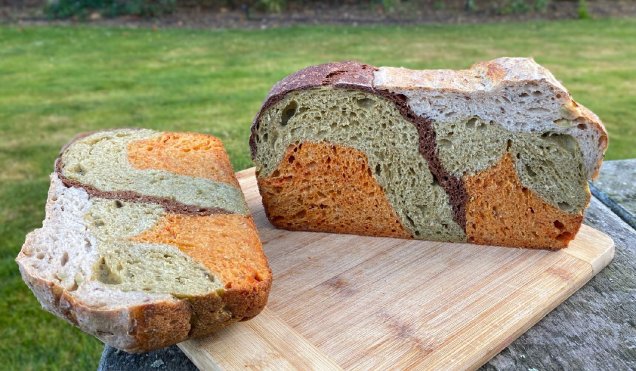
“I threw the leftover dough into a different pan and baked it, this one is coming to campus to share. The flavors are pretty mild but they’re there. If I did it again, I’d increase the basil and maybe find another red (paprika was just… fine). The garlic was very pronounced.”
I really appreciate the effort that went into baking a loaf, any loaf, never mind one with the Earth’s crust built into it. She’s a doctoral student at the University of Canterbury in New Zealand, and her dedication truly shows.
A lot of us in the U.S. and with U.S. connections are going to sitting down to a turkey dinner this week. A lot of us who live in the woodsier parts of North America also know that the farm-raised domesticated turkeys we put on the table are not the only kind of turkey out there. We have local flocks of wild turkeys around us who periodically come through our yard and entertain us with their antics. (We’re less entertained by the, shall we say, “fertilizer” they leave behind, but that has its uses, too.)
But did you know that there is a variety of wild turkeys found in the Yucatan Peninsula that has blue heads and irididescent turquoise-green and bronze-orange plumage? I didn’t until I stumbled across a reference to them this week. Look at these beauties!
Ocellated turkey, photograph by George Harrison via Wikimedia
Ocellated turkey, photograph by TonyCastro via Wikimedia
Ocellated turkeys, as they are called, are an important part of the local cuisine in addition to being extraordinary to look at.
The next time you’re writing a fantasy world and looking to spice up the local fauna, why not add some big shimmery-winged birds–that could end up roasted or stewed on the dinner table, too?
Out There is an occasional feature highlighting intriguing art, spaces, places, phenomena, flora, and fauna.
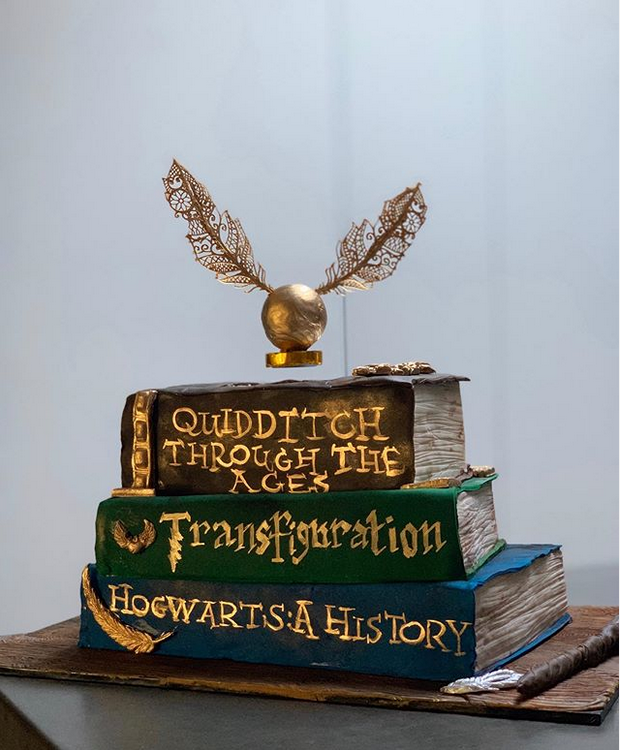
“I told you I was going to make a floating Snitch cake. (3 x 2 layer white chocolate mud cakes with vanilla meringue buttercream and blueberry and lemon or raspberry and black pepper filling. Special shout out to the wood-look board I made. [fist icon])”
Pritchett clearly is a foodie—just have a look at her amazing Twitter and Instagram feeds. Her dedication to getting the details just right is incredible. Everything is thoroughly thought-out and carefully prepared.
I’m gawping here! (Yes, I just declared gawp to be a word.)
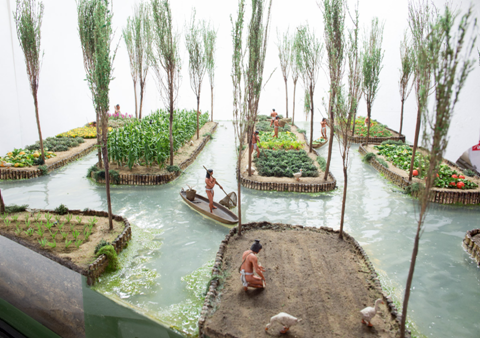
“These ingenious creations were built up from the lake bed by piling layers of mud, decaying vegetation and reeds. This was a great way of recycling waste from the capital city Tenochtitlan. Each garden was framed and held together by wooden poles bound by reeds and then anchored to the lake floor with finely pruned willow trees. The Aztecs also dredged mud from the base of the canals which both kept the waterways clear and rejuvenate [sic] the nutrient levels in the gardens.”
Apparently the chinampas were separated by channels, and canoes were used for transport. In addition to food crops and flowers grown, fish and birds drawn to the chinampas were caught for food as well.
What an incredibly smart feature to engineer! It also strikes me as a fantastic (no pun intended), pragmatic thing to adapt into a SFFnal world.
The Visual Inspiration occasional feature pulls the unusual from our world to inspire design, story-telling, and worldbuilding. If stuff like this already exists, what else could we imagine?
“I’m going to have to science the shit out of this” is my favorite line from the movie The Martian. The amazing thing about our species is that we do that every day, and every once in a while it pays off in a phenomenal way. Below are two cases that have the potential to do just that.
Researchers at the Lappeenranta-Lahti University of Technology LUT and VTT Technical Research Centre of Finland Ltd. have created a process for making protein from air. Specifically, it uses carbon dioxide, water, and electricity, plus added nutrients.
Apparently they’ve had a test installation running since June. The resulting protein powder, dubbed Solein, looks like flaky meal and reportedly tastes like wheat.
Professor Peng Wang from King Abdullah University of Science and Technology in Saudi Arabia lead a study introducing a strategy to produce fresh water. Essentially, a distillation unit attached to photovoltaic panels evaporates seawater at relatively low temperatures more efficiently than conventional solar stills and yet generates electricity at the same time.
One reason I love my fellow geeks and nerds so much is the dedication we put into things we care about. Exhibit number 18,452: a Minas Tirith wedding cake.
Photographer Jenny Wenny gives only this detail about it: “Minas Tirith wedding cake at the Enchanted Forest”; sadly no other information is available at all.
Isn’t it astounding, though? So incredibly detailed I wouldn’t want to touch it! And even though it’s a few levels short of its literary model, the adaptation works for its intended purpose perfectly. Kudos to the creator(s)!








 Co-Geeking


You must be logged in to post a comment.