(This post is mostly a Note to Self—I don’t want to forget about the study below—but if other people are interested, that’s great.)
The majority of languages spoken in North Eurasia belong to three language families—Turkic, Indo-European, and Uralic. My native language Finnish is a part of the Uralic languages; the main branches of the family are the Finno-Ugric and the Samoyed.
While there’s rough agreement over where and how Uralic languages developed and spread, and over what types of material cultures were found in the corresponding areas, no-one’s done comprehensive studies on the genetic history of Uralic-speaking peoples before.
This interdisciplinary study, lead by Kristiina Tambets from the University of Tartu, Estonia, compared genome-wide genetic variation of nearly all extant Uralic-speaking populations from Europe and Siberia.
“The genetic origins of Uralic speakers from across a vast territory in the temperate zone of North Eurasia have remained elusive. Previous studies have shown contrasting proportions of Eastern and Western Eurasian ancestry in their mitochondrial and Y chromosomal gene pools. While the maternal lineages reflect by and large the geographic background of a given Uralic- speaking population, the frequency of Y chromosomes of Eastern Eurasian origin is distinctively high among European Uralic speakers. The autosomal variation of Uralic speakers, however, has not yet been studied comprehensively. […]
“Here, we present a genome-wide analysis of 15 Uralic-speaking populations which cover all main groups of the linguistic family. We show that contemporary Uralic speakers are genetically very similar to their local geographical neighbours. However, when studying relationships among geographically distant populations, we find that most of the Uralic speakers and some of their neighbours share a genetic component of possibly Siberian origin. Additionally, we show that most Uralic speakers share significantly more genomic segments identity-by-descent with each other than with geographically equidistant speakers of other languages. We find that correlated genome-wide genetic and lexical distances among Uralic speakers suggest co- dispersion of genes and languages. Yet, we do not find long-range genetic ties between Estonians and Hungarians with their linguistic sisters that would distinguish them from their non-Uralic-speaking neighbours.”
And the conclusion:
“Here, we present for the first time the comparison of genome-wide genetic variation of nearly all extant Uralic-speaking populations from Europe and Siberia. We show that (1) the Uralic speakers are genetically most similar to their geographical neighbours; (2) nevertheless, most Uralic speakers along with some of their geographic neighbours share a distinct ancestry component of likely Siberian origin. Furthermore, (3) most geographically distant Uralic speaking populations share more genomic IBD segments with each other than with equidistant populations speaking other languages and (4) there is a positive correlation between linguistic and genetic data of the Uralic speakers. This suggests that the spread of the Uralic languages was at least to some degree associated with movement of people. Moreover, the discovery of the Siberian component shows that the three known major components of genetic diversity in Europe (European hunter-gatherers, early Neolithic farmers and the Early Bronze Age steppe people) are not enough to explain the extant genetic diversity in (northeast) Europe.”
I find the question of which material cultures may have spread together with which languages absolutely fascinating. Having my own small language / culture be a part of a larger study like this makes it even more special.
I was also surprised to learn that only three Uralic languages—Hungarian, Finnish, and Estonian—are not listed as endangered in the UNESCO Atlas of the World’s Languages in Danger. (I did know that several of the tiniest ones like Mari or the Permic languages have been endangered for decades, but I had thought that some of the Samoyed or Ugric languages had more speakers than that.)
While I doubt these three will go extinct very soon, there’s pressure at least in Finland to adopt more and more loanwords from English. Then again, we three may end up being rather rare, all in all, and I’m not quite sure whether to be alarmed over our potential disappearance or proud of our preciousness—or both.
Tambets, Kristiina et al. 2018. “Genes reveal traces of common recent demographic history for most of the Uralic-speaking populations”. Genome Biology 19:139. DOI: https://doi.org/10.1186/s13059-018-1522-1. The article is openly accessible (CC BY 4.0).
I remember liking Nalle Puh stories (as they were translated into my native language) quite a bit, so I wonder what my reaction to the voice acting will be, since I didn’t grow up thinking of the characters in terms of gender.
You see, Finnish does not have grammatical gender at all; we only have gender-neutral third-person pronouns (singular hän or plural he). This means that for me the only explicitly female character in the gang was Kengu because she was a mother, and the only explicitly male character was Risto Reipas because he was a human boy. The others were their own individual, quirky, stuffed-animal selves.
I guess the closest I can come is associating the stuffed animal characters with the non-binary gender identity. They didn’t need categorization into male or female, because that’s not how I saw their world working. I still don’t, even though talking about them in English forced me to learn which pronouns English associates with each.
It’s fascinating to notice myself using gendered English-language pronouns and yet at the same time still thinking of the stuffed animal characters as not fitting into those divisions. Eating too much honey and getting stuck in someone’s doorway, or figuring out that a popped balloon and an empty jar of honey go splendidly together do not require the gendering of anybody in the story.
I really do wonder how my perception changes after hearing voice actors and their intonational choices—or whether it will change at all.
Hey, look! We found a thing on the internet! We thought it was cool, and wanted to share it with you.
I first became aware of Adrian Tchaikovsky when he won the Arthur C. Clarke Award in 2016. I’ve been meaning to check out his writing since then. Ironclads, a limited-edition hardcover novella, finally made it to the top of my TBR pile last month.
The novella was great in several respects, but I was especially tickled by the American POV character’s descriptions of Finland and Finns. For example:
“All the middle of Nordland is the bit we’ve got problems with, basically: Sweden and Finland, say the maps. Sweden is where the fighting is, and the other place… Finland is weird. Finland is different.“
– Adrian Tchaikovsky: Ironclads
The version of U.S. in the story is fighting in Scandinavia, and, due to having laxer laws on genetic modification, Finland apparently has become home to very interesting types of special forces.
But the best, the absolutely best detail is mentioned in this section:
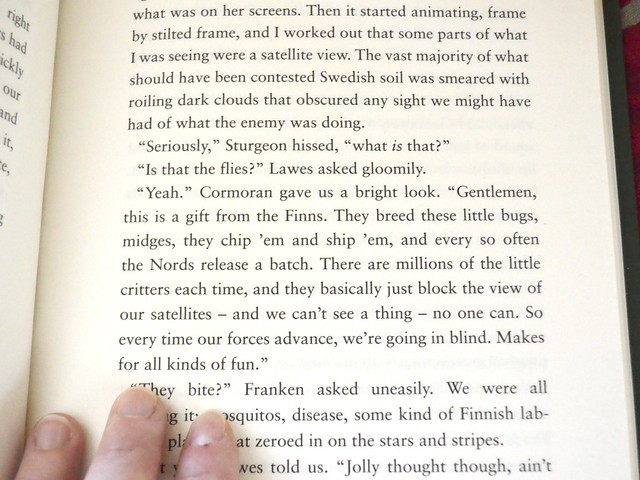
“[F]or a long time I couldn’t even work out what was on her screens. Then it started animating, frame by stilted frame, and I worked out that some parts of what I was seeing were a satellite view. The vast majority of what should have been contested Swedish soil was smeared with roiling dark clouds that obscured any sight we might have had of what the enemy was doing.
“’Seriously,’ Sturgeon hissed, ‘what is that?’
“’Is that the flies?’ Lawes asked gloomily.
“’Yeah.’ Cormoran gave us a bright look. “Gentlemen, this is a gift from the Finns. They breed these little bugs, midges, they chip ’em and ship ’em, and every so often the Nords release a batch. There are millions of the little critters each time, and they basically just block the view of our satellites – and we can’t see a thing – no one can. So every time our forces advance, we’re going in blind. Makes for all kinds of fun.’
“’They bite?’ Franken asked uneasily. We were all thinking it: mosquitoes, disease, some kind of Finnish labgrown plague that zeroed in on the stars and stripes.
“’Not yet,’ Lawes told us. ‘Jolly thought though, ain’t it?’”
– Adrian Tchaikovsky: Ironclads [original emphasis]
The militarization of mosquitoes! We already joke—as a way of dealing with an irritant that’s just a part and parcel of life—that mosquitoes are the Finnish air force. Finally, someone did it! 😀
It makes perfect sense in a world with aggressive biological research to turn a ubiquitous pest into an asset. Come to think of it, it sounds very much like the strategies that Finns used in the Winter War of 1939-1940 against Soviet forces—making native conditions work for you and against the enemy.
Of course, no one person can disapprove or approve of any characterization on behalf of their whole group. However, in My Official Opininon As a Finn, Tchaikovsky managed to balance well the view of Finland as part of Scandinavia with Finns being distinctly different from their Swedish, Norwegian, and Danish cousins. Also, he got so many little details right, like the way the Finnish language sounds, or our deep appreciation of nature.
I practically tore through the book. Kudos!
Tchaikovsky, Adrian. Ironclads. Oxford: Solaris, 2017, p. 22 and p. 29.
This post has been edited to correct a typo.
Serving exactly what it sounds like, the Quotes feature excerpts other people’s thoughts.
Juhannus is the Finnish celebration of midsummer. People usually go to a summer cottage, burn bonfires, sauna bathe, and enjoy fresh food.
Or… in our case, this year, stay in town and play! I’ve just started cleaning up my quest lists and churning out the last Legion achievements etc. in earnest before Battle for Azeroth launches in August.
I could even have a juhannus sauna in game. I’m pretty sure one of the Pinchwhistle Point huts in Spires of Arak is a sauna:
Tile floor, wooden benches, a large wood pail, and a stove for heating and making steam—sounds like a sauna to me!
Happy Midsummer! Hyvää juhannusta!
Images: 3-laptop evening by Eppu Jensen. Screencap from the MMORPG World of Warcraft, Warlords of Draenor expansion.
Of Dice and Dragons is an occasional feature about games and gaming.
“[…] I only regret one thing—making my detective a Finn. I don’t really know anything about Finns and I’m always getting letters from Finland pointing out something impossible that he’s said or done. They seem to read detective stories a good deal in Finland. I suppose it’s the long winters with no daylight.”
– author Mrs. Oliver in Agatha Christie’s Cards on the Table
This excerpt comes from a Hercule Poirot novel. It’s a page-long burst by an imaginary author who doesn’t really care about getting certain details wrong, for example when one would use a dictograph vs. phonograph. That, of course, leads to feedback from more knowledgeable readers.
Being a Finn, I guffawed! Finns are busy readers indeed these days; it may already have been the case back in the 1930s as well.
(But, good grief, way to insult Romanians and Bulgarians, Christie! There’s a lot of interest in Christie’s writing, but on the other hand a lot of it hasn’t aged well, especially the racism and bigotry.)
Christie, Agatha. Cards on the Table. New York, NY: HarperCollins Publishers, 2011 [1936], p. 66.
Image by Eppu Jensen
Serving exactly what it sounds like, the Quotes feature excerpts other people’s thoughts.
Alku (‘Beginning’), a piece by the Finnish vocal folk hop ensemble Tuuletar, appears in a Game of Thrones commercial. The band’s website says,
“’Alku’, the opening track from Tuuletar’s debut album “tules maas vedes taivaal” has been sold for the use of one of the most popular tv-series in the whole world, HBO’s Game of Thrones. The song will be heard in the season 7 DVD and Blue-Ray [sic] commercial, which will be broadcasted worldwide. The deal was made together with Finnish record label Bafe’s Factory and ThinkSync Music from London.”
The ThinkSync news page on the sale links to a German-language DVD / Blu-Ray trailer for GoT season 7 on YouTube with Alku in the background:
GAME OF THRONES Staffel 7 – Trailer #2 Deutsch HD German (2017) by Warner Bros. DE
Tuuletar mashes up a cappella, beatboxing and Finnish folk music and poetry into a unique combination. Their debut album, Tules maas vedes taivaal (‘On Fire and Earth, in Water and Sky‘), won the prestigious Emma Award (the Finnish version of a Grammy) for the best ethno album of the year in 2016.
Vocalists Venla Ilona Blom, Sini Koskelainen, Johanna Kyykoski and Piia Säilynoja make up Tuuletar. More videos at YouTube or Tuuletar website.
Congrats, Tuuletar! I first found the band two years ago just before they released their debut record, and am absolutely delighted to see them doing so well. And Alku is so amazing it gives me chills—always a sign of greatness!
The Snow Village hotel in Kittilä in Lapland, Finland, has gone all-out Game of Thrones for their 2017-2018 season. The snow and ice sculptures of various characters and scenes embellishing the resort were created in collaboration with HBO Nordic.
According to an Yle article (NB. in Finnish only), the hotel’s current look was finished at the beginning of December. While Finns built the structural parts of the snow village, the carving was done by an international team of artists with members from Ukraine, Poland, Latvia, and Russia.
It looks absolutely amazing! Just out of curiosity, I also had a look at the restaurant menus, and it sounds. So. Delicious! (Sadly, now I miss home!)
The downside is that the pricing is, erm, quite high, to stick with a polite understatement. Then again, what else is to be expected when you have to rebuild a significant part of your infrastructure every winter?
As a reader, and specifially a reader of speculative and historical fiction primarily not in my native language, I run into differences in culture a lot. And as a person in a multicultural, multilingual relationship in a strange country where I’m a cultural and linguistic minority, from time to time I find myself slammed against more deep-seated cultural assumptions.
Joan pointed out that culture is a way of thinking, or cognition, or perspective. As an example, I’d like to share two failures of cultural expectations from my personal experience.
At a con once, I wanted to get a book signed by an American author. I happened to know from their online presence that the author is an introvert. Even though we were both at a public place where introverted authors and panelists often don a more outgoing persona than they do in private, as another introvert I wanted to make sure I’d be especially considerate. However, quite without intending to I tripped over a distinctly Finnish quirk.
One of the big unspoken assumptions in the Finnish culture is that silence isn’t a negative. (Erik and I have both written about it for instance here, here, and here.) In essence, how I understand it, silence means space, and space means respect to other people.
Accordingly, at the abovementioned autograph session, when it came my turn I said my hellos, presented the author with my book, and waited silently. It wasn’t until the author asked me “Did you read it?” that I realised they expected me to say something else. And I had thought I was being courteous not to burden them with yet another dose of chitchat on a weekend full of being “on” at a busy con. I can’t remember for sure, since it was a kind of a deer in the headlights moment for me, but I think I was able to stutter my way to an exit without actually breaking into a run. In any case, not terribly smooth on my part.
I’ve also had a previously friendly person walk away from me when, in the middle of a presentation, I (I’m guessing “merely”) nodded to them to acknowledge their presence and silently continued to listen to the speaker (I’m guessing instead of starting a conversation with the friendly person). Although it’s been years, I still find that an utterly, completely, and thoroughly puzzling reaction.
Over the years, I’ve built a store of strategies and stock exchanges I can pull out if needed, but it’s been hard to try and perform—for it is essentially a performance—in a way that feels unnatural and at times even rude to me. Even after 10+ years, I still can’t bring myself to commit to it wholeheartedly. I suspect I’ll always be the odd, quiet one in Anglo-American contexts, but that’s my background and temperament.
So: yes, cultural assumptions and perspectives are difficult to convey, whether in writing or otherwise. Adding surface details to a fictional culture is easy, and it can be a fantastic tool for both creating distance from the everyday world and deepening the invented one. I love seeing glimpses of the practicalities that fictional characters deal with; I would find—and have found—stories seriously lacking without them. Never, though, should the surface glitter be where invention on the part of author ends; that is as unsatisfying as a lack of external cultural markers.
Being a truly exceptional author has, for me, come to mean not only the ability to create layered, nuanced worlds (or convey the complexities of everyday life in historical fiction). In addition, skilled authors I enjoy the most are able to avoid massive infodumps and to suggest underlying cultural values subtly, as inseparable part of narration and dialogue. And that’s a very challenging thing to do. It sometimes takes me more than one read-through to feel I’m beginning to understand a story. Then again, worthwhile things often are the most difficult ones.
A random assortment of memorable moments, thoughts, views, and quotes from our time at Worldcon 75 in Helsinki.
From the panel: Always Connected, It’s Mandatory with Effie Seiberg, Fred C. Moulton, Jo Lindsay Walton, Kristina K., and Tommi Helenius
I missed who said it and whether there were further details, but one panelist mentioned a study with the finding that merely having a cell phone on your desk, even if it’s off, lowers your ability to concentrate by about 20 percent.
The tidbit certainly gives food for thought. If true, it gives an added bonus my decision to keep my phone out the way on a small side table. Phone out of direct line of sight: +2 to concentration roll!
From the panel: Pronouns, Who Needs Gender Pronouns with Cenk Gokce, Johanna Sinisalo, Catherine Lundoff, Kelvin Jackson, and John Chu
Johanna Sinisalo shared a story from producing the freebie anthology given to congoers, Giants at the End of the World. The translator for a story she was editing asked the gender of a very minor character that passes by in the background in order to use the correct pronoun, so she passed the question on to the author. Their reply was: “Who knows?”
John Chu continued on the effect that grammatical details like that have on thinking: in English you have to specify, whereas in languages that have different pronoun systems, speakers may specify the gender of their characters.
There was an audience comment on the 3rd person singular pronoun it used of people (in reference to a panelist who remarked that that’s possible in some dialectal uses in some languages). In the commenter’s view, people want to contain multitudes, and using it of people would be taking something away.
Clearly, defining characters’ gender matters greatly to some people and not so much to others (like the “Who knows?” Finnish author). Of course, not all writing nor all works of fiction are or should be the same, or created for the same purpose. For example, when the mood takes me, I’m delighted to read fluffy comfort lit that at other times would drive me to distraction. I think the variety that exists is fantastic, and limiting our expressions—especially in speculative fiction—is, well, limiting. We as a species do indeed contain multitudes.
Autographs: I got my copy of Maresi by Maria Turtschaninoff signed.
From the panel: Editor’s Dream with Thoraiya Dyer, Masumi Washington, Katrina Archer, and Robert S. Malan
Katrina Archer, a Canadian copyeditor who works with both Canadian and American writers, mentioned that she creates a style sheet for each individual story. She includes, among others, notes on word selections (in consultation with the authors) and the dictionary and spellings used.
Self-evident, when you think about the pragmatics of editing. I’m going to steal that idea to apply for my various projects.
From the panel: Reviewing 101 with Juan Sanmiguel, Markku Soikkeli, John Clute, and Fred Lerner
Fred Lerner, by his own description “a recovering librarian” (yay librarians!), quoted Sturgeon’s Law (to the effect of: 90% of everything is crap) and noted that it therefore follows 10% is of use, so if a reviewer cannot find that 10% maybe they should do something different.
I’ll have to try and remember this. Not that I review things that often, but to vet other reviewers. (Also, note to self, a related critique panel mentioned Mary Robinette’s method which I believe is the one she tweets about here.)
In the exhibits hall: On guest of honor Nalo Hopkinson’s table, a puzzle featuring her book covers had been set out for passersby to work on. Irresistible! And a really inventive, unintrusive promo method.
Made it: There’s photographic proof I was at Worldcon!
From the panel: Jack of All Trades, Master of Several with Carl, Roseanne Rabinowitz, and Jani Saxell
Carl remarked that “external brains” (=tech) can help us branch out because looking up information is very easy.
Jani Saxell noted that as SF operates at the edges of the new and strange, you cannot prepare for everything; there should be a place for generalists in SFnal stories.
As a Jill of Many Trades myself, I found the topic fascinating. I’d note that finding information may have gotten much easier, but a lot still depends on an individual’s ability to sift the useful from useless and absorbing the appropriate bits.
Seen in person: We’ve streamed it a few times before, so we knew the routine, but it was surprisingly exciting to be able to attend the Hugo Awards ceremony.
Seen in person: I also had several nice random meetings with both old friends (some of whom I haven’t seen in over 15 years) and new-to-me people. For example, on Friday we saw a Finnish journalist and fan Jussi Ahlroth on morning tv talking about the con and later that day actually met him. Cool. 🙂
Speaking of cool: Did you know that John Howe (yes, THAT John Howe!) was at Worldcon?!?
From the panel: Older Women in Genre Fiction with Catherine Lundoff, Delia Sherman, Liisa Rantalaiho, and Helena McCallum
The panel noted among other things that women’s bodily needs aren’t usually present in stories. Older women don’t have to deal with e.g. menstruation, but they do have physical ailments due to age. Elizabeth Moon was mentioned as someone who is great at describing the difficulty of getting going in the morning, for example. The panelists also talked about how, just like in real life, older women in stories are often hiding in plain sight (i.e., ignored).
Liisa Rantalaiho noted: Older women have sex.
Another fascinating panel through and through. Elizabeth Moon’s name came up in other panels, too; clearly I need to look her up.
Seen in person: Speaking of looking people up, I found a few other new-to-me authors and artists to try. I often do that if I like what someone’s said at a panel or program item.
The end is nigh: At some point during the con, signs for marking the end of the line (when queueing into program rooms) appeared for people to hold up and pass on. Of course it would’ve been nicer if long lines hadn’t happened at all, but it was a practical and humorous solution to an annoying facilities problem.
From the panel: Gender and “Realistic History” with Cheryl Morgan, Thomas Årnfelt, Gillian Pollack, Jo Walton, and Scott Lynch
Jo Walton said that women are left out when canons get formed; if you go looking for women in extant documents, they are there.
Thomas Årnfelt mentioned a few examples of women’s occupations gleaned from 12th c. Parisian tax documents: various positions in food and textile industries, barber, goldsmith, locksmith, and night guard, among others.
Cheryl Morgan talked about how people have been constructing gender(s) in many various ways in history / around the world. E.g. beer brewing and tavern keeping are now seen as male professions, when in fact they were purely women’s work at one point. Another example she gave is that a man couldn’t work in Nelson’s army (or Napoleon’s?? can’t make out my handwriting) if he didn’t know how to sew.
Lively discussion and many, many examples. I kept missing references writing down others. I wish this panel had been videotaped!
Seen in person: A live astronaut. All three presentations / panels with Kjell Lindgren were fascinating! Here’s the video of The Kjell & Jenny Show: A NASA Astronaut and his PAO where Kjell talks about the astronaut selection and preparation process.
The Kjell & Jenny Show: A NASA Astronaut and his PAO by Worldcon 75
Once upon a time on a lunch break: I ate at the Messukeskus Hesburger fast food joint (also fondly known as Hese) purely out of nostalgia. And was proud of myself, both as a Finn and an introvert, for sharing a table and a conversation with a total stranger. I don’t typically do that. At the same place my top half was also, memorably but unfortunately, splattered with hot chocolate. Oh well. Accidents happen, and I wasn’t scalded.
From the panel: Pullantuoksuinen – Writing While Multilingual with Nina Niskanen, Aliette de Bodard, Emmi Itäranta, Ken Liu, and Jakob Drud
Emmi Itäranta commented that juggling two languages simultaneously is sometimes a hindrance (if you find a fantastic phrase in one language but not the other), but it also makes you a better writer because it forces you to be more specific in your meaning.
Ken Liu noted that it’s perhaps more important to explain a cultural concept for yourself than the audience.
I have a bad habit of code-switching out of pure sloth with Erik since he knows Finnish so well. Perhaps I ought to try and stick to one language at a time. Apart from making puns; that I won’t give up. 😀
From the panel: On the Care and Feeding of Secondary Characters with Fiona Moore, Carrie Patel, Mur Lafferty, Teresa Nielsen Hayden, and Diana ben-Aaron
“Knowing why characters exist tends to make them flat. Try not to know that.”
Really great quote. If you know who said it, please let me know! (Jo Walton???)
Another choice quote:
“I liked the way everyone was pleasant and polite. Panelists seemed to get along well with each other, even when they disagreed. Audiences seemed appreciative. The whole thing was good, low-tension fun. I sometimes think the discussions on the Internet leave people with a really wrong idea of what the experience of attending a convention is like. Problems are few, attitudes are positive, and people laugh and smile a lot.”
– Greg Hullender commenting at File 770
There were problems, and I witnessed some true clueless behavior first hand, but on the whole I agree with Greg. I saw so many examples of people greeting each other, sharing small moments of connection, helping each other out in general, troubleshooting tech issues, sharing tips and smiles, and giving up their seats to those who needed it or who might enjoy a panel more. Fandom definitely is my family. ❤
From the panel: Book Blogs with Cora Buhlert, Teresa Nielsen Hayden, Shaun Duke, and Thomas Wagner
Shaun Duke of The Skiffy and Fanty Show (I think—please correct me if I’m attributing this to the wrong person) said some authors don’t seem to understand how the Internet works. Apparently he’s chosen not to review some people because he’s seen how they’ve treated other fans and reviewers online.
Yup. Rep gets around.
Images: Fandom Is Family by Lada (ladule_b) via Instagram. Maresi by Eppu Jensen. Nalo Hopkinson puzzle by Nalo Hopkinson via Patreon. Art of the Snapshot panel audience by Baron Dave Romm (david_e_romm) via Instagram. Hugo Awards ceremony collage by Aki Parhamaa (writer_aki) via Instagram. John Howe by Aki Parhamaa (writer_aki) via Instagram. End of Line by Tiina Vastamaa (tiinatupuna) via Instragram. Dingy bird via MTV.How It Happens is an occasional feature looking at the inner workings of various creative efforts.
A random assortment of memorable moments, thoughts, and quotes from our time at Worldcon 75 in Helsinki.
From the presentation: Crackpot Archaeology in Scandinavia by Martin Rundkvist
One of the distinguishing traits of the crackpot is the insistence on finding meaning in every discernible pattern. To the crackpot, randomness is never acceptable.
(This is a particularly useful observation for me as a historian who works on areas and periods where we have extremely limited evidence. When evidence is so scarce, it is tempting to squeeze as much meaning as we can out of every text or artifact. Sometimes we just have to accept the randomness.)
From the workshop: Beyond the Great Wall of Europe: Worldbuilding for Non-European Settings by Jenn Lyons
In this workshop, we were divided up into small groups and assigned to come up with various aspects of worldbuilding for a hypothetical fantasy world. The group assigned to government (which I was not part of) described a society of small scattered bands without permanent leadership who pull together in times of crisis and select a temporary leader. Their ideas were based on certain Native American societies of the northeastern woodlands and gave a fairly accurate description of how societies at that scale historically tended to operate. Some other folks in the room—including the workshop leaders—critiqued them based on a European colonial misunderstanding of native North American cultures.
(It was a good reminder of how difficult it can be, even with the best of intentions, to think ourselves out of Eurocentric traditions—and why it might have been a good idea to spend a little more time working through what we mean by “European.”)
From the panel: Non-Binary Representation with Nick Hubble, D Franklin, and Nino Cipri
Non-binary characters in fiction written by binary authors have a tendency to feel like thought experiments rather than people.
From the panel: Editor’s Dream with Thoraiya Dyer, Masumi Washington, Katrina Archer, and Robert S. Malan
Always follow the submission guidelines!
(As someone who has coordinated academic conferences, I cannot agree with this strongly enough!)
From the panel: Asexuality in SFwith Todd Allis, Kat Kourbeti, and Jo Walton
The portrayal of asexuality in fiction tends to be gendered. Female asexual characters are often portrayed as inexperienced, with the assumption that she will blossom into sexuality once she finds the right person, while male asexual characters are often portrayed as quirky, damaged, or focused on obsessions that leave no room for romantic love.
From the presentation: Logic of Empire: Economics of Colonialism in Fantastic Fiction by Jesper Stage
North America in the age of European colonialism was a real post-apocalyptic setting, once European diseases had wiped out over 90% of the native population.
(I’ve never thought of it in those terms, but it’s one of the most apt descriptions I’ve ever heard.)
From a panel presenter whose name I didn’t catch, when the audience let him know they couldn’t hear him:
“You’re different to English audiences; they just sit quietly and complain at the end.”
From the panel Loses Something in the Translation: Conveying Humor, Idioms, and Cultural Concepts across Languages with Gili Bar-Hilel, Shaoyan Hu, Elena Pavlova, Dirk van den Boom, and Mirka Sillanpää
A few choice quotes:
“Writing something funny is actually very serious and hard work.”
“Toilet jokes work in most languages”
“As you know, Germans are not funny.”
From the panel: Fantasy Worldbuilding without Ableism with Fran Wilde, Marieke Nijkamp, Likhain, Nalo Hopkinson, and Leon Adams
Disability can be a too-easy go-to for authors who want to make a hero “unlikely” without engaging with the reality of living with disability.
What counts as a disability depends on context. Issues that are trivial to us, such as eyesight problems that are easily corrected with glasses, could be serious disabilities in a world without that technology. On the other hand, dyslexia, which is a challenge in the highly literate modern world, would be trivial in a world without writing.
How It Happens is an occasional feature looking at the inner workings of various creative efforts.





 From the panel: Jack of All Trades, Master of Several with Carl, Roseanne Rabinowitz, and Jani Saxell


 Images: Fandom Is Family by Lada (ladule_b)
