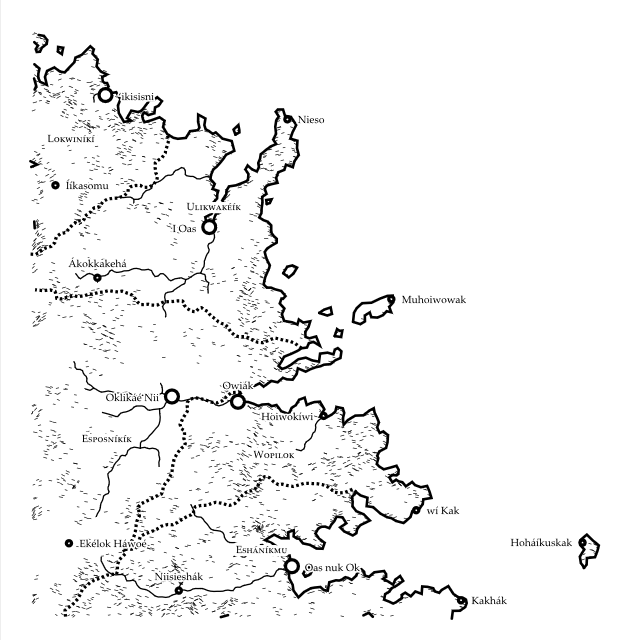
An autogenerated map for a fantasy world, including slopes, borders, coastlines, rivers, cities, and territories, created with Uncharted Atlas. Coding by Martin O’Leary
Currently mainly existing to feed material to the Uncharted Atlas twitterbot, the tool and its code are available for others as well.
“I wanted to make maps that look like something you’d find at the back of one of the cheap paperback fantasy novels of my youth. I always had a fascination with these imagined worlds, which were often much more interesting than whatever luke-warm sub-Tolkien tale they were attached to.
“At the same time, I wanted to play with terrain generation with a physical basis. There are loads of articles on the internet which describe terrain generation, and they almost all use some variation on a fractal noise approach, either directly (by adding layers of noise functions), or indirectly (e.g. through midpoint displacement). These methods produce lots of fine detail, but the large-scale structure always looks a bit off. Features are attached in random ways, with no thought to the processes which form landscapes. I wanted to try something a little bit different.”
Uncharted Atlas also generates names for cities, towns, and regions with a separate bit of code, following a set of consistent rules. For an explanation of how it works and to try your own hand at it, see the terrain notes and language notes.
As a user, I’d like to see a way to connect several of these individual maps into a larger unity, but that’s getting ahead of things—just having a free tool like this is fantastic. 🙂 Kudos!
In Making Stuff occasional feature, we share fun arts and crafts done by us and our fellow geeks and nerds.
Like the Hobbits’ dinner at the Prancing Pony in Bree, we get a pretty clear description of what the rangers of Gondor eat at their camp in Ithilien and it all makes a lot of sense for people who are stuck out in the wild away from supply lines living off rations. Ham, dried fruit, butter, and cheese are all preserved foods that keep well long-term. (4.5) Not all breads keep well, but there are many kinds that do. I’ve stuck to this description with a couple of adjustments.
First, I added a cucumber salad for the sake of some more vegetables. This particular salad uses vinegar and salt, not unlike a pickling brine. While this salad wouldn’t last as long as a proper pickle, the brine does help it keep a little longer.
Second, I made a softer bread rather than the hardtack Faramir’s troops would probably have had for their regular rations. Since Ithilien has olive trees and other characteristically Mediterranean vegetation, I’ve used a basic Mediterranean-style dough that can be baked in many different ways. (4.4)
The thinking behind these adjustments (other than I wanted a vegetable and didn’t feel like making hardtack again) is that Faramir broke out the good stuff for his honored guests. (Remember we’re going by the novel here, not the Peter Jackson movies—which were mostly great but turned Faramir into a total jerk.) Cucumbers and soft fresh bread may not be much of a luxury to most of us, but for weary travelers they could be a welcome change from waybread and forage.
“After so long journeying and camping, and days spent in the lonely wild, the evening meal seemed a feast to the hobbits; to drink pale yellow wine, cool and fragrant, and eat bread and butter, and salted meats, and dried fruits, and good red cheese, with clean hands and clean knives and plates. Neither Frodo nor Sam refused anything that was offered, nor a second, nor indeed a third helping. The wine coursed in the veins and tired limbs, and they felt glad and easy of heart as they had not done since they left the land of Lórien.”
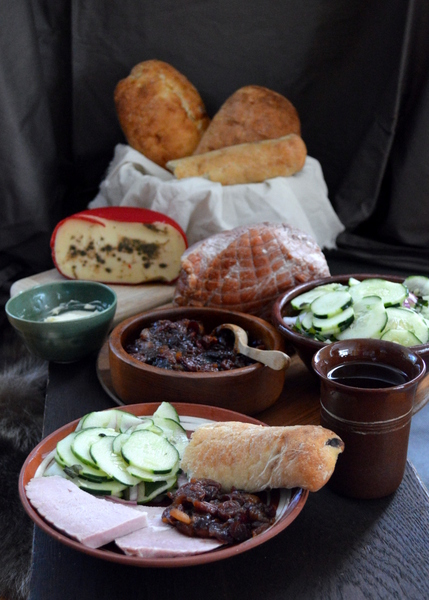
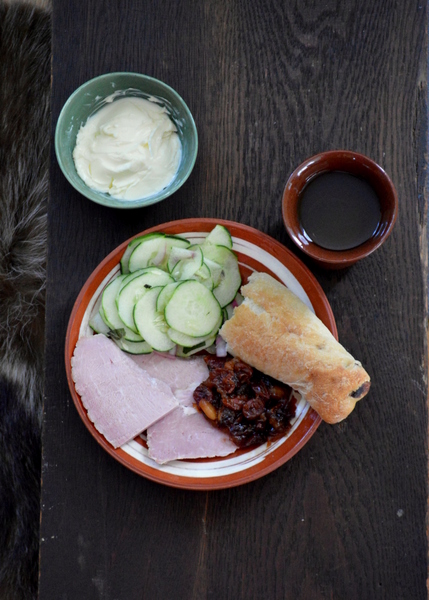
The rangers of Gondor in Ithilien offer a simple but satisfying dinner for two hungry Hobbits. For this month’s meal, we have a version following Tolkien’s description (with the addition of a salad, just to have a vegetable on the table). We served up ham with dried fruit sauce, a cucumber salad, bread, butter, and cheese, and a cup of wine to go with it.
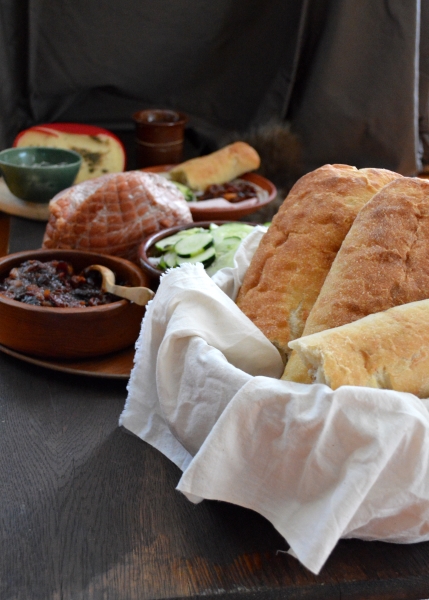
A makeshift narrow trestle table holds brown glazed pottery as well as plain wooden bowls and serving plates, closely resembling the rangers’ base. Butter is served from its own little green ceramic bowl and bread is accessible from a fabric-covered basket. Hunks of cheese can be cut on the same small wooden cutting board that it’s served on.
While there were solid choices on the list, what struck me was that out of 15 named creators only 2 were women. That’s 13%. Since women make up half of the world’s population, an eighth is an unacceptably low proportion in my eyes, so I made a list of my own.
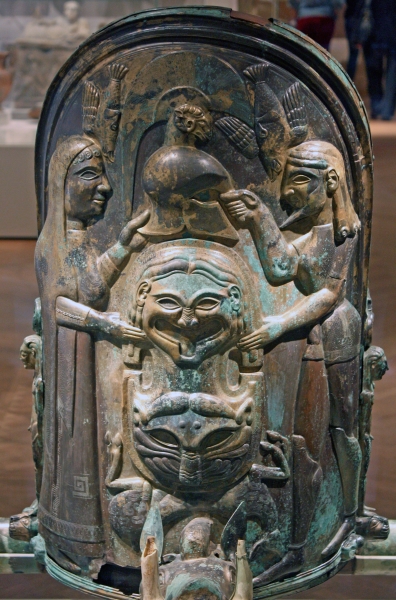
Even Achilles knows that women are an integral part of the world.
Notes on my list: 1) it’s novels only (no anthologies), 2) in a random order, 3) with no double entries (otherwise I’d include also Jemisin’s The Inheritance Trilogy), 4) and I include not only a variety of flavors within the fantasy genre but also historical fiction. Moreover, 5) I’ve included old and newer favorites as well as new-to-me authors whose works sound intriguing. Finally, 6) the common denominator is (like in the Game of Thrones) the presence of power struggles of various sorts, negotiation of identities, and survival.
1. Ursula K. Le Guin. The Earthsea cycle (A Wizard of Earthsea; The Tombs of Atuan; The Farthest Shore; Tehanu; Tales from Earthsea; The Other Wind)
Aspects of identity examined in an island-based early medievalesque world with magic and lots of sailing.
2. Kai Ashante Wilson. Sorcerer of the Wildeeps
Sword and sorcery, gods and mortals, with a band of mercenaries working as caravan guard in focus. (Linguist’s note: Fascinating mix of vernacular and more formal language.)
3. N.K. Jemisin: The Dreamblood duology (The Killing Moon; The Shadowed Sun)
Ancient-Egyptian-flavored fantasy on a moon orbiting a Jupiter-like gas giant.
4. Samuel R. Delany. Nevèrÿon series (Tales of Nevèrÿon; Neveryóna; Flight from Nevèrÿon;The Return to Nevèrÿon)
Sword and sorcery in a world before the dawn of history, with strong elements of power, economic development and breaking barriers.
A blend of a coming-of-age story with high-stakes intrigue and danger on an island with water-based tech.
Enjoy! I know I will get back to this list after finishing my current reading project.
Image: Monteleone chariot with Thetis and Achilles, detail of image by Peter Roan on Flickr CC BY-NC 2.0 (Etruscan, currently Greek and Roman galleries, The Metropolitan Museum of Art; 2nd quarter of the 6th century BCE; bronze inlaid with ivory)
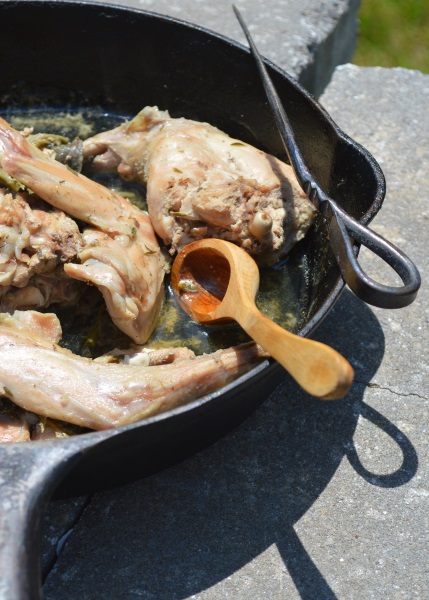
Tolkien is very clear about not only what goes into Sam’s rabbit stew but how Sam cooks it. I’ve stuck as close as I can to that recipe.
Lembas presents more of a problem, since magical Elvish bakeries are in short supply these days, but we are helped by Gimli’s observation that lembas is like a delicious version of the Dale-men’s cram. (2.8) Cram is also mentioned in The Hobbit, which tells us: “it is biscuitish, keeps good indefinitely, is supposed to be sustaining, and is certainly not entertaining, being in fact very uninteresting except as a chewing exercise. It was made by the Lake-men for long journeys.” (H13) All of which suggests one thing: hardtack.
Hardtack has been made for centuries as a way of making grain into rations that are dense with nutrition and resistant to spoilage, both qualities that are desirable in food that must sustain travelers on long journeys.
“’I’ve got a bit of a stew for you, and some broth, Mr. Frodo. Do you good. You’ll have to sup it in your mug; or straight from the pan, when it’s cooled a bit. I haven’t brought no bowls, nor nothing proper.’
“Sam and his master sat just within the fern-brake and ate their stew from the pans, sharing the old fork and spoon. They allowed themselves half a piece of the Elvish waybread each.”
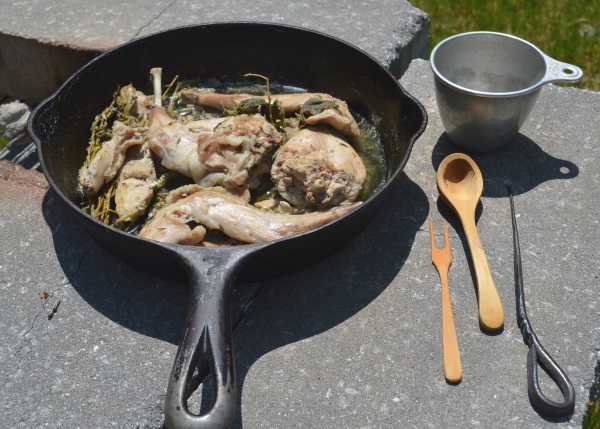
The simplest and most famous of all meals in The Lord of the Rings is without doubt the rabbit stew cooked in the wilds of Ithilien by Sam Gamgee. This is the closest Tolkien comes to giving us a recipe and we have done our best to honor both Tolkien’s words and the simplicity of the scene he evokes. This month we have a simple rabbit stew cooked on a fire outdoors and accompanied by our version of lembas bread.
Like in The Lord of the Rings, our stew is served from the pan. Hobbit implements from previous dinners (Long-Expected Party and Farewell Feast in Bag End) make a reappearance. There’s also a skewer-like metal poker for cooking, and an old metal measuring cup has pretensions of mughood. Lembas wrapped in strawberry leaves and blackberries inside a piece of cloth add a hint of comfort to the austerity.
The idea for this month’s dinner is a meal that doesn’t actually happen in Tolkien’s text. We were trying to imagine what sort of a dinner the Fellowship might have enjoyed if they had arrived at Moria and found a thriving Dwarven colony there instead of a fallen kingdom. Not only is there no particular meal in the text for us to use for reference, in fact it is a bit of a puzzle to work out what proper Dwarven food would actually be like. Gimli doesn’t have much of an opportunity in The Lord of the Rings to serve up food of his own. There’s plenty of Dwarves and plenty of food in The Hobbit, but it’s mostly the Dwarves eating food prepared by other people—Hobbits, Elves, Beorn, etc.—or making do with what they can find in the wild. We don’t get much of a sense of what Dwarves cook for a nice dinner at home or offer to guests.
So, a little speculation is called for. We can start with the fact that Moria is underground. Thorin recounts to Bilbo that the Dwarves of the Lonely Mountain traded with the Men of Dale for food rather than growing their own. (H1) We know that the Dwarves of Moria traded with the Elves of Hollin long ago, so Balin and company would probably have traded for food from the world outside as well. (2.4) Since the lands west of the Misty Mountains were quite desolate, most of the Dwarves’ trade would have been with people to the east, especially with the Beornings whose baking Gimli praises. (2.8) In those days of wolves and war, keeping the trade routes open for fresh food would have been difficult. The Dwarves of Moria would have mostly had to make do with food that would keep for a long time.
These are the ideas that inform our menu: ingredients that keep (salted and smoked meats, roasted nuts, dried lentils) and things they could have gotten in trade from the Beornings or other peoples east of the mountains (honey, bread, and flour).
“’I thought it was only a kind of cram, such as the Dale-man make for journeys in the wild,’ said the Dwarf.
‘So it is,’ they answered. ‘But we call it lembas or waybread, and it is more strengthening than any food made by Men, and it is more pleasant than cram, by all accounts.’
‘Indeed it is,’ said Gimli. ‘Why, it is better than the honey-cakes of the Beornings, and that is great praise, for the Beornings are the best bakers that I know of.’”
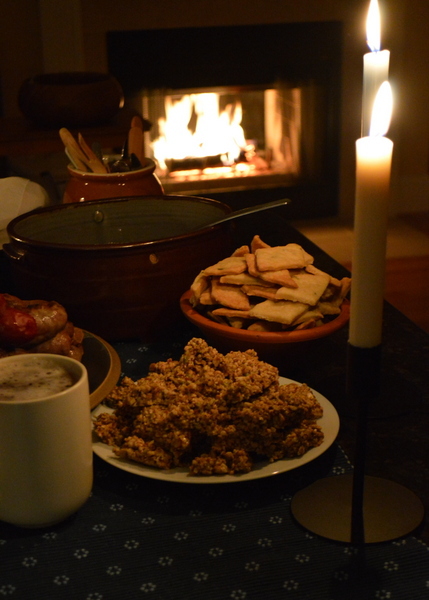
We never get to see proper Dwarven food in The Lord of the Rings, but what if we had? What would a proper Dwarven feast look like? For this month’s dinner, we try to imagine what sort of a welcome Frodo and the company might have received in Moria if they had come in better days, when Balin and his followers were bringing the ancient kingdom of the Dwarves back to life. Lentil soup, rye bread, rosemary crackers, a great pile of sausages, and honey-nut cakes make a hearty meal for weary travelers, with beer and whiskey cider punch on the side.
Instead of place settings, a pile of heavy plates stands near the food for an informal help-yourself serving. There’s also a utensils crock with a mishmash of forks, knives, and spoons. Two simple candle holders of black metal hold white tapers. They are accompanied by a tall white marbled pillar candle and a silver napkin ring for a little more flair.
A table runner with hexagonal woven decorations softens the polished stone table, and a striped scarf stands in for banners or wall hangings.
Chunky stoneware mugs for the frothy beer and simple pottery bowls for the soup are perfect for the setting.
Elven food leaves us in a bit of a pickle, as Sam Gamgee would say. We know that Elves eat and drink, but Tolkien’s descriptions of their food, as with most things Elven, are long on ethereal glamour and short on detail. (Most of our information about Elven food comes from The Hobbit. The Lord of the Rings is a little more circumspect about what exactly Elves eat.) We have to do a little detective work to come up with a menu.
“Pippin afterwards recalled little of either food or drink, for his mind was filled with the light upon the elf-faces, and the sound of voices so various and so beautiful that he felt in a waking dream. But he remembered that there was bread, surpassing the savour of a fair white loaf to one who is starving; and fruits sweet as wildberries and richer than the tended fruits of gardens; he drained a cup that was filled with a fragrant draught, cool as a clear fountain, golden as a summer afternoon.”
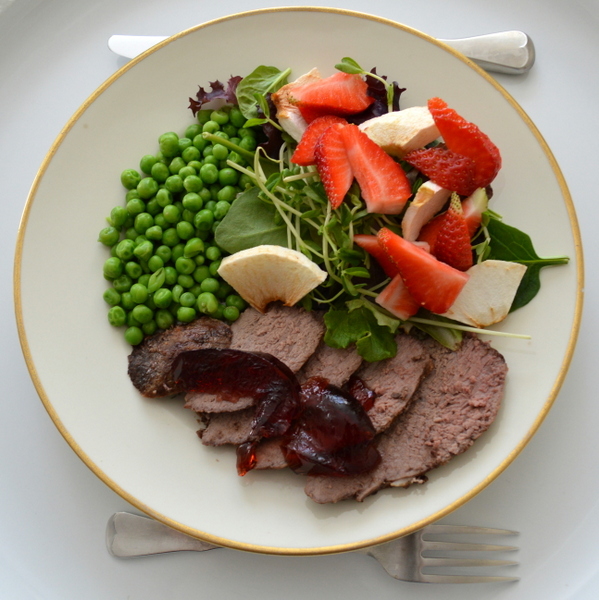
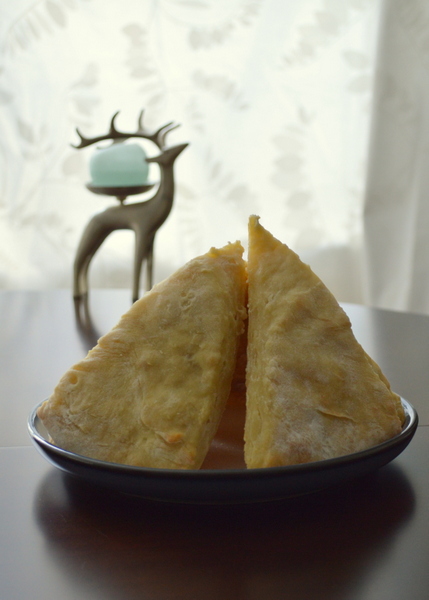
This month we present an Elven dinner such as Frodo and his companions might have enjoyed during their stay in Rivendell. With very little information from Tolkien to go on, we have put together a dinner of roast lamb, peas, bannocks, and salad, with cardamom buns for dessert and wine to go with it.
The dark wood beams Frodo saw upon waking in Rivendell inspired us to use a dark table. The vibrant greens, reds and browns of this dinner prevent the mostly white table setting from getting monotonous. A printed white on white tablecloth with meandering vines provides a thematically appropriate background. A silver-stemmed martini glass and a reindeer candle holder bring glimmers of silver to the table.
The dessert is as delicious to the eye as to the mouth: Erik’s cardamom buns are pretty enough on their own not to require a more ornate plate, especially with a small mound of strawberries placed in the middle.









 Co-Geeking
You must be logged in to post a comment.