“As he watched the TV, he remembered a lecture in his second year of college by a professor of environmental science. The gist had been that institutions, even individual departments in governments, were the concrete embodiments of not just ideas or opinions but also of attitudes and emotions. Like hate or empathy, statements such as ‘immigrants need to learn English or they’re not really citizens’ or ‘all mental patients deserve our respect.’ That in the workings of, for example, an agency, you could, with effort, discover not just the abstract thought behind it but the concrete emotions.”
– Control (John Rodriguez)
That… sounds like sociology or anthropology. Clearly environmental science has more connections with humanities / social sciences than I’ve previously thought!
VanderMeer, Jeff. Authority (Southern Reach Trilogy 2). New York, NY: Farrar, Straus and Giroux, 2014, p. 147.
Modern fantasy literature has taken a lot of inspiration from ancient Greek and Roman mythology. Many people have noted how comic book superheroes play much the same role in modern culture that heroes like Hercules and Odysseus did for ancient readers. The important difference is that Greeks and Romans regarded their heroes as real, semi-divine figures of history. Modern fantasy knows it’s all made up. That’s one of the fundamental differences between myth and fiction: the poet who retells a myth wants you believe that the story is true; the fiction author knows they’re spinning a tale.
But modern people aren’t the first to tell stories just as stories. Ancient literature, in addition to myths that made claims to historical and religious truth, offered tales of adventure, romance, and comedy, just like modern fiction. It even had some works that we would class as speculative fiction. Metamorphoses—more commonly known as The Golden Ass—by Apuleius is one of them.
There are lots of translations available. Here’s one you can read online, but I particularly recommend the translation by Sarah Ruden (Yale, 2012), which expertly captures the wit and cheek of Apuleius’ original text.
The story is told by Lucius, a young man about town who gets in over his head with magic and accidentally turns himself into a donkey. He then has madcap misadventures—getting stolen by bandits, requisitioned by a soldier, displayed in the arena, and mutely witnessing all kinds of domestic comedy and tragedy as he tries to stay alive long enough to find the antidote to cure his transformation.
In this passage, Lucius the donkey has been bought by a local magnate and is being trained to perform tricks, which causes a bit of a tricky situation for the human mind in the donkey body:
He gave me to a favored freedman of his, a well-off man, having instructed him to take good care of me. This man treated me kindly and fed me well and, to please his patron, eagerly encouraged my tricks. First he taught me to recline at the dining table, then to wrestle and even dance with my forelegs in the air. Then—even more remarkable—to respond to words by tossing my head, signing “no” by throwing it back and “yes” by nodding. When I was thirsty, I could request a drink by alternately winking my eyes at an attendant. Of course, this was all perfectly simple for me to follow and I hardly needed a trainer, but I was afraid to behave in too human a way at the table uninstructed, or they might take me for an ill omen, set on me as a monster, and serve up my fat body to the vultures.
– Apuleius, The Golden Ass 10.17
(My own translation)
Lucius’ adventures range from the lewdly ludicrous, as when a rich lady takes him for a lover, to the tragic, as when he witnesses the death of a happy newlywed couple. On the way, just about every level of society, from poor farmers to rich landowners comes in for a bit of satirical skewering. There’s also a surprise ending, which I won’t give away here.
In transforming Lucius into a donkey, Apuleius also addresses the anxieties of his time, in a society where slavery was routine and barriers of language and culture often impeded communication. Romans of his time looked on some other peoples in their world as little better than animals, and must have worried about being seen the same way themselves by others. Sudden loss of status, whether by being taken captive in war or stripped of citizen rights in the court, was nothing strange. While no one had to worry about not behaving donkeyishly enough, as Lucius does, many Roman slaves probably faced the predicament of ingratiating themselves with their masters without seeming too clever or ambitious. The story of Lucius’ adventures, like much fantasy and science fiction of recent decades, provides a way to observe and comment on these anxieties and even, in the end, to offer some hope.
The Golden Ass is a good read and a nice example of how there’s nothing new in the human urge to make up fantastical stories, or to use that fantasy to contemplate contemporary problems.
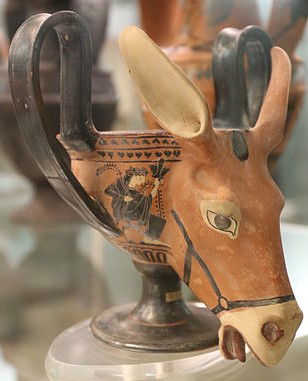
Image: Donkey head kantharos, photograph by Pymouss via Wikimedia (Athenian, currently British Museum; late 6th c. BCE; black-figure pottery)
History for Writers looks at how history can be a fiction writer’s most useful tool. From worldbuilding to dialogue, history helps you write. Check out the introduction to History for Writershere.
“Sometimes undercover work as a Librarian involved posing as a rich socialite, and the Librarian in question got to stay at expensive hotels and country houses. All while wearing appropriately high fashion and dining off haute cuisine, probably on gold-edged plates. At other times, it involved spending months building an identity as a hard-working menial, sleeping in attics, wearing plain woollen dress, and eating the same food as the [boarding school] boys.”
– Genevieve Cogman: The Invisible Library
That’s a different kind of library gig all right!
Cogman, Genevieve. The Invisible Library. New York, NY: Roc, 2016, p 2.
Serving exactly what it sounds like, the Quotes feature excerpts other people’s thoughts.
The anthology Hidden Youth, with Erik’s story “How I Saved Athens from the Stone Monsters”, is expeced in November. We don’t know exactly when yet, but we know that the file has been sent to the printer. It’s very exciting—almost there!
I rounded up some of the artwork commissioned for the collection, but first here’s my headcanon picture for “Stone Monsters.”
In the beginning of “Stone Monsters,” there’s a scene where Mnestra, one of the protagonists who works as a flute girl, uses her veil to try and attract customers. I don’t think it was Erik’s intention, but the scene immediately brought to my mind this amazing, dynamic Greek statue we’d seen years ago at The Met:
When thinking about “Stone Monsters,” this is the image that I connect with the story. Unfortunately the dancer’s veil is drawn so close that we can’t see her face. That’s where the Hidden Youth artists come to the rescue. I just happened to see this sneak peek by Paula Arwen Owen of her papercut illustration for “Stone Monsters” on Twitter:
That’s eggplant and egg, all right, with a herma in the background. 🙂 Love it!
Then I was curious and went looking for Hidden Youth art. Others have also posted glimpses of their work in progress. For example, Ellen Million:
They all look so great—can’t wait to have the book in my hands!
Images: Bronze statuette by Eppu Jensen (Greece; c. 3rd-2nd century BCE; bronze). Papercutting by Paula Arwen Owens via Twitter. Attic room by Ellen Million via Instagram. Two girls by Thio Wina Oktavia via Twitter. Dormitory by Kat Weaver via Twitter. Street seller by A. D’Amico via Twitter. Leaning girl by Jay Bendt via Tumblr. Under clouds by Charis Loke via Twitter.
In Making Stuff occasional feature, we share fun arts and crafts done by us and our fellow geeks and nerds.
The other day I saw yet another recommended books article with a headline of the type:
[number] Books You Must Read
[number] Books Every [persontype] Should Read
Ah hah hah hah haa. No. So much no. A non-descriptive headline isn’t an attraction, it’s a turnoff.
Writing a header like that, enthusiastic as it’s probably supposed to be, just comes across as lazy, narrow-minded, lazy, self-centered, and lazy marketing-speak.
It makes me think that your interests, oh dear random person on the Internet, aren’t even in the same galaxy as mine. Worse off, it sounds like you don’t care enough about your job to throw in even one modifier, not one, to narrow down the audience for your list.
There are no books you get to flat-out tell me I must or should read. For one, you’re not the boss of me. You don’t get to dictate my choices. For another, you’re not the arbiter of universal taste. What you promote is not and cannot ever be a must of anything for the rest of humankind. Furthermore, you know nothing of me; literally, not a thing. You don’t know whether I’m interested in whatever it is you’re promoting, whether I hate it, whether I’m lukewarm, or whether it might be a PTSD trigger. Assuming your recommendations are a must for everyone else is dismissive of priorities, experiences, and circumstances that differ from yours. Lastly, your puny title tells me absolutely nothing about your list. There’s not even an indication of whether we’re talking about fiction or non-fiction. I won’t waste a click on a header that’s laughably generic. Congratulations, you’ve just wasted both your time and your employer’s dollars.
Instead, tell me why I might want to have a look at your list. For example, the headlines below have a significantly higher likelihood of getting a click, provided I’m remotely interested in the topic / genre / protagonist / etc.:
[number] Books to Read If You Like [topic]
Exploring [genre] Worlds: [number] Books for Newcomers
[number] Books with [type of protagonists]
Our Favorite [genre] Books in the Style of [popular title]
Love [author]? You Might Also Like These [number] Books on [topic]
New Books for [popular title] Fans to Check Out
[number] Books to Consider for [topic] Enthusiasts
Darker, Edgier [genre] Worlds
The [number] Most Inventive Books that Break [genre] Barriers
[number] Worlds to Delve into If You Like [author]
Much, much more informative, don’t you agree?
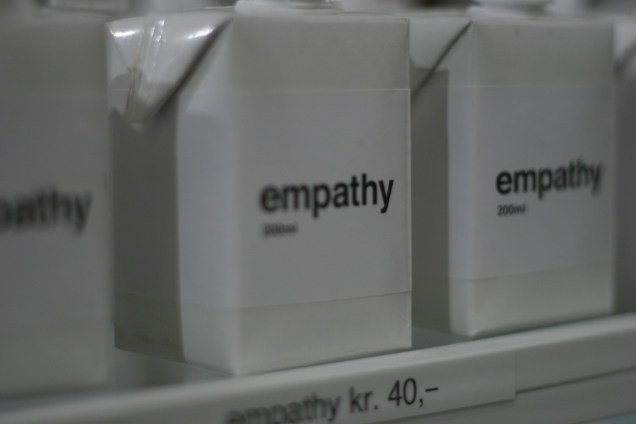
Image: detail of photograph by Mundo Resink via Flickr, CC BY-SA 2.0
In 2015, commemorating the 150th anniversary of Alice’s Adventures in Wonderland, Princeton University Press reprinted a color edition with illustrations by Salvador Dalí.
Surreal, almost psychedelic, and rarely seen before the reprint, the original gouaches were first published in 1969.
The color use is amazing, and the surrealist style fits elements of the story. However, I can’t escape the feeling that had I seen these illustrations as a kid, they would’ve given me nightmares.
I’m most interested in Arrival (based on a story by Ted Chiang and out very soon now!), Altered Carbon by Richard K. Morgan, and Lilith’s Brood by Octavia E. Butler. It would also be great to see Ann Leckie’s Ancillary series, Red Mars by Kim Stanley Robinson, and Daniel José Older’s Bone Street books on screen.
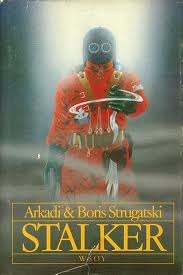
It was also intriguing to see Roadside Picnic by Arkady and Boris Strugatsky on the list, for I’m not used to seeing Eastern bloc SFF authors in the Anglo-American market. According to the all-knowing Internets, Roadside Picnic was turned into a Russian SFF art film Stalker in 1979. I never saw that, but did read the Finnish translation (Stalker: huviretki tienpientarelle) when I was too young to really understand it, so it would be nice to refresh my memory.
Besides works in progress mentioned in Zutter’s list, I’m looking forward to OtherLife. It’s adapted from Kelley Eskridge’s Solitaire (2002), which I read only this year and loved. Unfortunately, OtherLife seems currently to have paused in post-production. We live in hope, though! (I’ve been following the story of its development on Eskridge’s blog; do visit for a glimpse of indie movie projects from a writer’s perspective.)
Anything on your radar that especially tickles your fancy? Do share!
Google tells me with a lovely doodle that it’s the 37th anniversary of the first printing of The Neverending Story by Michael Ende.
Originally published in German on September 01, 1979, Die unendliche Geschichte was translated into Finnish in 1982 (and apparently English in 1983, with the film adaptation in 1984). I can’t quite remember if I ever read it. At the same time, I want to recall a gorgeous tome with both green and red print, so I guess I must at least have been handling the Finnish translation at one point.
(No, I did not imagine the green and red print!)
While the movie version isn’t terribly well-made nor the first I saw in a theater, it is one of the first screen adaptations that made me realize I was a geek even if I didn’t have a word for it at the time. It’s purely for nostalgia that I own and occasionally rewatch it. I’m now wondering whether I should’ve bought the book instead.
ICBIHRTB—pronounced ICK-bert-bee—is short for ‘I Can’t Believe I Haven’t Read This Before’. It’s an occasional feature for book classics that have for some reason escaped our notice thus far.
The other day, Erik and I were at the library borrowing some light evening viewing. On my way to the circ desk my eye fell on the Just Returned cart and on a relatively recent SFF novel that I’ve heard good things about. (I always stop to check the cart. It’s often the best spot to pick up the popular new acquisitions.)
I picked it up and flipped over to the book description to remind myself what it was about. The novel is set in an apocalyptic or dystopic world with major environmental issues. And that made me promptly put it back down. I didn’t even finish reading the book description.
What my reaction made me realize is that, for now, I’ve reached my tolerance for dark storylines with brooding characters in dire situations.
My little episode at the library collided with two random online pieces.
“One of the things that struck me about the shortlist for this year is empathy as a theme that runs through a lot of these books. Empathy across races, across borders… One of the things [my] book is about is the ability of humanity to seize value in things that are different, and the danger when that doesn’t happen.”
Tchaikovsky’s comment made me conscious of not just how done I am with dystopia, but also how much I’ve been missing stories where the nicer aspects of humanity are clearly present. That doesn’t mean all feel-good stories all the time. It does mean that lifting the darker side of humanity up into the limelight is not enough if, at most, the positive universals get slapped on like a thin coat of paint on a dilapidated theater.
“Stories have many functions: entertainment, healing, education, illustration, explanation, misdirection, persuasion. Stories have the power to shape worlds and to change lives, and so there is a lot at stake when an author sits down to write. Many people fold stories like delicate paper ships and launch them from obscure corners of the world, hoping that their ships land on distant shores and spread some of the truth of their lives to strangers. It is an act of communion, an act of humanity, the sharing of your story with another person. We each contain within us a private cosmos, and when we write of ourselves, we make visible the constellations that constitute our experience and identity.
[…]
“There can be no story without empathy. Our stories begin because we are able to enter the lives of other people. We are able to imagine how a person might move through the world, how their family might operate, what their favorite foods might be, how their nation works, how their town works, and the smallest, most inconsequential aspects of their lives rise up to meet us at our desks. You can’t write if you can’t empathize. Solipsism is anathema to good writing.”
Taylor’s piece crystallized in my mind why dystopias drag me down. It’s because many dystopic stories ignore or trivialize humane acts or traits like cooperative labor or generosity, and in doing so, they omit crucial aspects of humanity. And that—unless extremely, extremely skillfully executed—makes dystopias unsatisfying for me, exactly as I tend to think many utopian stories boring.
Just like darker traits, selfless characteristics exist today because in the past they helped us survive. They still do. We need them, and we’re better for it.
So much of my reading lately has included dystopic worldbuilding. I didn’t realize quite how much that’s been subconsciously bothering me. I’m full, thank you. No wonder books like The Long Way to a Small Angry Planet by Becky Chambers—one of the Clarke nominees, by the by—make such joyful reading experiences.
Story Time is an occasional feature all about stories and story-telling. Whether it’s on the page or on the screen, this is about how stories work and what makes us love the ones we love.
Monday is when I write, from a historian’s perspective, about some interesting or useful tidbit for writers, especially writers of genre fiction. I’m doing that again today, but from a different angle. Today I want to talk about representation, specifically the representation of people who are not straight white cis men in books, television, movies, games, and other media.
First things first: I’m a straight white cis man with no significant mental or physical challenges. I am a native-born citizen of the country in which I live and a native speaker of its majority language. I am financially secure and socially comfortable. I am not, as far as I know, heir to any titles of nobility, but other than that, if a privilege exists in the world, I’ve probably got it.
Yeah. I’m about to talk about representation. If anyone wants to get off this ride, now’s the time.
When creators and fans talk about adding representation to popular media, the refrain from people who look like me is often: “Why do we have to have X in this story? What do you mean you can’t identify with the characters? Why can’t all you Xes identify with people who aren’t exactly like yourselves?”
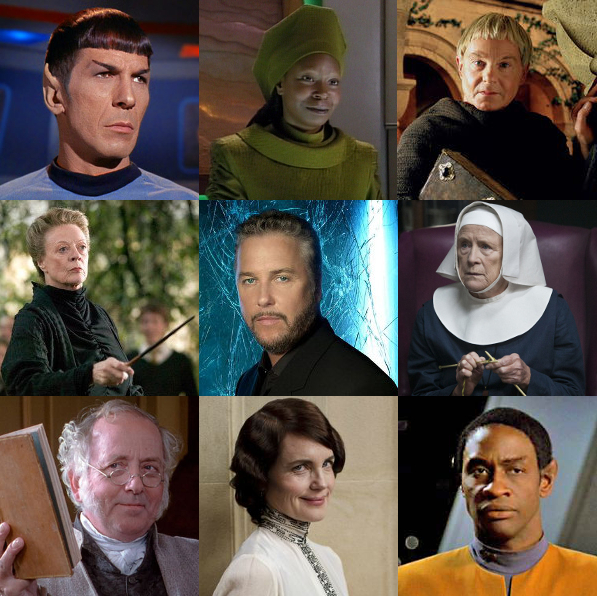
I understand where this response comes from. There are white guys all over the place in popular media, but I’ve never identified with a character just because he was a white guy. There are so many of them that I couldn’t identify with them all if I wanted to. When I look at a character and think Hey! That’s me! it comes from traits other than outward identities. Here are some of the characters I’ve felt connected to over the years:
Spock (Star Trek), Guinan (Star Trek: The Next Generation), Brother Cadfael (Cadfael novels and tv series), Minerva MacGonagall (Harry Potter novels and films), Gil Grissom (CSI), Sister Monica Joan (Call the Midwife), Mr. Bennet (Pride and Prejudice), Cora Crawley (Downton Abbey), Tuvok (Star Trek: Voyager)
They’re not all the same gender, race, age, or even species as I am. Two of them are members of a religious order, and I’m not religious at all. Most of them don’t even (fictionally) live in this century.
What can we learn from this collection? (Other than that I have a thing for Vulcans and a rather inflated sense of my ability to dole out wise advice to young ‘uns.) That representation is an aspect of privilege even when you’re not being represented. Having white guys all over the place frees me to look at the characters in my media and identify with them not based on the outward categories they fall into but because they’re thoughtful, introverted, curious, even-tempered, and passionate about knowledge.
On the other hand, I am a member of a very small minority who is rarely represented in media, and then usually in a dismissive, stereotyped, even offensive way: history professors. According to most books, movies, and tv shows, we are boring, joyless pedants in tweed jackets with elbow patches who obsess over minutiae and care only about names and dates.
“Easily the most boring class was History of Magic, which was the only one taught by a ghost. Professor Binns had been very old indeed when he fell asleep in front of the staff room fire and got up the next morning to teach, and left his body behind him. Binns droned on and on while they scribbled down names and dates, and got Emeric the Evil and Uric the Oddball mixed up.”
– J. K. Rowling, Harry Potter and the Philosopher’s / Sorcerer’s Stone Ch. 8
We always wear period clothes and are at best dimly aware of what century we actually live in, if not actively in denial about it.
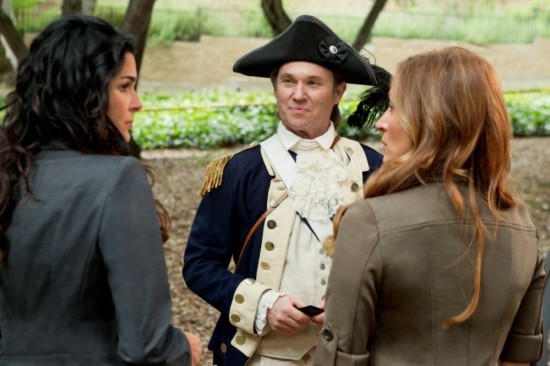
Professor Dwayne Cravitz from Rizzoli and Isles s. 2 ep. 6 “Rebel Without a Pause”
(Not to mention that we make our (black) graduate students do unpaid labor so that they can have the “authentic slave experience.”)
Oh, and if we’re medieval historians, we’re indistinguishable from renfaire performers. (I can’t find a link to it now, but the memory is seared in my mind of an NPR interview with a scholar attending the annual medieval studies conference in Kalamazoo which made it clear the interviewer thought it was basically a fantasy convention.)
Come on by my history class sometime. I won’t be wearing a costume or droning on about names and dates. I’ll be deep in conversation with my students about social structures, economic forces, multicultrual interactions, source analysis, and all the other interesting parts of history.
Now, history professors are not, by any stretch of the imagination, a historically oppressed or marginalized group. I know how aggravating it can be to be badly represented even as a comfortably privileged middle class white man, but I can’t really imagine what it must be like to be, say, a Native American woman, or a gay man who uses a wheelchair, or a Muslim teenager with Asperger’s, and have to deal with not only the weight of the social disadvantages that come with that and seeing people like myself so rarely and poorly portrayed in media.
Of course we can all identify with people who aren’t like us. That’s not the point. The point is that, no matter who we are, we all deserve to see enough people outwardly like ourselves in books, television, movies, and other media that we don’t have to identify with them just to feel like we’re there.
History for Writers is a weekly feature which looks at how history can be a fiction writer’s most useful tool. From worldbuilding to dialogue, history helps you write. Check out the introduction to History for Writers here.




 Co-Geeking


.jpg)


You must be logged in to post a comment.