Representation Is for Everyone

Monday is when I write, from a historian’s perspective, about some interesting or useful tidbit for writers, especially writers of genre fiction. I’m doing that again today, but from a different angle. Today I want to talk about representation, specifically the representation of people who are not straight white cis men in books, television, movies, games, and other media.

First things first: I’m a straight white cis man with no significant mental or physical challenges. I am a native-born citizen of the country in which I live and a native speaker of its majority language. I am financially secure and socially comfortable. I am not, as far as I know, heir to any titles of nobility, but other than that, if a privilege exists in the world, I’ve probably got it.

Yeah. I’m about to talk about representation. If anyone wants to get off this ride, now’s the time.

When creators and fans talk about adding representation to popular media, the refrain from people who look like me is often: “Why do we have to have X in this story? What do you mean you can’t identify with the characters? Why can’t all you Xes identify with people who aren’t exactly like yourselves?”

I understand where this response comes from. There are white guys all over the place in popular media, but I’ve never identified with a character just because he was a white guy.  There are so many of them that I couldn’t identify with them all if I wanted to. When I look at a character and think Hey! That’s me! it comes from traits other than outward identities. Here are some of the characters I’ve felt connected to over the years:
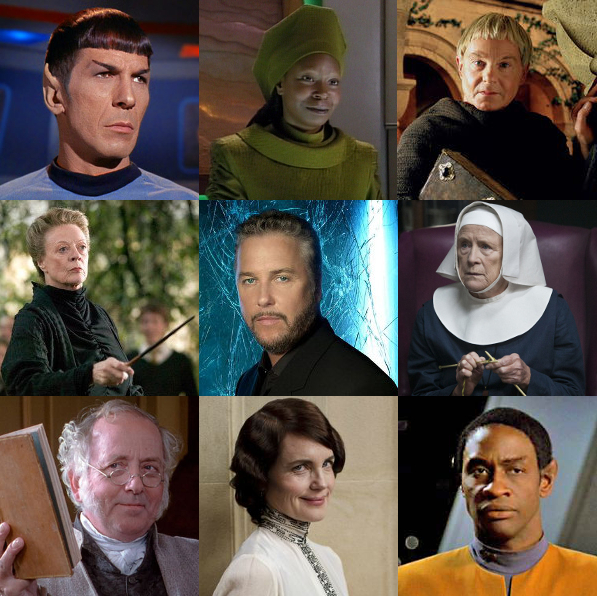
Spock (Star Trek), Guinan (Star Trek: The Next Generation), Brother Cadfael (Cadfael novels and Cadfael tv series), Minerva MacGonagall (Harry Potter novels and films), Gil Grissom (CSI), Sister Monica Joan (Call the Midwife), Mr. Bennet (Pride and Prejudice), Cora Crawley (Downton Abbey), Tuvok (Star Trek: Voyager)
Spock (Star Trek), Guinan (Star Trek: The Next Generation), Brother Cadfael (Cadfael novels and tv series), Minerva MacGonagall (Harry Potter novels and films), Gil Grissom (CSI), Sister Monica Joan (Call the Midwife), Mr. Bennet (Pride and Prejudice), Cora Crawley (Downton Abbey), Tuvok (Star Trek: Voyager)

They’re not all the same gender, race, age, or even species as I am. Two of them are members of a religious order, and I’m not religious at all. Most of them don’t even (fictionally) live in this century.

What can we learn from this collection? (Other than that I have a thing for Vulcans and a rather inflated sense of my ability to dole out wise advice to young ‘uns.) That representation is an aspect of privilege even when you’re not being represented. Having white guys all over the place frees me to look at the characters in my media and identify with them not based on the outward categories they fall into but because they’re thoughtful, introverted, curious, even-tempered, and passionate about knowledge.

On the other hand, I am a member of a very small minority who is rarely represented in media, and then usually in a dismissive, stereotyped, even offensive way: history professors. According to most books, movies, and tv shows, we are boring, joyless pedants in tweed jackets with elbow patches who obsess over minutiae and care only about names and dates.

“Easily the most boring class was History of Magic, which was the only one taught by a ghost. Professor Binns had been very old indeed when he fell asleep in front of the staff room fire and got up the next morning to teach, and left his body behind him. Binns droned on and on while they scribbled down names and dates, and got Emeric the Evil and Uric the Oddball mixed up.”

– J. K. Rowling, Harry Potter and the Philosopher’s / Sorcerer’s Stone Ch. 8

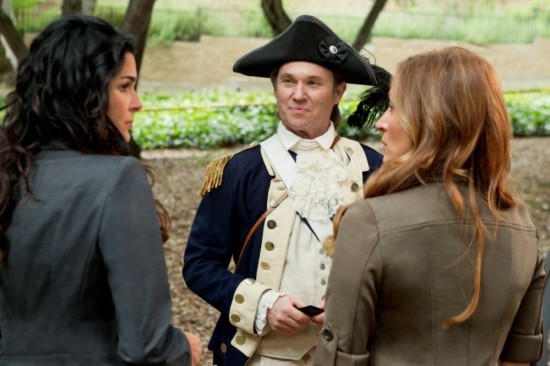
We always wear period clothes and are at best dimly aware of what century we actually live in, if not actively in denial about it.
160815RizzoliIsles
Professor Dwayne Cravitz from Rizzoli and Isles s. 2 ep. 6 “Rebel Without a Pause”

(Not to mention that we make our (black) graduate students do unpaid labor so that they can have the “authentic slave experience.”)

Oh, and if we’re medieval historians, we’re indistinguishable from renfaire performers. (I can’t find a link to it now, but the memory is seared in my mind of an NPR interview with a scholar attending the annual medieval studies conference in Kalamazoo which made it clear the interviewer thought it was basically a fantasy convention.)

Come on by my history class sometime. I won’t be wearing a costume or droning on about names and dates. I’ll be deep in conversation with my students about social structures, economic forces, multicultrual interactions, source analysis, and all the other interesting parts of history.

Now, history professors are not, by any stretch of the imagination, a historically oppressed or marginalized group. I know how aggravating it can be to be badly represented even as a comfortably privileged middle class white man, but I can’t really imagine what it must be like to be, say, a Native American woman, or a gay man who uses a wheelchair, or a Muslim teenager with Asperger’s, and have to deal with not only the weight of the social disadvantages that come with that and seeing people like myself so rarely and poorly portrayed in media.

Of course we can all identify with people who aren’t like us. That’s not the point. The point is that, no matter who we are, we all deserve to see enough people outwardly like ourselves in books, television, movies, and other media that we don’t have to identify with them just to feel like we’re there.

Images: Spock via Memory Alpha; Guinan via Memory Alpha; Cadfael via Heroes Wikia; Minerva MacGonagall via Harry Potter Wiki; Gil Grissom via CSI: Wiki; Sister Monica Joan via PBS; Mr. Bennet via Jane Austen variations; Cora Crawley via Downton Abbey Wiki; Tuvok via Wikimedia; Rizzoli and Isles “Rebel Without a Pause” via Sidereel

History for Writers is a weekly feature which looks at how history can be a fiction writer’s most useful tool. From worldbuilding to dialogue, history helps you write. Check out the introduction to History for Writers here.
20 Fantasy Worlds to Visit

Bryce Wilson at Screen Rant published a list of 15 fantasy books / series to “shak[e] off some serious Westeros withdrawal” after the sixth season finale of Game of Thrones aired at the end of June.

While there were solid choices on the list, what struck me was that out of 15 named creators only 2 were women. That’s 13%. Since women make up half of the world’s population, an eighth is an unacceptably low proportion in my eyes, so I made a list of my own.

Flickr Peter Roan Monteleone Chariot
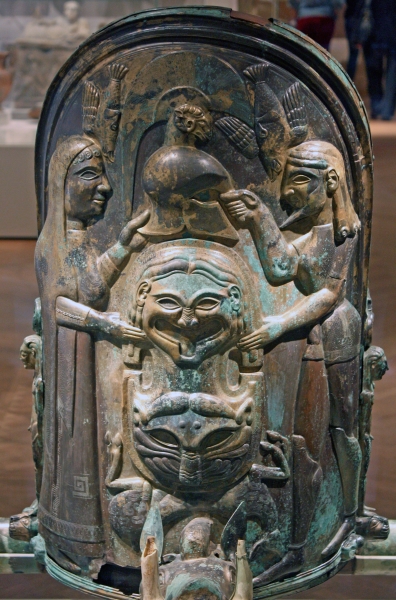
Even Achilles knows that women are an integral part of the world.

Notes on my list: 1) it’s novels only (no anthologies), 2) in a random order, 3) with no double entries (otherwise I’d include also Jemisin’s The Inheritance Trilogy), 4) and I include not only a variety of flavors within the fantasy genre but also historical fiction. Moreover, 5) I’ve included old and newer favorites as well as new-to-me authors whose works sound intriguing. Finally, 6) the common denominator is (like in the Game of Thrones) the presence of power struggles of various sorts, negotiation of identities, and survival.

1. Ursula K. Le Guin. The Earthsea cycle (A Wizard of Earthsea; The Tombs of Atuan; The Farthest Shore; Tehanu; Tales from Earthsea; The Other Wind)

Aspects of identity examined in an island-based early medievalesque world with magic and lots of sailing.

2. Kai Ashante Wilson. Sorcerer of the Wildeeps

Sword and sorcery, gods and mortals, with a band of mercenaries working as caravan guard in focus. (Linguist’s note: Fascinating mix of vernacular and more formal language.)

3. N.K. Jemisin: The Dreamblood duology (The Killing Moon; The Shadowed Sun)

Ancient-Egyptian-flavored fantasy on a moon orbiting a Jupiter-like gas giant.

4. Samuel R. Delany. Nevèrÿon series (Tales of Nevèrÿon; Neveryóna; Flight from Nevèrÿon; The Return to Nevèrÿon)

Sword and sorcery in a world before the dawn of history, with strong elements of power, economic development and breaking barriers.

5. Rosemary Kirstein. The Steerswoman

D&D-like adventures in a medievalesque world with hidden computer technology.

6. Saladin Ahmed. Throne Of The Crescent Moon

Old-fashioned sword-and-sorcery with an Arabian Nights flavor.

7. Robin Hobb. The Farseer trilogy (Assassin’s Apprentice; Royal Assassin; Assassin’s Quest)

Convoluted political intrigues and power struggles in the Six Duchies.

8. Kate Elliott. Black Wolves

Four generations of dynastic struggles in a Central-Asia-influenced world with demons and a power-hungry new religion.

9. Nicola Griffith. Hild

Political intrigue between Anglo-Saxon kingdoms in a fictionalized 7th-century Britain.

10. David Anthony Durham. The Acacia trilogy (Acacia: The War with the Mein; Acacia: The Other Lands; Acacia: The Sacred Band)

Political, economic, mythological and morally ambiguous forces battle for the control of the Acacian empire.

11. Nicole Kornher-Stace. Archivist Wasp

Yearly duels to the death to gain or retain the title Archivist in a post-collapse world with ghosts.

12. Charles R. Saunders. Imaro

Sword and sorcery, heroic warriors, grand landscapes, giants and magic in a world inspired by Africa.

13. Robert Harris. Cicero trilogy (Imperium; Lustrum [U.S. title: Conspirata]; Dictator)

Rise to and repercussions of power told through a fictional biography of Cicero.

14. Alaya Dawn Johnson. The Spirit Binders series (Racing the Dark; The Burning City)

A coming-of-age story in an island world resembling Polynesia where people have learned to bind elemental powers to their command.

15. Joe Abercrombie. The First Law trilogy (The Blade Itself; Before They Are Hanged; Last Argument of Kings)

Demons and humans in a dark, edgy world full of skirmishes.

16. Guy Gavriel Kay. The Sarantine Mosaic (Sailing to Sarantium; Lord of Emperors)

Power voids, political intrigue, assassins and travels in a world inspired by 6th-century Mediterranean.

17. Brandon Sanderson. Mistborn series (The Final Empire; The Well of Ascension; The Hero of Ages)

Magic from metals in a mist-laden world.

18. Patrick Rothfuss. The Kingkiller Chronicle (The Name of the Wind; The Wise Man’s Fear; Day Three: The Doors of Stone [working title])

Magic and music meet in a coming-of-age story.

19. Aliette de Bodard. Obsidian and Blood books (Servant of the Underworld; Harbinger of the Storm; Master of the House of Darts)

Three standalone Aztec noir fantasy-mysteries with blood magic, star-demons and war.

20. Kameron Hurley. The Worldbreaker Saga (The Mirror Empire; Empire Ascendant; The Broken Heavens [forthcoming])

Brutal power struggles in a world where plants can walk and kill, and blood magic opens portals between parallel realities.

Bonus entry by a fellow Finn:

Emmi Itäranta. The City of Woven Streets

A blend of a coming-of-age story with high-stakes intrigue and danger on an island with water-based tech.

Enjoy! I know I will get back to this list after finishing my current reading project.

Image: Monteleone chariot with Thetis and Achilles, detail of image by Peter Roan on Flickr CC BY-NC 2.0 (Etruscan, currently Greek and Roman galleries, The Metropolitan Museum of Art; 2nd quarter of the 6th century BCE; bronze inlaid with ivory)

Messing with numbers is messy.

Quotes: Our Ability to Come Together

“Because it’s those things we celebrate as ‘other’ that make us truly human. It’s what we label ‘soft’ or ‘feminine’ that makes civilization possible. It’s our empathy, our ability to care and nurture and connect. It’s our ability to come together. To build. To remake. Asking men to cut away their ‘feminine’ traits asks them to cut away half their humanity, just as asking women to suppress their ‘masculine’ traits asks them to deny their full autonomy.

“What makes us human is not one or the other–the fist or the open palm–it’s our ability to embrace both, and choose the appropriate action for the suitable situation we’re in. Because to deny one half […] is to deny our humanity and become something less than human.”

– Kameron Hurley: The Geek Feminist Revolution

Because people are not stereotypes. Stereotypes aren’t just lazy, they’re outright dangerous if carelessly applied.

Hurley, Kameron. The Geek Feminist Revolution. New York, NY: Tor, 2016. Chapter “Women and Gentlemen: On Unmasking the Sobering Reality of Hyper-Masculine Characters.”

Serving exactly what it sounds like, the Quotes feature excerpts other people’s thoughts.

Leena Krohn Is a 2016 World Fantasy Awards Finalist

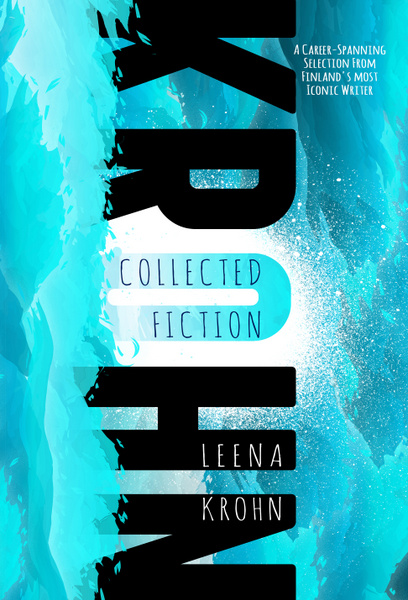
Finnish author Leena Krohn’s English-language anthology Collected Fiction (Cheeky Frawg Books, 2015) is a finalist for the World Fantasy Awards in the Collection category.

Cheeky Frawg krohn-cover-large

Collected Fiction appeared on The New Yorker‘s and The A.V. Club‘s best-of lists last year (see previous posts here and here). It was also recommended by the New York Public Library.

The awards will be presented during the World Fantasy Convention, held October 27-30, 2016 in Columbus, Ohio. Congratulations for the nomination!

Found via Locus Online.

Image via Cheeky Frawg Books.

Why Hidden Youth Matters to Me

There are just five days to go in the Kickstarter for Hidden Youth, the anthology of speculative fiction about marginalized young people in history. As I posted before, my story, “How I Saved Athens from the Stone Monsters,” is one of the stories in this awesome collection. I wanted to post again to thank everyone who has contributed to making Hidden Youth happen and also to say something about why this collection is so important to me, and would be even if I didn’t have a story in it.

160701frescoI teach ancient Mediterranean history at a state university. Ancient Mediterranean history is the dead-white-guy-est of all dead-white-guy history. It’s filled with the sorts of dead white guys that people make white marble statues of and that living white guys like to point to as the pinnacles of western literary, artistic, and philosophical achievement. We’ve basically had two thousand years of white guys burnishing their white-guy cred by laying exclusive claim to the legacy of the great dead white guys of the ancient Mediterranean. So successfully have they done this that a lot of people have a hard time imagining an ancient Mediterranean world that isn’t all white guys.

Now, I’m a white guy. I’ve always had the comfort of seeing myself in history. Even as a professional historian, doing my best to be objective and fully conscious of how complicated, contingent, and constructed such identities are, I can never really know what it is like to look at history and not see people who look like me. That’s a barrier I can’t cross, but I have a lot of friends who live on the other side, especially my students.

Half my students are women and a lot of them are black, Hispanic, and southeast Asian kids from working-class towns. They’ve lived their lives in the shadow of other people’s histories. They have been shown the dead-white-guy-marble-statue version of history and told—sometimes subtly, sometimes not so subtly—“This is ours. You don’t belong here.” I consider it my job to say: “Yes, you do. You were always part of this history.”

160701kantharosThe ancient Mediterranean world was multicultural, multi-ethnic, multilingual, and full of connections both within itself and to the larger world beyond. Like in my story, there were Egyptians in late classical Athens with their own Isis temple. A Sri Lankan king sent ambassadors to open diplomatic relations with Rome. And it wasn’t all a bunch of men, either. The queen of Halicarnassus was a military adviser to the Persian king. A wealthy woman of African ancestry was buried in style in late Roman York. The evidence is everywhere once you start to look for it.

The power of dead-white-guy-marble-statue history is strong and it needs to be challenged. I confront it in the classroom and my scholarly work, but we also need books like Hidden Youth out there to send the message: history is for everyone, not just people who look like me.

If you’ve already supported Hidden Youth, thank you so much. If you haven’t, please consider it. You can give as little as a dollar, and if you can’t do that, please spread the word.

On a less serious note, let me offer an added incentive to give: if Hidden Youth meets its funding goal, in honor of the collection’s theme I promise to translate and post my picks for The Top Five Greek and Latin Poems that Read Like Teenage Facebook Updates.

UPDATE: Hidden Youth got funded! Hooray! So, as promised, here you go: The Top Five Greek and Latin Poems that Read Like Teenage Facebook Updates.

Images: Bull leaping fresco (restored), photograph by Nikater, via Wikimedia (Knossos; 1550-1450 BCE; fresco). Janifrom kantharos, via People of Color in European Art History (Etruria, currently Villa Giulia; 6th c. BCE; ceramic)

Announcements from your hosts.

Hidden Youth Kickstarter

Life is tough as a flute girl working the streets of Athens—and that’s before the monsters attacked. When the city’s guardian statues suddenly come to life and start rampaging through the city, Mnestra, an Egyptian girl, and her Thracian friend Lampedo get separated in the chaos. Can Mnestra find the courage to rescue her friend and confront not only the monsters tearing up the city but also the most powerful man in Athens?

My short story “How I Saved Athens from the Stone Monsters” will be published this fall in the anthology Hidden Youth, a collection of 22 short fantasy and science fiction stories about young people from marginalized groups throughout history. This anthology follows the previous collection Long Hidden which told the stories of people who are often left out of speculative fiction.

I am honored to have my work chosen for Hidden Youth, but this anthology needs our help to make it out into the world. Check out the Kickstarter for Hidden Youth and consider supporting this work.

Announcements from your hosts.

Medieval Texts Hidden inside Newer Books?

After the invention of the printing press, old handwritten books and documents were commonly recycled as reinforcements in new bookbindings made in the 15th through 18th centuries. Now, thanks to an x-ray technique developed in the Netherlands, these hidden manuscript fragments are readable without destroying the book they’re a part of.

It’s all possible with macro x-ray fluorescence spectrometry (MA-XRF), which allows even pages glued to each other to be read. Dr. Erik Kwakkel at Leiden University, one of the academics behind the Hidden Library project attempting to uncover more of these fragments, has both been interviewed and written about the process.

Kwakkel leiden_ub_583_x_x

Dr. Kwakkel describes the importance of this discovery for The Observer like this:

“Every library has thousands of these bindings, especially the larger collections. If you go to the British Library or the Bodleian [in Oxford], they will have thousands of these bindings. So you can see how that adds up to a huge potential.”

He blogs about his projects and findings at Tumblr and at medievalbooks; see the latter e.g. for the exclusive behind-the-scenes post on the Hidden Library project.

Now I’m hoping we will eventually find a wealth of medieval texts in bookbindings. It’s really fascinating what we can discover with modern technology!

Image: A printed book with medieval manuscript fragments inside the spine, photograph by Erik Kwakkel (Leiden, University Library, nr. 583; 16th c. with 12th c. fragments)

Quotes: Soon I’ll Have to Switch to Finnish

“German is my last recourse for emotional outbursts and my grammar goes all to hell–heck!–when I’m mad. Soon I’ll have to switch to Finnish or learn a new language to stay ahead.”

– Kat Richardson: Poltergeist

A first-time father ponders on the nigh impossibility of keeping his language in check in front of his toddler son.

We do have some great swear words in Finnish, but, then again, I’m biased. 🙂

Richardson, Kat. Poltergeist. New York, NY: Roc, 2009, p. 88.

Serving exactly what it sounds like, the Quotes feature excerpts other people’s thoughts.

Life Cycle of a Book Infographic

This may be of interest to prospective writers (or anyone wishing to better understand the steps involved with traditional publishing): an infographic by Rachel Doll, University Press of Florida, shows a book’s journey from conception to publication.

UPF Life Cycle of a Book
Life Cycle of a Book, screencap of pdf by Rachel Doll, University Press of Florida

It lays out explicitly at what point in the process the page proofs or the book itself, for example, will be available, and some of the times that each step requires. The graphic is available for download as .pdf from University Press of Florida.

How It Happens is an occasional feature looking at the inner workings of various creative efforts.

Fizzled Towel Day Salmiakki Babel Fish

My Towel Day celebrating fizzled: the candy from my stash that I thought was salmiakki fish (for Babel fish) weren’t fish at all but cars.

Salmiakki Selection

Ohwell. At least I was able to nom some salmiakki. Also, I spotted news from my old haunts (Turku, Finland) on the towelday.org site:

“In Turku, Cosmic Comic Cafe presents its 10th annual Towel Day. Yes, Cosmic Comic Cafe has been celebrating towelness for a decade already! Theirs might be the first and oldest ongoing bad poetry night on Towel Day, they started in 2006. Unlike everywhere else in this galactic sector, their poetry night is not a competition: anyone’s and everyone’s poem (including Vogons) will be recited immediately. You churn it up, we blurt it out! The poetry shows start at 20.00 and repeats every hour till 23.00. The DJ will provide entertainment between shows. The programme ends at midnight with the Most Evil Laughter in the Universe competition. Froods carrying a towel will get a discount on Pan Galactic Gargle Blasters. While waiting for the t-day, the Finnish Towel Day site and Facebook page will be publishing daily horrible poems dug up from the last year’s archive, and introducing Towel Day activities around the globe.” [original emphasis]

(Also, apparently in Pieterburen, Netherlands, the seal rescue centre is collecting secondhand towels. Aww!)

Bonus video from 2015: ESA astronaut Samantha Cristoforetti reads an excerpt from The Hitchhiker’s Guide to the Galaxy seemingly upside down on the International Space Station:

Towel day on the International Space Station by European Space Agency, ESA

Any Towel Day activities you’re up to?

Some things are just too silly not to share!