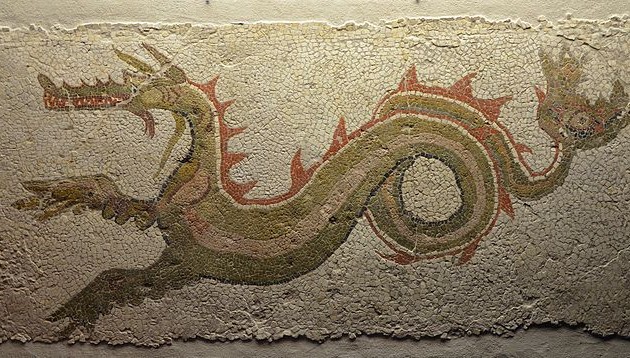
Sea monster, photograph by Carole Raddato via Wikimedia (Casa del Drago, Caulonia, Italy; 3rd c. BCE, mosaic)
This particular sea monster is in a mosaic from a house in the ancient Greek city of Caulonia in southern Italy from the third century BCE. Ancient depictions of sea monsters like this one often have long, snaky bodies, spiky fins, broad tails, and wings. These various pieces may have been cobbled together in the imagination from scattered sightings of whales, dolphins, sharks, squid, and other large sea creatures.
Out There is an occasional feature highlighting intriguing art, spaces, places, phenomena, flora, and fauna.
We often think of hyphenated identities as a particularly modern thing: Italian-American, African-Caribbean, etc. Not far from where I grew up you could go to a Franco-American heritage festival in the summer and see people walking around in t-shirts that said “Made in America with Irish Parts.” The idea that our identities can contain several distinct strands woven together is a familiar one to us, but not one we often apply to the past.
But look at this wall painting from the tomb of Petosiris, a local official in the Kharga Oasis in the western desert of Egypt. Petosiris lived during the second century CE, a time when Egypt was part of the Roman Empire. In his tomb, Petosiris took care to present himself as both Egyptian and Roman.
Wall painting from the tomb of Petosiris, photograph by Roland Unger via Wikimedia (Kharga Oasis; 2nd c. CE; fresco)
The large figure standing on the left is Petosiris himself (the damage to his face may have been done by Christians or Muslims in later centuries who mistakenly thought the image represented a pagan god). Petosiris’ name is Egyptian, but his image is painted in a typically Roman style, he wears a Roman tunic and toga, and he carries a scroll, a symbol of role as a local official for the Roman state. At the same time, he is twice the size of the other two figures in the scene, a characteristic of Egyptian art in which size was often used to indicate social status.
The other two figures are presenting Petosiris with offerings of bread and wine. The one on the left is painted in a Roman style, partially turned toward the viewer and painted with varying shading to suggest a three-dimensional image. He carries a tray of bread and pours wine from a jug into the ground. The figure on the right is painted in classic Egyptian style, clearly outlined and standing in a stylized two-dimensional posture. He offers a jug of wine and several loaves of bread on a tray. The rest of the space is filled up with a Roman-style grapevine and text in Egyptian hieroglyphics.
In this image, Petosiris proclaims an identity that is both Egyptian and Roman. We cannot be sure how he understood the combination of those identities. Did he think of himself as an Egyptian who could dress up as Roman when the occasion called for it? Or as a Roman who showed respect to the customs of his Egyptian ancestors? Or as a Roman-Egyptian, fully embracing both parts of his identity? While we cannot say for sure, it is clear that he wanted to be memorialized in his tomb as someone who could be, in some senses, both Egyptian and Roman. For Petosiris, there was a value in asserting both these parts of his identity.
Where there was one such person, there must have been many more who have not left us evidence of their identities. Clearly the local market in the oasis supported artists who could paint in either Roman or Egyptian style, as their clients requested. Kharga was a small, sleepy backwater far from the busy market towns and great harbor cities of the Mediterranean. If even in Kharga there was a demand to be able to assert a complex identity, we can only imagine how complicated the lives of people in Alexandria, Carthage, or Rome must have been.
History for Writers looks at how history can be a fiction writer’s most useful tool. From worldbuilding to dialogue, history helps you write.
A little while ago there was an Internet brou-ha-ha over Disney’s decision to cast singer Halle Bailey as Ariel in their upcoming live action version of The Little Mermaid. The harrumph is due to Bailey’s skin color.
I say the uproar is silly—it’s a fairytale, and if there’s one carved-in-stone-truth about fairytales it’s that they must and do change with the times. (Besides, I haven’t heard Bailey sing, but apparently she’s got an amazing voice. Scratch that: here’s a video clip of her singing “Unforgettable”, and her voice is indeed awesome. Talent is talent despite the shell it comes in.)
But in case someone’s arguing how black mermaids aren’t historical or some other claptrap (not even starting on mermaids being fictional to begin with), allow me to present a statue of one:
This statue depicts Dona Fish, part of the many Mami Wata traditions of Africa. As a water spirit that straddles earth and water, she often appears with the head and torso of a woman and the tail of a fish—i.e., just like a (western) mermaid.
Some ideas are so good they come around again, even thousands of years later. I recently stumbled across this beautiful glass bottle adorned with a sinuous octopus on Etsy seller Elstwhen’s shop. You can find this particular bottle here.
The Beast of the Void by Elstwhen
It reminded me of Minoan pottery, which is often adorned with vividly rendered sea life. While Elstwhen’s work is not a copy of the Minoan style, it makes similar use of asymmetry, flowing lines, and strong contrasts to create a similarly impressive effect.
Minoan flask, photograph by Wolfgang Sauber via Wikimedia (Archaeological Museum, Herakleion; c. 1500 BCE; painted pottery)
(We have no connection, financial or otherwise, with Elstwhen.)
In Making Stuff, we share fun arts and crafts done by us and our fellow geeks and nerds.
As a kid, I spent time playing in the small wooded areas nearby and imagined all sorts of critters living there. I know I did, but at some point I lost the ability (or willingness, or perhaps leisure? I remember an increase in homework around the same time). By the time I read of the enormous woodlands in Tolkien’s Lord of the Rings, I remember having trouble imagining the really large trees of Lothlórien or Mirkwood, or how Ents might be mistaken for trees.
You see, I grew up two hours south of the Arctic Circle. We have woods up there, of course, thanks to the Gulf stream. The trees may not necessarily grow very big, however—although there are exceptions—and the ones that do grow tall tend to be relatively thin and arrow-straight instead of bulky and gnarly. (Two examples here and here. Both are further south than where I grew up, but nevertheless very similar.)
So, even I can easily imagine how a forest might invoke stories of elves, trolls, ents, and other creatures on the basis of photos of Wistman’s Wood in Dartmoor, Devon, England.
Isn’t it breathtaking? It’s like there are Ents about to walk out from behind a tree at any moment!
Images: Andy Walker (CC BY-ND 2.0) via Flicker. Clifton Beard (CC BY-NC 2.0) via Flickr. Natural England/Peter Wakely (CC BY-NC-ND 2.0) via Flickr.
The Visual Inspiration occasional feature pulls the unusual from our world to inspire design, story-telling, and worldbuilding. If stuff like this already exists, what else could we imagine?
As usual, some days ago while doing something quite different I found an intriguing detail I wanted to look into. Finally I had the time to chase it down.
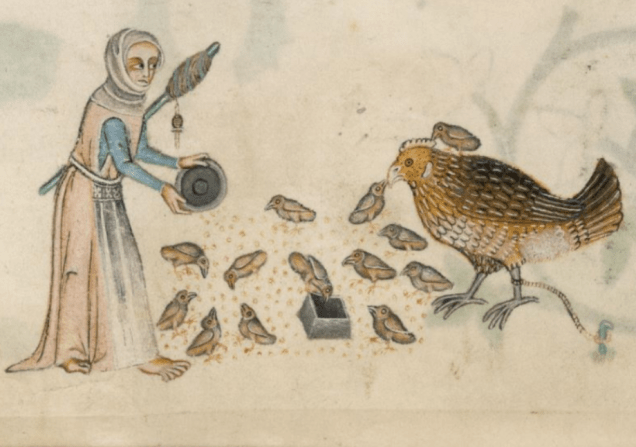
So: I was struck by this scene from an English illuminated manuscript.
Add MS 42130, f.166v via British Library (England; 1325-1340; illuminated manuscript)
The way the woman in the image is holding a distaff under one arm while she feeds chickens from a bowl feels incredibly authentic. I may not have to spin my own yarn nor feed chickens in 2018, but I have often held a thing under my arm momentarily while taking care of a small, short task. Such a lovely, realistic detail.
I do have one question for the artist, though: what on earth is that chick doing, standing on top of the hen and pecking her? (“Mom, look, I’m up here! Mom? Mom? Mooom!”) LOL!
The manuscript is from England and known as The Luttrell Psalter. Fortunately for us, British Library has digitized the whole manuscript. In addition to the chicken-feeding one above, the illuminations include a slew of other everyday scenes, like a miller in his windmill, bear-baiting(!), a wattle pen full of sheep, and various stages of tending fields and preparing food.
Being a textile nerd, I enjoyed the image of two women preparing fibers into yarn: one is using a spinning wheel, the other is carding.
Add MS 42130, f.193r via British Library (England; 1325-1340; illuminated manuscript)
The coloring is quite lovely. I do wonder, however, what’s with the awkward poses. The chicken-feeding image felt much more natural in that respect, too.
The Visual Inspiration occasional feature pulls the unusual from our world to inspire design, story-telling, and worldbuilding. If stuff like this already exists, what else could we imagine?
My very first WoW character, created towards the end of vanilla, was a female gnome mage. I still have her—specced the same, too—although I don’t play her as my primary anymore.
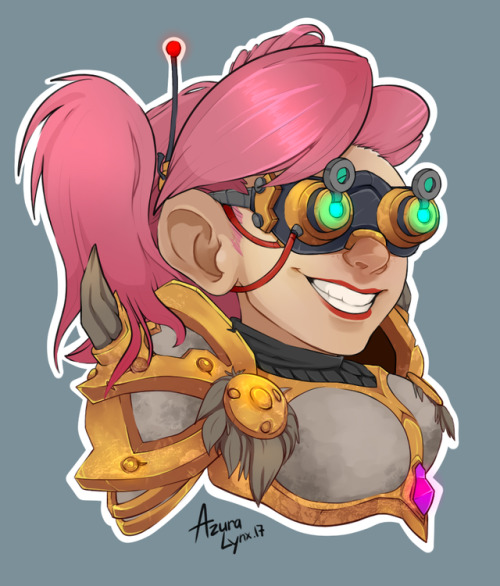
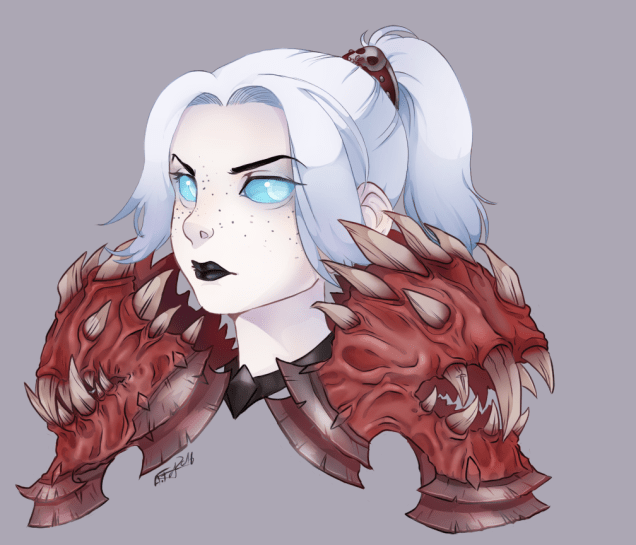
Anyway, I was looking for something else on the Internet when I fell into a hole on Tumblr and found all of this AWESOME female gnome fanart. I’ll share just five of my favorites below. And this is just the tip of the iceberg!
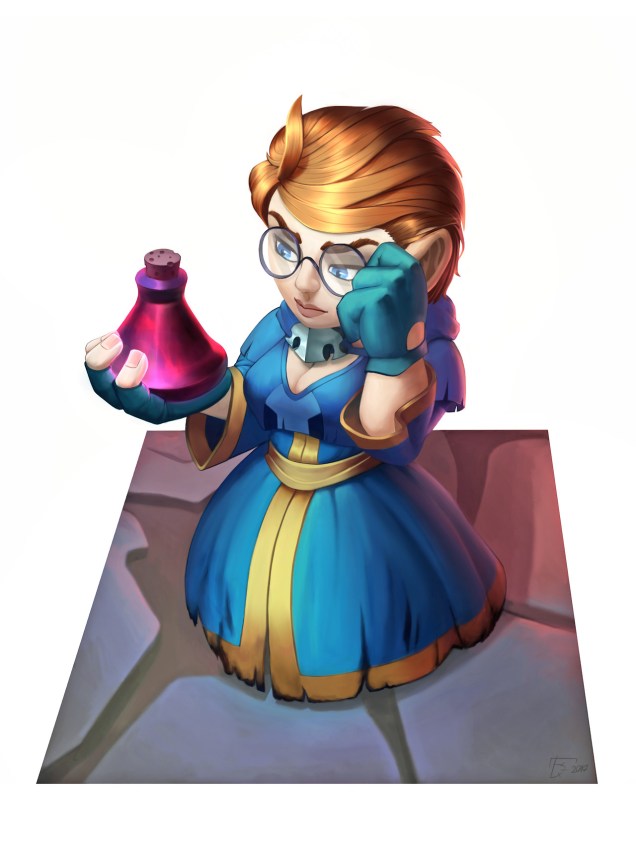
An alchemist by Boz:
Love the thoughtful expression!
A custom portrait of a gnome with goggles by Azuralynx (aka Niniel-Gnoll):
The grin! 😀
Sketch of a mage by Bryss (aka Alynissia):
Chromie, the dragon who prefers a gnome humanoid form, by mhazaru:
A death knight by Flyingterra—she clearly means business!
The range of illustration techniques is impressive, but even more so is how all of these artists capture the range of possibilities for gnome characters.
In the 1970s, NASA designed potential space habitats in three basic shapes—toroid, Bernal sphere, and cylinder. Artwork depicting some of the plans has now been published in several sizes without copyright restrictions. Here’s the NASA description of the images:
“A couple of space colony summer studies were conducted at NASA Ames in the 1970s. Colonies housing about 10,000 people were designed. A number of artistic renderings of the concepts were made.”
Below are some of my favorites.
A version of cylindrical habitats has since been seen in popular media—Babylon 5, anyone?
The residential buildings look kind of cutely 1970s. (And I say this as a non-fan of the 70s aesthetic!)
Apparently all of these designs were meant for thousands of people: the toroid and spherical stations could house around 10,000 and the cylinder a million. Wow. They certainly did not dream small!
All images courtesy of NASA Ames Research Center: Cylindrical habitat / interior view looking out through large windows (NASA ID number AC75-1086) and toroidal / cutaway view exposing the interior (NASA ID number AC75-1086-1) by Rick Guidice. Bernal sphere / construction crew at work (NASA ID number AC76-1288) by Don Davis. Bernal sphere / cutaway view (NASA ID number AC76-1089) by Rick Guidice.
Out There is an occasional feature highlighting intriguing art, spaces, places, phenomena, flora, and fauna.








_found_at_Caulonia_(Monasterace)_in_the_Casa_del_Drago,_3rd_century_BC,_Monsters._Fantastic_Creatures_of_Fear_and_Myth_Exhibition,_Palazzo_Massimo_alle_Terme,_Rome_(12836560653).jpg)


