Artifacts and Transmogrification: Retribution Paladin and Arms Warrior

In my last post about transmogrifying with artifact weapons, I mentioned how, with my elemental shaman and arcane mage, I got lucky and the base artifact appearance fit very well with the looks I had already created for the characters. In other cases, the base appearance doesn’t suit my existing look, but one of the unlockable color variants does.

Here, for instance, is my retribution paladin. I had her in a blue and gold set that the red base weapon didn’t match, but the blue alternative suits perfectly.

My arms warrior, on the other hand, wanted the red alternative color to match his red and purple set.

Of Dice and Dragons is an occasional feature about games and gaming.

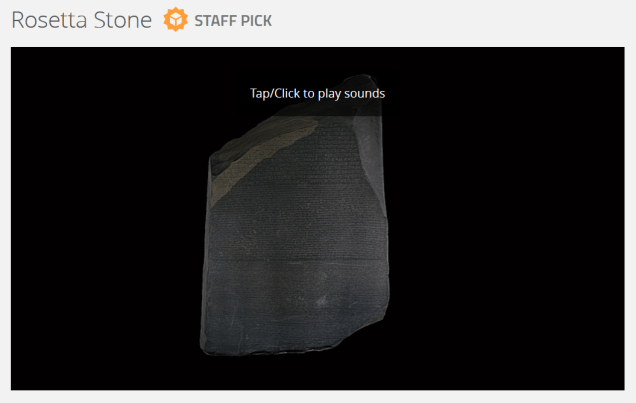
Rosetta Stone Online in 3D

The British Museum has made a 3D-scan of the Rosetta Stone and released it for exploration, download, and sharing. The model is available at the museum’s Sketchfab site:

Sketchfab British Museum Rosetta Stone Screencap
Screencap of the Rosetta Stone 3D model by the British Museum at Sketchfab

I just love the effort museums and libraries are making to bring their collections online. Providing 3D models is another step in making the collections relevant to the 21st century life.

Visit The British Museum at Sketchfab for additional 3D models—over 200 at this writing!

Hey, look! We found a thing on the internet! We thought it was cool, and wanted to share it with you.

How to Helsinki: Last Call

Worldcon is in Helsinki this year. As a Finnish-American couple, we are very excited about this! In the coming months, we’d like to offer some practical advice about visiting Finland to our fellow fans who are considering going to the event but haven’t had experience with Finland and Finns before.

Worldcon 75 is just a week away now. In case you missed any of our previous posts, you might want to check them out, too:


Here are a few last-minute tidbits, odds and ends, and random pieces of advice that might be worth knowing if you’re getting ready to head to Helsinki:

Low-alcohol beverages, like beer and cider, are available at most grocery stores. For harder liquor (22+ % alcohol), you’ll need to go to one of the state-run Alko stores; you also must be 20 years old and have valid government I.D. Anyone who looks under 30 years of age may be carded when buying alcohol.

Apteekki = pharmacy

Apua! = Help!

Ateneum Art Museum is one of the three museums forming the Finnish National Gallery and located conveniently on the south side of Rautatientori square close to Helsinki central railway station.

Flickr Alessandro Grussu Ateneum Art Museum

DO NOT FEED THE BIRDS. That creates problems for residents, outdoor sellers, and other visitors. The seagulls at Kaupptori, for example, are already quite adept at snatching food from people. (That means they will dive AT YOU and steal your food FROM YOUR HAND. I don’t know about you, but I find that intimidating and I don’t want it to happen to me! –Eppu)

Public drinking water fountains are rare in Finland, but tap water is clean and safe. Carrying a water bottle is a good idea.

Dual flush toilets are becoming very common, and they’re easy to operate: small button for small flush, big for large. Please do take part in our environmental efforts.

Electric sockets and plugs are Europlug type C or the grounded Schuko type F.

Elevator behavior humorously put: Keep your arms and legs inside the vehicle at all times, and for the sake of everything you hold dear, do not engage in small talk.
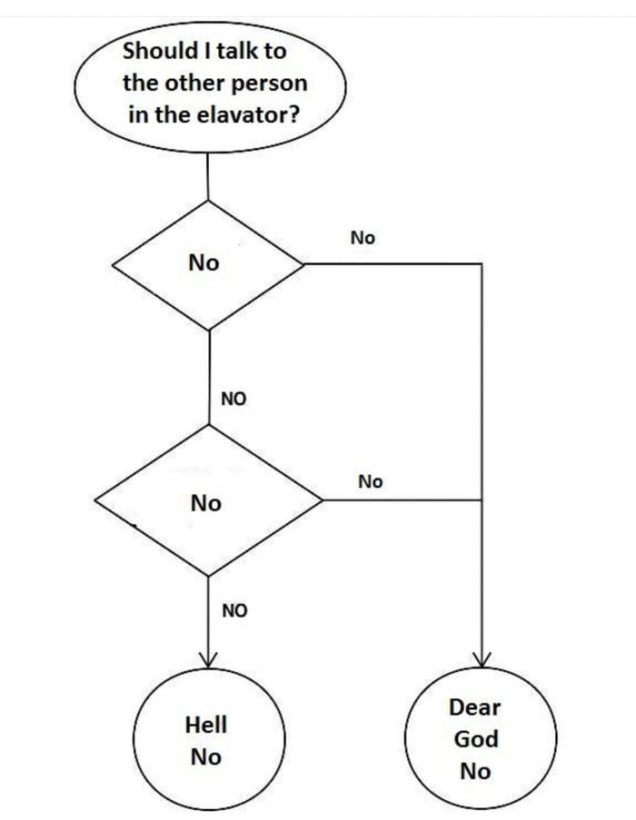
9gag Finland Elevator

More seriously: Elevator behavior shouldn’t be a problem; just be mindful that customs may be different than you’re used to and you’ll be fine.

The number for emergency services is 112. Also note that pay phones are almost non-existent in Finland because cell phones are so ubiquitous.

You may not be able to establish eye contact with strangers on the streets. This is perfectly normal in Finland; we love our personal space and want lots of it.

Gasoline is very expensive due to taxation—keep it in mind if planning to rent a car.

If you meet a Finn with whom you share a mutual acquaintance, you may be asked to take greetings to that person. It is vital that you follow through. Carrying greetings (the Finnish word is terveisiä, which covers the whole social scale from “Say hi to your buddies for me” to “Do give my sincerest regards to your honored great-grandmother”) is serious business in Finland.

Indoor spaces tend to be warm due to effective insulation. Dress in layers for the win!

With regard to the language issue, one of the most succinct answers is by author Elizabeth Bear: “[I’ve] heard some concern about the language issue. There is no language issue. If one of your languages is English […] you will have no issues at all navigating. (It’s sort of a running joke with my agent and I that while my books sell very well in the Nordic countries as imports, we can’t get a translation deal there. Because everyone speaks English […]”

Luggage storage is available e.g. at Helsinki central railway station and at the Kamppi long distance bus station.

Mosquitoes are the bane of the Finnish summer. (We actually joke about them being our air force. –Eppu) Current reports are that this has not been a bad mosquito year, but it’s still important to take precautions if you’re sensitive to bites and will be out and about in the late evening or early morning, which are the prime biting times.

The National Museum of Finland concentrates on Finnish history from the Stone Age to 19th century and has an extensive collection of objects. The building itself, of National Romantic style, may also be of interest. Free entry every Friday 4 p.m. to 6 p.m.; at other times, entry fees apply.
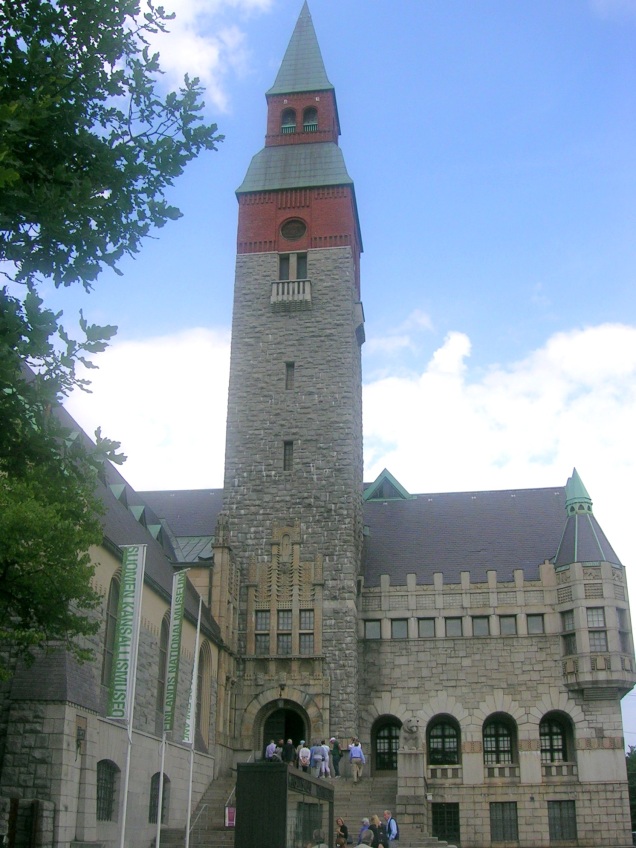
National Museum of Finland

Petrol is very expensive due to taxation—keep it in mind if planning to rent a car.

Pharmacy = apteekki

The word please (or the like) doesn’t exist in Finnish. Instead, the same function is embedded in the verb form of the sentence. This doesn’t mean that Finns are inherently rude; we may sound rude to native speakers of languages that use an explicit please word if we forget to use it in other languages, and we well might slip up since it’s not ingrained.

Finnish does not have gendered pronouns. The word hän means both ‘he’ and ‘she.’ It’s not unusual for Finns, even Finns who speak English very fluently and are highly aware of gender identity issues, to slip and use the wrong gendered pronoun when speaking English. (It’s a little like English speakers learning Spanish and having to remember that forks are masculine but spoons are feminine.)

Recycling is becoming very common. Your hotel room and Messukeskus might have containers for different types of trash. Please do take part in our environmental efforts.

If you bump into someone by accident, just saying “Sori” (comes from and sounds pretty much the same as English sorry) is usually sufficient. Finns don’t really do apologies for small accidents.

Towel hooks in bathrooms are only for storing the dry towels. Spread towels to dry elsewhere (rack, over the shower stall door / shower curtain bar) and hang to store.


Some additional reading & browsing

Images: Ateneum Art Museum by Alessandro Grussu on Flickr. Finland elevator behavior via 9gag. National Museum of Finland by Eppu Jensen

In Live and Active Cultures we talk about cultures and cultural differences.

The Secret of Roman Concrete

Trajan’s Market, Rome, with a vaulted concrete ceiling over brick walls, photo by Szilas via Wikimedia

Roman concrete is an architectural marvel. It made it possible for the Romans to build structures unlike any built with the techniques of stone masonry. It turns out Roman concrete is also a chemical marvel. The combination of volcanic ash and rock, lime, and seawater gradually becomes stronger over time as the interaction of the volcanic components and the seawater forms new minerals that fill up cracks and reinforce the structure.

An article from the Guardian explains the process:

Over time, seawater that seeped through the concrete dissolved the volcanic crystals and glasses, with aluminous tobermorite and phillipsite crystallising in their place. These minerals […] helped to reinforce the concrete, preventing cracks from growing, with structures becoming stronger over time as the minerals grew.

Given the limitations of Roman science, it’s doubtful that an ancient Roman concrete expert could have explained the chemical processes that happened in concrete, but that doesn’t mean that Romans just stumbled onto this formula by accident. Even with a limited theoretical understanding, smart people can acquire a lot of practical knowledge through experimentation and careful observation.

Thoughts for writers

Something to keep in mind when worldbuilding: practical knowledge doesn’t have to come from theoretical knowledge. In fact, it is often the opposite: theoretical knowledge develops from an attempt to explain what we already know practically to be true. If you want your fictional cultures to be able to make sturdy concrete, or airships, or vaccines, that doesn’t require them to have a modern understanding of chemistry, physics, or biology. Pre-modern peoples discovered lots of useful things by trial and error and paying close attention to the world around them, even if their attempts to explain why those things worked were sometimes wide of the mark, or they never attempted to explain them at all.

History for Writers is a weekly feature which looks at how history can be a fiction writer’s most useful tool. From worldbuilding to dialogue, history helps you write. Check out the introduction to History for Writers here.

Black Panther Poster & Trailer

A little more news on the Marvel Cinematic Universe movie Black Panther trickled out from San Diego Comic-Con. At this writing, the SDCC trailer hasn’t been released outside the con yet, but I’m hoping it’ll be out soon.

Meanwhile, we have this gorgeous poster to tide us over:

Tor com BPPoster

And, since apparently I didn’t post this before, here’s the teaser trailer:

Black Panther Teaser Trailer [HD] from Marvel Entertainment

It looks so amazing! Good thing February 2018 is just six and a half months away.

Image: Marvel Studios via Tor.com

Hey, look! We found a thing on the internet! We thought it was cool, and wanted to share it with you.

Quotes: A Question that Pretty Much No One Actually Asked to Be Answered

Aaron Pound at Dreaming About Other Worlds reviews the Star Wars movie Rogue One and includes this delicious bit of analysis:

“The obvious slicing and dicing of the intrigue and adventure in the early parts of the movie would be forgivable is [sic] one were able to think that it was done simply to try to cram as much of that as possible into the story, but instead the movie keeps shifting away from Jyn, Cassian, K-2SO and the rest of the intrepid rebels to focus on what can only be described as the deadly dull office politics of the Imperial Officer class. In large part, all these scenes really do is provide a really long-winded answer for the question ‘How did Grand Moff Tarkin become the commander of the Death Star’, which is a question that pretty much no one actually asked to be answered.”

– Aaron Pound

Reader, I LOLed. 🙂

Pound, Aaron. “Review – Rogue One: A Star Wars Story”. Dreaming About Other Worlds, June 01, 2017.

Serving exactly what it sounds like, the Quotes feature excerpts other people’s thoughts.

Quotes: My dear admiral, that post!

Admiral and Mrs. Croft, out driving in their one-horse chaise have come across a group of their acquaintances walking and offered to give a ride to one of them. Anne Elliot joins them.

“Very good-humoured, unaffected girls, indeed,” said Mrs. Croft… “and a very respectable family. One could not be connected with better people.—My dear admiral, that post!—we shall certainly take that post!”

But by coolly giving the reins a better direction herself, they happily passed the danger; and by once after judiciously putting out her hand, they neither fell into a rut nor ran foul of a dung-cart; and Anne, with some amusement at their style of driving, which she imagined not a bad representation of the general guidance of their affairs, found herself safely deposited by them at the cottage.

– Jane Austen, Persuasion


One of the loveliest descriptions of marriage I have ever read: we make up for one another’s eccentricities and, however strange we may look to anyone else, we get where we’re going in the end.

Austen may be famous for her romantic pairings like Elizabeth Bennet and Mr. Darcy, or Marianne Dashwood and Colonel Brandon, but I think Admiral and Mrs. Croft are one of her best images of real marital happiness.

Serving exactly what it sounds like, the Quotes feature excerpts other people’s thoughts.

Greek Myth, Etruscan Tomb

We like to think of the modern world as one in which different cultures intertwine and overlap with one another, but there were complicated cross-cultural interactions in the ancient world as well. For example, look at this wall painting from an Etruscan tomb.

Sacrifice of Trojan captives, photograph by Battlelight via Wikimedia (François Tomb, Vulci; late 4th c.; fresco)

This scene depicts an incident from the Trojan War. After his friend Patroclus was killed in battle, the great Greek warrior Achilles went mad with grief. He piled up an enormous funeral pyre for Patroclus, on top of which he also killed twelve Trojan prisoners. At the center of this painting, Achilles slits the throat of a naked Trojan prisoner while a Greek soldier leads another prisoner to the slaughter from the right. To the left, the ghost of Patroclus, in a blue cloak with a bandage over the fatal wound in his chest, looks on in dismay.

This incident comes from the Greek legends of the Trojan War and is mentioned in the Iliad, but it is a rather obscure scene. It was rarely, if ever, referred to in later Greek literature or depicted in Greek art. The fact that an Etruscan artist could use this event as the basis for a tomb painting demonstrates a more than passing knowledge of Greek myth.

The Etruscans were a people of northern Italy who had extensive trade contacts with the Greeks and imported large quantities of fine pottery and other Greek luxury goods. They also imported Greek legends and stories, which they frequently depicted in their own artworks. Like the painting in the François Tomb, Etruscan art often picks up on obscure or unusual incidents that were not widely depicted in Greek art. This selectiveness tells us that Etruscans were not just copying the Greek art that they acquired but were making conscious artistic choices based on extensive knowledge of the Greek material.

This painting also adds some uniquely Etruscan elements to the scene. The winged woman directly behind Achilles is Vanth, an Etruscan goddess whose role seems to have been to decide the fate of the souls of the dead. The blue-skinned man to Achilles’ right is Charu, another Etruscan god who led the souls of the dead to wherever Vanth decided to send them. Vanth and Charu are purely Etruscan characters with no basis in the Iliad. Greek myth had figures who performed similar functions, but they looked nothing like Vanth and Charu.

These two figures are not simply added to the scene. The way that they frame the sacrificial act and share a knowing look over Achilles’ head changes the scene’s meaning. Rather than just seeing Achilles’ awful act, we see that his act happens in a context that transcends the mortal world. The Greek afterlife was pretty much universally bleak, except for a few select troublemakers who got ironically tortured. The Etruscan afterlife is poorly understood, but they seem to have believed that the deeds of the living affected the fate of the dead, which could be pleasant or terrifying. In this painting, Vanth and Charu seem to be saying to one another: “We see what’s happening here, and it won’t be forgotten. We’re here for the Trojans this time, but Achilles’ day is coming.”

This painting is one that a Greek artist would never have painted and that a Greek viewer wouldn’t have understood. It only made sense to an Etruscan, but to an Etruscan who knew their Iliad well enough to recognize the figures of Achilles and Patroclus and identify the moment in the story that was being depicted. Here in this image we have a moment of cross-cultural interaction on display.

History for Writers is a weekly feature which looks at how history can be a fiction writer’s most useful tool. From worldbuilding to dialogue, history helps you write. Check out the introduction to History for Writers here.

Major Roman Roads Subway Map Style

A very, very cool map of major Roman roads done in subway map style:

Shasha Trubetskoy roman_roads_24_jun

Made by Sasha Trubetskoy, statistics major and designer, artist, and geography and data nerd.

Really fascinating! I know there were also some Roman roadworks running at least partially across the land from east to west along Hadrian’s Wall in Britain, but I don’t know whether there ever was a complete major road there.

In Making Stuff occasional feature, we share fun arts and crafts done by us and our fellow geeks and nerds.

Rating: Leverage, Season 5

We’ve been rewatching and rating Leverage and we’ve gotten up through season 4. (For more on how our rating system works, see here, which also covers season 1 of Leverage.) Here’s what we thought.

  1. “The (Very) Big Bird Job” – 6
  2. “The Blue Line Job” – 4
  3. “The First Contact Job” – 10
  4. “The French Connection Job” – 8
  5. “The Gimme a K Street Job” – 4
  6. “The D. B. Cooper Job” – 1.5
  7. “The Real Fake Job” – 6
  8. “The Broken Wing Job” – 10
  9. “The Rundown Job” – 10
  10. “The Frame-Up Job” – 9
  11. “The Low Low Price Job” – 8
  12. “The White Rabbit Job” – 3
  13. “The Corkscrew Job” – 6
  14. “The Toy Job” – 5
  15. “The Long Good-bye Job” – 9

Leverage goes out on a high note with an average rating of 6.6 for its final season, a small step up from 6.4 for season 4 and the best of any season. There are a mix of better and worse episodes this season, including a couple of real duds, but there’s a slew of 9s and 10s that just sparkle. This season has a mix of traditional con procedurals and more ambitious episodes that break out of the formula. The best episodes include both perfectly executed traditional grift stories and some of the more unusual attempts. The effort to do something different doesn’t always pay off, though, and this season’s failures are some of the episodes that stray farthest from the formula.

The absolute worst of the season—and in the running for worst of the entire series—is “The D. B. Cooper Job,” at 1.5, which, like season 4’s “The Van Gogh Job” is mostly about other characters played by the main cast, this time reinventing the story of skyjacker D. B. Cooper. While “The Van Gogh Job” had the advantage of a charming, if sad, love story, “The D. B. Cooper Job” is just a whole lotta brooding white guys being emotionally unavailable and stuff, which is pretty much the last thing we need more of on tv. Dishonorable mention also goes to “The White Rabbit Job,” at 3, which tries to do an Inception and seriously fails to pull it off.

Happily, we have three standouts tied for best of the season at a full 10 points. “The First Contact Job” is a kooky X-Files riff with a faked alien contact and tons of tongue-in-cheek sci-fi geek humor. “The Broken Wing Job” is a solo adventure for Parker (our favorite character!) which challenges her to figure out how to do the work of the whole team while recovering from a broken leg. Watching Beth Riesgraf play the whole range of Parker’s emotions from climbing-the-walls stir-crazy to oh-no-you-don’t-hurt-my-friend badass is a sheer delight. Finally, “The Rundown Job” trades in the series’ usual quirky humor for an action-packed bioterror thriller in Washington D. C. with just Parker, Hardison and Eliot (our three favorite characters!).

And that’s Leverage! A lot of good episodes and great characters. Well worth a rewatch!

Any Leverage fans out there want to weigh in? Got a different pick for the best or worst episodes of the season? Let us know in the comments!

In the Seen on Screen occasional feature, we discuss movies and television shows of interest.