Worldcon is in Helsinki this year. As a Finnish-American couple, we are very excited about this! In the coming months, we’d like to offer some practical advice about visiting Finland to our fellow fans who are considering going to the event but haven’t had experience with Finland and Finns before.
Worldcon 75 is just a week away now. In case you missed any of our previous posts, you might want to check them out, too:
Here are a few last-minute tidbits, odds and ends, and random pieces of advice that might be worth knowing if you’re getting ready to head to Helsinki:
Low-alcohol beverages, like beer and cider, are available at most grocery stores. For harder liquor (22+ % alcohol), you’ll need to go to one of the state-run Alko stores; you also must be 20 years old and have valid government I.D. Anyone who looks under 30 years of age may be carded when buying alcohol.
Apteekki = pharmacy
Apua! = Help!
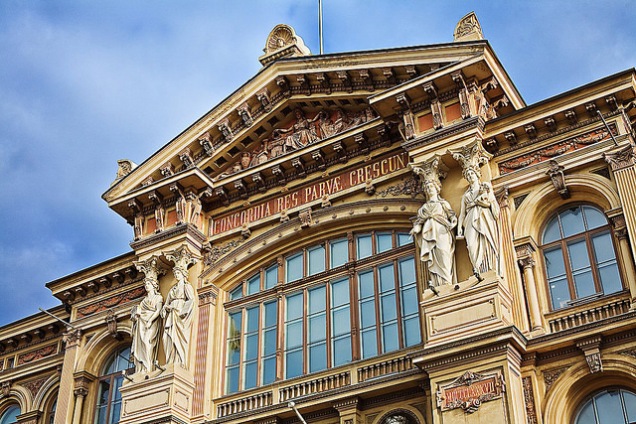
Ateneum Art Museum is one of the three museums forming the Finnish National Gallery and located conveniently on the south side of Rautatientori square close to Helsinki central railway station.
DO NOT FEED THE BIRDS. That creates problems for residents, outdoor sellers, and other visitors. The seagulls at Kaupptori, for example, are already quite adept at snatching food from people. (That means they will dive AT YOU and steal your food FROM YOUR HAND. I don’t know about you, but I find that intimidating and I don’t want it to happen to me! –Eppu)
Public drinking water fountains are rare in Finland, but tap water is clean and safe. Carrying a water bottle is a good idea.
Dual flush toilets are becoming very common, and they’re easy to operate: small button for small flush, big for large. Please do take part in our environmental efforts.
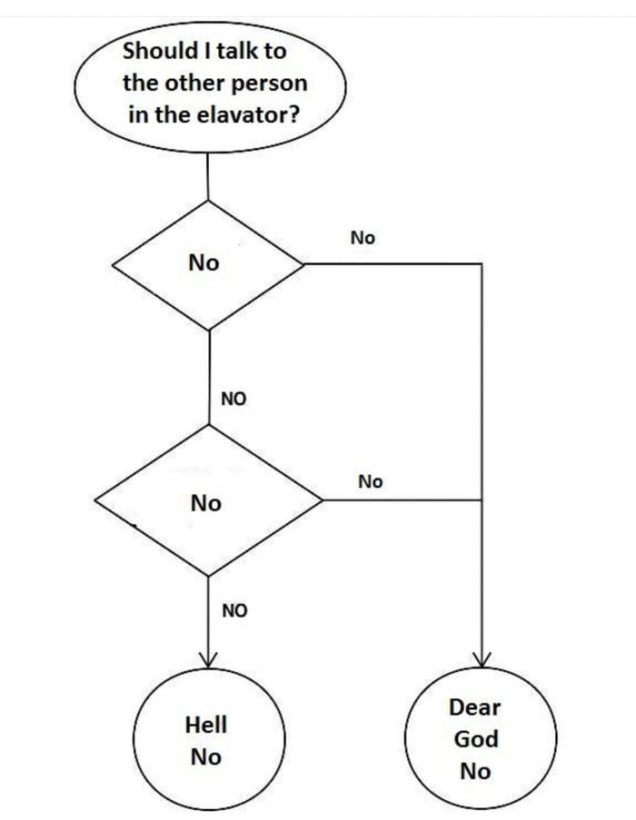
Elevator behavior humorously put: Keep your arms and legs inside the vehicle at all times, and for the sake of everything you hold dear, do not engage in small talk.
More seriously: Elevator behavior shouldn’t be a problem; just be mindful that customs may be different than you’re used to and you’ll be fine.
The number for emergency services is 112. Also note that pay phones are almost non-existent in Finland because cell phones are so ubiquitous.
You may not be able to establish eye contact with strangers on the streets. This is perfectly normal in Finland; we love our personal space and want lots of it.
Gasoline is very expensive due to taxation—keep it in mind if planning to rent a car.
If you meet a Finn with whom you share a mutual acquaintance, you may be asked to take greetings to that person. It is vital that you follow through. Carrying greetings (the Finnish word is terveisiä, which covers the whole social scale from “Say hi to your buddies for me” to “Do give my sincerest regards to your honored great-grandmother”) is serious business in Finland.
Indoor spaces tend to be warm due to effective insulation. Dress in layers for the win!
With regard to the language issue, one of the most succinct answers is by author Elizabeth Bear: “[I’ve] heard some concern about the language issue. There is no language issue. If one of your languages is English […] you will have no issues at all navigating. (It’s sort of a running joke with my agent and I that while my books sell very well in the Nordic countries as imports, we can’t get a translation deal there. Because everyone speaks English […]”
Mosquitoes are the bane of the Finnish summer. (We actually joke about them being our air force. –Eppu) Current reports are that this has not been a bad mosquito year, but it’s still important to take precautions if you’re sensitive to bites and will be out and about in the late evening or early morning, which are the prime biting times.
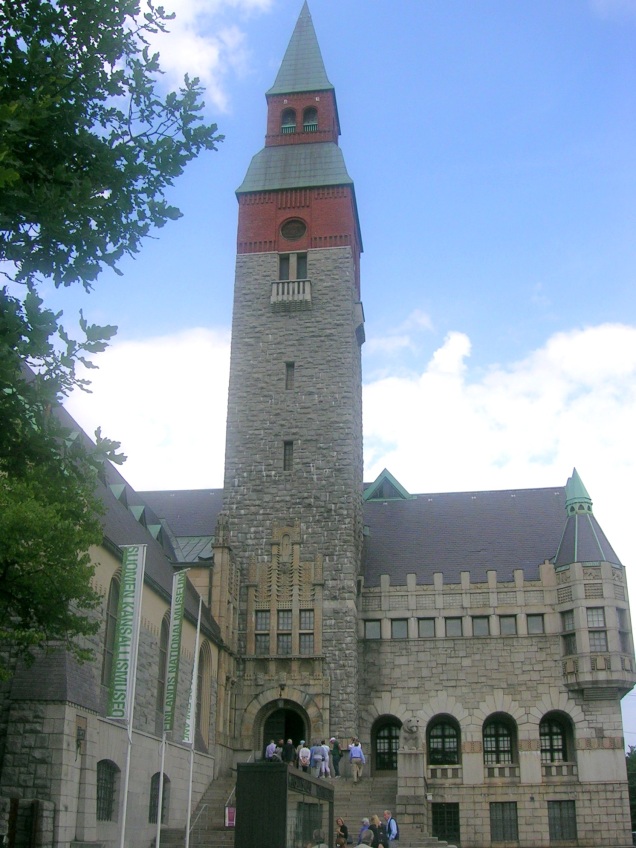
The National Museum of Finland concentrates on Finnish history from the Stone Age to 19th century and has an extensive collection of objects. The building itself, of National Romantic style, may also be of interest. Free entry every Friday 4 p.m. to 6 p.m.; at other times, entry fees apply.
Petrol is very expensive due to taxation—keep it in mind if planning to rent a car.
Pharmacy = apteekki
The word please (or the like) doesn’t exist in Finnish. Instead, the same function is embedded in the verb form of the sentence. This doesn’t mean that Finns are inherently rude; we may sound rude to native speakers of languages that use an explicit please word if we forget to use it in other languages, and we well might slip up since it’s not ingrained.
Finnish does not have gendered pronouns. The word hän means both ‘he’ and ‘she.’ It’s not unusual for Finns, even Finns who speak English very fluently and are highly aware of gender identity issues, to slip and use the wrong gendered pronoun when speaking English. (It’s a little like English speakers learning Spanish and having to remember that forks are masculine but spoons are feminine.)
Recycling is becoming very common. Your hotel room and Messukeskus might have containers for different types of trash. Please do take part in our environmental efforts.
If you bump into someone by accident, just saying “Sori” (comes from and sounds pretty much the same as English sorry) is usually sufficient. Finns don’t really do apologies for small accidents.
Towel hooks in bathrooms are only for storing the dry towels. Spread towels to dry elsewhere (rack, over the shower stall door / shower curtain bar) and hang to store.
Some additional reading & browsing
Bomfunk MC’s – Freestyler by BomfunkMCsVEVO – a music video with views of Helsinki cityscapes, including a pretty long stretch in the metro
Darude – Sandstorm by Darude – more views of Helsinki cityscapes in a music video
Finnish Nightmares – comic about a (stereo)typical Finn, Matti, in uniquely Finnish-style uncomfortable social situations
A Quick Guide to Helsinki by Mel, a New Zealander living in Finland, with city walks, places to visit, cultural sites, markets, daytrips and more from the point of view of an English-speaker learning the city
Trajan’s Market, Rome, with a vaulted concrete ceiling over brick walls, photo by Szilas via Wikimedia
Roman concrete is an architectural marvel. It made it possible for the Romans to build structures unlike any built with the techniques of stone masonry. It turns out Roman concrete is also a chemical marvel. The combination of volcanic ash and rock, lime, and seawater gradually becomes stronger over time as the interaction of the volcanic components and the seawater forms new minerals that fill up cracks and reinforce the structure.
Over time, seawater that seeped through the concrete dissolved the volcanic crystals and glasses, with aluminous tobermorite and phillipsite crystallising in their place. These minerals […] helped to reinforce the concrete, preventing cracks from growing, with structures becoming stronger over time as the minerals grew.
Given the limitations of Roman science, it’s doubtful that an ancient Roman concrete expert could have explained the chemical processes that happened in concrete, but that doesn’t mean that Romans just stumbled onto this formula by accident. Even with a limited theoretical understanding, smart people can acquire a lot of practical knowledge through experimentation and careful observation.
Thoughts for writers
Something to keep in mind when worldbuilding: practical knowledge doesn’t have to come from theoretical knowledge. In fact, it is often the opposite: theoretical knowledge develops from an attempt to explain what we already know practically to be true. If you want your fictional cultures to be able to make sturdy concrete, or airships, or vaccines, that doesn’t require them to have a modern understanding of chemistry, physics, or biology. Pre-modern peoples discovered lots of useful things by trial and error and paying close attention to the world around them, even if their attempts to explain why those things worked were sometimes wide of the mark, or they never attempted to explain them at all.
History for Writers is a weekly feature which looks at how history can be a fiction writer’s most useful tool. From worldbuilding to dialogue, history helps you write. Check out the introduction to History for Writershere.
A little more news on the Marvel Cinematic Universe movie Black Panther trickled out from San Diego Comic-Con. At this writing, the SDCC trailer hasn’t been released outside the con yet, but I’m hoping it’ll be out soon.
Meanwhile, we have this gorgeous poster to tide us over:
“The obvious slicing and dicing of the intrigue and adventure in the early parts of the movie would be forgivable is [sic] one were able to think that it was done simply to try to cram as much of that as possible into the story, but instead the movie keeps shifting away from Jyn, Cassian, K-2SO and the rest of the intrepid rebels to focus on what can only be described as the deadly dull office politics of the Imperial Officer class. In large part, all these scenes really do is provide a really long-winded answer for the question ‘How did Grand Moff Tarkin become the commander of the Death Star’, which is a question that pretty much no one actually asked to be answered.”
Admiral and Mrs. Croft, out driving in their one-horse chaise have come across a group of their acquaintances walking and offered to give a ride to one of them. Anne Elliot joins them.
“Very good-humoured, unaffected girls, indeed,” said Mrs. Croft… “and a very respectable family. One could not be connected with better people.—My dear admiral, that post!—we shall certainly take that post!”
But by coolly giving the reins a better direction herself, they happily passed the danger; and by once after judiciously putting out her hand, they neither fell into a rut nor ran foul of a dung-cart; and Anne, with some amusement at their style of driving, which she imagined not a bad representation of the general guidance of their affairs, found herself safely deposited by them at the cottage.
– Jane Austen, Persuasion
One of the loveliest descriptions of marriage I have ever read: we make up for one another’s eccentricities and, however strange we may look to anyone else, we get where we’re going in the end.
Austen may be famous for her romantic pairings like Elizabeth Bennet and Mr. Darcy, or Marianne Dashwood and Colonel Brandon, but I think Admiral and Mrs. Croft are one of her best images of real marital happiness.
Serving exactly what it sounds like, the Quotes feature excerpts other people’s thoughts.
We like to think of the modern world as one in which different cultures intertwine and overlap with one another, but there were complicated cross-cultural interactions in the ancient world as well. For example, look at this wall painting from an Etruscan tomb.
Sacrifice of Trojan captives, photograph by Battlelight via Wikimedia (François Tomb, Vulci; late 4th c.; fresco)
This scene depicts an incident from the Trojan War. After his friend Patroclus was killed in battle, the great Greek warrior Achilles went mad with grief. He piled up an enormous funeral pyre for Patroclus, on top of which he also killed twelve Trojan prisoners. At the center of this painting, Achilles slits the throat of a naked Trojan prisoner while a Greek soldier leads another prisoner to the slaughter from the right. To the left, the ghost of Patroclus, in a blue cloak with a bandage over the fatal wound in his chest, looks on in dismay.
This incident comes from the Greek legends of the Trojan War and is mentioned in the Iliad, but it is a rather obscure scene. It was rarely, if ever, referred to in later Greek literature or depicted in Greek art. The fact that an Etruscan artist could use this event as the basis for a tomb painting demonstrates a more than passing knowledge of Greek myth.
The Etruscans were a people of northern Italy who had extensive trade contacts with the Greeks and imported large quantities of fine pottery and other Greek luxury goods. They also imported Greek legends and stories, which they frequently depicted in their own artworks. Like the painting in the François Tomb, Etruscan art often picks up on obscure or unusual incidents that were not widely depicted in Greek art. This selectiveness tells us that Etruscans were not just copying the Greek art that they acquired but were making conscious artistic choices based on extensive knowledge of the Greek material.
This painting also adds some uniquely Etruscan elements to the scene. The winged woman directly behind Achilles is Vanth, an Etruscan goddess whose role seems to have been to decide the fate of the souls of the dead. The blue-skinned man to Achilles’ right is Charu, another Etruscan god who led the souls of the dead to wherever Vanth decided to send them. Vanth and Charu are purely Etruscan characters with no basis in the Iliad. Greek myth had figures who performed similar functions, but they looked nothing like Vanth and Charu.
These two figures are not simply added to the scene. The way that they frame the sacrificial act and share a knowing look over Achilles’ head changes the scene’s meaning. Rather than just seeing Achilles’ awful act, we see that his act happens in a context that transcends the mortal world. The Greek afterlife was pretty much universally bleak, except for a few select troublemakers who got ironically tortured. The Etruscan afterlife is poorly understood, but they seem to have believed that the deeds of the living affected the fate of the dead, which could be pleasant or terrifying. In this painting, Vanth and Charu seem to be saying to one another: “We see what’s happening here, and it won’t be forgotten. We’re here for the Trojans this time, but Achilles’ day is coming.”
This painting is one that a Greek artist would never have painted and that a Greek viewer wouldn’t have understood. It only made sense to an Etruscan, but to an Etruscan who knew their Iliad well enough to recognize the figures of Achilles and Patroclus and identify the moment in the story that was being depicted. Here in this image we have a moment of cross-cultural interaction on display.
History for Writers is a weekly feature which looks at how history can be a fiction writer’s most useful tool. From worldbuilding to dialogue, history helps you write. Check out the introduction to History for Writershere.
Really fascinating! I know there were also some Roman roadworks running at least partially across the land from east to west along Hadrian’s Wall in Britain, but I don’t know whether there ever was a complete major road there.
In Making Stuff occasional feature, we share fun arts and crafts done by us and our fellow geeks and nerds.
We’ve been rewatching and rating Leverage and we’ve gotten up through season 4. (For more on how our rating system works, see here, which also covers season 1 of Leverage.) Here’s what we thought.
“The (Very) Big Bird Job” – 6
“The Blue Line Job” – 4
“The First Contact Job” – 10
“The French Connection Job” – 8
“The Gimme a K Street Job” – 4
“The D. B. Cooper Job” – 1.5
“The Real Fake Job” – 6
“The Broken Wing Job” – 10
“The Rundown Job” – 10
“The Frame-Up Job” – 9
“The Low Low Price Job” – 8
“The White Rabbit Job” – 3
“The Corkscrew Job” – 6
“The Toy Job” – 5
“The Long Good-bye Job” – 9
Leverage goes out on a high note with an average rating of 6.6 for its final season, a small step up from 6.4 for season 4 and the best of any season. There are a mix of better and worse episodes this season, including a couple of real duds, but there’s a slew of 9s and 10s that just sparkle. This season has a mix of traditional con procedurals and more ambitious episodes that break out of the formula. The best episodes include both perfectly executed traditional grift stories and some of the more unusual attempts. The effort to do something different doesn’t always pay off, though, and this season’s failures are some of the episodes that stray farthest from the formula.
The absolute worst of the season—and in the running for worst of the entire series—is “The D. B. Cooper Job,” at 1.5, which, like season 4’s “The Van Gogh Job” is mostly about other characters played by the main cast, this time reinventing the story of skyjacker D. B. Cooper. While “The Van Gogh Job” had the advantage of a charming, if sad, love story, “The D. B. Cooper Job” is just a whole lotta brooding white guys being emotionally unavailable and stuff, which is pretty much the last thing we need more of on tv. Dishonorable mention also goes to “The White Rabbit Job,” at 3, which tries to do an Inception and seriously fails to pull it off.
Happily, we have three standouts tied for best of the season at a full 10 points. “The First Contact Job” is a kooky X-Files riff with a faked alien contact and tons of tongue-in-cheek sci-fi geek humor. “The Broken Wing Job” is a solo adventure for Parker (our favorite character!) which challenges her to figure out how to do the work of the whole team while recovering from a broken leg. Watching Beth Riesgraf play the whole range of Parker’s emotions from climbing-the-walls stir-crazy to oh-no-you-don’t-hurt-my-friend badass is a sheer delight. Finally, “The Rundown Job” trades in the series’ usual quirky humor for an action-packed bioterror thriller in Washington D. C. with just Parker, Hardison and Eliot (our three favorite characters!).
And that’s Leverage! A lot of good episodes and great characters. Well worth a rewatch!
Swedish fantasy and weird author Karin Tidbeck is giving book talks on her debut novel Amatka in the United States.
Amatka was originally released in Swedish in 2012. It was first published in English a few weeks ago, at the end of June 2017. The publisher describes the novel as follows:
“A surreal debut novel set in a world shaped by language in the tradition of Margaret Atwood and Ursula K. Le Guin.
“Vanja, an information assistant, is sent from her home city of Essre to the austere, wintry colony of Amatka with an assignment to collect intelligence for the government. Immediately she feels that something strange is going on: people act oddly in Amatka, and citizens are monitored for signs of subversion.
“Intending to stay just a short while, Vanja falls in love with her housemate, Nina, and prolongs her visit. But when she stumbles on evidence of a growing threat to the colony, and a cover-up by its administration, she embarks on an investigation that puts her at tremendous risk.”
In connection with the book birthday, Tidbeck will do a short publicity tour in the U.S. First, she’ll appear at Readercon 28 in Quincy, south of Boston, on July 13-16, 2017. (No further details at this writing.)
“I had spent some years collecting dream notes, and I found myself wondering if they could be mapped. What did my dream country look like? I found that some places showed up again and again, although the geography, events and people shifted. I ended up ordering the notes according to an imagined compass: north, south, east and west, and finally, a central city. […]
“Vanja, a somewhat reluctant protagonist, agreed to be my guide. But what was the world? Dreams, as I thought of them, are ruled by language. What would Vanja’s life be like? What would a society be like in a world where language ruled over matter? The story of Amatka began to unfold. It broke loose from my dream continent and became a world of its own.”
On the surface it sounds a bit like Le Guin’s The Left Hand of Darkness and Emmi Itäranta’s The Weaver. The way Tidbeck talks of language ruling over matter also reminds me of the way mathematics rules over reality in Yoon Ha Lee’s The Ninefox Gambit. As a linguist, I’m doubly intrigued and excited to read Amatka!
This post has been edited to correct a spelling error.
Worldcon is in Helsinki this year. As a Finnish-American couple, we are very excited about this! In the coming months, we’d like to offer some practical advice about visiting Finland to our fellow fans who are considering going to the event but haven’t had experience with Finland and Finns before.
Eppu here. First of all, I should note that I didn’t grow up in Helsinki, so I’ve had to learn the capital region transit system as an outsider. There’s no denying that it’s a big system with many moving parts (see what I did!) and that it can feel overwhelming. However, I find that, overall, information is abundant, the signage excellent, the electronic displays usually accurate, and the services run on time. Navigation or ticketing haven’t been a problem for us. (Note: Unfortunately I can’t competently comment on the success of the accessibility initiatives; I can only say there’s every attempt.)
Edited to add: Please also read Progress Report #5. Worldcon 75 staff have put together a very informational final report with lots of practical tips.
Some general information
The public transit network in the greater Helsinki area consists of local and regional buses, trams, commuter trains, subway (metro), and ferry. The system is managed by Helsinki Region Transport (in Finnish: Helsingin seudun liikenne or HSL; HSL on Wikipedia). Helsinki also provides city bikes for a fee (registration required).
Most lines operate between 5:30 a.m. and 11:30 p.m. or so. Nighttime lines, where they exist, are marked by letter N in the timetables (for example, 415 and 415N), and a higher night fare is charged between 2 a.m. and 4.30 a.m.
The metro sign is a white M in a red square.
Many Finns stay silent in public transit, although in large cities and/or with younger passengers this may not hold true. A Finn might also not ask someone blocking them to move; a wish to pass is often expressed only through body language.
Tickets, please
Always carry a valid ticket. Passengers without a ticket are charged a penalty fare of 80 euros.
There are several different kinds of tickets (single, day, travel card) and ways to get them (bus drivers, tram operators, text message, ticket machines / automats / kiosks).
The ticket machines operate in Finnish, Swedish, or English; payment is by coins, bills, or cards. Below is a how-to video:
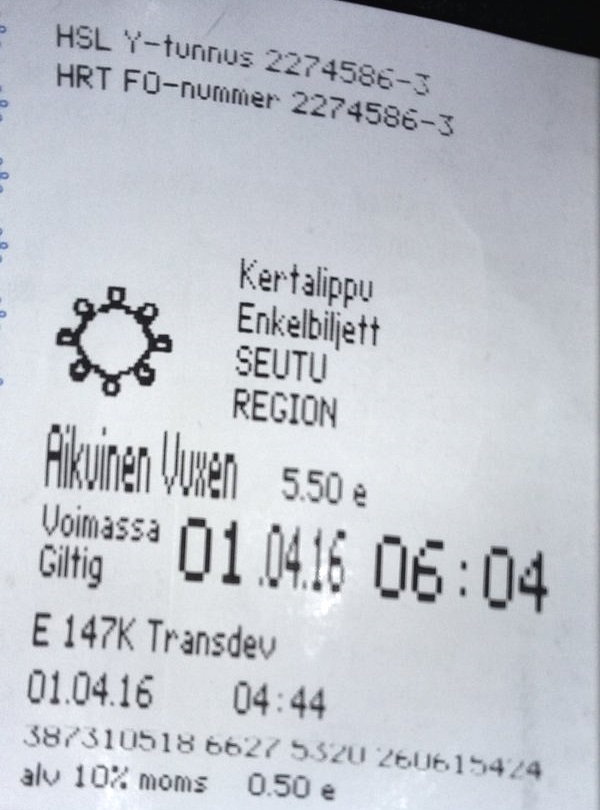
Paper tickets are Finnish-Swedish bilingual. Note that ticket validity is indicated with 24-hour clock and that dates are written out in day/month/year order.
The cheapest per-trip option, a travel card, is available from 14 to 366 days—i.e., a minimum of two weeks—so they’re basically the local commuter option.
If planning to make only two trips in one day, a day ticket (valid for 24 hours) is more expensive than two single tickets. Three or more trips justify the cost of a day ticket.
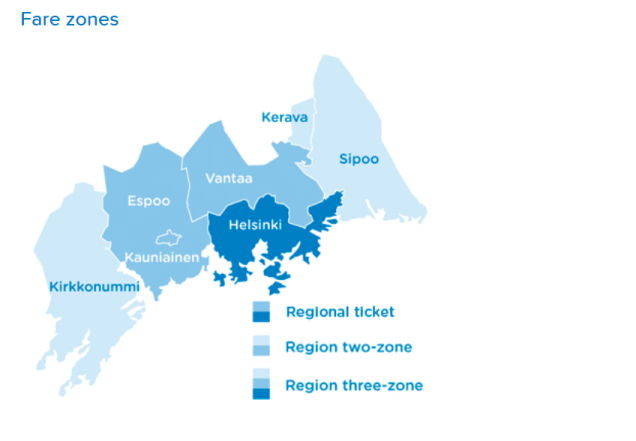
There are three zones: internal, regional (two zones) and the whole region (three zones). The internal tickets basically cover only one city (Helsinki; Espoo; Kauniainen; Vantaa) or municipality (Kirkkonummi) or transit zone unit (Kerava & Sipoo).
Helsinki central railway station is the biggest transportation hub in the greater Helsinki area. Other hubs include Pasila railway station, Sörnäinen, and Itäkeskus (literally, ‘east center’) in Helsinki, Espoon keskus (Espoo center) and Leppävaara in Espoo, and Myyrmäki and Tikkurila in Vantaa.
Unless your accommodations are in one of the adjoining cities, you should only need internal Helsinki tickets during the con.
Airport transit
At Helsinki-Vantaa airport, there are several local and regional buses in addition to train and taxi services. Trains stop between the two airport terminals and both at Pasila and the main railway station in Helsinki, with several stops in between.
Buses run between Helsinki-Vantaa and the city, ending in the vicinity of the Helsinki central railway station. Lines terminate either on Elielinaukio on the west or Rautatientori (railway station square) on the east side of the station.
For the city center, take either the HSL bus 415 or 615. The newest and fastest connection is the Ring Rail Line (I and P trains). Both the HSL buses and the airport train require a regional ticket (seutulippu). The private Finnair City Buses run between the airport and Elielinaukio.
Finding the spot
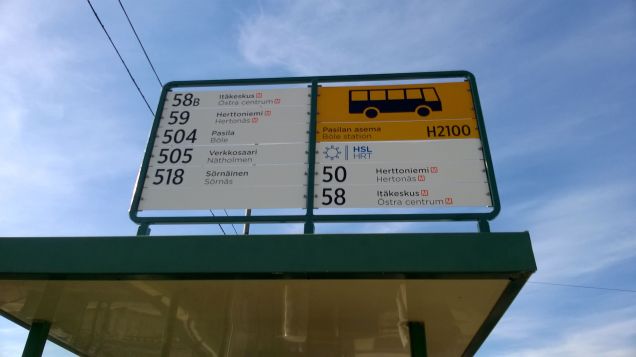
Bus and tram stops have both a unique 4-digit number and a name in both Finnish and Swedish. The stop number includes one or two preceding letters which indicate(s) the city or municipality of the stop (E for Espoo, H for Helsinki, etc.). For example, Pasilan asema / Böle station is H2100 in the photo below.
In practice, only the stop names are relevant, but you can use the stop numbers, too, with the Reittiopas route planner (see below).
Stops and departure bays display a sign with the route number(s) and destination(s) for the line(s) that use that particular stop. A small metro sign (white M in a red square) indicates that that line feeds to the metro.
Many of the stops also have transit maps and printed schedules. They are good for basic route finding if you know where you’re headed.
Electronic timetable displays at stops and terminals show either real-time or scheduled arrival / departure times for the line(s) serving that stop. Inside vehicles they typically display the route number and the name of the next stop.
You can also check out possible routes and options ahead of time with the Journey Planner (Reittiopas) in Finnish, Swedish, or English. Plug in your destination street address or attraction name and choose your preferred method and route; you can also adjust the amount of walking required or number of transfers in the settings.
Pertinent destination or stop names for Worldcon 75 are Helsinki-Vantaa airport (for which the route finder uses terms lentoasema or Helsinki-Vantaa airport T1-T2 corridor or combinations thereof), Helsinki railway station, Pasila or Pasilan asema (for Pasila railway station), and Messukeskus.
The Google Maps public transit directions also seem ok to me, but I haven’t used them often enough to comment on their reliability.
Note that the old Pasila train station is being demolished and a new one being built during the con. I haven’t personally been there, but on the basis of every newspaper photo I’ve seen it looks like signage and information on where to find connections, platforms, etc., is plentiful.
How to put a stop to it
The metro and commuter trains stop at every station. Enter and exit through any open door.
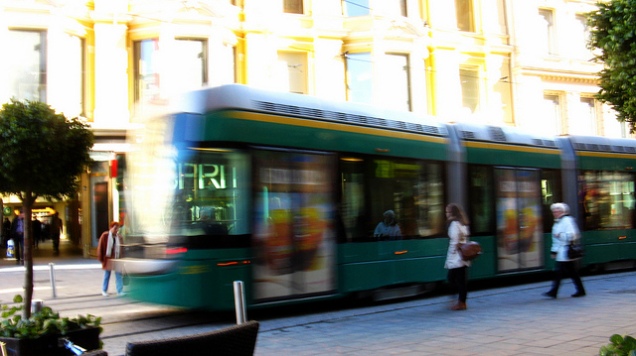
However, buses and trams only stop when requested. It is customary to enter through the front and exit through the middle or back doors. (People with accessibility issues may use the front door or middle door on low-floor buses both to enter and exit.)
At a bus stop, give a clear sign to the driver by holding your arm out to the side. Keep holding your hand out until the driver signals to show that s/he is going to stop.
Trams typically stop when there are passengers waiting. If the stop is shared by several routes, however, raise a hand to request that your tram stops to pick you up.
To exit at your stop, press the Stop button on the grab bars. (Note: Tape strips like some American buses use, for example, do not exist in Finland.) Do it early enough to give the driver time to stop safely. In fact, it’s not unusual to see people signal for a stop almost as soon as the bus or tram has left the previous stop.
What if I want to talk to someone?
The city of Helsinki tourist guides, the Helsinki Helpers, stand ready to answer questions until the end of August. Find them in their distinctive lime green vests on the inner city streets and cruise harbors. There’s also the Info Container tourist info kiosk on Keskuskatu next to Ateneum Art Museum (link to a map).
At or near Messukeskus, where you’ll be dealing mainly with hospitality workers or fellow fen, you will be in the best of company and are bound to find help, but Helsinki residents in general are used to tourists, too. Do not hesitate to ask passers-by for help if you need it. Many Finns, even if they tend to be reticent or shy of their English skills, are well-informed, eager to help, and give practical advice.
An outsider’s perspective
Erik here. As a foreign visitor, I’ve always found Helsinki quite an easy city to get around. The city center is compact and easily walkable, if that’s your preferred mode of transportation. If not, there are many good public transit options, as Eppu has explained. As with other parts of Finnish culture, there are some local details about getting around that may confuse you or not be obvious if you’re used to American cities. Here are a few things to keep in mind when you visit Helsinki:
Public transit has a bad reputation in some parts of the US. This does not apply in Finland. Finnish public transit is clean, modern, efficient, and easy to use. You’ll see everyone from parents with little children to business executives on their way to meetings riding the trains, buses, trams, and subway in Helsinki.
Always cross the street at a marked crosswalk and always obey the Walk/Don’t Walk signs. Even if the street is empty, don’t cross against the lights. This isn’t just a matter of courtesy, it’s also for your safety. Finland is a very law-abiding nation and drivers expect pedestrians to follow traffic signals. If a driver has a green light, they may not look out for pedestrians crossing the road in front of them. In Helsinki, unlike in many American cities, the buttons for crosswalk signals actually work.
In many places, you’ll find the sidewalk divided into two lanes, one for bicycles and the other for foot traffic. The lanes may be marked with painted symbols (a bicycle or a pair of walking figures), or the sidewalk may be partially paved, partially cobblestone (bicycles on the pavement, walkers on the cobble). Try to stay in the appropriate lane. This is also a matter of both courtesy and safety. There are a lot of bicycles in Helsinki and it’s both rude and dangerous to get in their way.
If there isn’t a marked division on the sidewalk, it’s good manners to stay to the right so that other people have room to get by you.
Turning right on a red light is not allowed anywhere in Finland, which is useful to know whether you’re driving or just walking around.
Few stores in Helsinki have public toilets and those that do may charge a fee. But free public toilets are available around the city. Look for dark green metal sheds on sidewalks and in parks, about the size and shape of a newsstand. These are free, clean, and kept in good condition.
As in many other European cities, look for street signs at the corners of buildings, not on free-standing posts.
Because Finland is a bilingual country, all road signs and many informational signs are posted in both Finnish and Swedish. Many places and neighborhoods around Helsinki also have names in both languages. Sometimes it’s obvious—it’s not hard even for an English speaker to guess that Eerikinkatu and Eriksgatan are the same street. Others are not so easy to guess. Without a little linguistic knowledge it can be hard to know that Ruoholahti is the same as Gräsviken. The announcements in public transit are also bilingual (occasionally trilingual, with English following Finnish and Swedish).
Online information for getting around in Helsinki
Accessibility (Helsingin seudun liikenne, HSL) – accessibility info for the greater Helsinki region
“Every American Transportation Planner Should Spend a Week in Helsinki” – part 1 of 3, part 2 of 3, and part 3 of 3 – by Garrett Wollman at Occasionally Coherent describes the greater Helsinki transit system in detail through American eyes
Getting around in Helsinki (Visithelsinki.fi) – links to basic descriptive articles, starting from “Arriving in Helsinki”


 Co-Geeking

