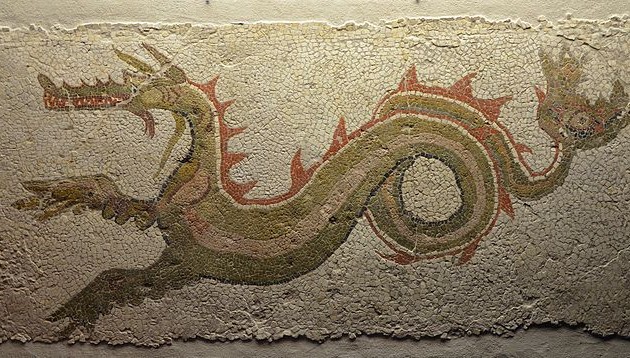
Sea monster, photograph by Carole Raddato via Wikimedia (Casa del Drago, Caulonia, Italy; 3rd c. BCE, mosaic)
This particular sea monster is in a mosaic from a house in the ancient Greek city of Caulonia in southern Italy from the third century BCE. Ancient depictions of sea monsters like this one often have long, snaky bodies, spiky fins, broad tails, and wings. These various pieces may have been cobbled together in the imagination from scattered sightings of whales, dolphins, sharks, squid, and other large sea creatures.
Out There is an occasional feature highlighting intriguing art, spaces, places, phenomena, flora, and fauna.
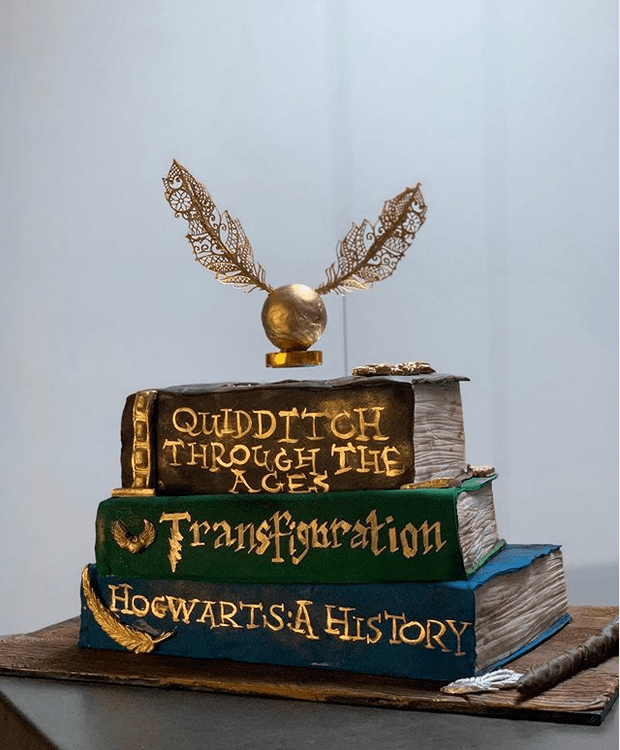
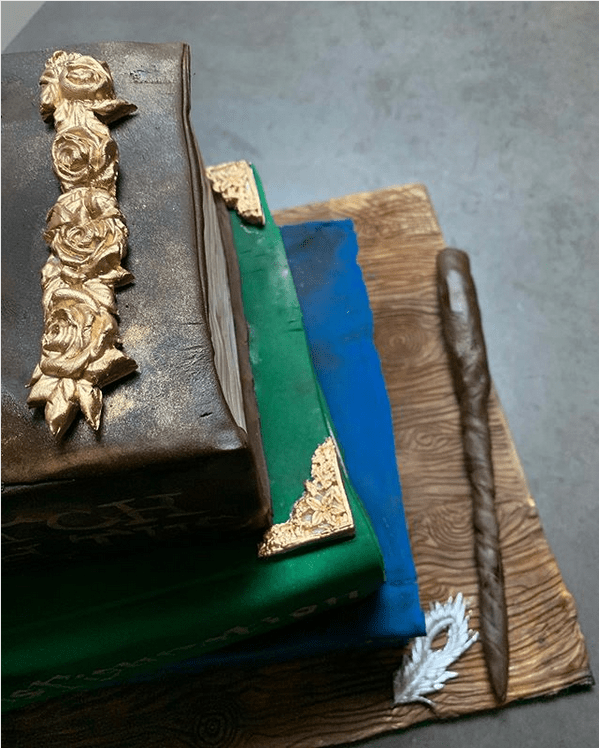
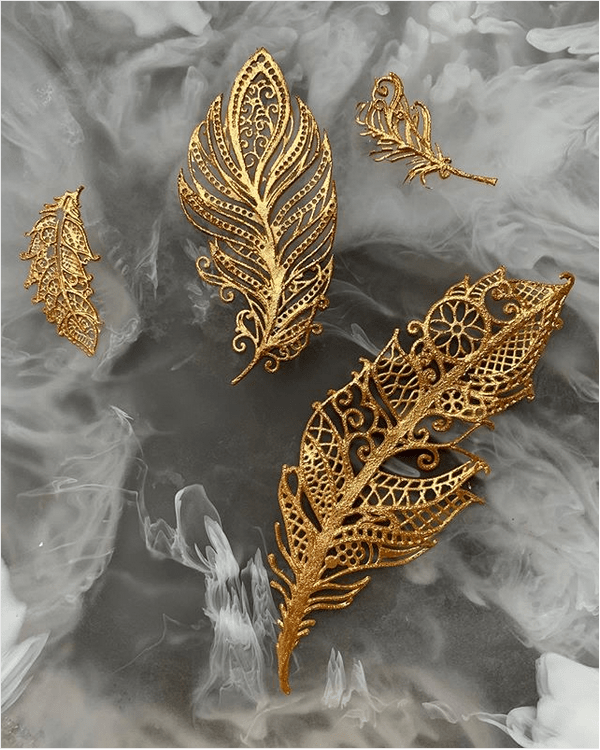
“I told you I was going to make a floating Snitch cake. (3 x 2 layer white chocolate mud cakes with vanilla meringue buttercream and blueberry and lemon or raspberry and black pepper filling. Special shout out to the wood-look board I made. [fist icon])”
Pritchett clearly is a foodie—just have a look at her amazing Twitter and Instagram feeds. Her dedication to getting the details just right is incredible. Everything is thoroughly thought-out and carefully prepared.
I’m gawping here! (Yes, I just declared gawp to be a word.)
A much darker view of the SW galaxy like in Rogue One; the story is set after the fall of the Empire and before the emergence of the First Order.
The writing credits are split between George Lucas and Jon Favreau, and episode directors include Taika Waititi and Bryce Dallas Howard. It won’t be Howard’s first directing gig, but the first I’m likely to see. (Basically I only know her as the twit of a corporate lady whose heels were practically glued on for the chase scenes in Jurassic World, although apparently I’ve seen her as Gwen Stacy in Sam Raimi’s Spider-Man 3.) The series music is by Ludwig Göransson, whose work on Black Panther I really liked, so that’s also promising.
One point of personal delight is the glimpse of a small craft flying over a flat, wooded land dotted with small lakes and smaller fields (the sequence starts at about the 15-second mark). It’s one of the very few instances on the large, international screens of places that look like my home that I’ve seen. I hope that’s not all of it!
Other than that there’s not much definite info to be got, so we’ll have to see. I can’t even decide yet on the basis of this trailer whether The Mandalorian is worth the trouble of looking up what Disney+ streaming might take to access or whether we should just wait for the disc release.
Hey, look! We found a thing on the internet! We thought it was cool, and wanted to share it with you.
Sea monsters prevented Alexander from building Alexandria. He took a wooden container in which a glass box was inserted, and dived in it to the bottom of the sea. There he drew pictures of the devilish monsters he saw. He then had metal effigies of these animals made and set them up opposite the place where building was going on. When the monsters came out and saw the effigies, they fled. Alexander was thus able to complete the building of Alexandria.
– Ibn Khaldun, Kitab al-‘Ibar
Translated by Franz Rosenthal
This wild tale about the foundation of Alexandria is cited by the 14th-century North African historian Ibn Khaldun as an example of the ludicrous fictions that some earlier historians had filled their histories with but that had no place in the kind of scientific, rational history he set out to write.
The story as Ibn Khaldun relates it seem to go back to a legend in the Alexander Romance, a highly fictionalized account of Alexander the Great’s campaigns, about a large snake that frightened the workers who were building the city of Alexandria on the coast of Egypt until Alexander had the snake caught and killed. Over centuries of retelling, the hunt for one big snake turned into a struggle against terrible sea monsters.
The story of Alexander and the sea monsters is fiction, not history, as Ibn Khaldun rightly points out, but what a story it is! Wood and glass submarines! Ancient kaiju! Tactical deployment of art! How has no one made a movie out of this already?
Serving exactly what it sounds like, the Quotes feature excerpts other people’s thoughts.
This ensuite cottage in Pali Hill, Mumbai, sits within a garden and literally brings the nature to your side. There are doors and windows, but both are oval or roundish, and even the former are see-through.
It was created by the India-based architectural studio The White Room, run by Nitin Barchha and Disney Davis. The organic shapes immediately have an otherworldly effect—at least I’ve never been in and rarely seen a house like this.
And here’s the ensuite bathroom:
I do have a vague recollection of maybe seeing something like this in Star Trek somewhere. Other than that, the closest existing visuals that come to mind are sets Weta Workshop created for The Hobbit and Lord of the Rings trilogies. It would be nice to see—or read of—more interiors that deviate so starkly from our own.
The Visual Inspiration occasional feature pulls the unusual from our world to inspire design, story-telling, and worldbuilding. If stuff like this already exists, what else could we imagine?
Abraham Lincoln, later the President of the U.S., is reported to have reacted to the white supremacist movement of 1840s thus:
“As a nation, we began by declaring that ‘all men are created equal.’ We now practically read it ‘all men are created equal, except Negroes.’ When the Know-Nothings get control, it will read ‘all men are created equal, exept Negroes, and foreigners, and Catholics.’ When it comes to this I should prefer emigrating to some country where they make no pretense of loving liberty—to Russia, for instance, where despotism can be taken pure, and without the base alloy of hypocrisy.” [original emphasis]
– Abraham Lincoln
Whoa, that’s pretty pointed. Granted, it’s decades since my U.S. history classes—not that we were taught that much to begin with, the focus was always on our fellow Nordics, Europe, and Russia—so it’s no wonder I can’t remember coming across this view of Lincoln’s.
Ghaemi, Nassir. A First-Rate Madness: Uncovering the Links Between Leadership and Mental Illness. New York: Penguin, 2011, p. 71-72.
Serving exactly what it sounds like, the Quotes feature excerpts other people’s thoughts.
Writing on the patch 8.2.5 story for the World of WarcraftBattle for Azeroth expansion, Robert “Bobby” Davis blogging at Kaylriene puts into words what I’ve long thought: while I understand the need for a company to put the best positive spin into talking about their own products, Blizzard really needs to stop deluding themselves about the quality of their storytelling. Here’s Kaylriene on the topic:
“Saurfang says what I’ve thought about the writing of this story the whole time – the faction conflict is stupid and outdated, because Blizzard tries to pretend there is a depth and nuance to it that doesn’t exist in their writing. The Horde are villains, outright – every time this cycle comes about, the Horde does something awful and atrocious that pushes the world into conflict, the Horde leaders who suddenly have conscience about it reject the action and rebel, we storm up to Orgrimmar to depose whomever the despot is today, and then we move on until the next time it happens. He makes clear in-lore precisely what I’ve felt about the faction conflict the whole time – it was set dressing that no longer serves a meaningful purpose.” [emphasis added]
I’m not inclined to be generous to a story that repeats the same gimmick ad nauseam. Granted, you don’t need to look farther than our own human history—and not very far at that—to find nigh-endless faction conflict. But this is supposed to be fantasy, a genre that can have anything happen.
It’s been years since I logged back to WoW for the story—these days I play for completely different reasons than following the plot du jour. Not being a PvPer the faction conflict never was a big draw to begin with, but it used to have at least somewhat interesting turns.
Now, I also understand the difficulty of a rotating team trying to keep up with past writing, storylines, character arcs, details, all of it. There is, however, a lot to be said for storytelling, continuity, and proactive quality control, especially in case of a billion(!)-dollar tech company, lest you end up looking rather like an incompetent fool.
I’ve been aware of the movie The Aeronauts for a good long while (got it on a list that I blogged about here, in fact). Now it’s two months to release time!
Set in 1862, the story is about two people looking to break barriers by hot-air-ballooning higher than anyone before. Felicity Jones stars as Amelia Wren, a female balloonist who agrees to take meteorologist James Glaisher (Eddie Redmayne) up to the sky to perform experiments.
Whoa—looks rather incredible! Although there seems to be a little too much of a pet peeve of mine: climbing on things only to fall down. It’s getting to be an overused feature in contemporary visual storytelling, if you ask me.
The trailer says it’s inspired by true events. Indeed: Glaisher broke the world record for altitude in September 1862, although Wren’s character is a complete fabrication. If you’ve come across more, please share.
Season 3 of Elementary adds a new character to the mix, shaking up the relationship between Sherlock and Joan in some interesting ways.
Here’s our episode ratings:
“Enough Nemesis to Go Around” – 3.5
“The Five Orange Pipz” – 5
“Just a Regular Irregular” – 6
“Bella” – 4
“Rip Off” – 6
“Terra Pericolosa” – 8
“The Adventure of the Nutmeg Concoction” – 7
“End of Watch” – 7
“The Eternity Injection” – 5.5
“Seed Money” – 6
“The Illustrious Client” – 4.5
“The One That Got Away” – 4.5
“Hemlock” – 6
“The Female of the Species” – 8
“When Your Number’s Up” – 5.5
“For All You Know” – 4
“T-Bone and the Iceman” – 3.5
“The View from Olympus” – 7.5
“One Watson, One Holmes” – 8
“A Stitch in Time” – 7
“Under My Skin” – 7.5
“The Best Way Out Is Always Through” – 6
“Absconded” – 8
“A Controlled Descent” – 0.5
The average rating this season is a solid 6, which is pretty good and a small step up from season 2’s 5.4. This season continues the previous season’s efforts at threading larger stories through the individual episodes. These larger stories include Watson striking out on her own as a detective and tangling with a female drug dealer, and Holmes taking on a new apprentice, Kitty (based on a character from one of the original Conan Doyle stories). Since one of our few ongoing complaints about the series is the shortage of female characters other than Watson, we find both these story lines offer positive developments, although we miss the Holmes-Watson camaraderie that the first two seasons had built up so carefully.
We are spoiled for choice for the best episodes this season with four topping out at 8: “Terra Pericolosa,” about the hunt for an antique map, “The Female of the Species,” in which Holmes and Bell chase stolen zebras, “One Watson, One Holmes,” about an internecine feud in the hacker collective Everyone, and “Absconded,” a kidnapping case connected to bees. Each of these episodes offers the wonderful complexity and unexpected turns that we have come to expect of Elementary, while leading to a satisfying conclusion. It is also significant that, although there are dead bodies in each episode, none of them is primarily a murder investigation. Not only does this ring true to the original stories, in which Holmes investigated everything from bank robberies to things that go clang in the night, it also makes a nice change of pace from the usual routine of the murder mystery procedural.
While there are a few weaker episodes in the 3-5 range, only one stands out as singularly bad: “A Controlled Descent,” at 0.5. In this episode, Holmes is dragged back into his drug-using ways by a lonely former dealer. While there is something to be said for the complexity with which Elementary handles Holmes’s addiction and recovery, this episode just feels cheap and forced, its dealer character a flat and uninteresting plot device.
We often think of hyphenated identities as a particularly modern thing: Italian-American, African-Caribbean, etc. Not far from where I grew up you could go to a Franco-American heritage festival in the summer and see people walking around in t-shirts that said “Made in America with Irish Parts.” The idea that our identities can contain several distinct strands woven together is a familiar one to us, but not one we often apply to the past.
But look at this wall painting from the tomb of Petosiris, a local official in the Kharga Oasis in the western desert of Egypt. Petosiris lived during the second century CE, a time when Egypt was part of the Roman Empire. In his tomb, Petosiris took care to present himself as both Egyptian and Roman.
Wall painting from the tomb of Petosiris, photograph by Roland Unger via Wikimedia (Kharga Oasis; 2nd c. CE; fresco)
The large figure standing on the left is Petosiris himself (the damage to his face may have been done by Christians or Muslims in later centuries who mistakenly thought the image represented a pagan god). Petosiris’ name is Egyptian, but his image is painted in a typically Roman style, he wears a Roman tunic and toga, and he carries a scroll, a symbol of role as a local official for the Roman state. At the same time, he is twice the size of the other two figures in the scene, a characteristic of Egyptian art in which size was often used to indicate social status.
The other two figures are presenting Petosiris with offerings of bread and wine. The one on the left is painted in a Roman style, partially turned toward the viewer and painted with varying shading to suggest a three-dimensional image. He carries a tray of bread and pours wine from a jug into the ground. The figure on the right is painted in classic Egyptian style, clearly outlined and standing in a stylized two-dimensional posture. He offers a jug of wine and several loaves of bread on a tray. The rest of the space is filled up with a Roman-style grapevine and text in Egyptian hieroglyphics.
In this image, Petosiris proclaims an identity that is both Egyptian and Roman. We cannot be sure how he understood the combination of those identities. Did he think of himself as an Egyptian who could dress up as Roman when the occasion called for it? Or as a Roman who showed respect to the customs of his Egyptian ancestors? Or as a Roman-Egyptian, fully embracing both parts of his identity? While we cannot say for sure, it is clear that he wanted to be memorialized in his tomb as someone who could be, in some senses, both Egyptian and Roman. For Petosiris, there was a value in asserting both these parts of his identity.
Where there was one such person, there must have been many more who have not left us evidence of their identities. Clearly the local market in the oasis supported artists who could paint in either Roman or Egyptian style, as their clients requested. Kharga was a small, sleepy backwater far from the busy market towns and great harbor cities of the Mediterranean. If even in Kharga there was a demand to be able to assert a complex identity, we can only imagine how complicated the lives of people in Alexandria, Carthage, or Rome must have been.
History for Writers looks at how history can be a fiction writer’s most useful tool. From worldbuilding to dialogue, history helps you write.


 Co-Geeking
_found_at_Caulonia_(Monasterace)_in_the_Casa_del_Drago,_3rd_century_BC,_Monsters._Fantastic_Creatures_of_Fear_and_Myth_Exhibition,_Palazzo_Massimo_alle_Terme,_Rome_(12836560653).jpg)
