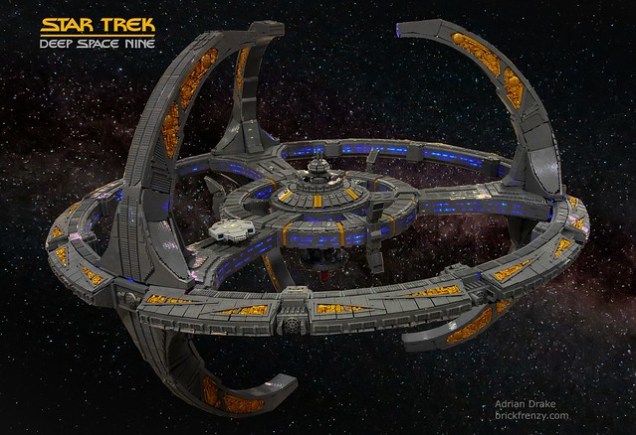
Star Trek: Picard Series First Trailer from SDCC

The first trailer for the Star Trek spinoff Picard was released at San Diego Comic-Con this past weekend, and it’s looking mighty fine:

Star Trek: Picard | SDCC Trailer – Sir Patrick Stewart Returns by CBS All Access on YouTube

Like Discovery, it’s absolutely breathtaking visually! I do wish technology had been more advanced when TNG and DS9 were filmed.

Storywise, I’m not quite as excited, though, for the borg stories never interested me. I will probably want to see this, however, since Sir Patrick Stewart is incomparable. Also, it would be a joy to see some old faces like Jeri Ryan (Seven of Nine).

Any thoughts you had?

Hey, look! We found a thing on the internet! We thought it was cool, and wanted to share it with you.

Representation Chart: Marvel Cinematic Universe, Phase 3

We all know that the representation of people of different genders and races is imbalanced in popular media, but sometimes putting it into visual form can help make the imbalance clear. Here’s a chart of the Phase 3 movies of Marvel’s Cinematic Universe (Captain America: Civil War; Doctor Strange; Guardians of the Galaxy Vol. 2, Spider-Man: Homecoming, Thor: Ragnarok, Black Panther, Avengers: Infinity War, Ant-Man and the Wasp, Captain Marvel, Avengers: Endgame, Spider-Man: Far from Home)

Characters included

(Characters are listed in the first movie in which they qualify for inclusion under the rules given below.)

  • Captain America: Civil War: Tony Stark / Iron Man, Steve Rogers / Captain America, Bucky Barnes / Winter Soldier, Rumlow / Corssbones, Clint Barton / Hawkeye, Vision, Scott Lang / Ant-Man, Zemo, Thaddeus Ross, Everett Ross, Natasha Romanoff / Black Widow, Wanda Maximoff / Scarlet Witch, Sharon Carter / Agent 13, Colonel Rhodes / War Machine, Sam Wilson / Falcon, King T’Chaka, T’Challa / Black Panther
  • Doctor Strange: Dr. Stephen Strange, Kaecilius, Dr. West, Dr. Christine Palmer, the Ancient One, Mordo, Wong
  • Guardians of the Galaxy Vol. 2: Peter Quill / Star-Lord, Yondu, Stakar Ogord, Ego, Taserface, Kraglin, Nebula, Ayesha, Gamora, Mantis
  • Spider-Man: Homecoming: Peter Parker / Spider-Man, Adrian Toomes / Vulture, Happy Hogan, Flash, Mason, Mr. Delmar, Mr. Harrington, May Parker, Betty, Shocker, Abe, Coach Wilson, Michelle, Liz, Ned, Principal Morita
  • Thor: Ragnarok: Thor, Loki, Grandmaster, Skurge, Bruce Banner, Odin, Hela, Heimdall, Topaz
  • Black Panther: Ulysses Klaue, Killmonger, W’Kabi, Shuri, M’Baku, N’Jobu, Ramonda, Zuri, Nakia, Okoye
  • Avengers: Infinty War: Eitri
  • Ant-Man and the Wasp: Luis, Hank Pym, Sonny Burch, Kurt, Hope Van Dyne / Wasp, Cassie, Janet Van Dyne, Dave, Bill Foster, Ava / Ghost, Agent Woo, Uzman
  • Captain Marvel: Talos (as Keller), Yon-Rogg, Ronan, Agent Coulson, Carol Danvers / Captain Marvel, Wendy Lawson, Nick Fury, Korath, Att-Lass, Maria Rambeau, Monica Rambeau, Minn-Erva
  • Avengers: Endgame: Pepper Potts, Morgan
  • Spider-Man: Far from Home: Quentin Beck / Mysterio, William Riva, Maria Hill, Janice, Mr. Dell, Brad

Rules

In the interests of clarity, here’s the rules I’m following for who to include and where to place them:

  • I only count characters portrayed by an actor who appears in person on screen in more or less recognizable form (i.e. performances that are entirely CG, prosthetic, puppet, or voice do not count).
  • The judgment of which characters are significant enough to include is unavoidably subjective, but I generally include characters who have on-screen dialogue, who appear in more than one scene, and who are named on-screen (including nicknames, code names, etc.)
  • For human characters that can be reasonably clearly identified, I use the race and gender of the character.
  • For non-human characters or characters whose identity cannot be clearly determined, I use the race and gender of the actor.
  • I use four simplified categories for race and two for gender. Because human variety is much more complicated and diverse than this, there will inevitably be examples that don’t fit. I put such cases where they seem least inappropriate, or, if no existing option is adequate, give them their own separate categories.
  • “White” and “Black” are as conventionally defined in modern Western society. “Asian” means East, Central, or South Asian. “Indigenous” encompasses Native Americans, Polynesians, Indigenous Australians, and other indigenous peoples from around the world.
  • There are many ethnic and gender categories that are relevant to questions of representation that are not covered here. There are also other kinds of diversity that are equally important for representation that are not covered here. A schematic view like this can never be perfect, but it is a place to start.

Corrections and suggestions welcome.

In the Seen on Screen occasional feature, we discuss movies and television shows of interest.

Black Mermaids Aren’t Far-Fetched

A little while ago there was an Internet brou-ha-ha over Disney’s decision to cast singer Halle Bailey as Ariel in their upcoming live action version of The Little Mermaid. The harrumph is due to Bailey’s skin color.

I say the uproar is silly—it’s a fairytale, and if there’s one carved-in-stone-truth about fairytales it’s that they must and do change with the times. (Besides, I haven’t heard Bailey sing, but apparently she’s got an amazing voice. Scratch that: here’s a video clip of her singing “Unforgettable”, and her voice is indeed awesome. Talent is talent despite the shell it comes in.)

But in case someone’s arguing how black mermaids aren’t historical or some other claptrap (not even starting on mermaids being fictional to begin with), allow me to present a statue of one:

Smithsonian Dona Fish Statue Angola

This statue depicts Dona Fish, part of the many Mami Wata traditions of Africa. As a water spirit that straddles earth and water, she often appears with the head and torso of a woman and the tail of a fish—i.e., just like a (western) mermaid.

Smithsonian had an exhibit on Mami Wata, and some materials are still available online. I encourage you to visit.

Found via Mahealani Uchiyama on Facebook.

Image: Dona Fish, photo by Don Cole via Smithsonian National Museum of African Art  (Ovimbundu peoples, Angola; c. 1950s-1960s; wood, pigment, metal, mixed media)

Out There is an occasional feature highlighting intriguing art, spaces, places, phenomena, flora, and fauna.

50th Anniversary of the Apollo 11 Moon Landing

July 20, 2019, is the 50th anniversary of the Apollo 11 mission—the spaceflight that landed the first people on the Moon.

Ben Feist, a software engineer and historian at NASA Johnson Space Center, and a team of other experts put together a website for Apollo 11 video, audio, and pictures of the astronauts and mission control.

Apollo 11 in Real Time Ben Feist Screencap

The site consists entirely of original historical mission material, with data and audio restored plus transcripts corrected. There’s video, too, and views of the Earth receding and Moon showing up in the viewscreen, various details from the lunar surface, and support teams back home. And a whole host of additional data.

How cool is that!?!

Image: screencap from the Apollo 11 in Real Time website by Ben Feist

In Making Stuff occasional feature, we share fun arts and crafts done by us and our fellow geeks and nerds.

Mulan in Live Action: First Trailer

Disney is making a live action version of their animated story Mulan, and the first trailer is out:

Disney’s Mulan – Official Teaser by Walt Disney Studios on YouTube

As far as the look goes, I’m all in favor of the live action one—how absolutely gorgeous! So far we can’t say how much the story may have been tweaked or which supporting characters might have been omitted, but I can’t say I’d lose much sleep over the loss of talking animals doing goofy gags in the sidelines.

According to IMDB, Mulan‘s U.S. release date is set on March 27, 2020.

Hey, look! We found a thing on the internet! We thought it was cool, and wanted to share it with you.

A Very Short Introduction to Intertextuality

Intertextuality—besides being an excellent Scrabble word—is a useful tool for thinking about literature and storytelling.

Intertextuality is when one literary work refers to or places itself in the context of another work. While different thinkers have used the term in different ways, it is often used to refer to cases in which the meaning of the later work is shaped by or depends upon knowledge of the first.

To make things a little more concrete, take the example of Arthurian legend. The early literary versions of King Arthur’s tales come from several different authors across several centuries, each of whom took certain basic ideas about a legendary king and his family and followers, and added in new characters, told new stories, or shifted the tales to new settings. Each of these literary works was engaged in intertextuality, drawing on a set of characters, stories, and ideas that their audience already knew while adding something new and different to the mix.

Or, to take it a step further, Monty Python and the Holy Grail is intertextual with the whole lot. The movie features such staple characters of Arthurian legend as King Arthur, Sir Lancelot, and Sir Gawain, and references to Camelot and the Holy Grail. Even though Monty Python’s take on the Arthurian legendarium goes in a very different direction than the traditional tales, it explicitly places itself in relationship to them. You don’t exactly have to know Arthurian legend in order to appreciate Holy Grail, but many of the jokes are built around subverting or parodying standard parts of the mythology.

By contrast, although Star Wars also makes use of Arthurian ideas—a farm boy who discovers his secret destiny, a magical sword, a wise mentor who disappears partway through the story—it is not intertextual with Arthurian legend in the same way that Holy Grail is. Star Wars does not have characters named Arthur or Lancelot. There is no planet Camelot. Even though Star Wars invokes some Arthurian themes, it does not use them to reproduce or comment on the Arthurian legends themselves: Luke does not become king, assemble a round table of Jedi knights, or go in search of a mystical cup.

We live in a great age of intertextuality, an age of cinematic universes, boundless fan fiction, and knowing parodies. It’s a useful idea to have at hand for thinking and talking about the stories in the world around us.

Images: Still from Monty Python and the Holy Grail via IMDb. Still from Star Wars IV: A New Hope via IMDb.

Story Time is an occasional feature all about stories and story-telling. Whether it’s on the page or on the screen, this is about how stories work and what makes us love the ones we love.

First Rise of Azshara Impression & Some Bad Jokes

Rise of Azshara is out! We’ve been taking it slowly, partly because the new zones remind us of Argus (and not always in positive ways—for example the drop rates, the rep farming) and partly because adulting is a thing. Mechagon looks fun, albeit maybe small; we’ve barely started there.

WoW BfA RoA Nazjatar South Monk on Mount

Anyway, the other night we first played some new zone content, especially Nazjatar, and then rolled through earlier Battle for Azeroth dungeons when my brain apparently went into bad jokes mode. Here are three of the funnier ones:

You could say that the drop rate for these Fathom Flesh is… abysmal.

I really hit the bottom with that one!

A tank and a healer walk into a 5-man dungeon. Three hours later they walk out.

Told you they were bad! 🙂

(Okay, fortunately it really doesn’t take three hours for the two of us to clear a BfA dungeon, but it does feel like very slow going!)

Of Dice and Dragons is an occasional feature about games and gaming.

Rating: Murdoch Mysteries, Season 10

It’s a mostly forgettable season 10 for our favorite turn-of-the-twentieth-century Toronto detective. Here’s our take on this season’s episodes:

  1. “Great Balls of Fire, Part 1” – 5
  2. “Great Balls of Fire, Part 2” – 6
  3. “A Study in Pink” – 6.5
  4. “Concocting a Killer” – 6
  5. “Jagged Little Pill” – 6.5
  6. “Bend it Like Brackenreid” – 6
  7. “Painted Ladies” – 4
  8. “Weekend at Murdoch’s” – 8
  9. “Excitable Chap” – 4
  10. “The Devil Inside” – 0
  11. “A Murdog Mystery” – 6
  12. “The Missing” – 6.5
  13. “Mr. Murdoch’s Neighborhood” – 5.5
  14. “From Murdoch to Eternity” – 3
  15. “Hades Hath No Fury” – 4
  16. “Master Lovecraft” – 3
  17. “Hot Wheels of Thunder” – 6
  18. “Hell to Pay” – 0

At an average rating of only 4.8, this season is the lowest of the series, dragged down by a number of episodes that are competent but uninspiring, and a few that we found entirely unwatchable, with little at the upper end to balance them out.

This season rings in with a pair of 0s in “The Devil Inside,” one more unnecessary slog with serial-killer Murdoch-fan James Gillies, who we thought we were done with for good back in season 7, and “Hell to Pay,” an unimaginative “conspiracy to frame the detective” cliffhanger with the added detriment of killing off one familiar female character and leaving another one in peril. These sorts of episodes are clearly an attempt by the writers to “add drama” and “make it personal” in the most tired and cliched of ways.

Some of the season’s other episodes, though not disastrous, didn’t work very well for us. The period pieces “Excitable Chap,” (4) a Murdoch version of Dr. Jekyll and Mr. Hyde, and “Master Lovercraft,” (3) about a young H. P. Lovecraft stumbling across a dead body on a visit to Toronto, both have some clever moments but are hampered by poor writing and lackluster acting. The new recurring character Detective Watts is charmingly quirky, but feels more like one writer’s pet project than an organic part of the Murdoch universe.

Besides these weaknesses, though, there are good points to the season. The season-opening two-parter, “Great Balls of Fire” parts 1 (5) and 2 (6), deals with the 1904 Great Fire of Toronto in a way that is both respectful of the historical tragedy and well-integrated into the series’ story and the lives of its characters. We enjoyed the return of Murdoch’s old friend and private detective Freddie Pink in “A Study in Pink” (6.5). Miss James gets to run an investigation of her own in “Jagged Little Pill” (6.5). And there is some delightful nonsense in “A Murdog Mystery” (6), an episode that kicks off with a murdered show dog, and “Hot Wheels of Thunder” (6), which brings roller derby shenanigans to the Murdoch world.

The one standout episode of the season, though, is “Weekend at Murdoch’s” (8), a gleefully silly romp using the Weekend at Bernie’s gimmick in which Murdoch goes to increasingly absurd lengths to try to lure out a killer using the corpse of our old favorite upper-class twit Roger Newsome (of the Mimico Newsomes). While this episode spells the end for Roger, we are happily left with his equally preposterous sister, Ruth, who becomes a new returning character.

Season 10 isn’t altogether bad, but it is a low point in the series. Here’s hoping for an upswing in season 11.

Image: The late Roger Newsome, from “Weekend at Murdoch’s” via IMDb

In the Seen on Screen occasional feature, we discuss movies and television shows of interest.

Quotes: There Was No Room for Romance

I don’t usually like to do two quotes posts in a row, but the interview at A Mighty Girl blog with Captain Marvel co-director Anna Boden was too good to pass. So:

“We didn’t take some kind of firm stance like ‘There will be no romance in this movie’ at the beginning. But as we were exploring the character and exploring what the story was really about, it was about her humanity and, ultimately, her friendships. Not just her buddy friendship that she makes with Nick Fury over the course of the journey but that key, essential friendship with Maria Rambeau from her past that helps link her to her own humanity. And even her friendship with Talos, the Skrull leader, which is a surprising friendship, as she kind of recognizes the humanity in him as well. There was no room for romance. That wasn’t the point. The point was about her connection to these friendships. That felt like a more true story to tell for this character.” [original emphasis]

– Captain Marvel co-director Anna Boden

Bang on. It really annoys me when action movie writers deign to put in a lone Smurfette of a woman, they’ll apparently also have to squeeze in a romance—usually poorly written and atrociously justified with respect to the rest of the story. It’s like regardless of the story, the presence of Wimmin Parts Dictates That There Must Be Romance(TM) Because Otherwise the World Will End. (Although sometimes they work for me, like in The Terminator, but that was better justified, not superficially tacked on.)

Women are people, and like most people, we are able to focus on multiple issues and shift our focus as needed. A war-invasion would definitely be the kind of a situation that takes most of one’s concentration! Besides, not everyone is interested in romance.

It makes for more realistic, genuine, accurate storytelling to show people acting like they do in real life, and to show various kinds of people within a group, any group. It’s so refreshing that the writers of Captain Marvel recognized that; I can’t believe Hollywood’s taken this long to realize it (and/or listen to the storytellers that do).

Serving exactly what it sounds like, the Quotes feature excerpts other people’s thoughts.

Away from Reality Rezzed #1 – Tentacular

I used to make a World of Warcraft comic called Away from Reality. I loved doing it, but it took a lot of work, so about four years ago, I gave it up. I don’t have the time or energy to start it up again, but every now and then I get an idea and think to myself: “That would make a good AFR comic.” And so I proudly present to you the first AFR Rezzed, an occasional return to the lives of Gord the long-suffering warrior, Alaxia the gentle druid, Hurgon the grumpy priest, Targe the blissfully ignorant hunter, Thizzible the role-playing lore-obsessed mage, and Morgatha the smart-ass warlock.

There’s an awful lot of tentacles around Azeroth these days, if you’re into that sort of thing.

Image by Erik Jensen

In Making Stuff occasional feature, we share fun arts and crafts done by us and our fellow geeks and nerds.