Quotes: Sometimes They Develop Entire Research Articles Around Something They Overheard on the Bus

Idle browsing brought me to CD Covington’s article at Tor.com about linguists and the movie Arrival, which is based on Ted Chiang’s short scifi piece “Stories of Your Life”.

“A linguist’s job is to think about language and how it works. Linguists enjoy that and often have conversations about which dialect features they personally have, or sometimes they develop entire research articles around something they overheard on the bus. This is what we do. Not everyone thinks about how language works or is even interested in the subject. So it’s not surprising that Weber is frustrated because he doesn’t think there’s any progress happening, when Dr. Banks knows she’s made considerable progress.” [original emphases]

– CD Covington

Yup—I can attest. I take such geeky, unabashed pleasure over thinking and talking about my favorite linguistic features…! 🙂

(Find my posts about Arrival here.)

Serving exactly what it sounds like, the Quotes feature excerpts other people’s thoughts.

Game of Thrones Now Also on Fabric

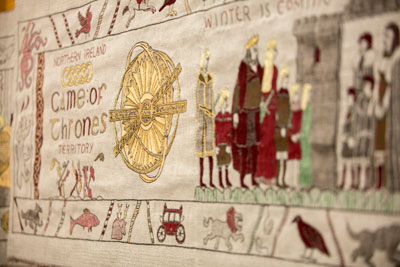
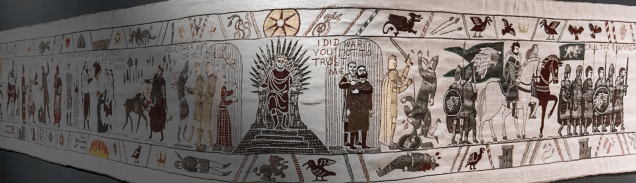
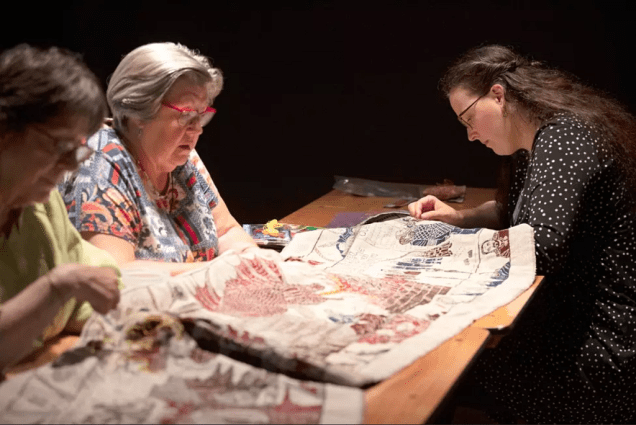
Another adaptation of the hugely successful tv series Game of Thrones is out. Embroiderers at the Ulster Museum and the Ulster Folk Museum produced a 77-meter long textile in the style of the Bayeux Tapestry.

NMNI GoT Tapestry Webpage Banner

Originally the embroidery depicted events, locations, and story from seasons 1 through 7, but in June 2019 further panels depicting season 8 were due to be added.

The R-rated tapestry was on display at the Ulster Museum earlier this year, but the exhibition page and a few small photos are still up on their website.

National Museums Northern Ireland GoT Tapestry1 Game-of-Thrones-400-b.xc97d611f

National Museums Northern Ireland GoT Tapestry2 Game-of-Thrones-400-c.x0c90f6d2

While we loved the production values for the show and the intricacy of the writing, we stopped watching after season 3 due to the upsetting amount of violence. I do confess, however, that this project really tickles the textile history geek part of my brain!

Found via Helsingin Sanomat (NB. Finnish only).

Images: Embroiderers at work by Paul Faith / AFP via Helsingin Sanomat. The others: Tourism NI via National Museums Northern Ireland.

Classifying Warfare: Predatory and Hierarchical

In his history of Western weapons and warfare, Of Arms and Men (Oxford: Oxford University Press, 1991), Robert O’Connell proposes an interesting model for examining the military systems of different cultures by analogy to the animal world. Animals use violence for different purposes and in different ways. Some violence is predatory, as when a wolf hunts a deer or an owl snatches a mouse out of a field. The point of the violence is to kill and consume prey. These animals’ methods and weapons (fangs, claws, beaks) are practical and efficient. They are meant to get the job of killing done as quickly and effectively as possible. Some prey animals have evolved similarly efficient weapons (hooves, horns, teeth) for self-defense. Other times, violence is hierarchical, as when deer lock antlers or dogs tussle with each other to establish an order of dominance within a pack. In these cases, the way that animals fight each other tends to be limited, almost ritualized, in a way that focuses more on display and intimidation than actual wounding—when deer are defending themselves from predators, they can kick and bite with wounding force, but when competing for dominance they lock antlers and shove in a way that minimizes the chance of one deer seriously harming another. The same model can be used as a way of thinking about warfare in human societies.

Some cultures’ ways of making war are like predatory animals’. Their weapons are simple and brutally efficient. Their goal is to kill and destroy, not just to force their opponents into submission. They do not recognize rules of war or limits on where, when, how, or against whom violence can legitimately be used. A classic example is the Roman legion. A legionary’s primary weapon was the gladius, a short sword used for thrusting and slashing at an enemy’s lower torso. The wounds left by a gladius were gory and horrible; the sight of bodies mutilated by Roman blades was enough to demoralize some warriors. Contemporary observers describe Roman soldiers going into a bestial frenzy on the battlefield and slaughtering everything in their path, not just enemy fighters but civilians, children, even animals.

Other cultures fight more like animals competing for dominance within a herd. Their warfare is contained within rules dictating what violence is acceptable and what is not. Battles often begin only after showy demonstrations of power and attempts to negotiate some peaceful resolution. The act of battle itself is brief and bounded by rituals; the goal is not to annihilate the enemy but to compel them to submit and recognize the superiority of the winning side. Ancient Greek hoplite warfare fits this model. Hoplites fought in brief campaigns between city-states, often decided in a single battle on a field which had been mutually agreed to by the two sides. Casualties in a hoplite battle were generally low; victory came when one side broke ranks and fled the field, not with the elimination of one army by the other. The violence of hoplite fighting was real, but it was strictly limited by rules of engagement and commonly understood principles of honor.

Whether a society leans toward predatory or hierarchical violence often depends on who their enemies are. Among people who share culture, history, and traditions, violence tends to be hierarchical. When communicating with the other side is easy and the belligerents in a war already agree on certain principles and ideals, it is easier to agree on limits and rules about war and to be confident that your opponents will abide by their promises. When fighting people with whom you don’t share culture and history, it is harder to rely on commonly agreed rules of war or to trust that the other side will stick to their agreements. Hoplite warfare developed among Greek city-states who were repeatedly fighting their close neighbors, and legionary warfare developed in an expansionist empire venturing further and further into unknown territory, but we can see similar patterns play out in other historical settings as well.

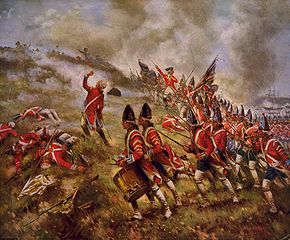
During the eighteenth century, wars among European states were often carried out in hierarchical ways. A British commander facing French troops and not feeling confident of victory could trust that if he surrendered instead of chancing a battle, he and his troops would not be slaughtered but would be treated according to certain basic rules and eventually ransomed back or released at the end of hostilities. Conditions for prisoners of war could certainly be horrendous—especially for the rank and file—but surrender was an acceptable, even honorable, option when there was no reasonable chance of victory. Since the best way to win a battle is to not have to fight it in the first place, convincing enemy troops to give up became as tactically important as fighting them in the first place. Hence the development of flashy, colorful uniforms and elaborate drill performances. The goal was to make one’s own troops look as impressive as possible in order to intimidate the enemy into giving up without a fight.

Meanwhile, in European colonies in the Americas, Africa, and Asia, European settlers faced off against native peoples whose languages, cultures, and traditions they did not share. Neither side could trust that the other would honor agreements or abide by even basic rules on the treatment of prisoners or civilians. Colonial warfare tended to be brutal and predatory. There was no point to trying to intimidate the enemy or force them to come to terms; the only goal of warfare was to kill as efficiently as possible. In England’s North American colonies, settlers developed a style of warfare for fighting against the indigenous people which diverged very far from the elaborate rituals of European warfare at the time. In the early battles of the American Revolution, the orderly performance of the British redcoat drill came up against the guerrilla tactics of American minutemen trained in the harsh school of frontier raiding and counter-raiding.

Hierarchical warfare, seen from outside the culture that practices it, can seem ineffective or even silly, war reduced to symbols and shadowplays, but hierarchical warfare is serious. It has real casualties, sometimes even carnage on a terrible scale. The point of the displays of power, the rules and rituals, is to preserve one’s own fighting force for the moment when it can make a decisive difference. The Cold War between the United States and the Soviet Union was one large struggle for hierarchical dominance, but it had real and devastating consequences for people throughout the world.

Societies that practice predatory warfare, encountering hierarchical-war cultures for the first time, often have an advantage, at least at first. The army not limited by rules of engagement and focused on killing rather than putting on an impressive display can be devastatingly effective against an unprepared opponent. At the same time, predatory warfare can also be self-defeating. The force that does not respect common rules of war can have a hard time concluding truces and treaties and may find itself dragged into wars it does not want to fight because no one trusts them enough to make peace with them.

Thoughts for writers

This way of classifying how societies fight can be useful for defining the terms of conflict in your stories. When you have powers that share a lot of culture and history fighting one another, like a world based on medieval European kingdoms or the states of ancient India, it makes sense to build in rituals, displays of power, and rules of war that are generally recognized. Of course, just because rules of war exist doesn’t mean that everyone follows them, but breaking those rules has consequences, not just for how your enemies treat you but for how your allies or potential allies think about you, too. Therein lies plenty of potential for interesting conflict and character development.

On the other hand, when two or more very different cultures run up against one another, such as in the borderlands between different cultures or at the edge of an expanding empire, warfare is likely to take on a more predatory nature. The absence of agreed-upon rules of war or rituals for establishing dominance without fighting will lead to more violence and brutality. Again, even within a predatory context, there can be opportunities for displays of power taking the place of fighting or the emergence of rough-and-ready rules of engagement. These sorts of developments would be important in-world events for characters engage in, too.

Image: “Battle of Bunker Hill” via Wikimedia (1909; paint on canvas; by E. Percy Moran)

History for Writers looks at how history can be a fiction writer’s most useful tool. From worldbuilding to dialogue, history helps you write. Check out the introduction to History for Writers here.
Living in a Science Fictional Present: Food from Air, Water from Sunlight

“I’m going to have to science the shit out of this” is my favorite line from the movie The Martian. The amazing thing about our species is that we do that every day, and every once in a while it pays off in a phenomenal way. Below are two cases that have the potential to do just that.

Researchers at the Lappeenranta-Lahti University of Technology LUT and VTT Technical Research Centre of Finland Ltd. have created a process for making protein from air. Specifically, it uses carbon dioxide, water, and electricity, plus added nutrients.

Solar Foods Solein Protein Powder Sm

Apparently they’ve had a test installation running since June. The resulting protein powder, dubbed Solein, looks like flaky meal and reportedly tastes like wheat.

Read more at Yle news (Finnish only), or in English at The Guardian or Solar Foods website.

Professor Peng Wang from King Abdullah University of Science and Technology in Saudi Arabia lead a study introducing a strategy to produce fresh water. Essentially, a distillation unit attached to photovoltaic panels evaporates seawater at relatively low temperatures more efficiently than conventional solar stills and yet generates electricity at the same time.

BBC News Wenbin Wang Solar Panel Water Purifier Concept

More at BBC News and journal Nature Communications.

Images: Solein protein powder by Solar Foods. Combined solar panel and water purifier by Wenbin Wang via BBC News.

Star Trek: Picard Series First Trailer from SDCC

The first trailer for the Star Trek spinoff Picard was released at San Diego Comic-Con this past weekend, and it’s looking mighty fine:

Star Trek: Picard | SDCC Trailer – Sir Patrick Stewart Returns by CBS All Access on YouTube

Like Discovery, it’s absolutely breathtaking visually! I do wish technology had been more advanced when TNG and DS9 were filmed.

Storywise, I’m not quite as excited, though, for the borg stories never interested me. I will probably want to see this, however, since Sir Patrick Stewart is incomparable. Also, it would be a joy to see some old faces like Jeri Ryan (Seven of Nine).

Any thoughts you had?

Hey, look! We found a thing on the internet! We thought it was cool, and wanted to share it with you.

Representation Chart: Marvel Cinematic Universe, Phase 3

We all know that the representation of people of different genders and races is imbalanced in popular media, but sometimes putting it into visual form can help make the imbalance clear. Here’s a chart of the Phase 3 movies of Marvel’s Cinematic Universe (Captain America: Civil War; Doctor Strange; Guardians of the Galaxy Vol. 2, Spider-Man: Homecoming, Thor: Ragnarok, Black Panther, Avengers: Infinity War, Ant-Man and the Wasp, Captain Marvel, Avengers: Endgame, Spider-Man: Far from Home)

Characters included

(Characters are listed in the first movie in which they qualify for inclusion under the rules given below.)

  • Captain America: Civil War: Tony Stark / Iron Man, Steve Rogers / Captain America, Bucky Barnes / Winter Soldier, Rumlow / Corssbones, Clint Barton / Hawkeye, Vision, Scott Lang / Ant-Man, Zemo, Thaddeus Ross, Everett Ross, Natasha Romanoff / Black Widow, Wanda Maximoff / Scarlet Witch, Sharon Carter / Agent 13, Colonel Rhodes / War Machine, Sam Wilson / Falcon, King T’Chaka, T’Challa / Black Panther
  • Doctor Strange: Dr. Stephen Strange, Kaecilius, Dr. West, Dr. Christine Palmer, the Ancient One, Mordo, Wong
  • Guardians of the Galaxy Vol. 2: Peter Quill / Star-Lord, Yondu, Stakar Ogord, Ego, Taserface, Kraglin, Nebula, Ayesha, Gamora, Mantis
  • Spider-Man: Homecoming: Peter Parker / Spider-Man, Adrian Toomes / Vulture, Happy Hogan, Flash, Mason, Mr. Delmar, Mr. Harrington, May Parker, Betty, Shocker, Abe, Coach Wilson, Michelle, Liz, Ned, Principal Morita
  • Thor: Ragnarok: Thor, Loki, Grandmaster, Skurge, Bruce Banner, Odin, Hela, Heimdall, Topaz
  • Black Panther: Ulysses Klaue, Killmonger, W’Kabi, Shuri, M’Baku, N’Jobu, Ramonda, Zuri, Nakia, Okoye
  • Avengers: Infinty War: Eitri
  • Ant-Man and the Wasp: Luis, Hank Pym, Sonny Burch, Kurt, Hope Van Dyne / Wasp, Cassie, Janet Van Dyne, Dave, Bill Foster, Ava / Ghost, Agent Woo, Uzman
  • Captain Marvel: Talos (as Keller), Yon-Rogg, Ronan, Agent Coulson, Carol Danvers / Captain Marvel, Wendy Lawson, Nick Fury, Korath, Att-Lass, Maria Rambeau, Monica Rambeau, Minn-Erva
  • Avengers: Endgame: Pepper Potts, Morgan
  • Spider-Man: Far from Home: Quentin Beck / Mysterio, William Riva, Maria Hill, Janice, Mr. Dell, Brad

Rules

In the interests of clarity, here’s the rules I’m following for who to include and where to place them:

  • I only count characters portrayed by an actor who appears in person on screen in more or less recognizable form (i.e. performances that are entirely CG, prosthetic, puppet, or voice do not count).
  • The judgment of which characters are significant enough to include is unavoidably subjective, but I generally include characters who have on-screen dialogue, who appear in more than one scene, and who are named on-screen (including nicknames, code names, etc.)
  • For human characters that can be reasonably clearly identified, I use the race and gender of the character.
  • For non-human characters or characters whose identity cannot be clearly determined, I use the race and gender of the actor.
  • I use four simplified categories for race and two for gender. Because human variety is much more complicated and diverse than this, there will inevitably be examples that don’t fit. I put such cases where they seem least inappropriate, or, if no existing option is adequate, give them their own separate categories.
  • “White” and “Black” are as conventionally defined in modern Western society. “Asian” means East, Central, or South Asian. “Indigenous” encompasses Native Americans, Polynesians, Indigenous Australians, and other indigenous peoples from around the world.
  • There are many ethnic and gender categories that are relevant to questions of representation that are not covered here. There are also other kinds of diversity that are equally important for representation that are not covered here. A schematic view like this can never be perfect, but it is a place to start.

Corrections and suggestions welcome.

In the Seen on Screen occasional feature, we discuss movies and television shows of interest.

Black Mermaids Aren’t Far-Fetched

A little while ago there was an Internet brou-ha-ha over Disney’s decision to cast singer Halle Bailey as Ariel in their upcoming live action version of The Little Mermaid. The harrumph is due to Bailey’s skin color.

I say the uproar is silly—it’s a fairytale, and if there’s one carved-in-stone-truth about fairytales it’s that they must and do change with the times. (Besides, I haven’t heard Bailey sing, but apparently she’s got an amazing voice. Scratch that: here’s a video clip of her singing “Unforgettable”, and her voice is indeed awesome. Talent is talent despite the shell it comes in.)

But in case someone’s arguing how black mermaids aren’t historical or some other claptrap (not even starting on mermaids being fictional to begin with), allow me to present a statue of one:

Smithsonian Dona Fish Statue Angola

This statue depicts Dona Fish, part of the many Mami Wata traditions of Africa. As a water spirit that straddles earth and water, she often appears with the head and torso of a woman and the tail of a fish—i.e., just like a (western) mermaid.

Smithsonian had an exhibit on Mami Wata, and some materials are still available online. I encourage you to visit.

Found via Mahealani Uchiyama on Facebook.

Image: Dona Fish, photo by Don Cole via Smithsonian National Museum of African Art  (Ovimbundu peoples, Angola; c. 1950s-1960s; wood, pigment, metal, mixed media)

Out There is an occasional feature highlighting intriguing art, spaces, places, phenomena, flora, and fauna.

50th Anniversary of the Apollo 11 Moon Landing

July 20, 2019, is the 50th anniversary of the Apollo 11 mission—the spaceflight that landed the first people on the Moon.

Ben Feist, a software engineer and historian at NASA Johnson Space Center, and a team of other experts put together a website for Apollo 11 video, audio, and pictures of the astronauts and mission control.

Apollo 11 in Real Time Ben Feist Screencap

The site consists entirely of original historical mission material, with data and audio restored plus transcripts corrected. There’s video, too, and views of the Earth receding and Moon showing up in the viewscreen, various details from the lunar surface, and support teams back home. And a whole host of additional data.

How cool is that!?!

Image: screencap from the Apollo 11 in Real Time website by Ben Feist

In Making Stuff occasional feature, we share fun arts and crafts done by us and our fellow geeks and nerds.

Mulan in Live Action: First Trailer

Disney is making a live action version of their animated story Mulan, and the first trailer is out:

Disney’s Mulan – Official Teaser by Walt Disney Studios on YouTube

As far as the look goes, I’m all in favor of the live action one—how absolutely gorgeous! So far we can’t say how much the story may have been tweaked or which supporting characters might have been omitted, but I can’t say I’d lose much sleep over the loss of talking animals doing goofy gags in the sidelines.

According to IMDB, Mulan‘s U.S. release date is set on March 27, 2020.

Hey, look! We found a thing on the internet! We thought it was cool, and wanted to share it with you.

A Very Short Introduction to Intertextuality

Intertextuality—besides being an excellent Scrabble word—is a useful tool for thinking about literature and storytelling.

Intertextuality is when one literary work refers to or places itself in the context of another work. While different thinkers have used the term in different ways, it is often used to refer to cases in which the meaning of the later work is shaped by or depends upon knowledge of the first.

To make things a little more concrete, take the example of Arthurian legend. The early literary versions of King Arthur’s tales come from several different authors across several centuries, each of whom took certain basic ideas about a legendary king and his family and followers, and added in new characters, told new stories, or shifted the tales to new settings. Each of these literary works was engaged in intertextuality, drawing on a set of characters, stories, and ideas that their audience already knew while adding something new and different to the mix.

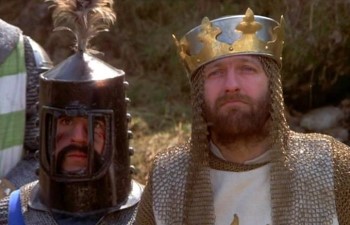
Or, to take it a step further, Monty Python and the Holy Grail is intertextual with the whole lot. The movie features such staple characters of Arthurian legend as King Arthur, Sir Lancelot, and Sir Gawain, and references to Camelot and the Holy Grail. Even though Monty Python’s take on the Arthurian legendarium goes in a very different direction than the traditional tales, it explicitly places itself in relationship to them. You don’t exactly have to know Arthurian legend in order to appreciate Holy Grail, but many of the jokes are built around subverting or parodying standard parts of the mythology.

By contrast, although Star Wars also makes use of Arthurian ideas—a farm boy who discovers his secret destiny, a magical sword, a wise mentor who disappears partway through the story—it is not intertextual with Arthurian legend in the same way that Holy Grail is. Star Wars does not have characters named Arthur or Lancelot. There is no planet Camelot. Even though Star Wars invokes some Arthurian themes, it does not use them to reproduce or comment on the Arthurian legends themselves: Luke does not become king, assemble a round table of Jedi knights, or go in search of a mystical cup.

We live in a great age of intertextuality, an age of cinematic universes, boundless fan fiction, and knowing parodies. It’s a useful idea to have at hand for thinking and talking about the stories in the world around us.

Images: Still from Monty Python and the Holy Grail via IMDb. Still from Star Wars IV: A New Hope via IMDb.

Story Time is an occasional feature all about stories and story-telling. Whether it’s on the page or on the screen, this is about how stories work and what makes us love the ones we love.