Beautiful Reconstructions of Mesoamerican Cities

Here are some beautiful computer reconstructions of important archaeological sites in Mesoamerica.

Tenochtitlán, Mexico, by Advestudios
Pueblo Bonito, Chaco Canyon, US, by Advestudios


Advestudios, which produced these images, also creates videos and 360 vistas. Their work is wonderful for helping to picture these sites as living, functioning cities and settlements.

Hey, look! We found a thing on the internet! We thought it was cool, and wanted to share it with you.


Rating: Deep Space Nine, Season 6

The Dominion war heats up, taking the characters of Star Trek: Deep Space Nine in lots of new directions, some more interesting than others. Here’s our take on what season 6 has to offer.

  1. “A Time to Stand” – 6
  2. “Rocks and Shoals” – 7
  3. “Sons and Daughters” – 0
  4. “Behind the Lines” – 3.5
  5. “Favor the Bold” – 5
  6. “Sacrifice of Angels” – 6
  7. “You Are Cordially Invited” – 8.5
  8. “Resurrection” – 2
  9. “Statistical Probabilities” – 4
  10. “The Magnificent Ferengi” – 8.5
  11. “Waltz” – 3
  12. “Who Mourns for Morn?” – 7.5
  13. “Far Beyond the Stars” – 8
  14. “One Little Ship” – 9
  15. “Honor Among Thieves” – 0
  16. “Change of Heart” – 4
  17. “Wrongs Darker than Death or Night” – 0
  18. “Inquisition” – 2
  19. “In the Pale Moonlight” – 7
  20. “His Way” – 1
  21. “The Reckoning” – 4
  22. “Valiant” – 2
  23. “Profit and Lace” – 2
  24. “Time’s Orphan” – 6
  25. “The Sound of Her Voice” – 4
  26. “Tears of the Prophets” – 5.5

This season’s ratings are all over the place. There are a number of strong episodes in the 7-9 range, but also multiple 0s. The average comes to 4.4, in line with season 5 and a bit less than seasons 3 and 4. It seems a bit unfair to average out this season’s episodes, though, because there are so many different things going on. The Dominion war storyline runs through the season and provides a lot of solid episodes. There are also big moments of character development, some good—Worf and Dax getting married in “You are Coridally Invited”, everyone’s favorite barfly getting a backstory in “Who Mourns for Morn?”—some less good—Kira doing a reverse Back to the Future on her mother and Gul Dukat in “Wrongs Darker than Death or Night,” Quark learning what it’s like to be a feeeemale in “Profit and Lace”. Then there are some episodes that just come out of nowhere, like Sisko having a vision of twentieth century science fiction and racism in “Far Beyond the Stars.”

At the bottom end of the scale, we have a trifecta of absolute 0s. There’s “Sons and Daughters,” in which Worf’s son Alexander and Dukat’s daughter Ziyal both get to have strained relationships with their respective fathers. There’s “Honor Among Thieves,” in which O’Brien inexplicably has an undercover mission infiltrating a seedy crime syndicate, an episode with no good reason to exist, let alone be in this series. And there’s the aforementioned “Wrongs Darker than Death or Night,” a limp episode for such a pretentious title that is both overly contrived and weightless at the same time. I’ve mentioned before that it sometimes feels like there was a frustrated noir writer in the writers’ room, and they have their fingerprints on this season as well. “Honor Among Thieves” is straight-up noir, and “Wrongs Darker than Death or Night” leans hard in the same direction. It’s as uninterseting now as it was before.

But this season also has some great episodes at the other end of the scale. The best of the season is “One Little Ship,” at 9, in which a miniaturized Dax, Bashir, and O’Brien in a miniaturized runabout help rescue the Defiant from being captured by the Jem’Hadar. It’s a fun episode that gives all the characters something to do and nicely balances the silliness of its main conceit with the seriousness of the ongoing war plot. Two more episodes that also strike a good balance between goofiness and gravity are “You Are Cordially Invited” and “The Magnificent Ferengi,” both at 8.5. In “You Are Cordially Invited,” the weighty question of whether Worf and Dax can make it as a couple despite their differences is interwoven with Klingon wedding rituals that are as gloriously over the top as you would imagine. “The Magnificent Ferengi” finds Quark, Rom, Nog, and some of our other favorite Ferengi mounting a rescue operation when their Moogie is captured by the Dominion, and it goes both hopelessly wrong and delightfully right.

For all that Deep Space Nine is remembered as the dark, gritty version of Star Trek, filled with tension and war, it has also given us some of the goofiest, most wonderfully weird episodes of the franchise.

Image: Little O’Brien and Little Dax contemplate big problems on the Defiant, from “One Little Ship” via IMDb

In the Seen on Screen occasional feature, we discuss movies and television shows of interest.

Quotes: Infohistory Is a Mess

Elizabeth Bear’s scifi novel Machine has a succinct sum-up of just some of the problems concerning information retrieval:

“Wait,” I said. “How can information decay?”

“They used to call it bit rot. Servers get taken down, data falls through the cracks and doesn’t get backed up. Physical substrates are destroyed or damaged, or degrade over time—especially the primitive ones. A holographic diamond is very durable but can’t be changed once it’s written to, and magnetic media only lasted a decan or so under ideal conditions.

“And even if the data is preserved somewhere, that somewhere might not be networked. If it’s networked, it might not be indexed. Even if it’s indexed, it might be half the galaxy away and take two or three ans for the file request to get there, be fulfilled, turn around, and come back. And then you might find out that you needed different files entirely.” He huffed with great satisfaction. “Infohistory is a mess.”

– from a discussion between Dr. Brookllyn Jens and the medical librarian AI Mercy in Machine by Elizabeth Bear [original emphasis]

Despite this being from a fictional work, it rings very true. My librarian heart was delighted to read an account that acknowledges not just the physical difficulties of dealing with old media—whatever shape that media might take, from cuneiform to CDs—but also the search-related problems. Metadata, or in case of libraries, the information about the items in the collection, doesn’t feature in stories very often. Also, it is why good reasearch librarians and archivists are worth their weight in gold.

Bear, Elizabeth. Machine. London: Saga Press, 2020, p. 203.

Serving exactly what it sounds like, the Quotes feature excerpts other people’s thoughts.

Trailer for Debris

Has anyone followed news on Debris? It’s a new tv series described to be a bit like Fringe. Here’s a trailer:

DEBRIS | Official Trailer by NBC on YouTube

The story follows two agents, one from MI6 and the other from CIA, who investigate debris—surprise, surprise—from an alien spacecraft falling to Earth.

Debris is set to debut on NBC on March 01, 2021.

Hey, look! We found a thing on the internet! We thought it was cool, and wanted to share it with you.

Living Vicariously Through Social Media: Dracula Parrots

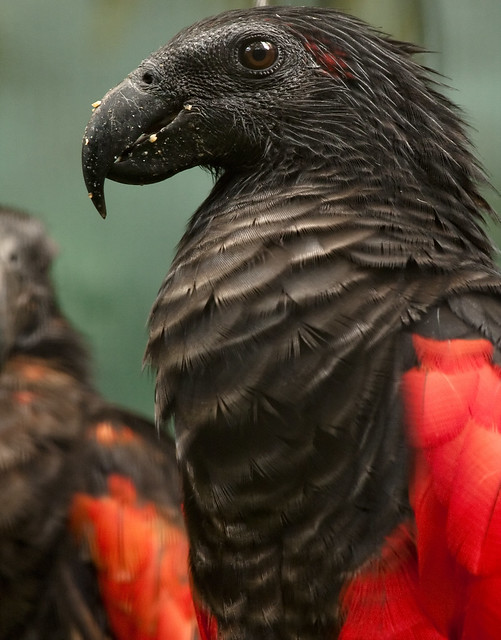
Hey there, handsome—what an amazing coloring these Dracula parrots (Psittrichas fulgidus) have!

Flickr Peter Tan Pesquets Parrot Head Shot

Endemic to New Guinea, they are also known as Pesquet’s parrots, and can be quite sizeable: 46 cm / 18” total length and 700-800 g (24-28 oz) in weight.

Flickr Meen Zhafri Pesquets Parrot Silhouette

Apparently, habitat loss and overhunting have pushed the species into a vulnerable status, and, according to BirdLife International, the population in decreasing.

Flickr Charles Davies Pesquets Parrot in Flight

*sigh* Why can’t we as a species take better care of our nice things? It’s not like we lack the brain power.

Found via Nature & Animals on Twitter. (NB. Seems to require a login in order to see post.)

Images: Head shot by Peter Tan via Flickr (CC BY-SA 2.0). Silhouette by Meen & Zhafri via Flickr (CC BY-NC 2.0) / KL Bird Park, May 2010. In flight by Charles Davies via Flickr (CC BY-NC 2.0).

Out There is an occasional feature highlighting intriguing art, spaces, places, phenomena, flora, and fauna.

A Preview of The Greco-Persian Wars

I am pleased to announce that my second book, The Greco-Persian Wars: A Short History with Documents, is coming out in just a few days. This book tells the story of the wars between Greeks and the Persian Empire in the early fifth century BCE through translations of ancient documents.

While the wars of the early fifth century in Greece dominate modern histories of Greco-Persian interaction, they were only part of a larger history in which the main actors were not Greeks but Persians, and whose events played out not simply in Greece but across the eastern Mediterranean. Looking at a broader history allows us to put the Greco-Persian Wars into a more meaningful context. The story of Persia’s engagement in Greece is not one of East-West cultural clashes or Greek ascendancy, but of Persia’s success in adapting to the challenges of an unstable, frequently violent frontier region, and that is the history my book explores.

This book features over eighty-five separate selections translated from Greek, Old Persian, Elamite, Akkadian, Hebrew, Aramaic, Egyptian, and Lycian, each with contextual notes. They are accompanied by a short historical introduction, a glossary, a chronology, maps, and a select bibliography.

Here is a selection from one of the documents. In this text, set some hundred years after the famous battles of Marathon, Thermopylae, Salamis, and Plataea, we see how complicated relations between Greeks and Persians remained. This text is a useful reminder that we have to think not of relations between Greece and Persia but between Greeks and Persians. On both sides, individuals had their own motivations and interests that could lead to unexpected alliances and tricky rivalries.

* * *

Friendship and its complications

Xenophon, Hellenica 4.1.31-39

Relationships of xenia, or guest-friendship were a traditional way in which Greek aristocrats formed personal relationships across the boundaries of the polis. Similar relationships were also extended to Persians who dealt with the Greek frontier. While these relationships could be channels for diplomacy and political negotiation, they could also create conflicting loyalties. The exchange between the Spartan king Agesilaus—at that time ravaging the Persian-held territories in Ionia—and the satrap Pharnabazus in 395 or 394 BCE shows both the potentials of xenia and its dangers.

First they greeted each other and Pharnabazus held out his right hand. Agesilaus clasped it. Then Pharnabazus spoke first, since he was the elder.

“Aegsilaus, and you other Spartans here,” he said, “I became your friend and ally when you were fighting the Athenians. Not only did I support your fleet with money, but I myself fought alongside you on horseback and we drove your enemies into the sea together. You cannot accuse me of ever having played you false, like Tissaphernes. Yet despite this, you have now left my land in such a state that I cannot even feed myself, unless I gather up the scraps you leave behind like an animal. All the beautiful houses and woods full of trees and beasts that my father left me, which I used to enjoy so much, I now see either cut down or burned up. Well, if I don’t know what is righteous and just, you tell me how these are the acts of men who know how to repay favors.”

The thirty Spartans were ashamed and said nothing, but then after a time Agesilaus spoke up.

“Pharanbazus,” he said, “I think you understand that in the Greek cities, people also become guest-friends to one another. But when their cities go to war, such people fight on behalf of their homelands against their friends, and even kill them, if it should so happen. In the same way, since we are now at war with your king, we are compelled to treat everything of his as enemy territory. However, we would think it the best thing in the world to become your friends. Now, if it were a matter of throwing off the king to be ruled by us instead, I certainly would not advise it, but if you side with us now you will have the chance to flourish without having any master or humbling yourself to anyone. I think freedom is, after all, worth any amount of money. Even so, we are not urging that you should be free and poor. Rather, by taking us as your allies, you will increase your own power, not the king’s, and by subduing those who are now your fellow slaves you will make them your own subjects. You will become both free and rich—what else could you need to have perfect happiness?”

“In that case,” said Pharnabazus, “shall I tell you plainly what I will do?”

“That would be a good idea,” said Agesilaus.

“Well then,” he said, “if the king sends another general here and makes me subordinate to him, I will gladly become your friend and ally. On the other hand, if he gives the command to me, ambition is such a powerful force that I will fight you to the best of my ability.”

When he heard these words, Agesilaus grasped Pharnabazus’ hand and said:

“My dear friend, I hope you will be our ally! But know this: I will leave your territory now as quickly as I can, and in the future, even if the war continues, we will leave you and your land alone as long as we have other foes to fight.”

That was the end of the meeting, and Pharnabazus mounted up and rode away, but his son Parapita, a fine young man, stayed behind. He ran up to Agesilaus and said:

“Agesilaus, I make you my guest-friend.”

“For my part, I accept,” Agesilaus replied.

“Remember it,” said Parapita. He at once gave the beautiful javelin he was carrying to Agesilaus. In return, Agesilaus took a splendid decoration from the horse his secretary Idaeus was riding and gave it to Parapita. Then the young man leapt upon his horse and followed after his father.

* * *

If you’ve found some of my previous posts about Persians, life in the Persian Empire, and the complicated relationships between Persians and Greeks interesting, you may enjoy The Greco-Persian Wars.

The Greco-Persian Wars: A Short History with Documents comes out February 24th from Hackett Publishing.

Hardcover: $49 / Paperback: $18 / e-book versions available

You can pre-order directly from Hackett or on Amazon or Barnes and Noble, or from your local bookseller.

Image: Greco-Persian Wars paperback cover by Hackett Publishing

Announcements from your hosts.


An Ancient Minoan Saffron Gatherer

Here’s a beautiful ancient Minoan fresco of a woman gathering saffron on a rocky hillside.

Saffron is a spice derived from the crocus flower, and since each flower produces only a tiny amount of the spice, gathering it on any scale is a labor-intensive process. With her large earrings and the many colorful, decorated layers of her clothing, this lady seems a little overdressed for such hard work. There may be various explanations. Perhaps this fresco represents a ceremonial harvest, not unlike the use of a golden shovel to dig the first scoop of dirt on a building project, or possibly a small harvest for religious use. It might also be simply an artistic depiction suitable for an elite home and not intended to represent the actual attire of an agrarian worker.

Whatever the case, it’s a beautiful work of art.

Image: Detail of saffron-gathering fresco, photograph by Yann Forget via Wikimedia (Akrotiri; c. 1700 BCE; fresco)

Out There is an occasional feature highlighting intriguing art, spaces, places, phenomena, flora, and fauna.

A Cappella Computer Sound Effects Uncannily Close to the Original

MayTree is a Korean a cappella group quite popular in Asia. They broke into my consciousness with this amazing short video of Windows sound effects performed by human voices:

windows sound effect (acapella) by MayTree on YouTube

Found via Whatever.

LOL! I just love my fellow nerds—we have an unparalleled dedication and interest in details.

Check out the MayTree YouTube channel for more.

An occasional feature on music and sound-related notions.

Two-Question Worldbuilding

There are lots of different ways to imagine new secondary worlds and the cultures within them. You can start from the ground up—literally—by drawing a map and thinking about how the landscape shapes the cultures within it. You can start with a big concept and work your way down into the details from that, or go the other way and start with a single detail that serves your narrative, then build the rest of the world around it.

But sometimes you don’t want to mess with all that. Sometimes you’re writing a story or mapping out a game and you need your characters to have a little bit of interaction with a far-off foreign land, but not enough to make it worth developing in every detail.

Here are two quick questions you can ask to lay the basis for simple worldbuilding for side cultures in pre-industrial worlds that still gives them some substance:

  • How many people have control over their own source of food?
  • How much do those people have to compete with others for food sources?

We’re not talking actual numbers or anything quantifiable here, just a general sense: a little bit, a fair amount, or a lot?

(Food sources come in many forms. We most often think of farms and herds of animals, but consider also fishing and hunting, trading with food-producing regions abroad, or raiding richer neighbors.)

The first question tells you about social structure: food is crucial to life, so access to it is one of the most powerful ways people can assert control over others or claim their own independence.

Where only a few people control the available food sources and most other people are in some way dependent on them, there is strong social stratification. It could take many forms: tenant farming, slave plantations, highly-regulated trade markets, or organized piracy of trade routes. Whatever the case, the society will have a small elite marked out by their wealth, way of life, or social privileges.

When most people control their own food sources, you have a much less stratified society. It could be small farms, independent merchant families, or bands of friends who hunt and fish together. The society need not be perfectly egalitarian—some farmers or trading partnerships may be wealthier than others—but when most people are self-sufficient, the rich have less leverage to get the poor to go along with any claims they make to special privileges. Societies where people aren’t dependent on others for survival can also have trouble organizing any kind of large-scale collective action, whether it’s setting up an organized legal system or sending an army on campaign.

In between, you get a range of possibilities: some people manage by fishing and keeping market gardens, others labor on the estates of the rich, while bands of young warriors form up now and then when things get tough to go plunder richer lands, then come home and return to their homesteads. In a society where people live at many different levels of subsistence, social stratification can be complicated, but also fluid. A tenant farmer may be able to save enough over time to buy a plot of their own and join the ranks of independent farmers, while an aristocrat who suffers a run of bad harvests may have to sell their tenanted estates and buy a smaller patch they can farm themselves, but that doesn’t make them social equals.

The second question goes to internal conflict: the more people who have to compete over resources, the more turmoil you are likely to see within a society.

When there is little competition over resources—either because they are abundant enough for everyone or because those who control them have a grip too tight to be challenged—societies are likely to be stable. Some may be inward-looking and peaceful, others may simply export their conflicts abroad: a state full of rich farmers might support a large army to invade and colonize other lands, or a society with no resources available at home might drive the poor and desperate to raid their neighbors or move away as laborers or mercenaries.

By contrast, in a culture where there’s not enough to go around or where those who have resources can’t effectively defend them, expect a high level of internal conflict. This conflict might take violent forms, from ongoing petty raiding between neighbors to civil wars, or it might be channeled into cutthroat negotiations between rival trading houses or a frantic scramble for royal patronage among the highborn families.

In between the extremes, at a moderate level of competition, you are likely to see a society that goes through cycles of stability and fractiousness, where the winners know that they can’t hold onto their gains forever, but the losers can afford to lick their wounds, build new alliances, and hope to come out on top next time.

Below is a rough chart of what a society with a particular combination of resource distribution and competition may look like. Remember that these are patterns and tendencies, not absolute rules. Our own world’s history will furnish plenty of examples of societies that don’t fit these patterns, and you can certainly imagine worlds that don’t. But if you find yourself in need of some quick-and-dirty worldbuilding, this is a good place to start.

Chart by Erik Jensen

History for Writers looks at how history can be a fiction writer’s most useful tool. From worldbuilding to dialogue, history helps you write.

Ryan Coogler Is Developing a Wakanda Series for TV

Fantastic news for Wakanda fans! Tor.com reports that “[a]ccording to Deadline, Black Panther director Ryan Coogler has made a 5-year television deal with Disney. His first scheduled project will be a drama set in Wakanda that will be featured on Disney+.”

Flickering Myth Coogler Black Panther Set w Boseman

Apparently developing this series is a part of a broader deal between Coogler’s production company Proximity Media and Disney.

Although we don’t have any other details yet, not even a tentative name, I’m pretty excited. I absolutely loved Black Panther, and as long as he keeps—or is allowed to keep—to that ethos, I have high hopes for the series!

Image via Flickering Myth.